
AI Risk Management for Canadian Businesses in 2026

Canadian businesses cannot afford to treat AI governance as a future problem. The NIST AI Risk Management Framework (AI RMF), released in january 2023, gives organizations a voluntary but widely adopted structure to govern, map, measure, and manage AI-related risks across the full system lifecycle. With Canada’s Artificial Intelligence and Data Act (AIDA) still paused as of july 2026, voluntary frameworks like the NIST AI RMF are the practical standard Canadian organizations rely on to demonstrate responsible AI use. The core compliance anchors shaping trustworthy AI practices here include PIPEDA, SOC 2, ISO 27001, and the NIST AI RMF itself.
What this means for your organization:
- AI risk management is not an IT problem alone. It requires cross-functional governance spanning legal, HR, operations, and IT.
- AIDA’s pause does not eliminate regulatory exposure. PIPEDA obligations, sector-specific rules, and reputational risk remain active.
- Voluntary frameworks like the NIST AI RMF carry real weight with auditors, partners, and regulators even without a legal mandate.
- Certifications such as SOC 2 and ISO 27001 signal credible governance to clients and regulators.
What are the biggest AI risks Canadian businesses face?
AI systems introduce risks that traditional software governance was never designed to catch. The NIST Generative AI Profile, released july 26, 2024, identifies risks specific to generative AI including confabulation (hallucinations), data poisoning, unauthorized data leakage, and harmful bias. These sit on top of the baseline risks every AI deployment carries.
The most common risks Canadian compliance professionals encounter:
- Cybersecurity vulnerabilities: AI models expand the attack surface, creating new vectors for adversarial inputs and model theft. Integrating AI with security frameworks is a practical first step.
- Data privacy under PIPEDA: Training data often contains personal information. Improper handling creates direct regulatory exposure.
- Model reliability and drift: A model that performs well at launch can degrade as real-world data shifts, producing unreliable outputs without warning.
- Bias and discrimination: Unrepresentative training data produces outputs that can harm individuals and expose organizations to human rights complaints.
- Operational overreliance: Teams that trust AI outputs without human oversight create single points of failure.
Documentation tools like model cards and data sheets help address transparency gaps by recording training data sources, known limitations, and intended use cases. The NIST AI RMF Companion is explicit that effective governance must move beyond IT-centric controls to a socio-technical approach that incorporates organizational culture and multiple stakeholder input.
Which Canadian AI risk management providers should you consider?
Five providers serve the Canadian market with meaningfully different strengths. The right fit depends on your sector, AI maturity, and the specific risks you need to address.
| Provider | Core Services | Industry Focus | Certifications and Trust Signals | Service Model | Best For | Rating |
|---|---|---|---|---|---|---|
| IRM Consulting & Advisory | Fractional CISO, AI governance, compliance programs, risk assessments | SaaS, startups, SMBs | SOC 2, ISO 27001, NIST AI100 | Fractional/virtual CISO, project-based | Cost-effective AI governance for growing companies | 5★ (20 reviews) |
| Digital Fractal Technologies Inc | AI readiness audits, AI agents, workflow automation consulting | Construction, logistics, industrial | Operational AI expertise | Project-based consulting | Practical AI transformation in industrial sectors | 5★ (6 reviews) |
| Private AI | Context-aware data de-identification, privacy solutions | Organizations handling sensitive data | Privacy-by-design AI | Not publicly listed | Advanced data privacy in AI ecosystems | 5★ (3 reviews) |
| [AI Analytics Inc](http://aianalytics.no changes needed; the passage appears correct.ai/) | AI risk consulting, analytics | Canadian businesses broadly | Canadian regulatory context | Consulting | Localized AI risk assessment | 5★ (1 review) |
| Global Risk Institute in Financial Services | AI risk research, education, leadership programs | Financial services | Regulatory alignment, industry leadership | Research and education | Financial institutions building AI risk literacy | 5★ (1 review) |
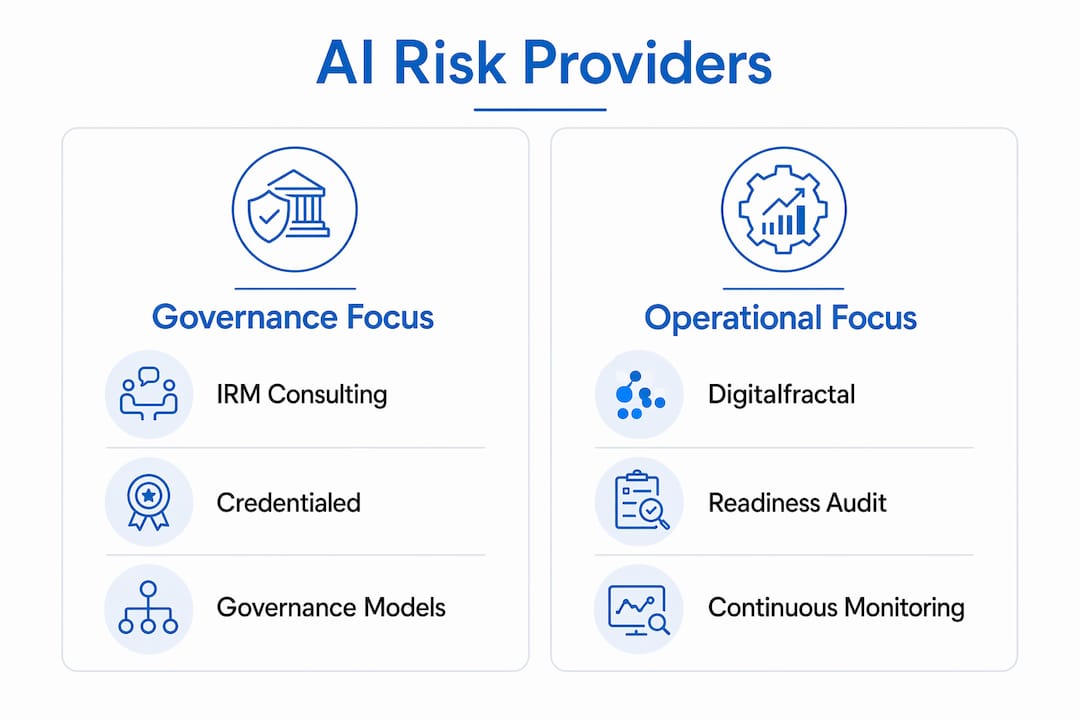
IRM Consulting & Advisory stands out for organizations that need credentialed governance without the cost of a full-time CISO. Their SOC 2, ISO 27001, and NIST AI100 certifications give compliance teams a concrete audit trail. Digital Fractal Technologies Inc takes a different angle: their AI readiness audits and workflow automation consulting are built for companies in construction, logistics, and industrial operations where the risk profile is operational rather than regulatory. Private AI addresses the specific challenge of using sensitive data in AI systems, applying context-aware de-identification so organizations can work with real data without exposing personal information. Global Risk Institute in Financial Services is the go-to resource for banks and insurers that need to build internal AI risk literacy and align with Canadian financial regulators.
How do you choose the right AI risk management provider?
The selection decision comes down to five criteria, and the order matters.
- Certifications and accreditations. SOC 2, ISO 27001, and NIST AI100 are the baseline trust signals. A provider without any of these is asking you to take their word for their governance competence.
- Sector expertise. A consultant who has never worked in financial services will miss the OSFI and FINTRAC dimensions that a bank’s compliance team cannot ignore. Match the provider’s track record to your industry.
- Socio-technical governance approach. Ask directly how they involve legal, HR, and operations in risk assessments. Providers who treat AI risk as a pure IT problem will leave gaps.
- Risk materiality tiering. A good provider applies proportionate AI oversight rather than the same controls to every AI use case. Over-engineering a low-risk chatbot wastes resources that belong on high-impact systems.
- Pricing and engagement model. Fractional or virtual CISO arrangements suit companies that need ongoing governance without a full-time hire. Project-based fees work better for defined audits or implementation sprints.
Pro Tip: Ask any shortlisted provider to name a Canadian regulatory instrument they have worked with directly, whether PIPEDA, OSFI’s technology risk guidance, or the federal Directive on Automated Decision-Making. A provider who cannot answer specifically has not done the work in this market.
- Verify references from clients in your sector, not just general testimonials.
- Confirm the provider’s familiarity with the NIST AI RMF and whether they use it as a living framework or a static checklist.
- Assess how they handle post-deployment monitoring, not just pre-launch risk assessment.
What do real AI risk management programs look like in practice?
Canadian organizations that have built credible AI governance programs share a few consistent patterns. Cross-functional ownership is the most common factor: the companies that avoid costly AI failures typically have a named AI risk owner who is not the CTO, and who coordinates input from legal, HR, and operations on a regular cadence.
The MIT AI Risk Initiative recommends maintaining a living repository of AI incidents, updated continuously as new risks emerge. Static risk registers become outdated within months of an AI deployment. Organizations that treat their risk documentation as a living record catch model drift and emerging attack patterns before they become incidents.
Common pitfalls from the Canadian market:
- Treating the NIST AI RMF as a one-time compliance exercise rather than an ongoing governance cycle.
- Failing to document training data provenance, which creates PIPEDA exposure when personal data is later discovered in a training set.
- Skipping post-deployment review because the pre-launch assessment passed. AI systems change behavior as real-world data shifts.
- Underestimating the reputational risk of a biased AI output in a customer-facing application.
How to implement an AI risk management program in your Canadian business
Start with inventory, not policy. You cannot govern what you have not cataloged.
- Inventory all AI systems in use, including third-party tools and embedded AI in SaaS platforms.
- Classify by risk materiality. High-impact systems (credit decisions, hiring tools, patient triage) need formal review. Low-risk tools (scheduling assistants, grammar checkers) need lighter controls.
- Assign cross-functional ownership. Name a risk owner for each high-impact system from outside the IT team.
- Apply the NIST AI RMF GOVERN and MAP functions to document intended use, known limitations, and potential harms before deployment.
- Build a pre-deployment review process that includes legal sign-off on PIPEDA compliance and a bias assessment for any system that affects individuals.
- Establish post-deployment monitoring with defined thresholds for model performance degradation and a clear escalation path.
How does AI risk affect your business reputation?
A single high-profile AI failure can undo years of brand equity. Canadian consumers and regulators have become more attentive to AI-related harms, and the reputational consequences of a biased hiring algorithm or a hallucinating customer service bot are no longer abstract.
Mitigation starts before deployment. Transparency about how an AI system works, what data it uses, and what its limitations are gives stakeholders a basis for trust. Organizations that publish model cards or plain-language AI use disclosures tend to recover faster from incidents because they have already established credibility. Post-incident response speed matters too: companies with a tested AI incident response plan contain reputational damage more effectively than those improvising under pressure.
What does ongoing AI monitoring look like after deployment?
Deployment is not the finish line. AI systems require continuous oversight because their behavior can shift as input data changes, as users find unexpected ways to interact with them, or as the external environment evolves.

Effective post-deployment monitoring includes automated performance tracking against defined accuracy and fairness thresholds, regular human review of edge cases and flagged outputs, and periodic full re-assessments tied to the NIST AI RMF MANAGE function. The AI vulnerability assessment process should be repeated at meaningful intervals, not just at launch. Audit logs, version control for model updates, and a documented change management process are the operational backbone of any credible monitoring program.
Digitalfractal offers a practical path to AI readiness
If the providers compared above focus primarily on governance, compliance, and risk advisory, Digitalfractal takes a different route to the same destination: getting your AI systems working safely and efficiently from the start.
Digitalfractal’s AI Readiness Audit identifies where your operations carry the most AI risk before you commit to a full deployment, so you address gaps at the design stage rather than after a failure. For companies in construction, logistics, and industrial sectors, that audit covers the operational risks that pure governance consultants often miss. The 90-day transformation timeline means you get concrete results, not a report that sits on a shelf. Use the AI Implementation Planner to map your next steps, or explore the AI integration benefits analyzer to quantify what responsible AI adoption could mean for your bottom line.
Key Takeaways
Effective AI risk management in Canada requires voluntary framework adoption, cross-functional governance, and continuous post-deployment monitoring because AIDA remains paused and no mandatory federal standard yet exists.
| Point | Details |
|---|---|
| AIDA is still paused | Canadian businesses rely on voluntary frameworks like the NIST AI RMF and PIPEDA for AI governance in 2026. |
| Cross-functional ownership is required | Legal, HR, operations, and IT must all have defined roles in AI risk governance, not just the IT team. |
| Risk materiality tiering saves resources | Classify AI use cases by impact before applying controls; high-risk systems need formal review, low-risk ones do not. |
| Post-deployment monitoring is non-negotiable | AI behavior shifts over time; living risk repositories and automated performance tracking catch problems before they escalate. |
| Digitalfractal for operational AI risk | Digitalfractal’s AI Readiness Audit addresses operational and deployment-stage risks for industrial and logistics sectors. |