Route Optimization AI: Canada’s 2026 Logistics Guide

What is AI route optimization and why does it matter for Canadian logistics?
AI-driven route optimization uses machine learning algorithms and constraint-based solvers to generate the most efficient delivery sequences across a fleet, accounting for traffic, time windows, vehicle capacity, and dozens of other real-world variables simultaneously. For Canadian logistics operations, where vast geography and seasonal disruptions compound the usual complexity, this matters more than it might elsewhere.
The core value is straightforward:
- Cost reduction: Transportation costs drop by 5–20% through shorter routes and better fleet use
- Speed: Route planning time decreases greatly, freeing dispatchers from hours of manual work
- Reliability: AI systems adapt to disruptions in real time, maintaining delivery commitments even when conditions change
- Scalability: Higher delivery volumes become achievable without adding vehicles or drivers
Traditional map tools cap out at 10 stops and offer no reordering. Modern AI planners sequence up to 120 stops in roughly 3 seconds. That gap is where the real operational difference lives.
How traditional routing fails and where AI steps in
Manual and rule-based routing breaks down fast. A dispatcher building routes in a spreadsheet or a basic TMS can handle a predictable day, but the moment a driver calls in sick, a road closes, or 200 new orders arrive after the morning plan is locked, the whole schedule unravels.
The structural problems with traditional methods:
- Static plans: Once set, they don’t adjust to traffic, weather, or new orders without manual rework
- Limited constraints: Most rule-based tools handle only a handful of variables; real fleets have dozens
- No learning: The system repeats the same logic every day, never improving from past performance
- Manual error: Human planners miss interactions between constraints that AI handles automatically
AI changes the equation by processing 180+ real-world constraints simultaneously, including driver shift limits, vehicle sizes, and live traffic, and re-optimizing in sub-5-minute cycles. The system also learns. Feedback loops analyzing historical data improve routing accuracy and ETA predictions over time, so the AI gets measurably better the longer it runs on your data.
What AI methods actually power route optimization?

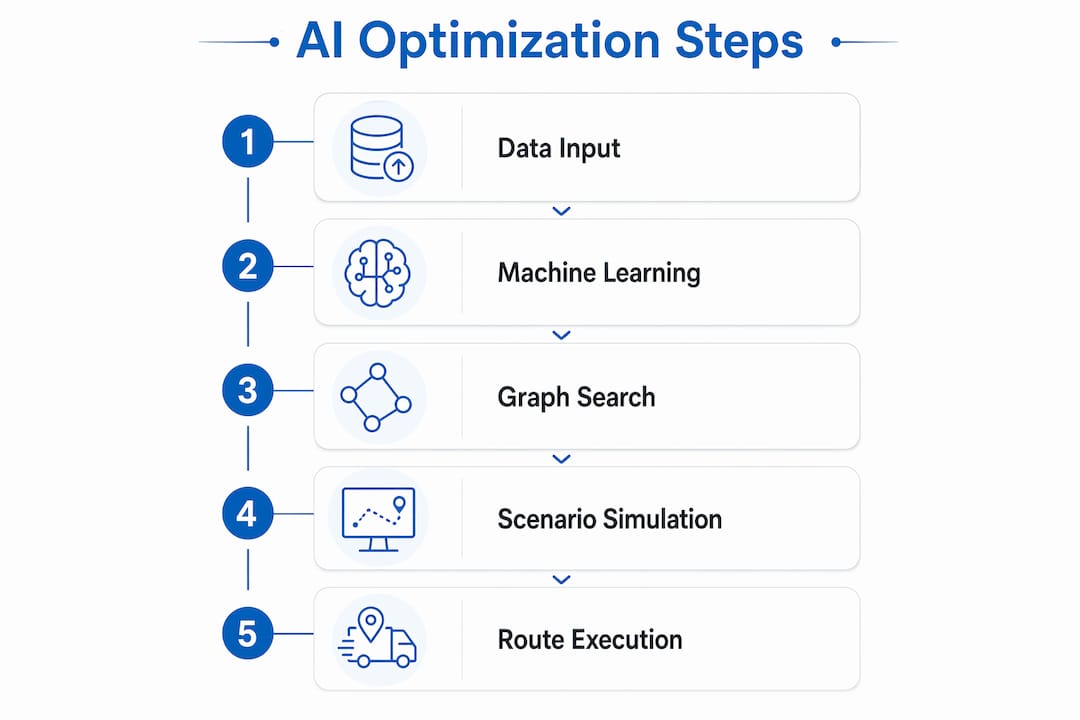
The algorithms underneath modern route optimization are not a single technique. Most enterprise platforms combine several approaches to handle different parts of the problem.
| AI Method | What It Does | Common Application |
|---|---|---|
| Machine learning | Learns from historical routes to predict travel times and demand | ETA accuracy, demand forecasting logistics |
| Constraint programming | Enforces hard rules like time windows and load limits | Fleet scheduling, compliance |
| Graph optimization | Finds shortest or fastest paths across a network | Multi-stop sequencing |
| Multi-objective optimization | Balances cost, time, and service level simultaneously | Enterprise fleet planning |
| Large language model parsing | Interprets natural language preferences and constraints | Conversational AI planning interfaces |
The LLMAP system, published in ACL Anthology research, demonstrates how LLM-as-Parser combined with graph search outperforms pure LLM-as-Agent approaches for multi-objective routing, handling user time limits, point-of-interest quality, and task dependencies in a single pass. Canada’s National Research Council has also collaborated on AI-driven truck route planners specifically designed for the country’s road network conditions.
Conversational AI interfaces now let planners run “what-if” scenarios in plain language, simulating depot changes or fleet mix adjustments without touching a configuration file. That shift from technical tool to collaborative decision support is where AI route planning is heading in 2026.

What measurable impact does AI route optimization deliver?
The numbers from deployed systems are consistent enough to treat as benchmarks rather than outliers.
Industry benchmark: AI route optimization reduces transportation costs by 5–20% and cuts route planning time by up to 75%.
Operational benefits that show up across deployments:
- Mileage reduction of 10–20% through tighter stop sequencing
- On-time delivery SLA performance exceeding 99% in high-volume networks
- Higher daily delivery volumes without fleet expansion
- Fewer empty miles, which directly cuts fuel spend and carbon output
- Dispatch teams shift from building routes manually to managing exceptions
The BigBasket deployment on the Locus platform achieved a 99.5% on-time delivery SLA while cutting total route distance by roughly 14.3%. Planning that previously took hours compressed to minutes. Those outcomes are not unique to one company; they reflect what properly configured AI routing does when fed good data.
Top Canadian providers of AI-driven route optimization
Four Canadian providers cover meaningfully different ground. The right choice depends on whether you need software, a transportation partner, or an AI integration consultant.
| Provider | Service Focus | Technology Approach | Industry Specialization | Rating |
|---|---|---|---|---|
| Routes Transport International | Transportation services and logistics routing | Established route solutions with local expertise | General freight and logistics, Ontario | 4.7★ (44 reviews) |
| Digital Fractal Technologies Inc | AI consulting, custom AI apps, workflow automation | AI readiness audits, custom AI agents, tailored integration | Logistics, construction, oil & gas, industrial | 5★ (6 reviews) |
| RouteOptix Management Systems Inc. | AI route optimization software | AI-powered scheduling with real-time adjustment | Canadian logistics operators | 5★ (1 review) |
| Gray Routes AI | AI route optimization, Toronto ON | Tailored AI routing solutions | Logistics firms | — |
Routes Transport International, based in Oakville, Ontario, is the most established name on this list for companies that need a transportation partner rather than software. Its strength is operational depth and a verified track record serving Canadian freight customers.
RouteOptix Management Systems Inc., out of Kitchener, Ontario, focuses specifically on AI route scheduling software with real-time adjustment capabilities. For Canadian logistics operators who want a purpose-built software platform rather than a consulting engagement, RouteOptix is the most direct fit.
Gray Routes AI, based in Toronto, offers tailored AI routing solutions for logistics firms. Its public profile is limited, so logistics teams should request a detailed capabilities demonstration before committing.
Digital Fractal Technologies Inc occupies a different lane. Rather than selling off-the-shelf routing software, it builds custom AI systems and conducts AI readiness audits to identify exactly where automation will generate the highest return. For firms whose routing problems are entangled with broader workflow inefficiencies, that consulting-first approach often surfaces more value than a software license alone.
How to choose the right AI route optimization provider
Selection criteria that actually matter for Canadian logistics operations:
- Technology compatibility: Can the platform connect to your existing TMS, ERP, or fleet telematics via API? Integration friction is the most common reason deployments stall.
- Constraint configurability: Does the system accept your specific business rules, such as driver rest requirements, load restrictions, or customer time windows?
- Industry experience: A provider who has deployed in your sector understands the edge cases that generic demos never show.
- Real-time capability: Static overnight planning is table stakes. Ask specifically how the system handles mid-route disruptions.
- Support model: Who do you call at 6 AM when a route fails? Understand the support structure before signing.
Pro Tip: Before any demo, send the provider a sample of your actual constraint set, including your hardest edge cases. A system that handles your real data in the demo is far more reliable than one that only performs on clean test scenarios.
Assessment steps worth taking: run a structured pilot on one route cluster before full deployment, check references from operations with similar fleet sizes, and confirm the vendor’s data residency practices if you operate under Canadian privacy requirements.
How AI readiness and custom integration maximize your results
Deploying AI routing on top of poor data or misaligned workflows produces disappointing results. The technology is only as good as the operational foundation underneath it.
Configuring real-world constraints like driver rest periods, load capacities, and site-specific dwell times is not optional. AI planners that skip dwell time at stops generate inaccurate ETAs and routes that look optimal on screen but fall apart in the field. Getting those parameters right before go-live is the difference between a successful deployment and a frustrated operations team.
Key integration considerations:
- Map your current TMS and fleet management data flows before selecting a platform
- Identify which constraints are hard rules versus preferences, since AI systems treat them differently
- Plan for a data cleaning phase; historical route data with gaps or errors degrades model quality
- Build a feedback loop so planners can flag AI-generated routes that don’t reflect ground truth
Digital Fractal Technologies Inc specializes in exactly this phase. Its AI readiness audit identifies automation opportunities across logistics workflows and produces a prioritized roadmap before any technology is purchased. That pre-implementation clarity prevents the most expensive mistake in AI adoption: buying a platform before understanding what problem you’re actually solving.
What data does AI route optimization require?
AI routing systems need structured, consistent data to perform well. The minimum viable dataset includes historical delivery records with timestamps, stop locations with geocoordinates, vehicle specifications, driver shift schedules, and customer time windows.
Higher-quality inputs that meaningfully improve output accuracy include real-time traffic feeds, site-specific dwell times per customer, seasonal demand patterns for demand forecasting in logistics, and historical exception data showing where routes failed and why. The more granular the historical record, the faster the model learns to generate routes that hold up under real conditions.
Implementation steps for adopting AI route optimization
A phased approach reduces risk and builds internal confidence before full deployment.
- Audit current routing performance to establish baseline metrics: average planning time, on-time rate, cost per delivery
- Clean and consolidate data from TMS, GPS, and customer records into a single accessible format
- Define constraint requirements with operations and compliance teams before vendor selection
- Run a structured pilot on one depot or route cluster, measuring against the baseline
- Train dispatchers on exception management rather than route building, since that is their new role
- Expand incrementally, adding depots or vehicle types as confidence grows
The AI Implementation Planner from Digitalfractal provides a structured framework for working through these steps, particularly useful for teams without prior AI deployment experience.
How does AI routing compare to traditional methods?
| Dimension | Traditional / Rule-Based | AI-Driven |
|---|---|---|
| Constraint handling | Dozens, manually configured | 180+ processed simultaneously |
| Replanning speed | Hours, requires dispatcher | Sub-5-minute automated cycles |
| Adaptability | Static until manually changed | Continuous real-time adjustment |
| Learning over time | None | Improves with each routing cycle |
| Stop sequencing scale | 10–20 stops typical | Up to 120 stops in seconds |
The honest limitation of AI routing is that it requires data infrastructure traditional methods do not. A dispatcher with local knowledge can build a workable route with a spreadsheet and a map. An AI system needs clean historical data, configured constraints, and integration with live traffic feeds to outperform that dispatcher consistently. The investment pays off at scale, but small operations with simple, stable routes may find the setup cost exceeds the return.
Privacy, security, and compliance concerns in AI routing
AI routing systems process sensitive operational data: driver locations, customer addresses, delivery schedules, and sometimes cargo contents. Canadian logistics operators must account for PIPEDA requirements governing personal information, and provincially regulated sectors may face additional obligations.
Key concerns to address with any vendor:
- Data residency: Where is route and driver data stored? Canadian data sovereignty requirements may prohibit offshore storage for certain industries.
- Access controls: Who within the vendor’s organization can access your operational data?
- Model transparency: Can the vendor explain why the AI generated a specific route? Explainability matters for compliance audits.
- Driver privacy: GPS tracking data collected for routing purposes must be handled in accordance with employment law and collective agreements where applicable.
Reviewing a vendor’s SOC 2 certification status and data processing agreements before deployment is standard practice for enterprise logistics operations in Canada.
Digitalfractal’s AI consulting approach for logistics teams
If you’ve reviewed the software providers above and concluded that your real challenge is figuring out where AI fits in your operation before buying anything, Digitalfractal offers a different starting point.
Rather than selling a platform, Digitalfractal conducts an AI readiness audit that maps your current workflows, identifies the highest-value automation opportunities, and delivers a concrete implementation roadmap, typically within 90 days. For logistics and supply chain teams whose routing problems are symptoms of broader data or process gaps, that diagnostic step prevents costly misdirected investment. Use the Digital Transformation Readiness Checker to get an initial read on where your operation stands before committing to a vendor selection process.
Key Takeaways
AI-driven route optimization delivers measurable cost and speed gains for Canadian logistics operations, but the results depend on data quality, constraint configuration, and choosing the right type of provider for your specific situation.
| Point | Details |
|---|---|
| Cost and time savings | AI routing cuts transportation costs by 5–20% and reduces planning time by up to 75%. |
| Real-time adaptability | Enterprise AI systems process 180+ constraints and re-optimize in sub-5-minute cycles during disruptions. |
| Data readiness is prerequisite | Clean historical delivery data, configured constraints, and TMS integration are required before AI routing performs reliably. |
| Canadian provider landscape | Routes Transport International suits transportation partnerships; RouteOptix targets software buyers; Digital Fractal Technologies Inc fits firms needing custom AI integration consulting. |
| Digitalfractal’s role | Digitalfractal’s AI readiness audit identifies automation opportunities and produces a roadmap before any platform purchase, reducing deployment risk. |