
How AI Flags Mobile Payment Fraud

AI can score a mobile payment in under 100 milliseconds and decide whether to approve it, challenge it, hold it, or decline it. If I had to sum up the article in one line, that’s it.
Here’s the plain-English version:
- I look at transaction data, device and IP data, behaviour signals, time patterns, and linked account activity
- I use those signals to spot things like card testing, account takeover, odd spending changes, and risky devices
- I combine rules with machine-learning scoring to sort payments into low-, medium-, or high-risk bands
- I map each score to an action: approve, step up with MFA or biometrics, hold for review, or decline
- I improve the system with analyst feedback and chargeback data, even when labels arrive 30 to 90 days later
A few numbers stand out. The article says fraud systems can process 25,000+ events per second and, in one November 2025 pilot, hit a 95.1% detection rate, cut false positives by 62%, and trimmed latency by 35.7%.
Put simply, the article shows that mobile fraud checks work best as a loop: score → act → review → retrain. If you run a payment app in Canada, that means tuning decisions around fraud loss, customer friction, and delayed dispute data instead of relying on fixed rules alone.
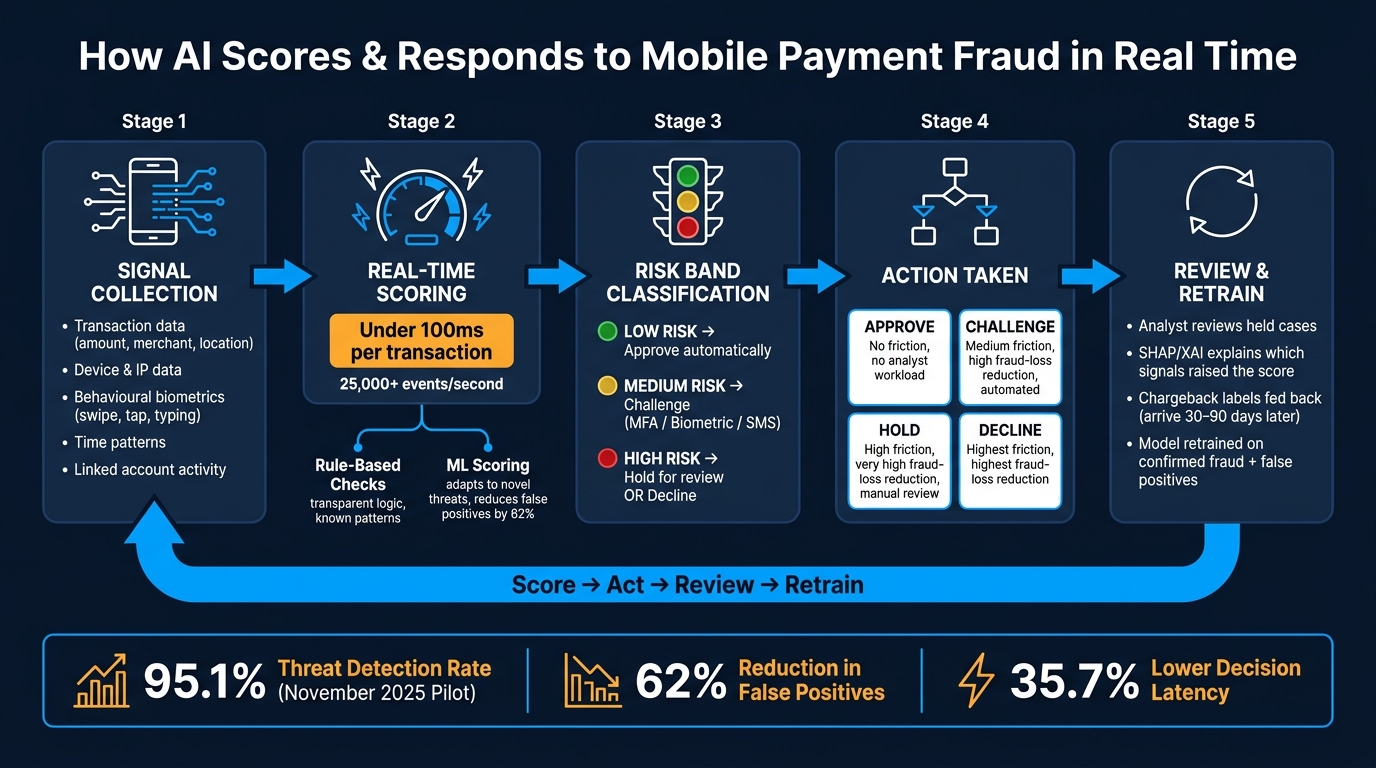
How AI Scores & Responds to Mobile Payment Fraud in Real Time
AI Powered Fraud Detection for Payments & Transactions | Maimoon Saleem | DSC MENA 25
sbb-itb-fd1fcab
How transaction scoring works inside a mobile app
Those signals matter only when the app rolls them into one risk score.
With each payment attempt, the system assigns a real-time risk score. That score looks at transaction context, device trust, and user behaviour, then decides what should happen next. The key issue is simple: what makes that score move up or down?
What raises or lowers a risk score
A score goes up when things drift from a user’s usual pattern. That can mean a larger transaction, a burst of activity, a new location, or a device the system doesn’t trust as much.
Timing matters too. The model looks at when a transaction happens, not just what happened. A payment made in one session may look fine, while the same payment in a different session can seem much riskier. After that, the app filters those signals through rules, models, or a mix of both.
Rule-based checks vs. machine-learning scoring
Both methods play different roles in a production fraud stack.
| Feature | Rule-Based Scoring | Machine-Learning Scoring |
|---|---|---|
| Adaptability | Static; requires manual updates for new patterns | Learns from new data and adapts to novel threat vectors |
| Complexity | Best for simple if-then logic | Handles patterns rules miss |
| Maintenance | Becomes harder to manage as rules accumulate | Can be updated through ongoing retraining |
| Explainability | High; logic is transparent and easy to audit | Often needs XAI tools such as SHAP or LIME |
| False Positives | More false alerts | Can reduce false positives by up to 62% in advanced systems |
Rules are fast and clear. They’re good at catching known patterns, like repeated failed attempts or payments from blocked regions.
Machine-learning models handle messier behaviour that fixed logic can miss. They’re better when fraud doesn’t follow a neat script.
Latency, thresholds, and escalation logic
Teams usually split scores into low-, medium-, and high-risk bands and tie each band to a response.
- Low risk: approve the payment automatically.
- Medium risk: trigger a challenge, such as MFA, a biometric check, or an SMS code.
- High risk: place the payment on hold for manual review or decline it outright, based on fraud loss and false-decline risk.
Those thresholds don’t stay fixed forever. Teams tune them over time to balance two costs: missed fraud and blocked legitimate customers. The score does its job only if it’s fed with the right behavioural and transaction signals.
Key signals AI looks for in mobile payment fraud
The score moves the most when spending shifts, card-testing patterns, and behaviour changes show up at the same time.
Spending pattern shifts and unusual transaction behaviour
AI flags fraud when spending breaks a user’s usual pattern for amount, merchant, location, or time of day.
The clearest triggers are transaction velocity and amount deviation. If there’s a burst of low-value attempts within minutes, that’s a classic probe. It often means someone is checking whether a card number works before trying a bigger purchase.
To avoid false alarms, models also look at merchant type, transaction timing, and location context. So a high-value purchase isn’t always a problem. If it fits the user’s normal context, it may still look fine.
When those patterns show up, the model looks at the next layer: does the same activity also fit known card-testing behaviour?
Stolen card signals in mobile payment flows
Stolen card use tends to follow a familiar pattern. Most fraudsters don’t jump straight to a big purchase. They start small, using low-value authorizations to confirm the card is active. This pattern is known as card testing or BIN-range probing.
These attempts often cluster across many accounts over a short period. That’s very different from a normal retry or a single failed payment.
Other red flags include:
- Transactions tied to merchant-device pairs already linked to fraud
- High-velocity failures across different cards from the same device
- Repeated failures across different cards from the same device, which point to card testing
Behavioural biometrics and account takeover clues
Behavioural biometrics track things like typing speed, swipe cadence, tap pressure, and navigation flow.
These signals build a behavioural profile that’s hard to copy. In many cases, a shift in behaviour shows account takeover before the payment itself looks suspicious.
| Signal | Legitimate Change | Suspicious Pattern |
|---|---|---|
| Device profile | Known device | New device ID with jailbreak or root signals |
| App navigation | Checking account balance before paying | Direct navigation to payment without checking balances or points |
| Typing & swiping | Consistent typing speed, familiar rhythm, and pressure | Robotic cadence or unusually fast, uniform input |
| Language/settings | Standard settings | Sudden unexpected language or locale switch |
| Login timing | Consistent with historical habits | Activity at unusual hours or rapid repeated attempts |
When behavioural signals are layered on top of transaction data, models have a better shot at telling apart a real user and a fraudster trying to take over the account.
Those signals then feed the next call: challenge, hold, decline, or lock.
What happens after a risk score triggers
Once a score passes a set threshold, the system needs to pick the least disruptive action that still cuts loss.
Challenge, hold, decline, or lock: mapping scores to actions
A typical fraud engine maps scores to four actions: approve, challenge, hold, or decline.
| Action | Customer Friction | Fraud-Loss Reduction | Analyst Workload |
|---|---|---|---|
| Approve | None | None | None |
| Challenge | Medium | High | Low (Automated) |
| Hold | High | Very High | High (Manual) |
| Decline | Highest | Highest | Low |
A challenge – such as a biometric prompt or stronger credential – fits moderate-risk scores. A hold makes sense when the score is high, but not clear enough to decline on the spot. A decline is for strong, high-confidence fraud signals. An account lock comes into play when there are signs of a broader compromise.
That balance matters. Fraud costs more than friction, but too much friction chips away at the customer experience. So thresholds can’t be based on gut feel. They need to match actual loss data.
When a transaction is held, it moves to analyst review. That feedback then feeds back into the model.
Case review, analyst feedback, and model updates
Analysts review held cases, confirm what happened, and send those labels back into the model. In XAI-enabled systems, SHAP shows which signals pushed the score up. The loop is simple: score → hold → analyst review → model update.
Confirmed fraud cases strengthen the patterns that were flagged for the right reasons. False positives matter too. They help the system stop flagging similar legitimate behaviour again and again.
"Gathering feedback from fraud analysts on the model’s predictions, such as whether a detected transaction was truly fraudulent… [is] crucial to achieve continuous improvement." – MDPI Beyond Accuracy: Economic Performance of Machine Learning Models
Not all fraud is caught in the moment. Some cases only show up later through disputes, which is why delayed data still has a big role.
How chargebacks and disputes improve detection over time
Chargebacks catch fraud that made it past the first check. But those labels often arrive 30 to 90 days later, so teams need to train on delayed outcomes.
"Confirmed labels in finance are commonly delayed (e.g., chargebacks), and the observed labels are shaped by review processes. Handling delayed supervision explicitly helps reduce the bias that arises when ‘not yet confirmed’ cases are implicitly treated as legitimate during training." – MDPI Review of Artificial Intelligence for Financial Fraud Detection
If teams ignore that lag, they can end up training models on incomplete labels. And that can push thresholds in the wrong direction.
Conclusion: Building a practical AI fraud response for Canadian organizations
Those signals only matter if they feed a clear response loop. Good mobile payment fraud detection is not one tool on its own. It’s a closed loop: score, respond, review, retrain.
Global fraud losses keep climbing, and Canadian mobile payment apps are under the same pressure.
In a November 2025 pilot that processed 2 million transactions per day, an AI fraud-detection system reached a 95.1% threat-detection rate, cut false positives by 62%, and reduced decision latency by 35.7% compared with baseline systems. That’s the bar Canadian teams should aim for: fast detection, low friction, and fast review.
The next step is simple in theory, but it takes discipline in practice. Tune thresholds. Feed in analyst feedback and chargeback labels. Keep the model explainable. For Canadian organisations, that means setting rules around actual loss rates, dispute patterns, and customer friction instead of guesswork.
The best fraud programmes don’t split detection, review, and retraining into separate jobs. They treat them as one continuous mobile workflow.
Teams that want help putting that workflow in place can work with Digital Fractal Technologies Inc for custom mobile app development, AI consulting, and workflow automation.
FAQs
How is a fraud risk score calculated?
In mobile payment apps, AI gives each transaction a fraud risk score by blending many signals into one number, often from 0 to 100. Machine learning models look at user behaviour, device data, and transaction patterns in real time.
Some models are trained to catch known fraud tactics. Others look for odd behaviour that doesn’t match past patterns, which helps flag new types of threats. The score also shifts based on context, like a user’s usual habits, so the system can be more accurate and cut down on false positives.
What usually triggers a payment challenge?
A payment challenge usually happens when a transaction doesn’t match expected known-good behaviour and crosses a risk threshold.
Common signals include suspicious identity or device details, unusual login or session patterns, geographic anomalies, unauthorised activity, or clear shifts in spending or usage patterns. That can lead to extra verification or the transaction being blocked for investigation.
How do chargebacks improve AI fraud detection?
Chargebacks give AI systems a much-needed feedback signal because confirmed fraud labels often show up late. When you feed chargeback data into the model, it’s less likely to treat still-unconfirmed transactions as legitimate. That cuts down training bias and gives the system a cleaner read on what fraud looks like.
This feedback loop also helps confirm earlier anomaly detections. Over time, it sharpens scoring and fine-tunes detection settings, so the model gets better at telling the difference between real threats and harmless anomalies.