Make a Supply Chain Control Tower Act in 90 Days, Not Just Report

A supply chain control tower is a centralized system that pulls data from your suppliers, carriers, warehouses, and internal systems into one place so you can see problems as they emerge, decide the best response, and act on it, often through AI-driven recommendations. The real payoff isn’t the dashboard. It’s faster, more confident decisions that cut the cost and duration of disruptions before they ripple through your network.
TL;DR:
- Only end-to-end supply chain control towers can predict problems before they happen, not just report after delays have occurred.
- Success requires integrating diverse data sources, normalizing formats, and implementing playbooks to streamline responses to disruptions.
- Real-time visibility, predictive analytics, and prescriptive recommendations improve key metrics like OTIF, inventory turns, freight spend, and stock levels.
- Starting with a narrow pilot focused on a single use case, such as transportation or inventory, increases the chances of a successful long-term deployment.
- Validation through a data and integration audit helps ensure that vendor platforms can act directly in your existing systems before making a multi-year investment.
Table of Contents
- What a Supply Chain Control Tower Covers End to End
- What You Actually Gain: Capabilities Mapped to Business Results
- Which Type of Control Tower Fits Your Organization
- The Data and Tech Stack Behind the Dashboard
- Your Pilot Checklist and the Mistakes That Sink Projects
- What Practitioner Engagements Teach You About Control Towers
- Control Towers in Practice: What Actually Changes on the Ground
- Where Control Towers Are Headed Next
- How to Evaluate a Control Tower Vendor Without Getting Sold
- Build, Buy, or Partner: A Straight Answer
- A Practical Next Step: Validate Before You Commit
- Sources
- FAQ
What a Supply Chain Control Tower Covers End to End
Most companies that say they have a control tower actually have a reporting dashboard with a good name. The difference matters because a dashboard tells you something went wrong after the fact. A real control tower, one built for end-to-end visibility, tells you something is about to go wrong and gives you a recommended fix.
Scope is where most projects quietly fail. An internal-only setup that only watches your own ERP and warehouse systems misses the disruptions that start outside your four walls: a supplier’s supplier missing a shipment, a carrier rerouting around a port closure, a co-packer running behind on a production run. A tower built for multi-party visibility has to ingest data from that wider ecosystem or its predictions are only ever half the picture.
The components that make this work aren’t glamorous, but skipping any one of them guts the system:
- Data ingestion, pulling structured and unstructured data from every relevant source, internal and external.
- Normalization, reconciling formats, units, and time zones so a delay flagged by a carrier API matches what your TMS reports.
- Analytics, layering descriptive, predictive, and prescriptive models on top of clean data.
- Playbooks, predefined response paths so a flagged exception routes to the right person with the right options, not a generic alert.
Leave out the playbooks and you’ve built an expensive alarm system. Leave out normalization and your analytics are guessing.
What You Actually Gain: Capabilities Mapped to Business Results
The capabilities that matter aren’t abstract. Each one ties to a number your CFO already tracks.
Real-time visibility means you can trace a shipment or an order across every node in the network, not just the one system you happen to be logged into. Predictive analytics flags a likely delay days before it happens, and prescriptive recommendations tell you what to do about it, reroute, expedite, or substitute inventory, rather than just showing you a red flag. That combination is what shortens exception resolution time and shrinks the financial hit when something does go wrong.
The KPIs that shift once this is working well:
- OTIF (on-time, in-full) improves because exceptions get caught and rerouted before they become missed deliveries.
- Inventory turns improve as demand signals sync with actual network conditions instead of static forecasts.
- Freight spend drops when routing decisions account for live carrier and lane data instead of last quarter’s contracts.
- Days of supply stabilizes because stockouts and overstocks get flagged before they compound.
None of this happens in a vacuum. Supply chain leaders consistently cite demand volatility, supplier reliability, and transportation disruption as their top operational headaches. A control tower is built specifically to blunt the impact of exactly those three problems.
Which Type of Control Tower Fits Your Organization
Not every company needs the enterprise version on day one, and starting there is often a mistake.
- Inventory control towers focus on stock positioning, safety stock, and replenishment triggers. Typically owned by supply planning teams, and a natural first step if inventory carrying cost is your biggest pain point.
- Transportation and logistics control towers track carriers, lanes, and freight spend in real time. Owned by logistics or transportation management, and often the fastest path to a visible win because freight data is usually the cleanest data a company has.
- Fulfillment and supply assurance towers watch order promising and supplier reliability, useful when your bottleneck is upstream rather than in transit.
- Enterprise end-to-end towers unify all of the above across the full network. Worth pursuing once you’ve proven value in one domain, but expect a longer integration timeline and heavier data governance.
Trying to build the enterprise version before proving the model on transportation or inventory is the single most common reason these projects stall out in year one.
The Data and Tech Stack Behind the Dashboard
The dashboard is the part everyone sees. The pipeline feeding it is the part that determines whether the recommendations are worth trusting.
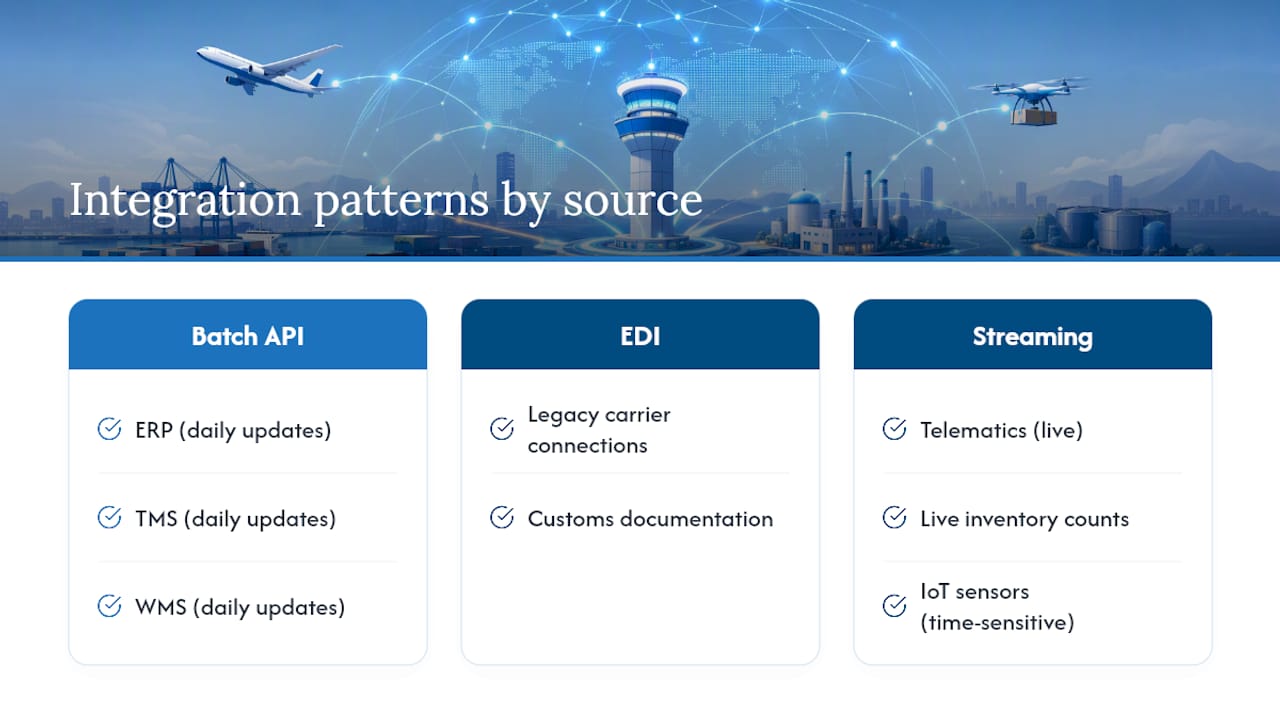
A functioning tower typically draws from ERP, TMS, and WMS systems, plus telematics feeds, carrier APIs, customs documentation, IoT sensors on high-value or temperature-sensitive freight, and even weather data for lane risk scoring. Getting all of that into one coherent view means choosing the right integration pattern for each source: batch API calls for systems that update daily, EDI for legacy carrier and customs connections, and streaming for anything time-sensitive, like telematics or live inventory counts. A one-time data pull looks fine in a demo and falls apart the first week it’s in production, because supply chain data changes by the hour, not the quarter.
Analytics maturity moves in stages: descriptive (what happened), predictive (what’s likely to happen), prescriptive (what to do about it), and increasingly, agentic execution, where the system doesn’t just recommend a fix but initiates it within defined guardrails. Modern AI-driven towers are built to automate the routine classification work while routing genuine exceptions to a human, which is a very different design goal than a dashboard meant only for browsing.
Pro Tip: Ask any vendor demo one question: “Can this system trigger a reroute or a reorder directly in my TMS or ERP, or does it just tell me to?” The answer separates a control tower from an expensive report.
Your Pilot Checklist and the Mistakes That Sink Projects
Skip any of these and you’ll spend more time firefighting the tower than the supply chain it’s supposed to fix.
- Treat data hygiene as a program, not a project. Master data drifts constantly. Most control-tower failures trace back to teams treating integration as a one-time setup instead of ongoing maintenance.
- Build integration governance before you build dashboards. Decide who owns partner onboarding and how new data sources get vetted before they hit production.
- Design human-in-the-loop review for high-stakes calls. A four-eyes check on anything above a defined cost or risk threshold keeps AI recommendations auditable, not just fast.
- Tune alert thresholds deliberately. Too sensitive and your team ignores every notification within a month; too loose and you miss the disruption you built the system to catch.
- Start with one quick-win use case, not the whole network, and define what success looks like before the pilot begins.
Pro Tip: Pick a pilot scope narrow enough to finish in 90 days but real enough that a win actually moves a number your leadership tracks, like freight cost or OTIF.
What Practitioner Engagements Teach You About Control Towers
The pattern that shows up again and again: companies buy the software, connect two systems, call it done, and wonder six months later why the recommendations are unreliable. Data integration isn’t a project with an end date. It’s ongoing maintenance, the same way you’d never call your accounting system “finished.”
What tends to work instead:
- AI generates the recommendation; a subject-matter expert validates it before execution on anything with real cost or safety exposure, preserving both speed and an audit trail.
- Scoping starts narrow. A readiness audit that maps your actual data quality and integration gaps before committing to a build saves months of rework later.
- Short, defined pilots, often 90 days, prove out data readiness and integration feasibility on one or two use cases rather than promising a full network rollout on day one.
Two use cases that come up often in these engagements: transportation exception handling, where scheduling agents flag and reroute around carrier delays, and cold chain monitoring, where sensor data triggers an alert before a temperature excursion turns into spoiled product.
Control Towers in Practice: What Actually Changes on the Ground
The clearest way to understand the value is to look at where the friction actually lives in a normal operation.
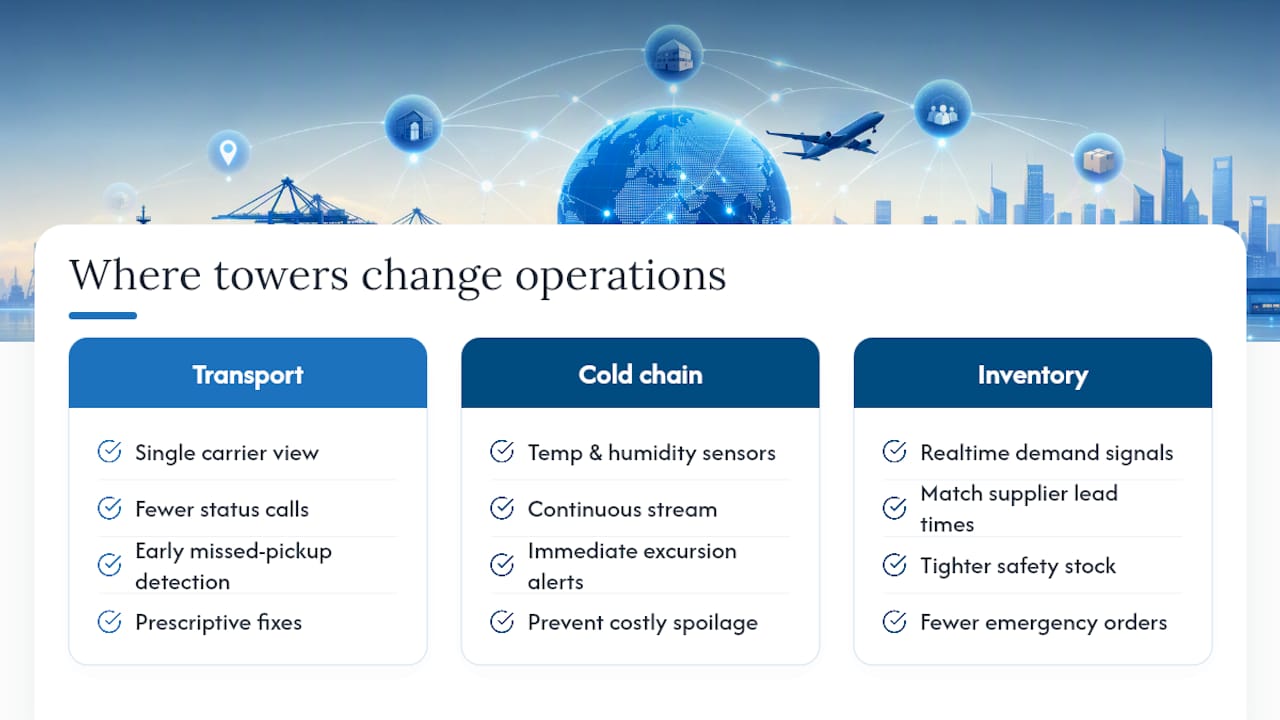
A transportation-focused deployment typically starts with freight visibility: carriers reporting into one normalized view instead of five separate portals. The first measurable win is usually fewer manual status-check calls and faster detection of a missed pickup or a delayed transit leg. Once that’s stable, the prescriptive layer kicks in, recommending an alternate carrier or lane before a delay becomes a missed delivery window.
Cold chain operations show a different kind of value. Temperature and humidity sensors feed a continuous stream into the tower, and an excursion outside the safe range triggers an immediate alert rather than a discovery at the receiving dock. The financial case here is straightforward: one prevented spoilage event on a high-value shipment often covers the cost of the monitoring investment for months.
Inventory-focused towers tend to show their value more slowly but more broadly. Instead of one dramatic save, you see a steady tightening of safety stock levels and fewer emergency reorders, because the system is reconciling demand signals with supplier lead times in near real time instead of on a weekly planning cycle.
The common thread across all three: the win doesn’t come from having more data. It comes from that data reaching someone, or something, that can act on it inside the window where action still matters. A tower that surfaces a problem an hour before a human would have noticed it anyway isn’t adding much. One that surfaces it three days early, with a specific recommended fix, changes the outcome.
Where Control Towers Are Headed Next
The next wave of development is less about dashboards and more about closing the loop between insight and execution.
Agentic AI is the clearest trend: systems that don’t stop at recommending a reroute but initiate it directly in the TMS or ERP, within guardrails a human has already approved. That shift is why evaluating a platform on its dashboard alone is increasingly the wrong test. The meaningful differentiator is whether the system can actually integrate into execution systems and close the loop, not just display a chart.
Expect deeper integration with supplier and carrier networks too, moving multi-party visibility from an aspiration to a baseline expectation. As more partners expose live APIs instead of static EDI feeds, towers will get better at predicting disruptions that originate two or three tiers upstream, not just at your own dock door.
Continuous tuning is also becoming a discipline in its own right. The most successful deployments treat AI thresholds as living settings that get adjusted with SME feedback, rather than a configuration you set once at go-live and forget. That ongoing calibration is what keeps a system from either drowning teams in false alarms or missing the disruption it exists to catch.
Sustainability and risk-scoring layers are starting to show up too, weighing carbon impact or geopolitical risk alongside cost and speed in prescriptive recommendations. It’s early, but for companies already tracking emissions targets, this is likely to become a standard input rather than a nice-to-have add-on within the next few years.
How to Evaluate a Control Tower Vendor Without Getting Sold
Vendor demos are built to impress, not to reveal what happens six months into a live deployment. A few criteria cut through that.
Ask how the platform handles data it wasn’t originally built to ingest. Every network has a quirky legacy system or a carrier still running EDI from a decade ago, and how gracefully a platform absorbs that tells you more than any polished screen. Ask specifically whether recommendations can trigger action inside your existing TMS, WMS, or ERP, or whether every insight still requires someone to manually execute the fix elsewhere. That distinction is the entire difference between visibility and execution.
Push on alert configuration too. A platform that lets you tune thresholds by lane, product category, or exception type will age better than one with a single global sensitivity setting, because the false-positive problem gets worse, not better, as you scale beyond one pilot use case. And ask how implementation actually works day to day: who owns onboarding a new supplier or carrier feed, and how long that takes in practice, not in the sales deck.
None of this replaces a proper technical evaluation. But asking these questions before signing anything filters out platforms built for a demo, not a decade of daily operations. Vendor pages will describe correlating data across siloed systems as the core value; your job is to confirm that correlation actually reaches a system that can act on it.
Build, Buy, or Partner: A Straight Answer
Build in-house only if you have dedicated data engineering capacity and a multi-year horizon. Most companies are better served buying or partnering, since the integration work is the hard part, not the dashboard.
In your first scoping workshop, ask three questions: What data sources do we actually have clean access to today? Which single use case, if fixed, moves a number leadership already tracks? And who on our team validates AI recommendations before they touch execution systems?
Get those three answers honestly, and the build-versus-buy decision usually answers itself.
— Souhail
A Practical Next Step: Validate Before You Commit
Before you sign a multi-year platform contract, it’s worth knowing exactly where your data and integrations actually stand. Digitalfractal’s AI readiness audit maps your current data quality, integration gaps, and use-case priorities so you scope a control-tower investment against reality instead of a vendor’s demo environment.
The audit covers three things: what data sources you can realistically integrate now, where your master data needs cleanup before any AI layer will trust it, and which one or two use cases, transportation exceptions, inventory triggers, cold chain monitoring, are worth piloting first. A short pilot built on that audit typically runs about 90 days and is designed to prove three things: that the data integration actually works, that alert noise stays manageable, and that at least one KPI, often freight cost or OTIF, moves in a measurable way.
If you’re weighing a control-tower investment and want to know what your own data can support before committing to a platform, the AI integration consulting team at Digitalfractal can walk through your current systems and scope a pilot built around your actual bottleneck, not a generic template.
Sources
- What is a Supply Chain Control Tower? | IBM
- Supply chain control towers: Providing end-to-end visibility | SAP
- Biggest challenges in supply chain (Statista)
- AI control towers 2.0: from visibility to execution
FAQ
What does a supply chain control tower do?
It centralizes data from internal systems and external partners so teams can spot disruptions early, get a recommended response, and act on it, often through automated or semi-automated execution.
Will AI replace supply chain management jobs?
No. AI in modern control towers is built to handle routine classification and flag recommendations, while human experts validate high-stakes decisions, which keeps the process both fast and auditable.
What is a control tower in logistics?
In logistics specifically, a control tower tracks carriers, lanes, and shipments in real time, flagging delays and recommending reroutes before they turn into missed deliveries.
What are the 7 C’s of supply chain management?
Definitions vary across sources and no single canonical list dominates; most versions include customer focus, collaboration, coordination, communication, cost control, capability, and continuous improvement.
How long does a control tower pilot typically take?
A focused pilot proving data integration and one or two measurable KPIs, like freight cost or OTIF, generally runs around 90 days when scoped narrowly.