
90 Day Pilot Proves Real Time Logistics Analytics for Ops

Real-time logistics analytics turns live telemetry from trucks, warehouses, and carrier feeds into decisions you can act on before a shipment goes wrong, not after. Done right, it cuts expedited-shipping costs, raises on-time delivery rates, and shrinks dwell time at docks and ports. The payoff shows up fastest in fleet tracking, exception handling, and inventory visibility, three areas covered in detail below alongside the architecture and rollout plan needed to get there.
TL;DR:
- Real-time logistics analytics can reduce dwell time at docks and ports by providing live data that enables immediate corrective actions.
- Key use cases include fleet tracking with predictive ETAs, dynamic rerouting, and item-level visibility, which help avoid delays and emergency shipments.
- Integrating siloed systems and ensuring data accuracy are crucial steps, as technical plumbing issues are common barriers to success.
- The initial pilots should focus on exception management and customer notifications, as they deliver measurable results within weeks and require less complex integration.
- A structured AI readiness audit helps determine which systems can connect quickly, setting the foundation for impactful short-term pilots like cold-chain alerts and automation.
Table of Contents
- Why Real-Time Logistics Analytics Matters Right Now
- Core Use Cases Worth Piloting First
- The Data Problems That Sink Real-Time Projects
- The Technology Stack Behind Live Logistics Data
- What to Measure and Where the ROI Shows Up First
- Rolling Out Real-Time Analytics Without Breaking Everything Else
- Where an AI Readiness Audit Fits Into a Logistics Rollout
- Where This Technology Delivers the Biggest Returns Next
- Get a Clear Path From Audit to Pilot
- Sources
- FAQ
Why Real-Time Logistics Analytics Matters Right Now
Batch reporting tells you what happened yesterday. Real-time supply chain visibility tells you what’s happening at this moment, and that gap in decision speed is where money gets made or lost. A dispatcher watching a live map can reroute a delayed truck before a customer notices. A planner reviewing last night’s report finds out after the customer has already called to complain.
The pressure to close that gap is coming straight from buyers. Nearly 44% of online shoppers now expect same-day or next-day delivery, which leaves almost no room for the multi-day blind spots that batch systems create. Meet that expectation without real-time visibility and you’re stuck throwing money at buffer inventory and rush freight to cover for the delay in knowing.
Stat check: Last-mile delivery accounts for a substantial share of total shipping costs, according to Statista’s cost-share data. It’s also the segment where live route data and dynamic rerouting produce the fastest, most measurable cost reductions.
The strategic case breaks down into three tied-to-KPI benefits. Fewer expedited shipments, because exception alerts catch problems while there’s still time for a normal fix. Higher on-time delivery rates, because live ETAs let dispatch intervene before a delay compounds. Lower cost-to-serve, because item-level visibility replaces safety-stock guesswork with actual demand signals. None of these show up in a monthly dashboard. They show up in the fifteen minutes after a truck misses a checkpoint.
Core Use Cases Worth Piloting First
Not every real-time logistics analytics use case deserves equal budget in year one. Some deliver ROI in weeks. Others need a mature data foundation first. Here’s the priority order that tends to work for logistics teams building their first real-time fleet visibility program.
- Fleet and asset tracking with predictive ETAs. Live GPS combined with traffic and weather feeds produces ETAs that update as conditions change, not a static number set at dispatch. Enterprise platforms like Maersk’s Visibility Studio use AI triangulation and risk mapping to flag port congestion and delay risk before it hits the delivery date.
- Dynamic route optimization. Telemetry feeding a routing engine in real time lets you reroute around a closed lane or a traffic jam mid-run, rather than discovering the miss after the truck is already stuck.
- In-transit and in-warehouse item-level visibility. Knowing where a specific pallet or SKU sits, not just where the truck is, lets planners make leaner inventory calls. Penske Logistics ties this single-pane-of-glass approach directly to fewer emergency orders and faster decisions on the floor.
- Cold chain monitoring with sensor-triggered remediation. Smart labels and disposable sensors report temperature excursions the moment they happen, which is the only way to save a load instead of writing it off. Kuehne+Nagel’s approach to real-time transportation visibility leans on exactly this kind of item-level sensor data.
- Automated exception management and customer communication. The highest-leverage use case for a lot of teams: auto-generated alerts and customer updates that fire the second a shipment deviates from plan, instead of a support rep finding out from an angry email.
Pro Tip: Start with exception management and customer communication before route optimization. It touches fewer systems, shows results in weeks instead of quarters, and builds the internal trust you’ll need before tackling harder integrations.
The Data Problems That Sink Real-Time Projects
Most real-time logistics analytics failures aren’t algorithm problems. They’re plumbing problems. Before trusting a live dashboard, resolve these four issues or the “real-time” label is cosmetic.
- Siloed systems. TMS, WMS, telematics, and ERP platforms were built by different vendors on different timelines, and they rarely speak the same data language out of the box. Integration work here is usually the biggest line item in any real-time rollout.
- High-velocity data handling. Event ordering, deduplication, and timestamp consistency matter more than people expect. A GPS ping that arrives out of sequence, or a duplicate event from a flaky cell connection, can make a truck appear to teleport across a map, and that kind of glitch erodes trust in the whole system fast.
- Carrier data gaps. Not every carrier reports location with the same frequency or accuracy, so platforms increasingly triangulate multiple data sources with AI to fill the gaps rather than relying on any single feed.
- Security and regulatory exposure. Telemetry data touches location, cargo details, and sometimes personal data on drivers, so vendor security posture is not optional. Checking a provider’s SOC audit framework compliance before you connect their API to your systems is a basic diligence step, not a formality.
The Technology Stack Behind Live Logistics Data
A working real-time architecture has five layers, and skipping any one of them is usually why a pilot stalls. Think of it as a pipe running from the truck to the dashboard, with several checkpoints along the way.
- Edge telemetry and ingestion. IoT sensors and telematics APIs are the source. Some fleet platforms push GPS updates as fast as once per second, which is the resolution needed for accurate geofencing and dwell-time tracking, per Navixy’s fleet visibility documentation.
- Event streaming and change data capture. Raw telemetry needs a streaming layer, tools built around patterns like Kafka or CDC pipelines, to move data continuously instead of in nightly batches.
- Streaming enrichment. This is where raw GPS coordinates become useful: geofencing logic, ETA models, and anomaly detection run against the live stream to flag problems the moment they occur, not after a report runs.
- APIs and workflow automation. Enrichment only matters if it triggers something. That means APIs feeding dashboards, alerts, and automated workflows, like the kind covered in Digitalfractal’s guide to AI scheduling agents for logistics companies, that turn a flagged exception into a rebooked shipment or a customer notification without a human clicking through five screens.
- Observability and data quality tooling. The layer teams forget until something breaks. Someone needs to monitor the pipeline itself, not just the shipments moving through it.
What to Measure and Where the ROI Shows Up First
Real-time logistics analytics earns its budget through a small set of KPIs, not a dashboard full of vanity metrics. Track these first:
- On-time delivery rate. The clearest external-facing number, and the one most tied to customer retention.
- Dwell time at docks and ports. Shrinking this by even a few hours per load compounds fast across a fleet.
- Expedited shipment rate. Every load that needs rush freight because a problem wasn’t caught early is a real-time analytics failure, and tracking the trend shows whether your exception alerts are actually working.
- Cost-to-serve per shipment. Rolls up freight, labor, and inventory carrying costs into one number leadership actually cares about.
Stat check: Given that last-mile delivery drives a large share of total shipping cost, even modest improvements in route efficiency or dwell time in that segment tend to produce the fastest visible ROI of any pilot.
The math is straightforward: if expedited shipments cost multiple times more than standard freight, avoiding even a handful per month through earlier exception detection covers the cost of a pilot quickly. Reduced demurrage from tighter dock scheduling adds on top of that. Run the exception-management and communication pilot first. It requires the least integration and shows the clearest before-and-after number within a single quarter.
Rolling Out Real-Time Analytics Without Breaking Everything Else
Moving from a pilot to a company-wide system fails more often from poor sequencing than from bad technology. Follow this order:
- Scope the pilot around one KPI. Pick a single measurable outcome, on-time rate for one lane, or exception response time for one warehouse, and resist the urge to solve everything at once.
- Write data contracts before you write code. Define who owns which data field, what “on time” actually means, and what SLA a carrier is held to for reporting frequency. Skipping this step is the single most common cause of pilot data disputes later.
- Automate the exception-to-action loop, but keep a human checkpoint. Full automation on day one invites errors nobody catches; a human-in-the-loop review for the first few weeks catches edge cases before they become policy.
- Scale through modular integrations, not a big-bang rollout. Add one carrier feed or one warehouse at a time, behind feature flags where possible, so a bad integration doesn’t take down a working system.
- Train dispatchers and planners on what the alerts mean, not just how to read them. A system nobody trusts gets ignored the first time it’s wrong.
Pro Tip: Budget as much time for change management as for integration work. A perfectly built pipeline that dispatchers route around because they don’t trust it delivers zero ROI, regardless of how good the underlying data is.
Where an AI Readiness Audit Fits Into a Logistics Rollout
A structured audit maps which systems, TMS, WMS, telematics, can actually feed a real-time pipeline today versus which ones need work first, so a pilot doesn’t stall on integration surprises three weeks in. It typically produces a prioritized list of automation opportunities and a realistic 90-day plan rather than a generic recommendation.
Common 90-day pilots include a scheduling agent that reduces manual dispatch time, a route optimization pilot tied to live telemetry, and a cold-chain alert system that catches temperature excursions before a load is lost. Readers building out any of these can review the logistics automation use cases guide for concrete examples and expected timelines, or map responsibilities across teams using AmmarAI’s use-case breakdown by role and industry.
Where This Technology Delivers the Biggest Returns Next
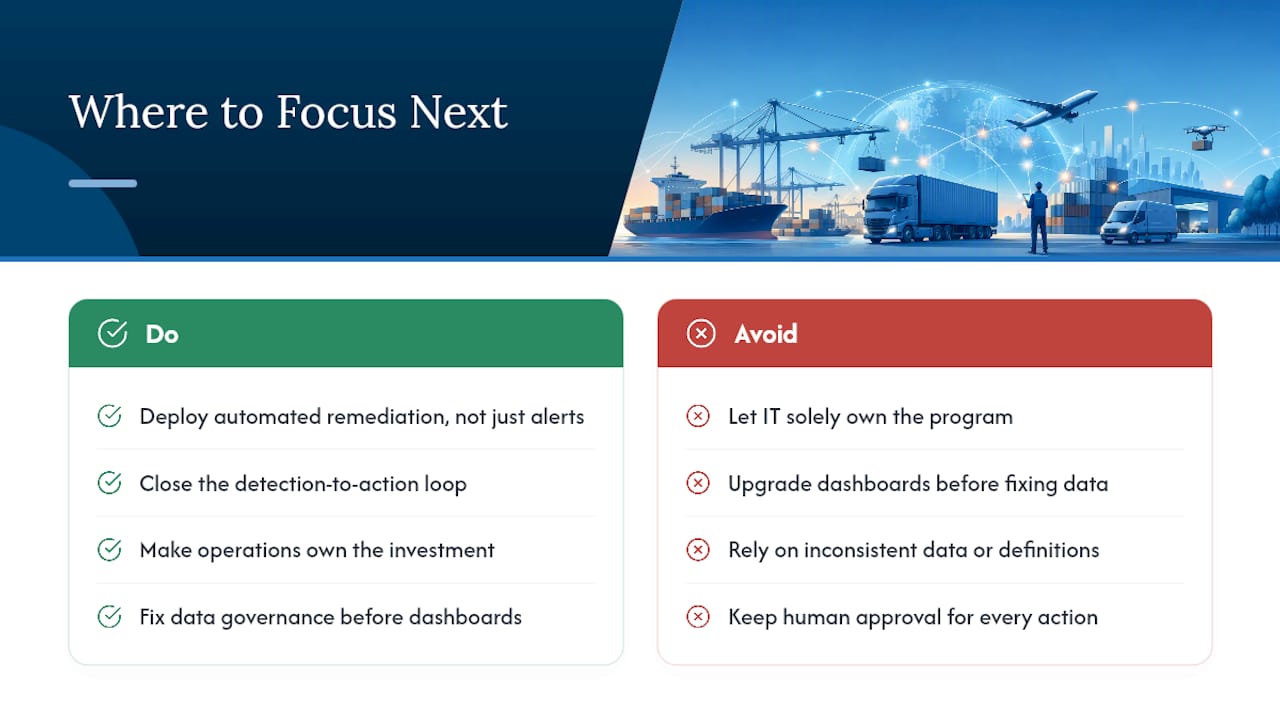
The next wave of value in real-time logistics analytics isn’t more dashboards. It’s automated remediation, systems that don’t just flag a cold-chain excursion but trigger a rerouting or a customer credit without waiting for a human to notice the alert. Predictive ETAs will keep improving as more carriers share telemetry, but the bigger shift is in closing the loop between detection and action.
Operations leaders should own this investment, not IT. The technology choices matter less than the willingness to change how dispatch and customer service actually work day to day. My one caution: none of this works if the underlying data is inconsistent or the teams feeding it don’t trust the definitions behind it. Fix data governance before you fix the dashboard, or you’ll just be visualizing bad information faster.
— Souhail
Get a Clear Path From Audit to Pilot
Most logistics teams don’t lack ambition around real-time analytics. They lack a realistic map of which systems are actually ready to connect and which integration will eat three months if nobody scopes it first. That’s what an AI readiness audit is built to solve: a structured assessment of your TMS, WMS, and telematics stack that ends with a prioritized 90-day pilot plan instead of a vague roadmap.
Specialized audits assess logistics operations aiming to move from batch reporting to live visibility without a year-long integration project. Clients typically walk away with a scoped pilot, such as a scheduling agent, a cold-chain alert system, or exception-management automation, that aims to show measurable results within a short timeframe. If you want to see where your own systems stand, start with the AI Readiness Audit or explore the AI scheduling agent built for logistics companies as a concrete first pilot to request.
Sources
- Statista — Delivery time expectation of online shoppers worldwide
- project44 — Supply Chain Visibility Software
- Maersk — Maersk Visibility Studio
- Penske Logistics — Real-Time Supply Chain Visibility
FAQ
What Is Real-Time Tracking in Logistics?
Real-time tracking is the continuous monitoring of shipments, vehicles, or inventory using live telemetry, GPS, sensors, and carrier feeds, so location and status update as events happen rather than through periodic reports.
What Are the 7 C’s of Logistics?
Definitions vary across sources, but a common version includes consistency, coordination, capability, communication, control, customer focus, and cost. Real-time analytics primarily strengthens communication and control by giving teams live status instead of delayed reports.
What Is Real-Time Analytics?
Real-time analytics processes data as it’s generated, seconds after an event occurs, rather than in scheduled batches, enabling immediate decisions like rerouting a truck or flagging a cold-chain excursion before it causes a loss.
Will Supply Chain Management Be Replaced by AI?
AI is automating specific tasks within supply chain management, like exception detection, ETA prediction, and route optimization, but it’s augmenting planner and dispatcher decisions rather than replacing the function. Tools like Digitalfractal’s AI scheduling agent are built to handle repetitive scheduling work so people can focus on exceptions that actually need judgment.
How Fast Should Fleet GPS Data Update for Real-Time Visibility?
High-frequency fleet platforms can update location very frequently, with some capable of providing updates once per second, a resolution that supports accurate geofencing and dwell-time tracking, though many operations run effectively on shorter intervals depending on the use case.