
Custom AI Development: A Decision Guide for Business Leaders

If your competitive advantage depends on proprietary data, unique workflows, or regulated data residency, custom AI development is worth serious consideration. If it doesn’t, buying or boosting an existing vendor product is almost certainly faster and cheaper. That’s the honest short answer.
The immediate next step: run an AI Readiness Audit before you write a single line of code or sign a vendor contract. It takes days, not months, and it tells you exactly where custom work pays off and where off-the-shelf tools will do the job.
Before going further, run this three-item decision check:
- Moat test: Can you write one sentence describing proprietary data, unique feedback loops, or workflow integration that a competitor cannot replicate within 18 months? If not, buy or boost.
- Data readiness: Do you have labeled, accessible, governed data in sufficient volume for the use case? No data, no custom model.
- Operational capacity: Does your team have the ability to monitor, retrain, and maintain a custom system in production? If not, budget for a managed retainer from day one.
All three boxes checked? Then a custom build at the application or fine-tuning layer is defensible. One or two unchecked? Start with a vendor product and revisit in 12 months.
Table of Contents
- What is custom AI development, and when does it beat off-the-shelf?
- What does a custom AI project actually look like, phase by phase?
- Which services should a custom AI vendor actually provide?
- What does custom AI development actually cost?
- How do you decide whether to build, buy, or boost?
- What are the real risks, and how do you mitigate them?
- How do you measure whether custom AI is actually working?
- How does Digitalfractal approach custom AI projects?
- Key Takeaways
- Why evaluation infrastructure is the part most teams get wrong
- Digitalfractal’s AI Readiness Audit gets you a scoped plan in 72 hours
- Useful sources
What is custom AI development, and when does it beat off-the-shelf?
Custom AI development means architecting the full stack your business actually needs: data pipelines, model selection and integration, orchestration logic, evaluation infrastructure, and operational runbooks, all shaped around your specific workflows. It is not training a foundation model from scratch. Training frontier models costs hundreds of millions to billions of dollars, which puts that option out of reach for virtually every organization outside the largest tech companies. What most businesses are actually building is the application and integration layer on top of existing base models.
The practical decision sits across three options:
- Buy: Purchase a SaaS product with AI built in (a CRM with lead scoring, a support platform with a chatbot). Fast to deploy, limited to the vendor’s feature set.
- Boost: Take a vendor product and layer in your proprietary data through retrieval-augmented generation (RAG), prompt engineering, or fine-tuning. RAG and prompt engineering address roughly 90% of enterprise use cases at lower cost and with fewer operational challenges than full fine-tuning.
- Build: Own the integration, RAG pipelines, evaluation criteria, and operational runbooks, blending base models into your business workflows. The right call when your domain data or feedback loop is a defensible moat.
MIT Sloan’s buy/boost/build framework puts it plainly: build only when domain expertise or differentiation cannot be replicated by vendors. Gartner’s guidance goes further, noting that most enterprise AI deployments in 2026 are a blend of embedded vendor features, bring-your-own-AI (BYOAI), and custom-built components, with governance (what Gartner calls TRiSM: trust, risk, and security management) woven in from the start.
The one-sentence moat test: Can your company point to proprietary data, unique feedback loops, or workflow integration that competitors cannot replicate in 18 months? If yes, build at the application or fine-tuning layer. If no, buy or boost and spend the saved budget on better data collection.

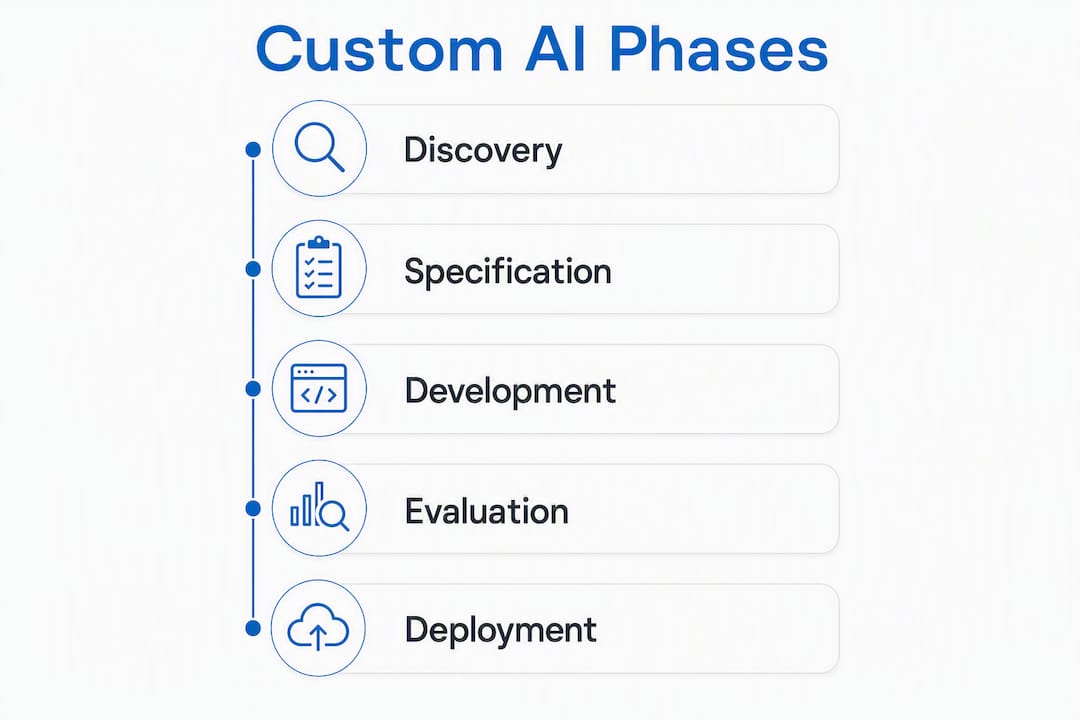
What does a custom AI project actually look like, phase by phase?
A well-run custom AI program follows a repeatable sequence. The phases below reflect what production-grade projects require; timelines are estimates that shift based on data readiness and integration complexity.
-
Discovery and use-case prioritization (weeks 1–2). Two or three stakeholder sessions to map workflows, identify automation candidates, and rank them by impact and feasibility. Deliverable: a prioritized use-case list with rough ROI estimates.
-
Data readiness and engineering (weeks 2–5). Audit existing data sources, assess quality and labeling gaps, and build or clean the pipelines needed to feed the model. Deliverable: a data readiness report and a working pipeline to a staging environment.
-
Spec and evaluation design (weeks 3–5, overlaps with data work). Write the technical specification: model architecture choices, integration points, acceptance criteria, and the evaluation suite. Building the eval pipeline before model development begins is the single practice that most separates successful projects from expensive failures. Deliverable: technical spec document and a baseline test set with scoring methodology.
-
Prototype / POC (weeks 4–8). Build a narrow, scoped proof of concept against the eval suite. The goal is to validate the core technical assumption, not to ship a product. Deliverable: working POC with eval scores, architecture doc, and a go/no-go recommendation.
-
MVP and integration (weeks 6–14). Expand the POC into a minimum viable product, integrate with production systems, and run against the full eval suite. Legacy system integration is often where timelines slip; plan for it explicitly. Deliverable: integrated MVP in a staging environment, code in repo, integration test results.
-
Shadow testing and staged rollout (weeks 12–18). Run the model in parallel with the existing process, compare outputs, and measure against baseline KPIs before any live traffic. Deliverable: shadow test report, rollout plan, alerting configuration.
-
Production and MLOps / retainer (ongoing from week 16+). Deploy to production with monitoring, drift detection, and a documented operational runbook. Deliverable: production system, runbook, retainer scope for ongoing tuning.
| Phase | Typical duration | Key deliverable | Common pitfall |
|---|---|---|---|
| Discovery | 1–2 weeks | Prioritized use-case list | Skipping ROI estimates |
| Data readiness | 2–4 weeks | Clean pipeline + readiness report | Underestimating labeling effort |
| Spec + eval design | 2–3 weeks | Technical spec + test set | Deferring eval to the end |
| POC | 3–5 weeks | Working POC + go/no-go | Scope creep into MVP territory |
| MVP + integration | 4–8 weeks | Integrated MVP in staging | Legacy API surprises |
| Shadow testing | 3–5 weeks | Shadow test report | Skipping this phase entirely |
| Production + MLOps | Ongoing | Runbook + monitoring | No owner assigned post-launch |
Which services should a custom AI vendor actually provide?
A capable vendor covers the full lifecycle, not just model development. Here is what a complete service catalog looks like, and why each piece matters:
- AI Readiness Audit. Inspects data shape, compliance constraints, integration points, and business metrics to produce a scoped roadmap and cost estimate. This is the entry point, not an upsell.
- Use-case prioritization. Ranks automation candidates by impact, feasibility, and data availability so you spend budget where it moves the needle.
- Data engineering and pipelines. Builds the infrastructure to collect, clean, label, and version the data the model needs. Skipping this is the most common reason projects stall.
- Embeddings and RAG systems. Connects your proprietary documents, databases, or knowledge bases to a base model without full fine-tuning. Usually the right first technical choice.
- LLM orchestration and agents. Chains model calls, tool use, and decision logic into multi-step AI workflow automation that handles real business processes. Scaling agents introduces its own coordination challenges.
- Fine-tuning (when justified). Adapts a base model on domain-specific labeled data. Appropriate when RAG and prompting cannot reach the required accuracy, not as a default.
- Evaluation and monitoring infrastructure. Test sets, automated scoring, CI hooks, drift detection, and alerting. Non-negotiable for any production system.
- MLOps and operational runbooks. Documents failure modes, retraining triggers, escalation paths, and cost controls so the system can be operated by your team after handoff.
- Security and compliance support. Data residency controls, access logging, and audit trails for regulated industries. Particularly relevant for oil and gas, healthcare, and financial services.
- Ongoing retainer. Periodic model revalidation, prompt tuning, and pipeline updates as your data and business requirements evolve.
The first five items on that list are typically one-time project deliverables. Evaluation infrastructure, MLOps, and the retainer are ongoing. Any vendor who treats evaluation as optional or hands off without a runbook is leaving you with a system you cannot safely operate.
Pro Tip: Ask any vendor candidate to show you the eval pipeline they built for a previous client. If they can’t, that tells you more than any proposal document will.
What does custom AI development actually cost?
Budget expectations vary widely, and the spread is real. A light API-driven pilot can run tens of thousands of dollars. A standard multi-step system with RAG, integrations, and an eval harness typically costs a mid-to-high five-figure to low six-figure amount. An enterprise multi-agent deployment with compliance requirements, fine-tuning, and full MLOps can be priced at a high six-figure level or more. For a detailed breakdown of what drives those numbers, Digitalfractal’s cost guide walks through the line items.
The primary cost drivers:
- Data work. Labeling, cleaning, and pipeline engineering often consume a significant portion of a project budget, especially when starting from raw operational data.
- Integration complexity. Connecting to legacy ERP, SCADA, or proprietary databases adds time and cost that API-only projects avoid.
- Model choice. Using a hosted API (OpenAI, Anthropic, Google) is cheaper upfront but carries ongoing usage fees and vendor dependency. Self-hosting an open-weight model shifts cost to infrastructure and engineering. Fine-tuning adds a one-time training cost on top.
- Evaluation infrastructure. Building a proper test set and automated scoring harness adds two to four weeks of engineering time but pays for itself in avoided production failures.
- Compliance and regulatory requirements. Data residency, audit trails, and access controls add scope in regulated industries.
- Ongoing usage and retainer. API token costs, hosting fees, and retainer for tuning are recurring. Budgeting a moderate fraction of the initial build cost annually is recommended for a maintained system.
| Engagement type | Typical budget | Timeline to production | Best for |
|---|---|---|---|
| Light pilot (RAG + API) | Tens of thousands of dollars | About 1 to 2 months | Validating a use case before full investment |
| Standard system (RAG + integrations + eval) | Mid-to-high five-figure to low six-figure investment | Several months | Workflow automation, document processing, predictive tools |
| Enterprise multi-agent deployment | High six-figure investment or more | Half a year or longer | Complex orchestration, compliance-heavy industries |
How do you decide whether to build, buy, or boost?
The real ROI of AI comes from integrating proprietary data and feedback loops into workflows, not from the model itself. The model is increasingly a commodity. That reframing changes how the build-vs-buy decision should be made.

Write your moat sentence first. Something like: “We have 10 years of labeled maintenance logs from 400 field assets that no competitor has access to, and our technicians generate new labeled outcomes daily.” That sentence justifies a custom build. “We want a chatbot for customer support” does not.
Guiding questions to work through before committing:
- Data residency and regulatory constraints. Does your data need to stay on-premises or within a specific jurisdiction? If yes, hosted API solutions may be off the table regardless of cost.
- Longevity of the use case. Is this a workflow that will exist in five years? Custom builds require ongoing investment; short-lived use cases rarely justify the upfront cost.
- Internal operational capacity. Who will own the system after launch? If no one, budget for a managed retainer or reconsider the build option.
- Speed to market. A buy or boost approach can go live in weeks. A custom build takes months. If the competitive window is short, that gap matters.
- Cost tolerance. Can the business absorb $100,000–$500,000 in upfront development plus ongoing operating costs? If not, start with a boosted vendor product and build toward custom over time.
Quick ROI checklist:
- Estimate the annual cost of the manual process being automated (labor hours × fully loaded cost).
- Estimate the build cost plus three years of operating costs.
- If the three-year operating cost exceeds the three-year manual cost, the economics don’t support a custom build at this stage.
- If the use case creates revenue or competitive differentiation that is hard to quantify, weight that separately and make it explicit in the business case.
What are the real risks, and how do you mitigate them?
Most custom AI projects don’t fail because the model was wrong. They fail because the evaluation infrastructure was missing, the data was worse than expected, or no one owned the system after launch.
The top risks, in order of frequency:
- Vendor model deprecation. If your system depends on a single API provider, a model version change or deprecation can break production overnight. Experts advise using multiple providers and running automated evaluation harnesses against every new model version.
- Insufficient evaluation infrastructure. Shipping without a test set and automated scoring means you have no way to know when the system degrades. This is the most preventable failure mode.
- Poor data quality or labeling. Garbage in, garbage out. Projects that skip the data readiness phase discover this at MVP, not at discovery, which is the most expensive time to find it.
- Unsupported handoff. The vendor delivers code; no one on your team can operate or retrain it. Require an operational runbook and a knowledge transfer session as contractual deliverables.
- Regulatory or data residency breaches. Using a hosted API to process data that must stay on-premises is a compliance failure, not a technical one. Catch it in the spec phase.
Mitigations to require in your RFP and contract:
- Multi-provider architecture with abstraction layers so model swaps don’t require full rebuilds. See AI vulnerability management best practices for a practical framework.
- Automated evaluation harness integrated into CI/CD, running on every model version update.
- Staged rollout with shadow testing before any live traffic.
- Contractual SLAs covering model performance thresholds, not just uptime.
- Change-management clauses requiring re-evaluation before any model substitution.
Pro Tip: Require the evaluation pipeline as a gated deliverable at the end of the spec phase. No eval pipeline, no green light to proceed to POC. This one gate catches more problems than any amount of post-launch monitoring.
How do you measure whether custom AI is actually working?
Measurement starts before the build, not after. The KPIs and evaluation methodology should be defined in the spec phase and locked before any model development begins.
Recommended KPIs by category:
- Task accuracy: Precision, recall, and F1 for classification tasks; BLEU or ROUGE for generation tasks; exact-match or semantic similarity for retrieval.
- Reliability: Hallucination rate, error rate, and out-of-distribution detection scores.
- Operational performance: Latency (P50 and P95), cost per query, and API error rate.
- User metrics: Adoption rate, CSAT or thumbs-up/down feedback, and escalation rate (for support or decision-support tools).
- Business outcomes: The metric the project was actually built to move: hours saved per week, defect detection rate, quote turnaround time, or whatever the use case targets.
Evaluation infrastructure checklist:
- A curated, representative test set with human-verified ground truth labels.
- Automated scoring scripts that run on every model version or prompt change.
- CI/CD hooks that block deployment if eval scores drop below threshold.
- Drift detection on production inputs to catch distribution shift before it degrades outputs.
- Alerting via Slack, PagerDuty, or equivalent when error rates spike.
- Periodic revalidation (quarterly at minimum) against a refreshed test set.
For a practical guide to AI testing and CI integration, the technical implementation details are covered in depth separately.
Governance roles that need to be named before launch:
- Executive sponsor: Owns the business case and escalation path.
- AI product owner: Manages the roadmap, acceptance criteria, and stakeholder communication.
- Data steward: Owns data quality, labeling, and access controls.
- ML engineer: Owns the model, eval pipeline, and retraining schedule.
- Responsible-AI reviewer: Signs off on bias checks, fairness audits, and ethics checkpoints before production.
Gartner’s TRiSM framework formalizes this governance layer as a requirement for any enterprise AI deployment, not an optional add-on.
How does Digitalfractal approach custom AI projects?
Digitalfractal’s entry point is the AI Readiness Audit: a structured inspection of your data shape, compliance constraints, integration points, and business metrics. The output is a scoped roadmap, a prioritized use-case list, and a cost estimate, delivered within 48–72 hours of kickoff. That document becomes the foundation for every subsequent phase.
What the audit covers:
- Data inventory: what exists, where it lives, how it’s governed, and what labeling or cleaning is needed.
- Compliance constraints: data residency requirements, regulatory obligations, and access control gaps.
- Integration points: existing systems (ERP, SCADA, CRM, mobile apps) and the complexity of connecting them.
- Business metrics: the specific KPIs the project needs to move, with baseline measurements where available.
- Feasibility assessment: which use cases are addressable with RAG and prompting, which require fine-tuning, and which should be deferred or bought.
From there, Digitalfractal delivers spec-first: the technical specification and evaluation suite are completed before any model development begins. Code lives in your repository from day one, not in a vendor-controlled environment. Shadow testing is a required phase, not an optional one.
For clients in logistics, construction, and oil and gas, the 90-day pilot to measurable workflow automation is a realistic target for well-scoped use cases. The handoff package includes architecture documentation, the full eval suite, and an operational runbook your team can actually use. Real business case studies show what that looks like across industries.
Ongoing retainer engagements cover model revalidation, prompt tuning, pipeline updates, and the governance checkpoints that keep production systems reliable as data and requirements evolve.
Key Takeaways
Custom AI development pays off when proprietary data, unique feedback loops, or regulatory constraints make off-the-shelf tools insufficient, and when the organization can commit to operating the system in production.
| Point | Details |
|---|---|
| Run the moat test first | Write one sentence describing your defensible data or workflow advantage before committing to a custom build. |
| Expect realistic timelines | Fast API-driven pilots take 1–2 months; full production systems typically require several months to half a year depending on data and integration complexity. |
| Require eval infra early | Demand the evaluation pipeline as a gated deliverable before POC begins, not as an afterthought after launch. |
| Budget for ongoing costs | Plan for 15–25% of the initial build cost annually to cover monitoring, retraining, and retainer support. |
| Digitalfractal’s starting point | An AI Readiness Audit delivers a scoped roadmap and cost estimate within 48–72 hours, giving you a concrete decision before any build commitment. |
Why evaluation infrastructure is the part most teams get wrong
The conventional wisdom on custom AI projects focuses on model selection: which LLM, which architecture, which vendor. That’s the wrong place to spend your attention. The model is the easy part. What actually determines whether a production system stays reliable six months after launch is the evaluation infrastructure, and most teams treat it as a nice-to-have.
Watching projects stall or quietly degrade in production, the pattern is consistent: the eval pipeline was deferred to “after we ship the MVP.” By then, the team has moved on, the budget is spent, and there’s no baseline to measure against when something breaks. A model update from the API provider, a shift in input data distribution, a new edge case from a customer segment you didn’t test, and suddenly the system is producing wrong outputs that no one catches for weeks.
The other thing worth saying plainly: custom development is not always the right answer. When a client’s use case is well-served by a boosted vendor product, that’s the recommendation. Spending $200,000 on a custom build when a $30,000 RAG layer on top of an existing platform would do the job is not a win for anyone. The AI Readiness Audit exists precisely to make that call before money is committed, not after.
What Digitalfractal prioritizes, and what any serious vendor should prioritize, is code-in-repo handoff and a runbook your team can actually operate. A system that only the vendor understands is a dependency, not an asset.
Digitalfractal’s AI Readiness Audit gets you a scoped plan in 72 hours
Most businesses spend months in internal debate about whether to build custom AI, what it will cost, and where to start. The AI Readiness Audit short-circuits that. Within 48–72 hours of kickoff, you get a prioritized use-case roadmap, a realistic cost estimate, and a clear recommendation on whether to build, boost, or buy for each identified opportunity.
Pilot engagements typically run tens of thousands of dollars and deliver a working POC with eval scores and an architecture recommendation. Full production builds are scoped after the audit, and the typical investment is $50,000 to $150,000 for standard systems, with enterprise deployments priced from $250,000 and up. Use the Digital Transformation Readiness Checker to get an initial read on where your organization stands before the audit conversation, or run the workflow automation benefits calculator to put a number on the manual processes you’re looking to address.
To book the AI Readiness Audit or discuss a scoped pilot, contact Digitalfractal directly at digitalfractal.com.
This article provides general information about AI development approaches and is not a substitute for professional technical or legal advice. Confirm regulatory and compliance requirements with qualified specialists for your specific industry and jurisdiction.
Useful sources
These are the primary references used in this article. Procurement teams and technical leads building RFPs or evaluation criteria will find them worth reading in full.
- Buy, boost, or build? Choose your path to generative AI | MIT Sloan — The clearest framework for matching organizational strengths to AI acquisition strategy. Start here before writing a build-vs-buy recommendation.
- Deploying AI: Should Your Organization Build, Buy or Blend? | Gartner — Covers the hybrid sourcing reality of enterprise AI in 2026 and introduces the TRiSM governance framework. Useful for governance sections of an RFP.
- Build vs Buy: A Practical Decision Tree for AI Products in 2026 | Gradient — Practitioner-level breakdown of the four-layer AI stack, cost realities, and multi-provider risk mitigation. Recommended for technical leads evaluating architecture options.
- Stanford HAI AI Index — Annual benchmark data on AI adoption, capability trends, and enterprise deployment patterns. Useful for grounding business cases in current market context.
- NIST Artificial Intelligence | NIST — The authoritative U.S. government source for AI risk management frameworks, including the NIST AI RMF. Required reading for any compliance or governance section of an enterprise AI program.