Custom AI Development Costs: What to Expect | Digital Fractal Technologies

AI development is a big investment, but knowing the cost drivers can save you time and money. Here’s a quick breakdown of what to expect:
- Data preparation: Takes up 30–50% of your budget. Cleaning, labelling, and structuring data is time-intensive.
- Annual maintenance: Plan for 15–30% of the initial cost yearly for updates and retraining.
- Project type matters: Costs range from $10,000 for simple chatbots to over $1,000,000 for enterprise AI platforms.
- Team expertise: Hiring AI specialists can cost $140–$160/hour in Canada, but outsourcing can reduce labour costs by 40–70%.
- Infrastructure: Cloud solutions are 30–45% cheaper for variable workloads, while on-premise setups save more over three years for steady usage.
Want to save? Start with a Minimum Viable Product (MVP) for $10,000–$30,000, use pre-trained models, and break your project into phases. AI can deliver a 3.5X ROI on average, with some companies seeing up to 8X.
Proper planning ensures your AI project stays on budget and delivers results. Keep reading for details on costs by project type, budgeting tips, and ROI forecasting.
How Much Does It Cost to Build an AI Solution For Business | AI Development Cost Breakdown [2025]
What Drives Custom AI Development Costs
When it comes to custom AI development, understanding the factors that shape the overall cost is crucial. Four key elements influence these expenses: project complexity, data preparation, team expertise, and infrastructure requirements.
Project Type and Complexity
The type and complexity of your AI project significantly impact costs. For instance, creating a simple chatbot using hosted APIs might cost between CA$8,000 and CA$65,000, while enterprise-grade systems requiring custom training can exceed CA$300,000. The cost difference isn’t just about features – it’s about the engineering effort needed for higher accuracy. While achieving a baseline accuracy of 85% is relatively straightforward, pushing that to 95% can demand up to 10 times more engineering effort and iterations.
Data Preparation and Management
Data preparation is often the most labour-intensive and expensive part of AI development, consuming anywhere from 30% to 50% of the total budget. This involves collecting, cleaning, structuring, and labelling data for training. Data sourcing becomes a major cost driver, especially since up to 96% of projects lack sufficient training data. For example, cleaning a dataset of 100,000 samples can take 80 to 160 hours, while annotating that same dataset might require 300 to 850 hours. Data analysts often dedicate 60% to 80% of their time to manual cleansing tasks. In regulated industries like healthcare or finance, additional costs for data anonymization and compliance reviews – aligned with standards like Canada’s Bill C-27 or HIPAA – must also be factored in.
Team Expertise and Development Time
The expertise of your development team plays a critical role in determining costs. In Canada and the US, in-house AI professionals typically earn between CA$176,000 and CA$300,000 annually, including benefits. For project-based work, senior AI developers charge CA$140 to CA$160 per hour. AI projects often require a mix of specialists, including data scientists, machine learning engineers, and DevOps experts. To manage costs, many companies combine local leadership with outsourcing to regions where rates range from CA$20 to CA$60 per hour, reducing labour expenses by 40% to 70%.
Infrastructure and Tools
AI systems demand powerful computing resources, especially for training advanced models. For example, training high-grade models can require over 3 million GPU hours, costing approximately CA$4 million in hardware usage alone. Most businesses rely on cloud platforms like AWS, Azure, or Google Cloud Platform, which bill based on usage. Real-time applications, such as fraud detection, require high-performance, low-latency infrastructure, making them more costly than batch-processing systems. Although the cost of AI computing power has dropped 280-fold since 2022, ongoing expenses for storage, bandwidth, and GPU compute remain significant. For variable workloads, cloud solutions are typically 30% to 45% cheaper than on-premise setups, while steady workloads may see 30% to 50% savings with on-premise infrastructure over three years.
Understanding these cost drivers provides a foundation for exploring detailed pricing models by project type.
Cost Breakdown by Project Type
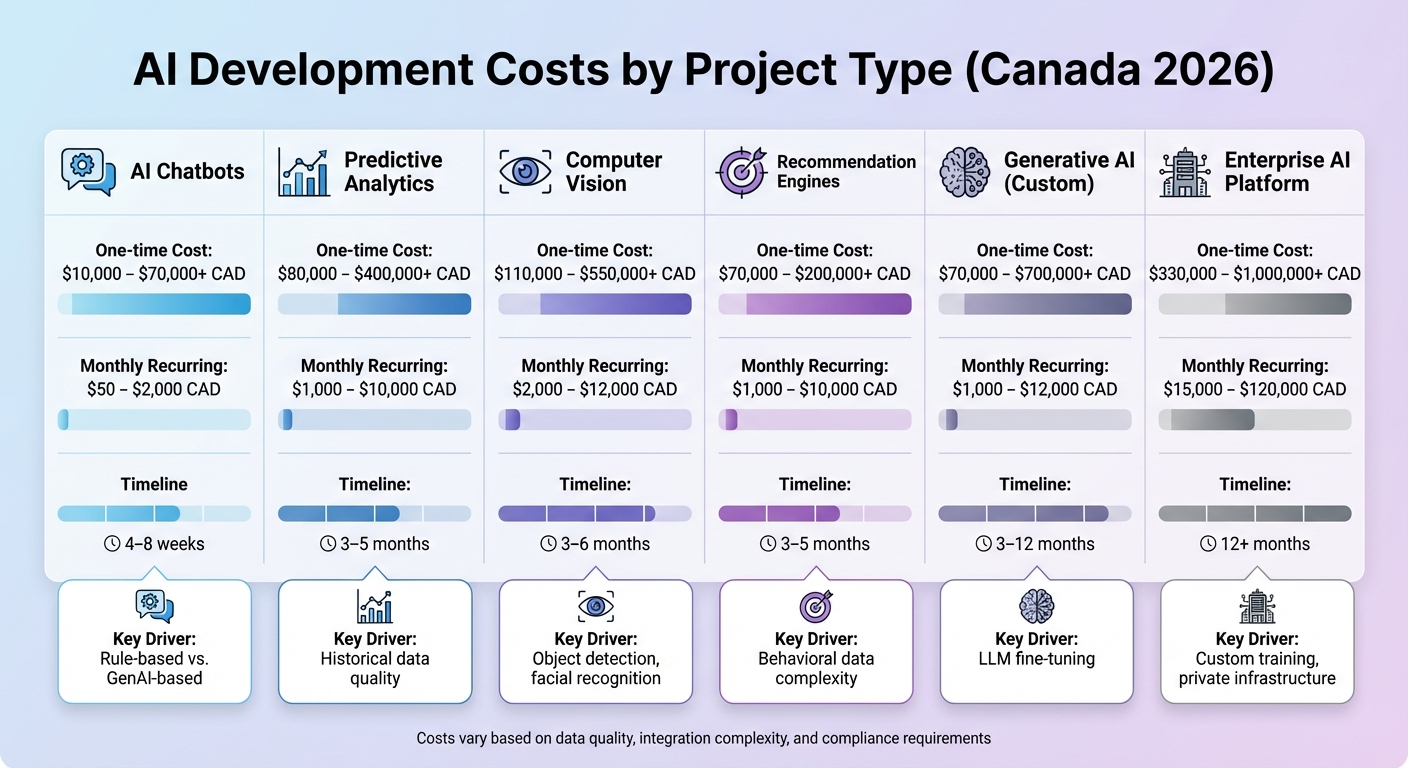
AI Development Cost Breakdown by Project Type 2026
Cost Comparison Across AI Project Types
Understanding the typical costs of AI projects can help you set realistic expectations and avoid budget shocks. Below is a table breaking down AI implementation costs in Canada as of 2026:
| AI Solution Type | One-Time Cost (CAD) | Monthly Recurring (CAD) | Timeline | Key Drivers |
|---|---|---|---|---|
| AI Chatbots | $10,000 – $70,000+ | $50 – $2,000 | 4–8 weeks | Rule-based vs. GenAI-based; integration depth |
| Predictive Analytics | $80,000 – $400,000+ | $1,000 – $10,000 | 3–5 months | Historical data quality and volume |
| Computer Vision | $110,000 – $550,000+ | $2,000 – $12,000 | 3–6 months | Object detection, facial recognition, hardware needs |
| Recommendation Engines | $70,000 – $200,000+ | $1,000 – $10,000 | 3–5 months | Behavioural data complexity |
| Generative AI (Custom) | $70,000 – $700,000+ | $1,000 – $12,000 | 3–12 months | LLM fine-tuning, content generation scale |
| Enterprise AI Platform | $330,000 – $1,000,000+ | $15,000 – $120,000 | 12+ months | Custom training, private infrastructure |
For example, in March 2026, a Toronto-based e-commerce startup automated their customer service FAQs using a hosted API integration with GPT. They spent $20,000 CAD on the initial build and $300 per month for usage. The project was completed in 8 weeks and reduced support tickets by 30%.
This breakdown highlights how costs can vary widely depending on the scope and specific needs of each project.
Why Costs Vary Within the Same Project Type
While the table provides a general cost range, actual expenses can differ significantly based on several factors. One of the biggest variables is data readiness. Poor-quality data can drastically inflate costs due to the need for extensive cleaning and restructuring. As Will Coulter from Databending explains:
If your data is scattered across systems, mislabeled, inconsistent, or trapped in PDFs from 2003, you’re going to spend a fortune just making it usable.
Another key factor is integration complexity. Connecting an AI solution to a sophisticated ERP or CRM system demands far more engineering hours compared to a simpler database integration. Additionally, your choice of model strategy matters. Hosted APIs can lower the initial costs for a minimum viable product (MVP), but custom-trained models require a larger upfront investment to achieve domain-specific accuracy and maintain intellectual property control.
Compliance requirements also add to the overall cost. Industries like healthcare and finance often face a 10%–25% increase due to the need for audit trails, encryption, and model explainability. For instance, Canada’s Bill C-27 mandates risk assessments and transparency. Legal reviews and privacy impact assessments alone can cost between $5,000 and $50,000 CAD.
Lastly, company size plays a role. Larger organizations often incur higher costs due to the complexity of legacy systems, stricter reliability standards, and multi-level approval processes. For industries like healthcare and finance, implementation costs can rise by 25% to 40% due to regulatory and data analysis requirements.
sbb-itb-fd1fcab
How to Manage and Reduce AI Development Costs
Start with a Minimum Viable Product
Jumping straight into a full-scale AI system can be risky and costly. Instead, start small with a Minimum Viable Product (MVP) or a proof of concept. This lets you test your idea without overcommitting resources. By validating your approach early, you can avoid unnecessary expenses and focus on what works.
Creating a lean MVP typically costs between $10,000 and $30,000 CAD and can be completed in four to eight weeks. This initial step is all about testing core functionalities and gauging actual ROI. Once you’ve confirmed the concept, you can expand confidently, armed with real-world data.
Use Existing Tools and Transfer Learning
One of the easiest ways to cut costs is by using pre-trained models and hosted APIs. These tools eliminate the need for expensive custom training and reduce the dependency on specialized hardware.
By incorporating pre-trained models and open datasets, you could save up to 40% during the early stages of development. Before diving into costly fine-tuning, experiment with prompt engineering on off-the-shelf models to see if they meet your needs. This is particularly useful for MVPs, internal testing, or quick validation projects.
Once you’ve minimized costs with these ready-made solutions, you can move forward in structured, manageable steps.
Break Projects into Phases
Breaking your AI project into smaller phases can help you manage costs and focus on what truly matters for your business. A phased approach often includes three key stages: Discovery ($10,000–$30,000 CAD), Scaling ($30,000–$100,000 CAD), and Strategic Integration ($100,000+ CAD).
This method spreads expenses over time and ensures that each phase delivers measurable results. For example, the discovery phase alone – when done right – can prevent up to 25% of total project costs by avoiding costly rework later on. Each phase should have clear goals, like achieving a specific level of model accuracy or usability, before moving to the next step.
Work with an Experienced Development Team
The right team can make or break your AI project. Partnering with skilled AI consultants can save you from costly errors that inexperienced teams might overlook. In fact, 60% of AI projects fail due to avoidable mistakes, many of which seasoned professionals are equipped to handle.
Experienced teams can also help you navigate the tricky balance of falling computing costs and rising talent expenses. They can reduce operational costs by 25–35% through strategies like optimizing inference, selecting the right models, and improving prompt design. Additionally, outsourcing to AI-focused teams with domain-specific expertise can cut development time by 30–40% compared to building an in-house team.
For example, Digital Fractal Technologies Inc offers AI consulting and custom software development. Their approach combines phased implementation with expert guidance, helping businesses achieve scalable, cost-effective solutions tailored to their needs.
Budgeting and ROI Forecasting
AI Development Cost Components
When planning a budget for custom AI, it’s crucial to break it down into specific phases. The discovery and planning phase – which includes requirements analysis, feasibility studies, and project scoping – typically consumes around 10% of the initial budget. Data engineering, covering tasks like data collection, cleaning, labelling, and preprocessing, can account for a significant portion – 30% to 50% of overall costs.
The largest chunk of the budget, about 65%, goes to development and integration. This includes 40% for backend development and 25% for frontend work. Additionally, 5–10% should be set aside for UI/UX design, which involves wireframing and prompt engineering. Testing and quality assurance, a critical phase for ensuring security, reliability, and fairness, typically requires 15% to 25% of your budget.
For Canadian companies, compliance with regulations like Bill C-27 (coming into effect in 2026) adds another layer of cost. Legal reviews for compliance can range from $5,000 to $25,000 CAD, and privacy impact assessments may cost between $10,000 and $50,000 CAD. Properly structuring your data from the start is key to avoiding costly overruns later.
It’s also important to plan for expenses beyond the initial build, especially for long-term system maintenance.
Ongoing Maintenance Costs
AI systems require consistent upkeep; they’re not "set it and forget it" solutions. Over time, models degrade as new data emerges, meaning continuous monitoring and retraining are necessary. Industry standards suggest allocating 15–20% of the initial build cost annually for maintenance.
For Generative AI projects, these costs can be even higher – 15–30% of the initial build cost annually – due to the need for token optimization, prompt library management, and drift detection. Monthly operational costs also vary. A light-use internal tool might cost under $100 CAD per month, whereas high-volume enterprise applications can exceed $5,000 CAD per month. However, applying smart caching and efficient prompt design can lower ongoing operational costs by 25–35%.
Calculating Business ROI
Once you’ve outlined your costs, the next step is to evaluate the return on investment (ROI). AI ROI is typically measured through metrics like revenue growth, cost savings, and efficiency improvements. On average, AI projects deliver a return of 3.5X, with some companies reporting returns as high as 8X.
"Approximately 40% of companies have seen more than a 10% cost decrease across all business units thanks to AI automation." – McKinsey
The timeline for seeing returns depends on the type of project. Simple tools like chatbots or automation systems often generate ROI within 6–12 months, while more advanced Generative AI copilots may take 18–24 months. To keep costs manageable as usage scales, focus on tracking the cost per successful output rather than just API calls. Breaking projects into phases – such as Discovery, Minimum Viable Product (MVP), and Scaling – enables quarterly re-forecasting as adoption rates and model efficiency evolve.
Conclusion
Key Takeaways
When it comes to custom AI development, careful planning and a realistic budget are non-negotiable. Here’s what stands out from our cost analysis:
- Data preparation and annual maintenance are major cost drivers. Data preparation alone can account for 30%–50% of the budget, while annual maintenance, including retraining and updates, typically requires 15%–30%.
- Start small and scale smart. Launching with a Minimum Viable AI (MVAI) and phasing the project helps validate ROI early and keeps costs manageable over time.
- AI is a long-term commitment. Expect ongoing investments for maintenance and updates. For Canadian businesses, compliance with Bill C-27 (effective 2026) adds another cost layer. Embedding compliance measures early can save up to three times the cost compared to retrofitting later.
- Smart infrastructure choices matter. Features like auto-scaling, prompt caching, and token tracking can cut operational costs by 25%–35%.
"Understanding the detailed cost structure of AI development is key to transparent budget management and turning complex projects into predictable business investments rather than a ‘black box’ of costly experiments." – Ilia Kiselevich, CEO & Founder, SolveIt
The rewards are undeniable. On average, AI projects deliver a 3.5X return, with some companies achieving as much as 8X. Simple automation tools can show results in as little as 6–12 months, while more complex systems may take 18–24 months. The secret lies in tying every dollar spent to measurable outcomes – whether it’s saving time, boosting revenue, or cutting costs – so your AI investment becomes a calculated step forward, not a gamble.
Why Partner with Digital Fractal Technologies
Digital Fractal Technologies is your go-to partner for managing AI development costs effectively. Their strategic discovery phase ensures your technical scope aligns with business goals, preventing unnecessary features and focusing on high-ROI elements. They offer flexible engagement models tailored to your needs:
- Fixed-Price for projects requiring cost certainty
- Time & Materials for evolving requirements
- Dedicated Teams for scaling efforts
This tailored approach ensures every dollar you spend is put to work, driving measurable business results and making your AI initiative a success from the ground up.
FAQs
What factors influence the cost of custom AI development?
The price tag for custom AI development can vary widely, and it largely hinges on a few critical factors. These include the size and complexity of your project, the time and resources needed for data preparation – think collecting, labelling, and cleaning data – and the type of AI model architecture you choose. On top of that, you might need to budget for cloud computing resources, hiring specialized AI experts, and ensuring ongoing maintenance to keep the system running smoothly and staying current.
To keep your expenses under control, it’s crucial to have a clear picture of your project’s goals from the outset. Partnering with an experienced provider like Digital Fractal Technologies Inc can make a big difference. They focus on delivering scalable, purpose-built AI solutions tailored specifically to meet your business needs.
How does starting with a Minimum Viable Product (MVP) help control AI development costs?
Starting with a Minimum Viable Product (MVP) lets you zero in on the core features that truly matter, keeping the initial scope of your AI project manageable. By using pre-trained models and testing your solution early, you can sidestep unnecessary costs and refine your approach based on actual user feedback.
This step-by-step method helps control upfront expenses, avoids overcomplicating the development process, and spreads out future maintenance costs. It’s a practical way to stay within budget while ensuring the final product meets your business goals and provides long-term value.
Why does data preparation account for such a large portion of AI development costs?
Data preparation plays a key role in AI development, as the quality of your data directly influences how well your AI model performs. This process includes several stages: collecting, cleaning, labelling, and validating data to ensure it’s accurate, consistent, and aligned with the project’s needs.
Each of these steps demands a great deal of effort, the right tools, and skilled professionals, which can significantly drive up costs. However, putting resources into thorough data preparation is essential. It ensures your AI system produces dependable results and operates as intended, making it a vital part of your development budget.