
API Cache Invalidation Across Distributed Systems

If your API cache runs on more than one node, local delete logic is not enough. I’d use a layered setup: event-driven invalidation to spread changes, versioned keys to stop stale overwrites, and TTL or stale-while-revalidate to limit how long old data can stay in cache.
Here’s the short version:
- Distributed caches fail quietly. A write can succeed on one node while others still serve old data.
- Async invalidation adds risk. Events can be late, dropped, duplicated, or arrive in the wrong order.
- TTL alone does not fix this. If many hot keys expire together, you can flood upstream APIs.
- Versioned keys reduce race problems. Old events cannot replace newer cache state if each version uses a different key.
- Soft expiration helps with traffic spikes. You can serve slightly old data for a short window while a background refresh runs.
- You still need a hard staleness limit. TTL sets the maximum age of cached data if event delivery fails.
A few numbers show why this matters: poor data quality costs companies about $12.9 million per year on average, and about 19% report losing customers because of inaccurate data.
Advanced Caching Strategies: L1/L2 Synchronization with .NET + Redis
sbb-itb-fd1fcab
Quick comparison
| Method | What I use it for | Main upside | Main risk |
|---|---|---|---|
| Event-driven invalidation | Spread updates across nodes | Low read latency, near real-time sync | Messaging failure or delay |
| Versioned cache keys | Stop delete races and stale overwrites | Safer cache correctness | More old keys stay around until expiry |
| Hard TTL | Put a fixed limit on stale data | Simple safety limit | Traffic spikes on expiry |
| Soft expiration | Keep latency low on hot keys | Fewer stampedes | Brief stale responses |
My take: if you need cache invalidation that holds up in production, don’t pick just one control. Use propagation for speed, versioning for correctness, and expiry for backup. Then track hit rate, stale-read rate, invalidation lag, and message failures so you can see when the system starts drifting.
That’s the core of the article below, without the noise.
How distributed cache invalidation breaks down
Distributed cache failures are often silent. Requests still return responses, and at first glance everything seems fine. The trouble shows up later, when a downstream service acts on data that was quietly out of date. If transport fails, invalidation may never reach every cache node.
Stale reads after writes and missed invalidation events
A write succeeding on one node doesn’t mean every other node knows about it right away. In many systems, invalidation moves through async messaging, so events can arrive late or get dropped.
You see this in Saga-based workflows, where isolation is limited. One node can commit a write while other caches keep serving the old value until the invalidation message finally shows up.
Duplicate, out-of-order, and racing updates
As soon as invalidation becomes async, ordering stops being a nice-to-have and starts becoming part of correctness. At-least-once delivery means invalidation has to be idempotent. If it isn’t, duplicate or late events can replay old state.
Out-of-order delivery makes things worse. An older change can arrive after a newer one, and the cache can fall back to stale data until some later update fixes it. Concurrent writes create the same kind of mess: there’s no promise about which write wins, so cache state can drift out of sync.
Cache stampedes after expiry
When the same TTL expires across many nodes at the same time, hot keys can trigger a cache stampede. Put simply, a single TTL by itself won’t save you.
| Failure Mode | Primary Cause | Typical Impact |
|---|---|---|
| Stale read | Lack of isolation in async transactions | Old data served after a successful write |
| Missed invalidation | Dropped or delayed messaging events | Nodes can diverge silently |
| Duplicate event | At-least-once delivery semantics | Inconsistent cache state after repeated processing |
| Out-of-order update | Unsequenced event delivery | A newer value can be replaced by an older one |
| Cache stampede | Aligned TTL expiry across nodes | Sudden burst of upstream requests |
This is why distributed systems need propagation, sequencing, and TTL backstops, not just local delete logic.
Main patterns for keeping cache nodes in sync
No single method fixes distributed cache invalidation by itself. In practice, these patterns work best in layers: one spreads changes across nodes, another cuts down race conditions, and a last safety net helps if an update slips through.
Event-driven invalidation with pub-sub propagation
The idea is pretty simple: when a source-of-truth record changes, the service that owns that data publishes an invalidation event to a shared channel. Each subscriber then drops or refreshes the affected key. You get faster consistency without forcing services to call each other directly.
The pub/sub model decouples publishers and subscribers in time, place, and execution. That separation is a big reason it works well at scale.
Still, propagation alone isn’t enough. Async delivery means invalidation handlers need to be idempotent. If the same event shows up twice, handling it twice should have the same result as handling it once.
Propagation helps keep nodes lined up. Versioned keys help make sure stale deletes don’t win.
Versioned cache keys to avoid delete races
Event-driven invalidation handles propagation. Versioned keys deal with what happens when propagation is delayed or only partly delivered.
Instead of deleting a cache entry and hoping every node gets the message, you put a version, timestamp, or data revision right into the cache key. When the underlying record changes, the new key points to fresh data, and the old key just becomes unreachable, with no delete message needed. That guards against delete races just as much as stale reads. If an invalidation event arrives late, it can’t overwrite a newer cache state when each version lives under its own key.
Asynchronous API changes can happen without coordination between stakeholders, and that lack of synchronisation can lead to system instability or service failures. Versioned keys cut down that coordination burden a lot. The trade-off is simple: you use more storage until TTL or LRU eviction clears out old keys.
Taken together, these two patterns help reduce drift. But TTL still needs to step in when events are missed.
Where custom integration engineering matters
Standard patterns get you most of the way there. But in high-volume, regulated, or mixed-backend setups, you often need tighter control. Digital Fractal Technologies Inc supports custom cache invalidation logic tailored to those integration constraints – that kind of custom logic matters.
Even with pub/sub and versioned keys in place, TTL still needs to catch anything the event path misses.
Safety layers: soft expiration and TTL backstops
Once you have propagation and versioned keys in place, expiry controls define the failure boundary. Think of them as the fallback when invalidation misses an update, especially stale reads caused by missed invalidation events. Networks partition. Brokers restart. Messages get delayed or lost.
Hard TTL versus soft expiration
Hard TTL removes an entry from cache as soon as its time-to-live expires. The next request has to fetch new data. That gives you freshness within a set window, but it also means every expiry can cause a synchronous fetch. Under load, that can lead to cache stampedes.
Soft expiration, also called stale-while-revalidate, keeps serving the cached value for a short period while a background refresh runs. That keeps latency low because the refresh happens outside the critical path.
Which one should you use? It comes down to what the data affects.
Hard TTL makes sense for financials, security, or internal dashboards, where accuracy matters more than a short latency hit. Soft expiration fits product catalogues and high-traffic web applications, where a small staleness window is fine, but a latency spike is not.
Use the expiry mode based on the business cost of stale data, not just the cache setup.
Serving stale data briefly to prevent latency spikes
Soft expiration cuts down cache stampedes by serving the current entry for a short window while the background refresh finishes. The staleness window should come from business tolerance, not cache convenience. For example, a product price may need a tighter window than a product description.
TTL as a recovery path when events fail
TTL should remain in place even if event-driven invalidation is working well. If invalidation fails, TTL still puts a limit on staleness. Set TTL to the longest stale-data window the business can accept.
Here’s how the trade-offs play out:
| Approach | Freshness | Latency on expiry | Best fit |
|---|---|---|---|
| Hard TTL | Guaranteed within the TTL window | High (synchronous fetch) | Financials, security, dashboards |
| Soft expiration | Eventual; may serve stale data briefly | Low (background revalidation) | Product catalogues, high-traffic APIs |
| TTL safety net | Bounded by the TTL window | Depends on the expiry strategy | All systems, as a safety net |
Treat TTL as the last line of defence. It stops stale data from hanging around forever and sets the boundary for the freshness, latency, and upstream load trade-offs covered in the next section.
Choosing the right trade-off and final recommendations
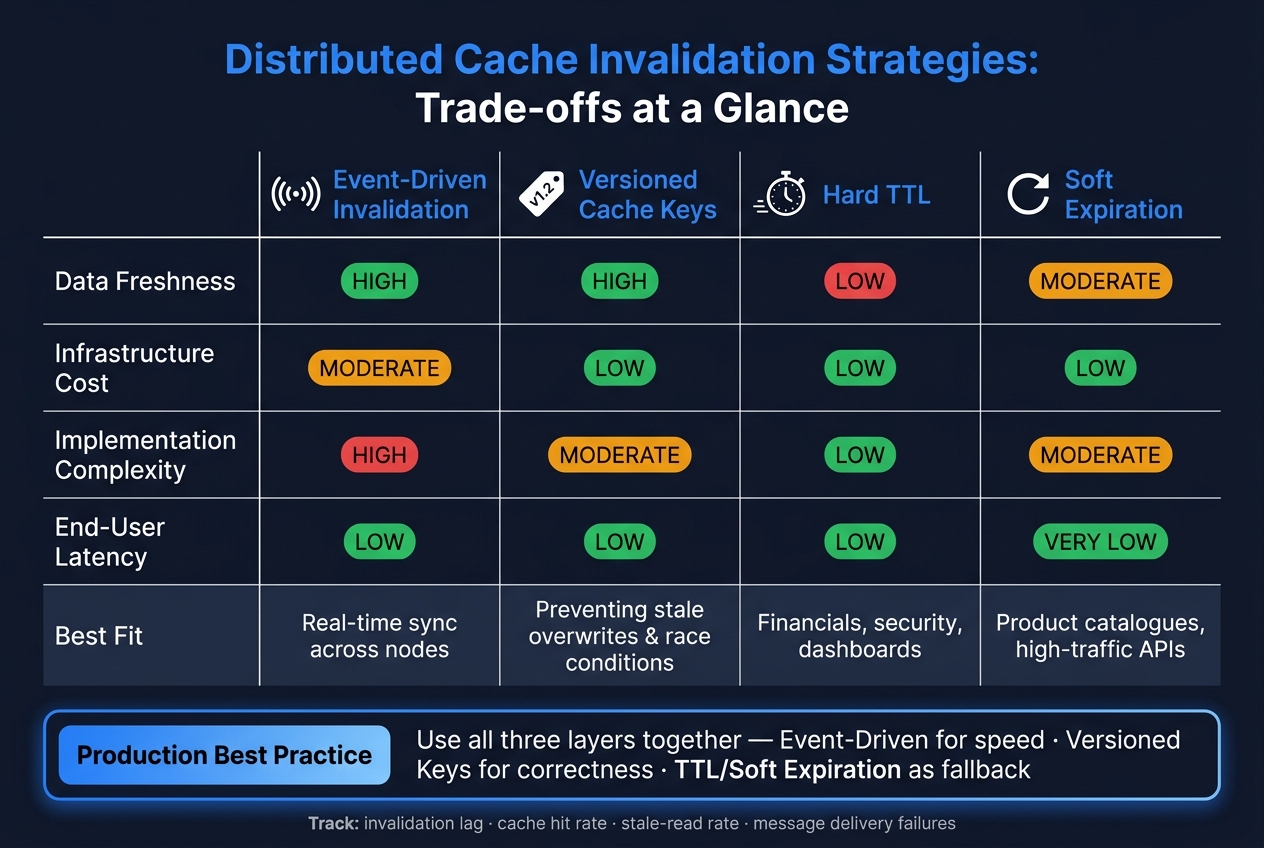
Distributed Cache Invalidation Strategies: Trade-offs at a Glance
Freshness, cost, and latency trade-offs
Once you’ve set up propagation and expiry controls, the next call is pretty simple: how much staleness, latency, and cost can you live with? The best move is usually to pick the lightest option that keeps all three in check.
Use this table to choose the smallest control that still hits your freshness target.
| Strategy | Data Freshness | Infrastructure Cost | Implementation Complexity | End-User Latency |
|---|---|---|---|---|
| Event-Driven Invalidation | High (real-time) | Moderate | High | Low |
| Versioned Cache Keys | High (correctness) | Low | Moderate | Low |
| Hard TTL | Low (stale until expiry) | Low | Low | Low |
| Soft Expiration | Moderate | Low | Moderate | Very low |
There’s a clear pattern here. If you want near real-time freshness, you’ll usually pay for it with more moving parts. If you want to keep things simple and cheap, you’ll have to accept a bit more stale data. That’s the trade-off. No magic trick gets you all four wins at once.
A layered approach for production systems
In production, the setup that tends to hold up best uses all three layers: event-driven invalidation for speed, versioned keys for correctness, and TTL or soft expiration as the fallback. One layer helps cover the gaps left by another.
Think of it like a seatbelt, airbags, and brakes. You don’t rely on just one thing when failure is expensive.
What ties these layers together is observability. If you can’t see what your cache is doing, you’re flying blind. Track:
- invalidation lag
- cache hit rate
- stale-read rate
- message delivery failures in your pub/sub layer
These signals show whether your invalidation flow is doing its job or slowly drifting out of sync.
Conclusion: cut stale data without overloading upstream APIs
At scale, coordination failures aren’t rare. They’re normal. Missed events, race conditions, and out-of-order updates aren’t edge cases; they’re part of life in distributed systems running across many nodes. That’s why one control on its own usually won’t survive real production pressure.
Teams that handle this well treat freshness, latency, and cost like a triangle. Tighten one side, and the other two push back. The aim isn’t to wipe out staleness completely. It’s to keep stale data inside a window your organisation can tolerate, and to make sure more than one control is enforcing that window.
FAQs
How do I choose the right TTL?
Choosing the right time-to-live (TTL) is a balancing act between data freshness, backend latency, and operational cost.
A shorter TTL keeps data more up to date. But it also leads to more backend requests, higher cost, and more latency. A longer TTL can improve performance and cut backend load, but it also increases the chance of stale data.
The best move is to match your TTL settings to your business requirements, then monitor the load that follows so your infrastructure stays cost-effective.
When should I use versioned cache keys?
Use versioned cache keys when data structures change and you need to maintain compatibility for API clients. Put version details in the cache key or the API structure so clients can check compatibility and avoid nasty surprises.
This matters most in distributed systems, where data models can change on different schedules. Versioning also helps with audit trails, access to older data, and rollbacks. On top of that, it cuts down on stale or mismatched cached responses.
How can I detect stale reads early?
Use versioning so data is fetched with a version number, then compare that version with the expected or current state before moving ahead. Optimistic concurrency control helps here too. It checks version consistency at commit time and stops stale transactions before they go through.
In distributed API integrations, watch read lag and latency to spot cases where data is likely stale. And if you need steadier reads, tie them to a specific state instead of relying on a moving “latest” state.