AI Implementation Cost: A Practical Budgeting Guide

Most mid-market AI projects vary widely in build cost, reflecting scope and complexity, with operating expenses increasing accordingly once live. Simpler SaaS-layer integrations have lower initial costs, while enterprise-grade or regulated deployments generally require substantially higher budgets for custom platforms. The single biggest cost driver is not the AI model itself — it is the labor and integration work required to connect AI to your existing systems, which typically represents the majority of total project investment.
The most effective way to reduce budgeting risk before you write a single check: commission an AI readiness audit. It surfaces data gaps, integration blockers, and compliance constraints that, left unaddressed, can significantly increase baseline project costs.
Table of Contents
- What drives AI implementation cost? The five core budget lines
- How much does AI cost? Realistic ranges by project size
- Cloud, on-premise, or hybrid: how your infrastructure choice changes the numbers
- How to measure ROI on AI projects and which KPIs actually matter
- The AI readiness audit checklist that prevents cost overruns
- Practical strategies to control and reduce AI integration cost
- What does an AI project timeline actually look like?
- What to ask vendors and a compact RFP checklist
- Key Takeaways
- The cost conversation most organizations are having too late
- Digitalfractal’s AI Readiness Audit cuts the cost of getting it wrong
- Useful sources
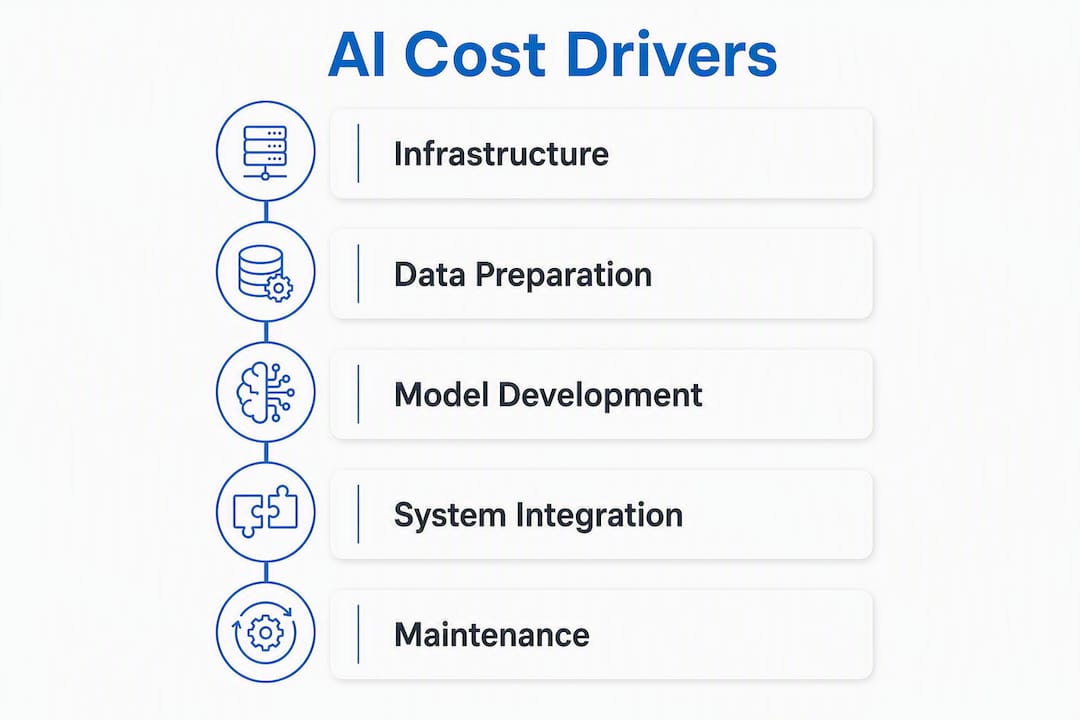
What drives AI implementation cost? The five core budget lines
Understanding where money actually goes is the first step to controlling it. Most organizations budget for the model and forget the plumbing.
1. Infrastructure (compute and storage)
This covers cloud GPU instances, vector databases, object storage, and data transfer. For API-based deployments, costs are variable and tied to request volume. Dedicated GPU servers for on-premise or private cloud deployments carry a fixed monthly cost that can run from a few thousand to tens of thousands of dollars depending on the hardware tier. Common line items: AWS, Azure, or Google Cloud GPU instances; Pinecone or Weaviate for vector storage; S3-compatible object storage for training data.
2. Data acquisition and preparation
Raw data is rarely ready for AI. Cleaning, deduplication, labeling, and structuring data can consume 20–35% of direct project budget, and fragmented or unlabeled data can add 25–60% to baseline cost when discovered mid-project. Line items here include data labeling tools or services, ETL pipelines, and data governance tooling.
3. Model development and tuning
This ranges from calling a third-party API (OpenAI, Anthropic, Google Gemini) with prompt engineering to fine-tuning an open-source model (Llama, Mistral) to training a proprietary model from scratch. API fees constitute a smaller share of total project cost than most buyers expect. Custom training, by contrast, is expensive and usually unnecessary for most business use cases.
4. System integration and engineering effort

Connecting AI outputs to your CRM, ERP, ticketing system, or data warehouse is where budgets most often blow up. Authentication (SSO, OAuth), API endpoint mapping, error handling, and testing across environments all require senior engineering time. Legacy system integration is the primary reason initial estimates get underestimated by 30–60%.
5. Ongoing maintenance and MLOps
Post-launch, you pay for monitoring, retraining, observability tooling, and incident response. Tools like MLflow, Weights & Biases, or managed MLOps platforms add to monthly operating cost. Budget for several weeks of intensive post-launch tuning after any production deployment.
Commonly missed line items:
- Change management can represent 10–20% of total project cost for large rollouts.
- Legal and compliance overhead often adds 30–60% extra in regulated industries (healthcare, finance, energy).
- Post-launch tuning: 4–8 weeks of dedicated engineering time
- Staff training and adoption support: often zero-budgeted, frequently project-critical
Pro Tip: Before scoping any build work, run a data readiness check and map every integration endpoint your AI system will need to touch. Teams that do this before signing a vendor contract consistently avoid the largest category of budget surprises.
How much does AI cost? Realistic ranges by project size
The table below maps project tiers to typical one-time build costs and monthly operating expenses. These figures reflect published benchmarks and mid-market data from production deployments.
| Project Tier | Typical Scope Example | One-Time Build Cost | Monthly Operating Cost |
|---|---|---|---|
| SaaS adoption / micro | Plug-in AI feature via vendor API, minimal config | $2,000 | $200 |
| Small business | Single-workflow automation, off-the-shelf model, light integration | $15,000 to $80,000+ | $1,000 |
| Lower mid-market | Multi-workflow automation, moderate integration, some fine-tuning | $50,000–$150,000 | $5,000 |
| Upper mid-market | Custom model tuning, ERP/CRM integration, MLOps setup | $150,000–$300,000 | — |
| Enterprise | Multi-system integration, custom pipelines, governance layer | $300,000 | $20,000–$50,000 |
| Regulated enterprise | Healthcare, finance, or energy with audit controls, data residency | — | — |
What moves a project from one band to the next is almost always integration depth, not model sophistication. A logistics company automating a single dispatch workflow lands in the small-business tier. Add real-time ERP sync, driver app integration, and a compliance audit trail, and you are in upper mid-market territory before you have written a line of custom model code.
For custom AI development, the build cost is only part of the picture. Post-launch operations often represent 40–60% of the total three-year cost of ownership, with inference and MLOps costs outpacing build costs by Year 3.
Cloud, on-premise, or hybrid: how your infrastructure choice changes the numbers
The hosting model you choose affects not just cost but compliance posture, latency, and how quickly you can scale.

Cloud (API-managed and serverless)
The default starting point for most organizations. You pay per request or per token, with no upfront hardware investment. The risk: at scale, per-request fees compound fast. Model operating costs at volume require you to multiply your per-request rate by projected monthly volume and add a 20–30% buffer for usage spikes. A support bot handling 50,000 tickets per month at $0.002 per request costs $100/month at baseline — but spike traffic and multi-turn conversations can triple that figure without a usage cap in place.
On-premise (private deployment)
Appropriate when data residency requirements, regulatory mandates, or IP sensitivity make cloud hosting untenable. Upfront hardware costs for a capable GPU server (NVIDIA A100 or H100 class) run from $15,000 to $80,000+ depending on configuration, with ongoing maintenance, power, and cooling adding to total cost of ownership. Private deployments also require your team to manage model updates, security patching, and observability tooling — work that managed cloud services handle automatically.
Hybrid
Most enterprises land here: sensitive data and inference stay on-premise or in a private cloud (AWS GovCloud, Azure Government), while non-sensitive workloads and development environments run on standard cloud infrastructure. Hybrid architectures add networking and data-sync complexity, which means more integration engineering hours.
When compliance multiplies cost:
- Data residency requirements (HIPAA, SOC 2, FedRAMP) add audit controls, encryption-at-rest, and access logging
- SSO and role-based access control integration adds 40–80 engineering hours per system
- Private deployments in regulated industries generally incur substantially higher costs than equivalent cloud deployments when considering audit controls, dedicated infrastructure, and compliance documentation.
Practical guidance by scenario:
- Starting out or validating a use case: use managed cloud APIs; keep infrastructure cost minimal
- Scaling a proven use case with moderate data sensitivity: consider reserved cloud instances to reduce per-unit cost by 30–40% versus on-demand pricing
- Regulated industry or IP-sensitive model: budget for private deployment from the start; retrofitting compliance controls post-launch is far more expensive than building them in
For teams managing cloud cost optimization, the biggest lever is often moving from on-demand to reserved or committed-use pricing once usage patterns stabilize.
How to measure ROI on AI projects and which KPIs actually matter
The ROI formula for AI is straightforward. The hard part is choosing the right inputs.
ROI = (Net Benefit / Total Cost) × 100
Where net benefit equals cost savings plus revenue uplift minus total AI spend (build plus operating). Payback period is total build cost divided by monthly net benefit. A $150,000 build that saves $20,000 per month in labor and error-correction pays back in 7–8 months.
Business leaders should track a focused set of 7–8 KPIs rather than every metric the platform exposes. The most useful split is operational metrics that signal system health, and business outcome metrics that justify continued investment.
Operational KPIs (system health):
- Request error rate (target below 2% for production systems)
- Latency (P95 response time; set SLA thresholds before go-live)
- Hardware utilization (GPU/CPU; under-utilization signals over-provisioned infrastructure)
- Cost per successful task (total monthly AI spend divided by tasks completed without error)
Business outcome KPIs:
- Cost per ticket handled (for support automation)
- Revenue uplift per AI-assisted sale (for sales intelligence tools)
- Cycle time reduction (for document processing or logistics routing)
- Adoption rate (percentage of target users actively using the system at 30/60/90 days)
The translation from technical to business metrics is where most teams lose the thread. Cost per token is a cloud billing metric. Cost per ticket handled is what your CFO cares about. Build the bridge between them in your reporting from day one.
Quick breakeven scenarios:
A customer support bot handling 2,000 tickets per month at $8 average labor cost per ticket saves $16,000/month. At a $60,000 build cost, payback is under 4 months. A document extraction system processing 500 contracts per month, replacing 40 hours of manual review at $75/hour, saves $3,000/month — payback on a $30,000 build in 10 months.
Successful AI is measured by concrete business outcomes, not only cost reductions. Tracking AI ROI by industry benchmark helps you set realistic targets before you commit to a build budget.
For a broader perspective on productivity and ROI gains from AI adoption, agency-level AI ROI data shows measurable output improvements that translate directly to the business-outcome KPIs above.
The AI readiness audit checklist that prevents cost overruns
An AI readiness audit is a structured assessment of your data, systems, and governance before any build work begins. It typically takes 2–4 weeks and produces a scoped risk register, integration map, and realistic budget estimate. The payoff: teams that complete one before signing a vendor contract avoid the majority of integration-driven overruns.
What a readiness audit covers:
- Data accessibility and quality (can the AI system reach the data it needs, and is that data clean?)
- System integration mapping (which APIs, endpoints, and authentication flows are required?)
- Governance and compliance constraints (PII flags, data retention policies, regulatory requirements)
- Organizational readiness (who owns the AI system post-launch, and is there a support plan?)
Readiness checklist (answer yes/no for each):
- [ ] Data is accessible via API or queryable database (not locked in PDFs or legacy flat files)
- [ ] Canonical entity IDs exist across systems (customer IDs match between CRM and ERP)
- [ ] SSO or a defined authentication method is available for AI system access
- [ ] API endpoints for target systems are documented and tested
- [ ] Latency SLAs for dependent systems are defined and measurable
- [ ] PII fields are identified and flagged in source data
- [ ] Data retention and deletion policies are documented
- [ ] A named internal owner for the AI system exists
- [ ] Compliance constraints (HIPAA, SOC 2, CCPA) are documented and scoped
- [ ] A rollback plan exists if the AI system underperforms post-launch
Red flags that signal likely budget escalation:
- Data lives in three or more disconnected systems with no master record
- No API access to the primary data source (requires custom extraction work)
- Missing or inconsistent entity IDs across systems (data matching adds weeks of engineering)
- No internal owner identified for post-launch operations
- Compliance requirements discovered after scoping begins
Pro Tip: Scope your pilot at 15–25% of your expected production budget. A pilot that costs $20,000 on a projected $100,000 build is appropriately sized. Pilots quoted at $5,000 for a $200,000 production system are almost always missing the integration and governance work that makes production viable.
A 90-day Digitalfractal AI readiness audit produces a scoped risk register, integration map, and a prioritized automation roadmap. For proprietary outcome data from completed engagements, contact Digitalfractal directly.
Practical strategies to control and reduce AI integration cost
Cost control in AI is mostly an architecture and procurement discipline, not a negotiation exercise.
Architecture tactics:
Start with API-first deployments before committing to custom model development. Most business use cases — document classification, support triage, data extraction — are solved adequately by a well-prompted foundation model via API. Custom training is expensive and usually reserved for cases where proprietary data creates a genuine competitive advantage.
Use retrieval-augmented generation (RAG) instead of full model retraining when you need the model to reference your internal knowledge base. RAG adds a vector database and retrieval layer but avoids the $50,000–$200,000+ cost of a fine-tuning run on a large model.
Batch and cache requests wherever real-time response is not required. Batch processing can reduce inference costs by 40–60% for document-processing workloads. Cache frequent queries to avoid redundant API calls.
Smaller models are often sufficient. A 7B-parameter open-source model running on a modest GPU instance handles many classification and extraction tasks at a fraction of the cost of a frontier model API. Test smaller models first; scale up only when accuracy benchmarks require it.
Operational tactics:
Set usage caps and burst buffers at the infrastructure level before go-live. Without caps, a single runaway process or traffic spike can generate thousands of dollars in unexpected API charges overnight.
Measure cost per successful task from the first week of production. Raw token usage tells you nothing about efficiency; cost per completed, error-free task tells you whether the system is performing at the economics you projected.
Stage your rollout. Deploy to 10–20% of target users first, measure adoption and error rates, then expand. Staged rollouts catch integration failures before they affect the full user base and limit the cost of remediation.
Procurement and vendor tactics:
Scope-based contracts with defined deliverables and acceptance criteria protect you from open-ended time-and-materials billing. Require vendors to break out one-time build, monthly operating, retraining cadence, and licensing as separate line items in every proposal.
Negotiate pilot-to-production pricing triggers upfront. A vendor who quotes a $15,000 pilot should commit to a production pricing structure before you sign the pilot agreement — otherwise the pilot is a loss-leader and the production quote will surprise you.
Insource vs. outsource decision:
Outsource when: you lack internal ML engineering capacity, the use case is not core IP, or you need to move faster than hiring allows. Insource when: the model or data pipeline is a competitive differentiator, you have the engineering team, or long-term operating cost savings justify the investment. Most mid-market organizations outsource the build and gradually insource operations as the system matures.
What does an AI project timeline actually look like?
Budgets are consumed unevenly across phases. Most organizations underestimate how much post-launch operations cost relative to the initial build.
| Phase | Typical Duration | Mid-Market Spend | Enterprise Spend |
|---|---|---|---|
| Discovery and readiness audit | 2–4 weeks | $5,000–$20,000 | $20,000–$60,000 |
| Prototype / proof of concept | 4–8 weeks | $10,000 | $40,000 |
| Pilot (limited production) | 4–8 weeks | $20,000–$60,000 | $60,000–$150,000 |
| Production rollout | 8–16 weeks | $30,000 | $100,000–$300,000 |
| Post-launch tuning (intensive) | 4–8 weeks | $10,000–$30,000 | $30,000–$80,000 |
| Year 1 operating (monthly) | Ongoing | — | $20,000–$50,000/mo |
Discovery and the readiness audit are the highest-leverage phases for cost control. Skipping them to save $10,000–$20,000 upfront routinely adds $50,000–$150,000 in rework costs during production rollout.
Post-launch operations are where the long-term cost story plays out. Build-year costs are front-loaded, but by Year 3, inference compute, MLOps, and retraining often outpace the original build cost. Budget for this explicitly in your three-year financial model.
For AI deployment best practices that reduce post-launch remediation costs, the key is building monitoring and human-in-the-loop review into the production architecture from the start, not as an afterthought.
What to ask vendors and a compact RFP checklist
A vendor proposal that does not answer these questions is incomplete. Require responses to every item before comparing quotes.
Minimum technical questions:
- What data access and format requirements does your solution need?
- What authentication method does your system use, and does it support SSO?
- What are your defined SLAs for uptime, latency, and error rate?
- How does the system scale under 3× and 10× current projected volume?
- What observability and monitoring tooling is included or required?
- What is your retraining cadence, and who triggers it?
- What support tier is included, and what is the escalation path for production incidents?
Commercial questions:
- Break out one-time build, monthly operating, licensing, and compliance costs as separate line items.
- What is the pricing structure if we exceed projected usage by 50%?
- What acceptance criteria define project completion for billing purposes?
- What is the production pricing structure if we proceed from pilot?
Scoring criteria for comparing responses:
| Criterion | What to look for |
|---|---|
| Data readiness support | Does the vendor help assess and prepare your data, or assume it is ready? |
| Integration effort transparency | Are integration hours itemized separately from model development? |
| Total cost of ownership | Does the proposal include Year 2–3 operating cost estimates? |
| Governance and compliance | Are compliance controls scoped and priced, not assumed? |
| Observability included | Is monitoring and alerting part of the build, or a separate line item? |
Common vendor proposal traps:
A PoC quote is not predictive of production cost. Pilots typically represent 15–25% of eventual production cost — a $20,000 PoC does not mean production will cost $80,000. It means you have validated the concept; the real integration, governance, and scaling work is still ahead.
Watch for proposals that omit observability, support, and post-launch tuning. These are not optional line items — they are the difference between a system that works at launch and one that works six months later. Require vendors to price them explicitly.
Comparing bespoke AI development versus ready-made tools is a useful framework for evaluating vendor proposals that mix custom and off-the-shelf components.
Key Takeaways
Realistic AI budgeting requires treating integration and labor as the primary cost driver, not the AI model, and planning explicitly for post-launch operations that often exceed build cost by Year 3.
| Point | Details |
|---|---|
| Integration drives cost | Labor and integration typically represent the majority of total AI project cost — not the model or API fees. |
| Pilot ≠ production budget | Pilots generally cost a fraction of the eventual production budget; a proof-of-concept quote should not be used to forecast full build cost. |
| Post-launch ops compound | Post-launch operations often represent a substantial portion of the total multi-year cost; budget for this before you sign. |
| Hidden costs are predictable | Change management, compliance overhead, and post-launch tuning are known line items — scope them upfront. |
| Digitalfractal reduces risk | A Digitalfractal AI readiness audit surfaces integration blockers and compliance constraints before build costs escalate. |
The cost conversation most organizations are having too late
The pattern I see most often is this: an organization gets a vendor PoC quote, anchors their board budget to it, and then discovers six months into production rollout that the real cost is two to three times higher. The PoC was real. The production system is a different animal.
The reason is almost never the AI model. Foundation models are commoditizing fast, and API costs have dropped significantly over the past two years. The reason is always the same: data that was assumed to be clean and accessible turns out to be fragmented across four systems with no canonical IDs; the ERP does not have a documented API; compliance requirements that were not scoped add six weeks of security engineering; and the internal team that was supposed to own the system post-launch has no bandwidth.
None of these are surprises if you look for them before you start. An AI readiness audit is not a consulting formality. It is the document that tells you whether your $150,000 budget is realistic or whether you are actually looking at $300,000 once the integration work is properly scoped.
The other thing worth saying plainly: operational efficiency is not the same as strategic value. A support bot that cuts ticket volume by 30% is genuinely useful. But the organizations that get the most from AI are the ones that use it to do things they could not do before — not just to do existing things cheaper. That distinction matters for how you set KPIs, how you justify the investment to a board, and how you decide which use cases to prioritize.
Budget conservatively. Audit first. Measure outcomes, not outputs.
Digitalfractal’s AI Readiness Audit cuts the cost of getting it wrong
The biggest financial risk in an AI project is not the technology. It is starting the build before you know what you are building into. Digitalfractal’s AI Readiness Audit delivers a scoped risk register, integration map, and prioritized automation roadmap in 90 days — so your budget reflects what the project actually requires, not what a vendor PoC suggested.
Following the audit, Digitalfractal’s AI integration consulting team handles the full implementation: system integration, MLOps setup, monitored rollout, and post-launch tuning. Every engagement is scoped to your specific systems and compliance requirements, not a generic playbook.
If you are at the stage of building a business case or preparing an RFP, the Digital Transformation Readiness Checker is a practical starting point. For organizations ready to move from assessment to implementation, book a scoping call with Digitalfractal directly.
Useful sources
The cost ranges and KPI guidance in this article draw from the following sources. Use them for vendor validation, deeper modeling, and governance benchmarking.
- AI Implementation Cost vs ROI: Finding the Balance — Harvard Business School Online’s framework for evaluating AI spend against measurable business outcomes
- AI Implementation Cost in 2026: Full Benchmarks — primary source for cost tier ranges, hidden cost categories, and pilot-to-production ratios
- AI Implementation Cost 2026 — $15K to $2M+ by Scope — detailed cost bands by project type and integration complexity
- How Much Does AI Cost? The Complete Guide For 2026 — data readiness cost impact and the common buyer mistake of overweighting API fees
- AI development cost: full budget guide for 2026 — three-year cost-of-ownership modeling and post-launch operating cost benchmarks
- Top AI KPIs that business leaders need to know — TechTarget’s guidance on KPI selection and operational metric shortlists for production AI systems
- AI cost modeling guidance — per-request cost modeling methodology and usage-spike buffer recommendations