
AI Business Case for Boards: A Canada-Ready Guide

Build your AI business case now. Canadian boards that approve a focused 90-day pilot today will have validated ROI data before competitors finish debating the concept. The single action to take this week: commission an AI Readiness Audit to identify your highest-impact automation opportunity and establish the baseline metrics your board needs to approve a pilot budget.
Why the urgency is real:
- Canada’s National AI Strategy targets broad business AI adoption and cites CAD $37 billion in venture capital committed to the ecosystem, yet most SMEs have experimented without formally integrating AI.
- The gap between experimentation and integration is exactly where a focused business case pays off. Many SMEs experiment with generative AI but stop short of formal adoption because they lack a sector-specific, board-ready justification.
- NIST guidance confirms the highest-confidence cases start with a specific, measurable problem, not a broad technology mandate.
Table of Contents
- What does a board-ready AI business case actually require?
- How do you quantify AI benefits beyond a simple ROI calculation?
- What does a realistic AI budget and 90-day pilot timeline look like?
- What governance and Canadian compliance requirements must the business case address?
- How do you build the AI business case step by step?
- What do sector-specific AI business cases look like for Canadian industries?
- Digitalfractal turns your AI business case into a board-ready deliverable
- Key Takeaways
- Why AI business cases are not like traditional IT procurement
- Useful sources and tools for further reading
What does a board-ready AI business case actually require?
Every submission your board reviews should clear this checklist before it reaches the table.
Strategic alignment. The use case must connect to at least one corporate priority: cost reduction, revenue growth, risk mitigation, or regulatory compliance. State which pillar it serves and why AI is the right lever.
Use case definition. Name the specific process, the team affected, what AI will do, and what it will not do. Vague scope is the fastest way to lose a board vote.

Quantified value elements. Cover direct benefits (labor hours recovered, error rates reduced, downtime avoided) and indirect ones (faster decision cycles, improved data quality, reduced insurance exposure). Popular AI use cases in industry show that productivity and preventative intelligence consistently top the list.
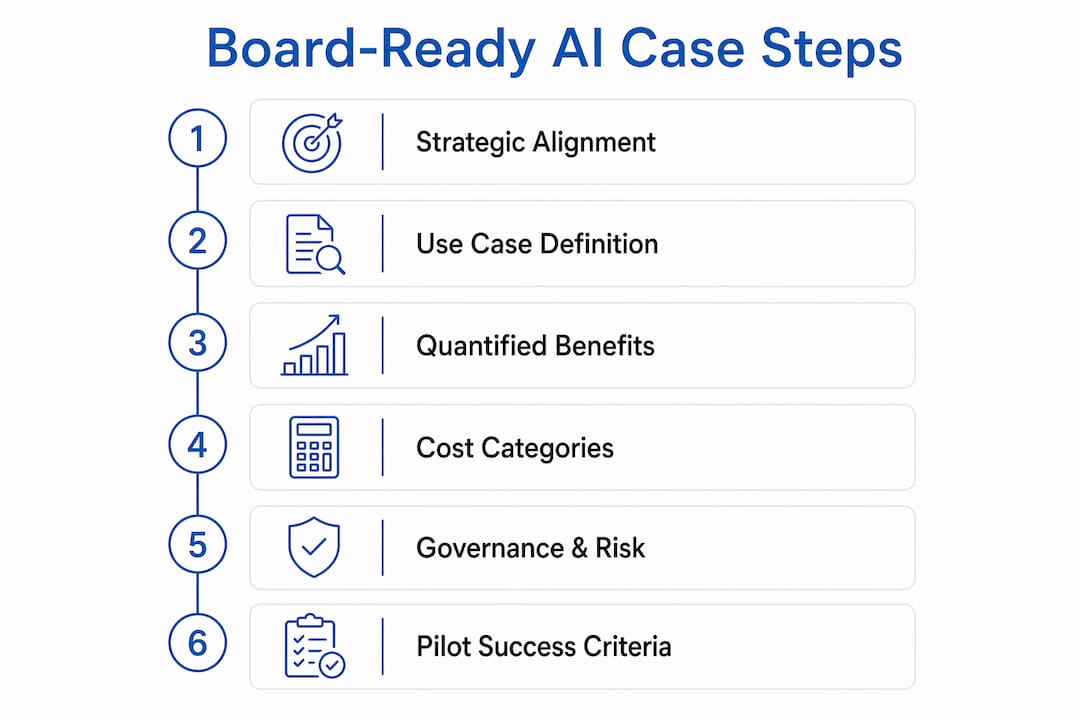
Cost categories. Discovery and data preparation, model development, system integration, licensing and compute, staff training, change management, and ongoing monitoring. Miss any one of these and your budget will be wrong.
Governance and risk controls. Data residency (Canadian servers or contractual equivalents), privacy compliance under PIPEDA and applicable provincial law, vendor security posture, and an ethical oversight mechanism.
Mandatory front-page KPIs. At minimum: time saved per user per week, defect or error rate reduction, and unplanned downtime hours avoided. These three metrics are legible to every board member regardless of technical background.
Pilot success criteria. Define the threshold that triggers scale approval before the pilot starts. A moving target after the fact destroys credibility.
How do you quantify AI benefits beyond a simple ROI calculation?
Single-horizon ROI misleads for AI investments because the value compounds. Strategic advisors recommend mapping returns across strategic pillars and tying them to stages of AI adoption, not a single year-one payback.
Three valuation lenses to present:
- Net Present Value (NPV) across three horizons. Model conservative, expected, and stretch scenarios over years one, two, and three. Year one captures direct labor and error savings. Year two adds cross-functional reuse of the same model or data pipeline. Year three reflects scaling economies as the same infrastructure serves additional use cases.
- Option value. The pilot creates the organizational capability and data infrastructure to launch the next use case faster and cheaper. That optionality has real value even if you never formally price it.
- Compound value across pillars. A predictive maintenance model that reduces downtime also improves safety records, lowers insurance premiums, and strengthens procurement negotiations. Map each secondary benefit to a dollar proxy, even a rough one.
Use the AI Integration Benefits Analyzer to model these scenarios before presenting to the board.
| KPI Type | Example Metric | Why It Matters to the Board |
|---|---|---|
| Leading | Hours of manual data entry eliminated per week | Visible early; confirms adoption |
| Lagging | Defect rate reduction (%) after 90 days | Validates the core value claim |
| Predictive | Unplanned downtime hours avoided per quarter | Directly tied to revenue protection |
| Strategic | LTV uplift from faster customer response | Connects AI to growth, not just cost |
Pro Tip: When hard numbers aren’t available yet, use measurable proxies. If you can’t price downtime directly, use your maintenance team’s fully loaded hourly rate multiplied by average incident duration. Boards accept transparent assumptions far better than missing numbers.
What does a realistic AI budget and 90-day pilot timeline look like?
Cost buckets to include in every submission:
- Discovery and data prep: Process mapping, data audit, gap analysis. Often underestimated; plan for 15–20% of total project cost.
- Model development or customization: Building, fine-tuning, or configuring the AI component for your specific data and process.
- System integration: Connecting the AI layer to your ERP, fleet management system, or operational platform. Legacy system integration is consistently where timelines slip.
- Licensing and compute: Cloud infrastructure, API costs, and any third-party model licensing.
- Staff training and change management: The human side of adoption. Boards routinely underfund this; it should be a named line item.
- Ongoing monitoring and data ops: Model performance degrades over time without labeled data refreshes and drift monitoring. This is the cost most boards miss entirely.
90-day pilot timeline:
- Days 1–15: Finalize use case scope, confirm data availability, assign pilot owner and executive sponsor.
- Days 16–30: Complete data preparation, configure the AI model, establish baseline metrics.
- Days 31–60: Run the pilot in a controlled environment, collect leading KPI data weekly.
- Days 61–75: Analyze results against pre-defined success criteria, document findings.
- Days 76–90: Present board-ready pilot report with scale recommendation and phased budget.
Pro Tip: Budget a dedicated data operations line from day one. Ongoing labeling, validation, and drift correction typically run 10–15% of initial development cost annually. Boards that skip this line discover it painfully in year two.
What governance and Canadian compliance requirements must the business case address?
Primary risks to document:
- Model performance drift over time without a retraining schedule
- Data quality gaps that produce biased or unreliable outputs
- Vendor lock-in where proprietary model formats prevent switching
- Privacy breaches under PIPEDA or Quebec’s Law 25
- Operational failure modes if the AI system goes offline mid-process
Canadian-specific requirements. Data residency is a real procurement constraint for federally regulated industries and public-sector contracts. Confirm whether your vendor stores and processes data on Canadian soil or offers contractual equivalents. Canada’s National AI Strategy explicitly promotes responsible AI adoption aligned with Canadian values, which means ethical oversight is not optional for organizations seeking government contracts or regulated-sector approvals.
The EU’s Apply AI strategy offers a useful governance reference: sectoral flagships, experience centers, and AI-first procurement policies that Canadian boards can adapt as a benchmark.
A practical AI governance framework should include model validation plans, rollback provisions, data contracts with escrow clauses, and a named ethical oversight committee.
Procurement and data residency clauses carry legal weight. Have qualified legal counsel review vendor contracts before signing, particularly for cross-border data flows or regulated-sector deployments.
How do you build the AI business case step by step?
Info-Tech Research Group recommends a storyboard approach that forces early work on assumptions, risk mitigation, and total cost of ownership transparency. Here is the ordered playbook:
- Assign an owner and executive sponsor. No owner, no accountability. The sponsor provides budget authority; the owner delivers the submission.
- Define the use case and affected persona. One sentence: who does what differently, and what does AI replace or augment?
- Map the current process and capture baseline metrics. You cannot claim a benefit you haven’t measured before the pilot.
- List required data and system dependencies. Identify gaps now, not during integration.
- Build the pilot plan. Scope, timeline, success criteria, and a named scale trigger.
- Define the measurement approach. Leading and lagging KPIs, measurement frequency, and the person responsible for each.
- Secure budget and governance sign-off. Present the one-page template below to the board.
One-page business case template fields:
| Field | What to Include |
|---|---|
| Front-page verdict | One sentence: recommended action and expected primary benefit |
| Strategic alignment | Which corporate pillar this serves and why AI is the right approach |
| Benefits summary | Top three quantified benefits with conservative and expected figures |
| Cost summary | Total pilot cost, phased budget, and ongoing ops estimate |
| KPI table | Three leading and two lagging indicators with baseline and target |
| Pilot plan | 90-day milestones and scale trigger criteria |
| Risks and mitigations | Top three risks with named mitigation actions |
| The ask | Budget amount, approval required, and decision deadline |
Use an impact/feasibility matrix to triage candidate use cases: high-impact, high-feasibility wins (predictive maintenance, document processing) belong in the first pilot. High-impact, low-feasibility bets (full autonomous decision-making) belong in a later stage once data infrastructure is proven. For guidance on scaling AI products beyond the pilot, the compound-value framing applies directly.
What do sector-specific AI business cases look like for Canadian industries?
Construction: predictive maintenance for heavy equipment
- Problem: Unplanned equipment failures on remote job sites cost days of downtime, emergency parts logistics, and labor reallocation.
- AI capability: Sensor-fed anomaly detection that flags equipment stress before failure occurs.
- Expected benefits: Reduction in unplanned downtime hours, reallocation of maintenance labor from reactive to scheduled, lower parts costs through planned procurement.
- KPIs: Unplanned downtime hours per quarter, maintenance cost per equipment hour, mean time between failures.
- Pilot checkpoint: After 60 days, compare flagged anomalies against actual failures. A detection rate above your pre-defined threshold triggers scale approval.
NIST guidance specifically recommends predictive maintenance as a high-confidence starting point because the data (sensor logs, maintenance records) typically exists and the success metric (downtime avoided) is unambiguous.
Logistics: preventative intelligence for fleet and route optimization
- Problem: Fuel costs and late deliveries erode margins and damage client relationships.
- AI capability: Real-time route optimization combined with predictive vehicle health monitoring.
- Expected benefits: Fuel cost reduction, improved ETA reliability, fewer emergency roadside repairs.
- KPIs: Fuel cost per kilometer, on-time delivery rate, unplanned vehicle downtime hours.
- Pilot checkpoint: 30-day fuel and ETA data versus pre-pilot baseline.
| Sector | Use Case | Primary KPI | Pilot Duration |
|---|---|---|---|
| Construction | Predictive equipment maintenance | Unplanned downtime hours avoided | 60–90 days |
| Logistics | Fleet health and route optimization | Fuel cost per km, on-time rate | 30–60 days |
| Oil and Gas | Pipeline anomaly detection | Incident response time reduction | 60–90 days |
For logistics-specific implementation detail, AI in distribution covers integration points and measurable KPIs in depth.
Digitalfractal turns your AI business case into a board-ready deliverable
Boards approve pilots when the numbers are credible and the plan is specific. Digitalfractal’s AI Readiness Audit does the diagnostic work that most organizations skip: it maps your current processes, identifies the highest-impact automation opportunities, and produces the baseline metrics your business case requires.
From there, the AI Implementation Planner structures your 90-day pilot path with milestones the board can track, and the Workflow Automation Savings Calculator translates operational inputs into the financial projections your CFO needs to sign off. Every deliverable is designed for a board submission, not a technical audience. Use the Digital Transformation Readiness Checker to assess your organization’s starting point, then book a readiness audit to move from assessment to approved pilot.
Key Takeaways
A board-ready AI business case requires quantified benefits, phased costs, a 90-day pilot plan, and Canadian governance controls documented before the vote.
| Point | Details |
|---|---|
| Build the case now | Canada’s National AI Strategy cites a significant amount of venture capital committed to the AI ecosystem; the adoption gap is closing fast. |
| Go beyond simple ROI | Model NPV across three horizons and include option value and compound cross-pillar benefits. |
| Budget the full cost | Include ongoing data ops and drift monitoring, the line item most boards miss until year two. |
| Anchor to sector KPIs | Construction and logistics pilots succeed when tied to downtime avoided and fuel cost per km. |
| Start with Digitalfractal | The AI Readiness Audit delivers the baseline metrics and pilot plan your board needs to approve. |
Why AI business cases are not like traditional IT procurement
Most boards evaluate AI the same way they evaluate an ERP upgrade: fixed scope, defined deliverable, one-time ROI calculation. That framing is wrong, and it explains why so many AI pilots stall after the first deployment.
AI is not a product you buy and install. It is a capability you build iteratively. The first pilot generates data that makes the second use case cheaper and faster to validate. The governance infrastructure you build for predictive maintenance in construction applies directly to route optimization in logistics. That compounding effect is real, but it only materializes if the board approves a capability-building model rather than a project-by-project procurement cycle.
The practical implication: present your AI business case with a three-stage horizon. Stage one is the pilot, with tight scope and measurable KPIs. Stage two is the scale decision, triggered by pilot data. Stage three is the cross-functional reuse of the same data and model infrastructure across additional use cases. Mario Thomas’s framework and NIST’s operational guidance both point to the same conclusion: the organizations that capture the most value from AI are the ones that treat governance, measurement, and iteration as permanent functions, not one-time project tasks.
Boards that insist on a traditional payback-period calculation before approving a pilot are, in effect, requiring proof before evidence exists. The right ask is a funded pilot with pre-defined success criteria and a named scale trigger. That is how you get the evidence the board says it needs.
Useful sources and tools for further reading
- Canada’s National AI Strategy: AI for All — the primary Canadian government framework for AI adoption priorities and economic context.
- NIST AI Implementation Guidance — practical operational guidance on starting with specific problems, measuring with KPIs, and managing change.
- EU Apply AI Strategy — comparative governance practices including sectoral flagships and AI-first procurement policies.
- Mario Thomas: Building Effective AI Business Cases — compound value framing and multi-horizon return models for boards.
- Info-Tech Research Group: Build Your AI Business Case — storyboard templates, phased cost analysis, and pilot approval criteria.
- Digitalfractal AI Implementation Planner — structured 90-day pilot planning tool.
- Digitalfractal Workflow Automation Savings Calculator — financial projection tool for automation ROI.
- Agentic AI: Pilot to Enterprise Transformation — perspective on scaling autonomous workflows from pilot to enterprise.
- For procurement contracts and data residency clauses, engage qualified legal counsel familiar with Canadian federal and provincial privacy law before signing vendor agreements.