
PIPEDA vs GDPR: What Canadian Compliance Teams Must Know

For most Canadian organizations, PIPEDA governs domestic commercial handling of personal information, while the GDPR applies the moment you process the data of anyone located in the EEA, regardless of where your servers sit. The GDPR’s rules are more prescriptive and paperwork heavy than PIPEDA’s. Run an EU-exposure check on your data inventory today. If you find any, treat the GDPR as directly applicable and start documenting.
- The Office of the Privacy Commissioner of Canada enforces PIPEDA domestically.
- The European Commission’s adequacy decision covers transfers to PIPEDA-regulated organizations, but not full statutory equivalence.
- GDPR Article 33 imposes a 72-hour breach notification clock that PIPEDA does not mirror.
Key Takeaways
GDPR compliance requires documented lawful bases, records of processing, and a tested 72-hour breach response, none of which PIPEDA alone provides.
| Point | Details |
|---|---|
| Scope differs fundamentally | PIPEDA covers Canadian commercial activity; GDPR follows the data subject’s location in the EEA. |
| Breach clocks aren’t equivalent | GDPR requires 72-hour supervisory notice; PIPEDA uses a harm-based threshold with no fixed deadline. |
| Documentation is the real gap | Records of processing, DPIAs, and lawful-basis mapping have no direct PIPEDA equivalent. |
| Provincial law may control first | Quebec’s Law 25 and similar provincial statutes can override PIPEDA for regulated organizations. |
| Technical support closes gaps fast | Digitalfractal helps build the data inventories and breach runbooks that GDPR readiness requires. |
Table of Contents
- PIPEDA vs GDPR: A Side-by-Side Comparison
- What Legal and Operational Differences Actually Force Program Changes
- How Provincial Laws and Bill C-27 Change the Picture
- Your PIPEDA-to-GDPR Compliance Checklist
- If Your Organization Processes EU Residents’ Data
- Where Canadian Privacy Programs Fall Short
- Getting Technical Help With GDPR Implementation
- Where to Read the Primary Sources
- Frequently Asked Questions
- Sources
PIPEDA vs GDPR: A Side-by-Side Comparison
The two regimes share a common ancestor in fair information practices, but they diverge sharply once you look at enforcement mechanics and documentation burden.
| Dimension | PIPEDA | GDPR |
|---|---|---|
| Scope / territorial reach | Private-sector commercial activity across Canada | Any processing of EEA residents’ data, regardless of company location |
| Lawful basis | Consent-centered model | Six lawful bases under Article 6, consent is only one |
| Individual rights | Access, correction, complaint | Access, erasure, portability, objection, restriction |
| Breach reporting | “Real risk of significant harm” trigger | 72-hour notice to supervisory authority (Art. 33) |
| Enforcement / fines | OPC investigations, limited statutory penalties | Fines up to 4% of global turnover |
| Employee data | Generally covered if commercial | Covered as personal data, subject to full rights regime |
| Recordkeeping | Principle-based accountability | Mandatory records of processing (Art. 30) |
| Cross-border transfers | Adequacy decision covers PIPEDA-regulated transfers | Requires SCCs, BCRs, or an adequacy finding |
A few things jump out immediately. GDPR’s breach clock is far tighter than PIPEDA’s harm-based trigger, discussed in more detail below. Its rights regime is also broader on paper, and its enforcement teeth are considerably sharper. If you’re only mapping one row today, make it recordkeeping. It’s the row that quietly drives the most remediation work.
What Legal and Operational Differences Actually Force Program Changes

The gap between these two laws isn’t philosophical. It shows up in specific documents your team either has or doesn’t have yet.
Consent and lawful basis. PIPEDA leans heavily on consent as the mechanism for legitimizing collection and use. The GDPR gives you six lawful bases under Article 6, and consent under GDPR must be freely given, specific, and unbundled from other terms. Practical effect: a PIPEDA-style checkbox buried in your terms of service will not survive GDPR scrutiny.
Documentation and accountability. GDPR requires a formal Article 30 record of processing activities and, for higher-risk processing, a Data Protection Impact Assessment under Article 35. PIPEDA’s accountability principle is real but not documentary in the same way. Canadian organizations get help here through the OPC’s compliance guidance and self-assessment tool, but that tool won’t produce a GDPR-ready ROPA on its own.
Individual rights. The GDPR grants explicit portability and erasure rights that don’t have a clean PIPEDA analog. Building a portability workflow after the fact, under deadline pressure, is where most organizations lose weeks.
Breach reporting. This is the starkest contrast in the whole comparison.
Statistic Callout: GDPR Article 33 requires supervisory notification promptly after becoming aware of a breach, where feasible. PIPEDA instead applies a “real risk of significant harm” standard with no fixed clock. A team built only around PIPEDA’s slower, judgment-based process will miss the GDPR deadline by default, not by exception.
Enforcement and remedies. The OPC investigates and can pursue Federal Court remedies, but its statutory fine authority is narrow. GDPR authorities can levy fines up to 4% of worldwide annual turnover for the most serious violations.
- Consent design needs a GDPR-specific layer if you have EU exposure.
- Records of processing should exist as a living document, not an annual exercise.
- Breach response plans need a 72-hour internal escalation path, tested, not theoretical.
How Provincial Laws and Bill C-27 Change the Picture
PIPEDA doesn’t operate alone inside Canada. Quebec, Alberta, and British Columbia each have private-sector privacy statutes deemed “substantially similar,” which means provincially regulated organizations in those jurisdictions look to the provincial law first, not PIPEDA.
Quebec’s Law 25 already imports several GDPR-like features: mandatory privacy impact assessments for certain projects, expanded consent requirements, and administrative monetary penalties that dwarf anything currently available under PIPEDA. The proposed federal Consumer Privacy Protection Act under Bill C-27 would add comparable enforcement powers and rights federally, though its legislative timeline remains unsettled.
Comparative legal analyses tracking PIPEDA, Quebec’s Law 25, the proposed CPPA, and the GDPR consistently flag one pattern: penalty regimes are converging toward GDPR-style scale, even where rights language still differs.
- If you operate in Quebec, Law 25’s assessment and penalty rules likely control before PIPEDA does.
- Treat Bill C-27 as a planning input now, not a future problem, given the direction it signals for notice and penalty design.
Your PIPEDA-to-GDPR Compliance Checklist
Split your workstream into two tiers: what PIPEDA already requires, and what you only need if GDPR exposure is confirmed.
PIPEDA baseline (do this regardless of EU exposure):
- Confirm a documented privacy governance structure with a named accountable individual.
- Audit consent language against the 10 fair information principles in PIPEDA’s Schedule 1.
- Stand up a breach log with a harm-assessment template, even absent a fixed reporting clock.
- Run the OPC’s self-assessment tool and remediate any gaps it surfaces.
GDPR add-ons (only if EU exposure is confirmed):
- Build a formal Article 30 record of processing activities.
- Draft a DPIA policy defining which projects trigger an assessment.
- Map every processing activity to one of the six Article 6 lawful bases.
- Appoint an EU representative if you have no EU establishment but process EEA residents’ data.
- Build erasure and portability request workflows with response-time targets.
Assign an owner and artifact to each line. For example: owner, privacy lead; artifact, ROPA template; deadline, 90 days from confirmed EU exposure.
Pro Tip: Don’t rebuild from scratch. The OPC self-assessment tool’s outputs on data flows, retention schedules, and third-party disclosures map directly into GDPR’s Article 30 record fields. Repurpose that work instead of duplicating it.
- HR and employee-data programs need particular attention here; see AI-driven HR compliance practices for how documentation obligations extend into personnel files.
- Staff training on consent handling and breach roles closes the gap between policy and practice, covered in this AI training guide for Canadian businesses.
If Your Organization Processes EU Residents’ Data
Finding EU exposure in a data inventory changes your priorities immediately. The first move is containment, not paperwork: restrict transfers you can’t yet justify under a lawful basis, and inventory exactly which systems touch EEA-resident data.
- Identify every system, vendor, and data flow touching EEA-resident personal data.
- Apply Standard Contractual Clauses to any transfer outside a recognized adequacy framework.
- Update processor contracts with Article 28 clauses covering subprocessing, deletion, and audit rights.
- Run a DPIA if the processing involves large-scale monitoring, sensitive categories, or automated decision-making.
- Build the 72-hour breach escalation chain, tested end-to-end, with evidence logging built in.
- Within 30 days: complete the exposure inventory and lawful-basis mapping.
- Within 60 days: finalize processor contract amendments and SCC execution.
- Within 90 days: complete DPIA policy, ROPA draft, and portability/erasure workflow design.
Technical implementation of these controls, especially data inventories and deletion workflows for AI-driven systems, is covered in this GDPR compliance guide for image recognition systems.
Where Canadian Privacy Programs Fall Short
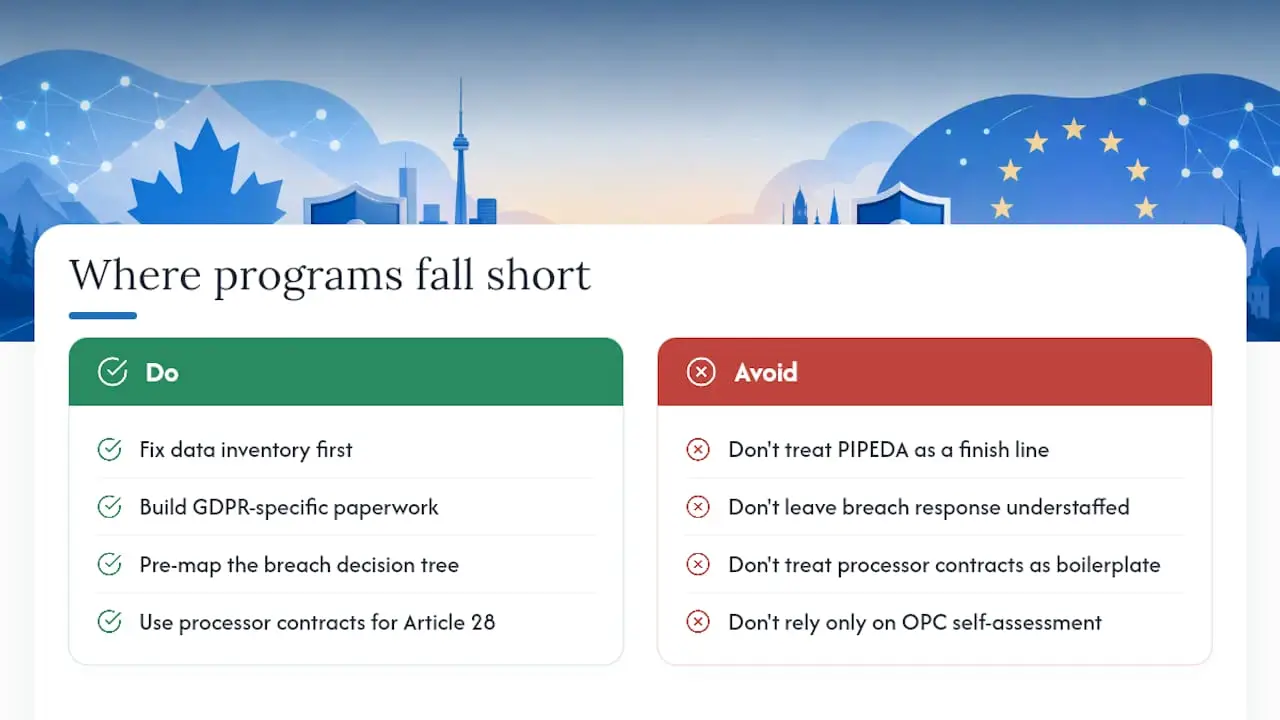
The most common mistake is treating PIPEDA compliance as a finish line rather than a floor. Teams pass an OPC self-assessment, feel confident, and never build the GDPR-specific paperwork that a single EEA customer or employee can trigger.
Understaffed breach response is the second blind spot. Legal reviews of the applicable regime take longer than 72 hours if nobody has pre-mapped the decision tree. Third, processor contracts get treated as boilerplate rather than as the place where Article 28 obligations actually live or die.
Fix the data inventory first. Everything else, DPIAs, lawful-basis mapping, breach timing, depends on knowing exactly where EU-resident data sits.
Getting Technical Help With GDPR Implementation
Building the technical side of GDPR readiness, data inventories, DPIA documentation, breach response runbooks, and automated deletion workflows, is a different skill set than the legal mapping itself, and most in-house privacy teams don’t have engineering bandwidth to spare on it.

Digitalfractal works with Canadian organizations to translate privacy requirements into working systems: automated data discovery, AI governance controls, and technical runbooks that turn a 72-hour breach policy into something your team can actually execute under pressure. This is optional support, not a replacement for legal counsel or your in-house compliance program; plenty of teams will implement the checklist above on their own. If you want a clearer picture of where your systems create GDPR exposure, start with Digitalfractal’s AI Audit & Opportunity Assessment to identify the gaps worth fixing first.
Where to Read the Primary Sources
- OPC’s PIPEDA overview and its self-assessment tool for baseline compliance benchmarking.
- GDPR Articles 6, 30, and 33 to 35 for lawful bases, recordkeeping, breach notice, and DPIA triggers.
- IAPP’s PIPEDA/GDPR matchup and the DataGuidance comparative analysis for deeper legal comparison.
- Dentons’ analysis of Canada’s adequacy status under the GDPR.
Frequently Asked Questions
Is PIPEDA equivalent to the GDPR?
No. PIPEDA is a narrower, consent-focused framework for Canadian commercial activity, while the GDPR is a more prescriptive regime covering anyone processing EEA residents’ data, wherever that organization is based.
Does PIPEDA compliance automatically satisfy GDPR requirements?
No. GDPR requires additional documentation, including records of processing, DPIAs where triggered, and lawful-basis mapping, that PIPEDA does not expressly mandate.
How is PIPEDA different from the CCPA?
PIPEDA and the CCPA (California’s consumer privacy law) both grant individual rights over personal information, but the CCPA applies based on revenue and data-volume thresholds for businesses serving California residents, while PIPEDA applies to commercial activity across Canada regardless of company size.
Do Canadian organizations need a Data Protection Officer under PIPEDA?
PIPEDA does not require a formal DPO role, though it requires a designated accountable individual. GDPR requires a DPO for organizations meeting specific processing-scale or sensitive-data criteria.
What happens if a Canadian company has EU customers but doesn’t comply with the GDPR?
The company remains subject to GDPR enforcement for that processing, including potential fines up to 4% of worldwide turnover, regardless of its PIPEDA compliance status.
This article is general information, not a substitute for advice from a qualified lawyer. Consult a qualified legal professional about your own circumstances before acting on anything here.
Sources
- PIPEDA requirements in brief – Office of the Privacy Commissioner of Canada
- PIPEDA compliance help – Office of the Privacy Commissioner of Canada
- GDPR matchup: Canada’s Personal Information Protection and Electronic Documents Act | IAPP
- GDPR v. PIPEDA – DataGuidance
- Canada’s PIPEDA remains adequate under the GDPR — what it means for business | Dentons