AI in Farming Robots: Key Innovations

If I had to sum it up in one line: AI farm robots work best today as labour support tools, not stand-alone replacements.
From the research covered here, I’d take away three plain points:
- Start with one narrow job like transplanting, crop-stress scouting, weeding, or spot spraying.
- Expect gains only when software, data, and staff oversight are in place.
- Plan for field limits such as GNSS dropouts, weather delays, power limits, and compliance checks in Canada.
A few numbers make that clear fast:
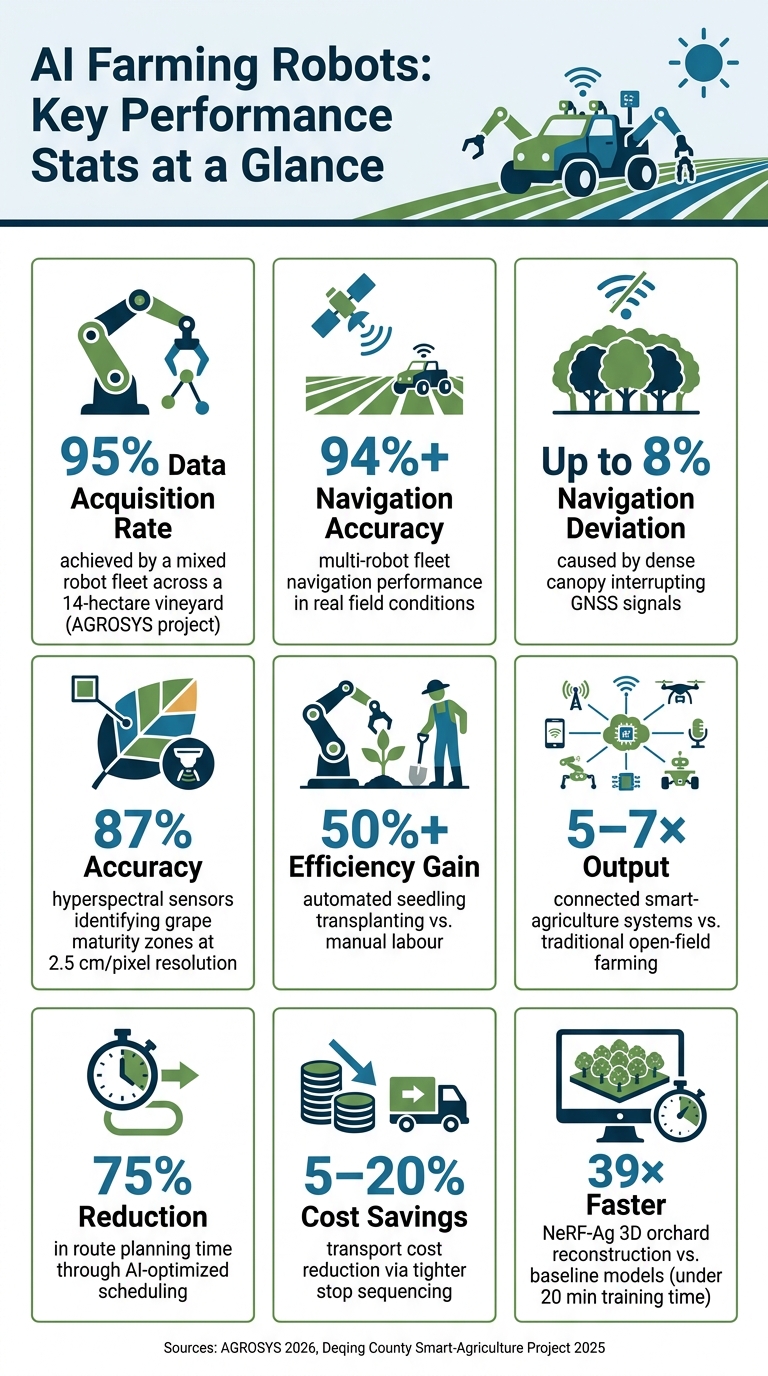
- A mixed robot fleet in a 14-hectare vineyard reached a 95% data acquisition rate and more than 94% navigation accuracy.
- Dense canopy could still push navigation off by up to 8%.
- Hyperspectral mapping identified grape maturity zones with 87% accuracy at 2.5 cm per pixel.
- Automated transplanting lifted output by more than 50%.
- Connected growing systems reached 5 to 7 times the output of open-field methods.
- Route planning time fell by up to 75%, with transport cost cuts of 5% to 20%.
So what’s the main point for a Canadian farm in August 18, 2026 terms? Buy for one repeatable use case first, keep people in the loop, and make sure your farm software can handle the data before you spend more.
What drives results is fairly simple:
- Vision and sensors help robots read crops, rows, stress, and obstacles.
- Planning tools help machines move around fields, workers, and other equipment.
- Software links turn field data into tasks, alerts, and schedules your team can use.
I’d read the article as a guide to where farm robots are already helping: harvesting support, transplanting, scouting, spraying, and weeding – and where they still need close human checks.
AI Farming Robots: Key Performance Stats & Adoption Metrics
Core AI Technologies in Modern Farming Robots
Computer Vision, Sensing, and Field Perception
Modern farm robots combine RTK-GPS, LiDAR, RGB-D cameras, IMUs, and spectral sensors to keep track of what’s happening in the field in real time. That mix matters because dense canopy can interrupt GNSS. When that happens, a robot can’t rely on one signal alone, so sensor fusion becomes a must.
SLAM algorithms such as Gmapping and AMCL, running on ROS-based architectures, help robots keep moving when GNSS gets weak. In dense canopy environments, signal loss can cause navigation deviations of up to 8% from planned trajectories. That’s a big enough drift to throw off field work, which is why pairing LiDAR with IMU data helps keep machines on course and work moving.
Processed NDVI, NDRE, and hyperspectral imagery can classify crop condition and maturity with high accuracy. In plain terms, that gives workers faster and more dependable information for day-to-day decisions in the field.
Once a robot can read the field well, the next job is movement: where to go, what to avoid, and how to work near people without causing problems.
Planning, Coordination, and Shared Autonomy
Current systems use global route planning and local obstacle avoidance to move around workers and equipment safely. That sounds simple on paper, but it gets harder when farms run mixed fleets of UAVs and UGVs at the same time.
To make that work, farms need a shared communication layer. It keeps vehicles from getting in each other’s way and cuts some of the load on workers during multi-machine operations. Otherwise, you end up with machines acting like drivers at a four-way stop, each waiting or moving at the wrong time.
Shared autonomy still needs human oversight when communications fail or when obstacles show up without warning.
That kind of coordination only works if robot decisions connect back to the farm’s own software and task systems.
Software Integration and Orchestration
The final layer is software integration. This is the part that turns robot output into farm action. Farm Management Information Systems (FMIS) and integration layers convert sensor data into tasks and alerts, while supporting centralized monitoring to help avoid downtime.
A 2025 smart-agriculture project in Deqing County, Zhejiang Province, shows what connected systems can do. By linking automated seedling transplanting, IoT environmental monitoring, and AI-driven scheduling, the project increased productivity to five to seven times that of traditional open-field farming. It also helped crops like arugula move from sowing to harvest in under one month.
For farms, the main issue is plugging robot data into existing management systems without adding friction to daily operations.
sbb-itb-fd1fcab
Where AI Farming Robots Are Delivering Measurable Results
Harvesting and Crop Handling Support
The clearest gains show up when robots take on repetitive, time-sensitive jobs.
At the Zhejiang Smart-Agriculture Demonstration Park in Deqing County, China, automated seedling transplanting systems finished batches in under one minute. That pushed transplanting efficiency up by more than 50% compared with manual labour.
You see the same trend in perennial crops, where fast 3D updates help growers make better pruning and harvest calls. NeRF-Ag delivers high-precision orchard 3D reconstruction in under 20 minutes of training time – 39 times faster than baseline models. In practice, that means growers can refresh orchard models more often instead of working from older field data.
Precision Weeding, Spraying, and Crop Protection
AI scouting helps robots treat ONLY the parts of a field that need attention, rather than spraying or treating everything. That cuts input waste and lowers operating cost.
For that to work, though, the robots need dependable sensing in the field. That’s where multi-robot scouting starts to pay off.
Scouting, Monitoring, and Multi-Robot Field Support
In a 14-hectare vineyard, the fleet produced season-long scouting data that helped guide irrigation and harvest decisions. The 2026 AGROSYS project tested a mixed fleet – including the Thorvald and Husky A-200 UGVs, along with DJI and Parrot UAVs – across a full growing season.
The system picked up water stress early through thermal imagery. At the same time, hyperspectral sensors identified grape maturity zones with 87% accuracy at a 2.5 cm per pixel mapping resolution.
That kind of steady field data makes multi-robot scouting much more usable for day-to-day farm decisions. At this point, the big issue isn’t sensing by itself. It’s whether the full system can keep working well under actual field conditions.
Benefits, Constraints, and Adoption Risks
Productivity, Labour, and Sustainability Gains
The real test isn’t whether these systems can work in a trial. It’s whether the upside is worth the day-to-day trade-offs.
Recent studies point to clear productivity gains. Automated transplanting boosts efficiency by more than 50%, and controlled systems can deliver 5 to 7 times the output of open-field workflows.
The labour impact goes past raw output. Automation cuts dependence on seasonal workers for repetitive planting and harvesting, while staff move into supervision and exception handling roles. That shift can ease pressure during peak periods, but it also changes what farms need from their teams.
There are input and cost gains too. Precision water and nutrient application reduces input use and lowers exposure to pesticides and heavy metals. Route planning time falls by up to 75%, and transport costs drop by 5% to 20% through tighter stop sequencing.
Power supply still shapes how much of that upside farms can bank on. Solar-powered fleets can run for long stretches in sunny conditions, but cloud cover makes performance less dependable.
Those gains matter most when farms can handle the technical and compliance issues that come with them.
Technical, Human, and Regulatory Barriers
The same systems that lift output can also bring field, data, and compliance problems.
In the field, conditions can throw off performance fast. Dense canopies weaken GNSS and can push navigation off by up to 8%. Wind shrinks UAV flight windows, and long periods of cloud cover reduce solar charging.
Data quality is another weak spot. If the data is poor or incomplete, model performance slips over time. That can turn a system that looked sharp at launch into one that misses the mark a few months later.
In Canada, deployment also has a legal side. Teams need to line up with PIPEDA, data-residency rules, and worker-tracking requirements under employment and collective agreements.
Integration is often where plans slow down. Linking these systems with ERP, TMS, and fleet telematics remains a common bottleneck, which is why phased rollouts by field section or route cluster can help cut risk.
AI-Powered Farming Robots That Work 24/7 | FULL DOCUMENTARY
Conclusion: What Recent Research Suggests for Canadian Adoption
Taken together, the research points to a simple pattern: start small, keep people involved, and scale only when field conditions stay steady.
Recent research shows AI farming robots do best in narrow, repeatable jobs with human oversight. In Canada, the bar is a bit higher. Dense canopy, weather, and weak connectivity can put pressure on navigation and connectivity, which is why fallback modes and safety redundancy matter.
For Canadian operations, that leaves three practical checks before any purchase or rollout.
Key Takeaways for Decision-Makers
Start with one proven workflow, such as transplanting or stress scouting. Put the focus on tasks where robots support workers directly and where human-in-the-loop oversight is easy to maintain.
Treat software fit as a deployment requirement, not an afterthought. Adoption depends on the operating base under the hardware. Audit your data setup and confirm ERP or fleet-telematics integration before committing to hardware.
Pilot one field or crop first, then scale after data, compliance, and integration checks pass. Build the rollout around the article’s software and orchestration thread: clean data, verified PIPEDA compliance, and confirmed system connectivity before expanding scope.
FAQs
What farm job should I automate first?
Start with an AI readiness audit. The goal is simple: map your current processes and spot the tasks that eat up time without asking for much judgment.
A good place to look is high-volume, repetitive, rule-based work. These are the jobs that tend to slow teams down and create friction day after day.
Good first candidates include:
- seedling transplanting
- inventory tracking
- routine data entry
Focus first on the jobs that create bottlenecks. That way, you’re not just adding AI for the sake of it – you’re clearing space for your team to spend more time on high-value work that needs human thinking.
How much staff oversight do AI farm robots need?
AI-driven farming robots cut manual labour by taking over repetitive jobs like seedling transplanting, crop handling, and environmental monitoring. They’re designed to work with little day-to-day supervision, using autonomous machinery and centralised, data-driven controls.
That said, human oversight still matters. People are needed when unusual situations come up and to keep things running well, especially when equipment breaks down or growing schedules change.
What should a Canadian farm check before buying one?
Before buying an AI-driven farming robot, Canadian operators need to look at their day-to-day needs first. The main goal is simple: figure out where automation can save time, cut manual work, or help the operation run more smoothly.
They should also make sure the system follows federal and provincial rules, including PIPEDA. On top of that, it should support Canadian standards like metric measurements, CAD currency formatting, local date conventions, bilingual functionality, accessibility, and occupational health and safety requirements.