
AI Lead Scoring in Canada: Get Data Ready Before the CRM Pilot

AI lead scoring is a machine learning model that gives each prospect a conversion probability, typically on a 0–100 scale, so your reps work the most promising leads first and spend less time on dead ends. It pays off when you have enough labeled history of won and lost leads for the model to learn from, and when your team will actually act on the ranking.
TL;DR:
- A reliable model needs at least 40 qualified and 40 disqualified leads, with consistent outcome labels, or imbalance and messy history can bias predictions.
- Combine fit, engagement, intent, and product usage signals, refresh enrichment weekly, and show reps the top two or three reason codes behind each score.
- Pilot one region, product line, or lead source, then compare routing based on scores with current practice on conversion and response time before expanding.
- Track conversion lift, routing response time, AUC, precision, recall, and calibration; retrain or roll back when lift fades, calibration drifts, or reps lose trust.
- For Canadian deployments, document legal authority and model versions, explain automated decisions, offer review or correction, and retain human oversight for high impact decisions.
Table of Contents
- What is AI lead scoring, and how is it different from rule-based scoring?
- Why do sales and marketing teams adopt AI lead scoring?
- How does AI lead scoring work: models, signals and reason codes?
- What data do you need before building a model?
- How do you pilot and operationalize AI lead scoring?
- What privacy and governance rules apply to AI lead scoring in Canada?
- How do you measure performance and keep improving?
- Why should scoring sit inside an AI readiness roadmap?
- How can an AI Readiness Audit prepare you for AI lead scoring?
- FAQ
- Sources
What is AI lead scoring, and how is it different from rule-based scoring?
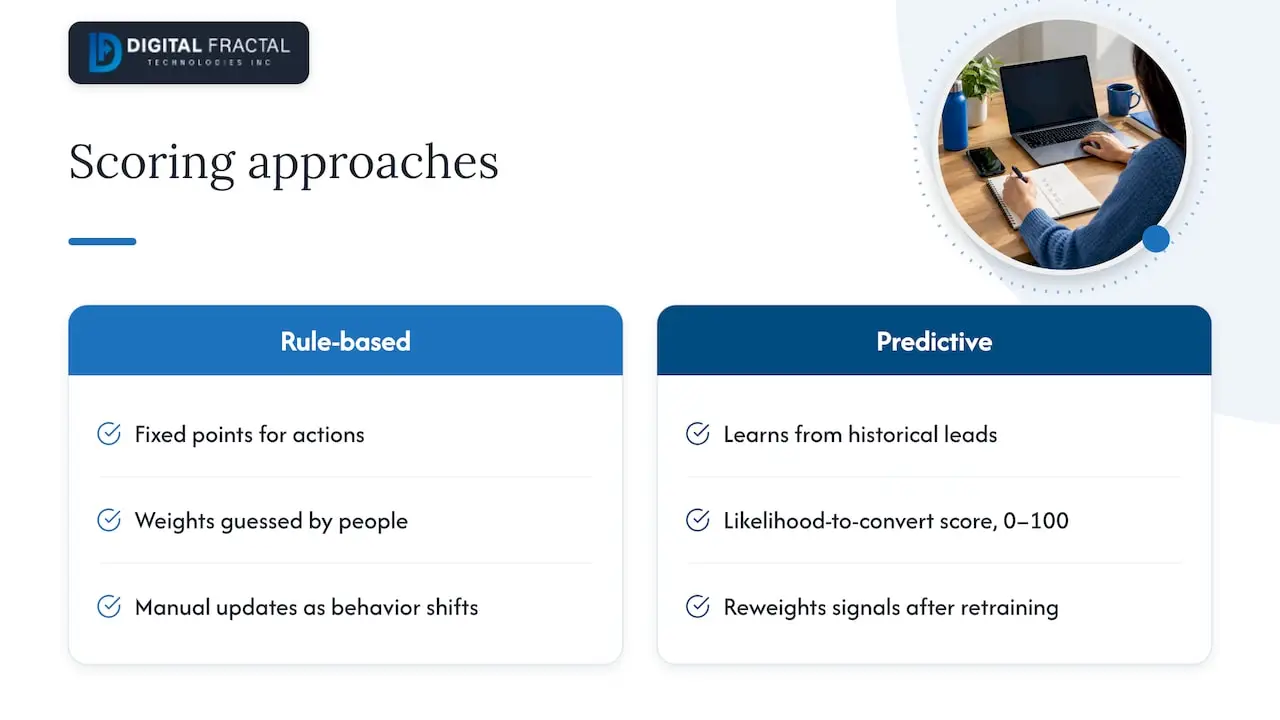
Rule-based scoring assigns fixed points for actions such as a pricing page visit or webinar signup, and may subtract points for a student email domain. Someone has to guess those weights, and someone has to keep revisiting them as buyer behavior shifts. Predictive scoring flips that. The model studies historical leads, firmographics, past interactions and conversion outcomes, then calculates a likelihood-to-convert score on a 0–100 scale.
Keep score and grade apart. The score estimates how likely a lead is to convert. A grade describes fit, such as company size or industry, and you can use both together.
Here is how reweighting works in practice. Say demo requests from mid-sized logistics firms start closing far more often than your rules assumed. After retraining, the model raises those signals on its own, while a rulebook stays frozen until someone edits it. That is the practical maintenance gap.
Why do sales and marketing teams adopt AI lead scoring?
Teams adopt it because it moves lead management from gut feel to evidence-based prioritization. The gains show up in a few places:
- Faster qualification: reps see a ranked queue instead of sorting a raw list.
- Higher conversion rates: effort goes to leads with the strongest buying signals.
- Better rep productivity: less time on unlikely prospects.
- More accurate routing: high scorers reach the right team quickly.
The strongest use cases are inbound lead qualification, routing to the right team or territory, account prioritization for account-based marketing, and scoring product-led users who show buying behavior inside a free tier or trial.
Early ROI signals are practical ones: shorter time to first contact, a rising share of high-score leads that become opportunities, and reps who trust the queue enough to work it in order. Scores also pair well with follow-up. Lead nurturing strategies can suit mid-score leads who are not ready for a call yet.
How does AI lead scoring work: models, signals and reason codes?
Under the hood, teams usually choose among gradient boosting (such as XGBoost), random forests and logistic regression. Academic comparisons find that gradient boosting often outperforms simpler methods like logistic regression on B2B data, because it handles complex, non-linear relationships. Logistic regression still earns its place when you need a simple, easily audited baseline.
The model learns from four families of signals:
- Firmographics: industry, company size, region, role.
- Behavioral engagement: email clicks, page visits, demo requests.
- Intent data: third-party research activity around your category.
- Product usage: trial activity, feature adoption, seat growth.
Combine fit and intent signals. A perfect-fit company that never engages is not a hot lead, and an eager visitor at a tiny, mismatched firm may not be either. Data quality matters just as much: weekly enrichment refreshes are recommended because stale records make any score unreliable.
Reason codes make the score usable. A high score means little to a rep on its own, but a reason code explaining pricing-page visits, a senior title and similarity to recent wins tells them what to say. Show the top two or three drivers right on the lead record. For a deeper look, see our AI agent explainability guide.
What data do you need before building a model?
Start with volume and balance. A reliable predictive model generally needs at least 40 qualified and 40 disqualified leads within your chosen training window. The model has to see both outcomes, because a pile of only wins teaches it nothing about what failure looks like.
Standardize labels before training. Decide exactly what counts as qualified and disqualified, apply it consistently across reps, and align it with your CRM’s business process flow. Practitioners report that failed projects usually trace back to inconsistent labeling, unclean history and class imbalance that biases models toward the majority outcome.
Then clean the foundation:
- Deduplicate contacts and accounts.
- Fix or retire stale contacts.
- Confirm the fields that matter most: source, role, company attributes, engagement history and outcome.
- Set a recurring enrichment cadence.
Pro Tip: Refresh enrichment on a fixed schedule, ideally weekly for active pipelines, so the model never scores leads from outdated job titles or company data.
How do you pilot and operationalize AI lead scoring?
Treat the first rollout as a pilot, not a company-wide switch:
- Pick a pilot segment. Choose one region, product line or lead source, and define success metrics and a timeframe up front.
- Map CRM fields and event sources. Confirm where outcomes, engagement events and firmographic fields live, and fix gaps before training.
- Train, validate and review reason codes. Check that the drivers make business sense to your sales leads, not just statistically.
- Integrate scores into routing and workflows. Set an SLA for rep response to high-score leads, and automate the handoff. Our workflow automation work covers this step.
- A/B test routing and measure lift. Compare score-driven routing against your current process on conversion and response time.
To operationalize, assign a named owner, set a retraining cadence, build a dashboard everyone can see, and train reps on how to read scores and reason codes. A feedback loop matters too, since real-time user feedback can sharpen retraining.
What privacy and governance rules apply to AI lead scoring in Canada?
Lead scoring uses personal information, so privacy-by-design is the baseline. The Office of the Privacy Commissioner of Canada recommends applying privacy by design, being open about AI limitations, and letting people query or challenge automated decisions that affect them.
Under PIPEDA guidance, organizations should document the legal authority for using personal information in models, be transparent about automated decision-making, and provide mechanisms for review or correction. Consider an algorithmic impact assessment when the use is sensitive.
Practical controls are straightforward:
- Keep human review for high-impact decisions.
- Record which data trained which model version.
- Log score changes so you can explain them later.
Our PIPEDA checklist for AI and our guide to AI audit trail systems go deeper.
How do you measure performance and keep improving?
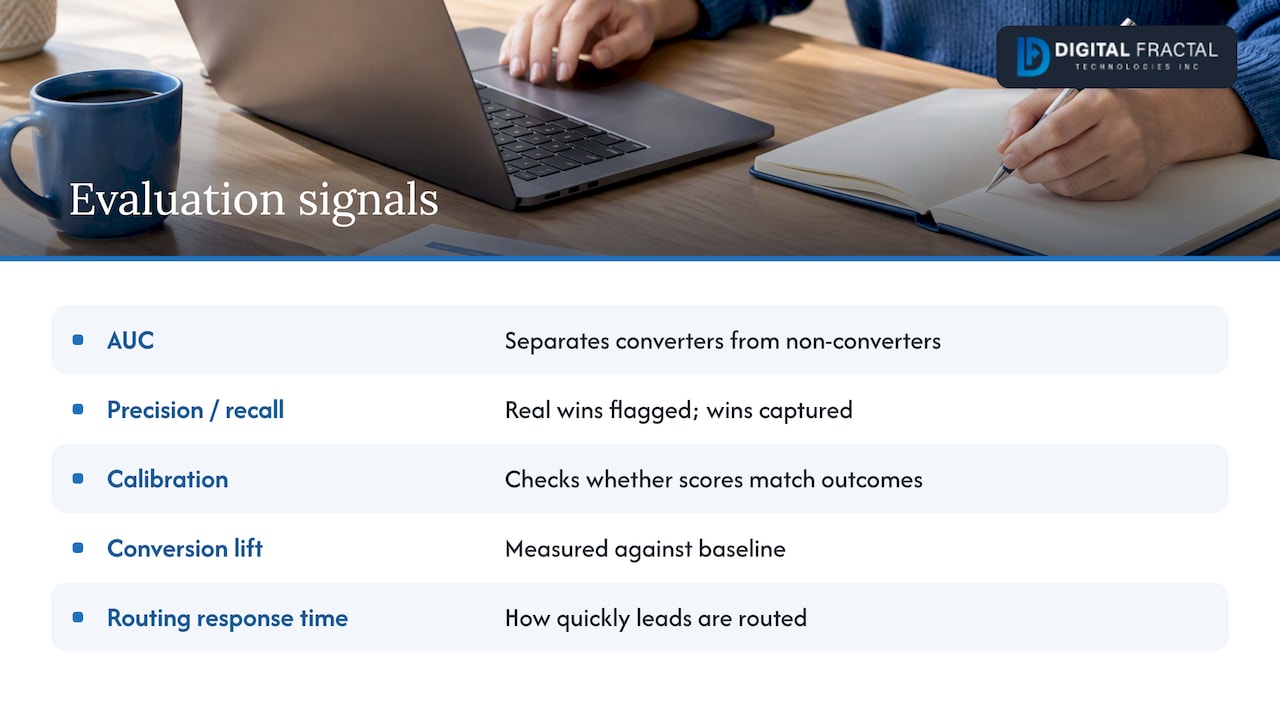
Track a short set of metrics. AUC shows how well the model separates converters from non-converters. Precision and recall show how many flagged leads were real wins and how many wins you caught. Calibration checks whether a score of 80 really behaves like an 80. On the business side, watch conversion lift against your baseline and routing response time.
Use closed-won and closed-lost outcomes to retrain on a regular schedule, and review reason codes for drivers that look like proxies for something unfair or irrelevant. Set your publish threshold before launch: for example, require the model to beat your current process on a holdout set. Roll back or retrain when conversion lift fades, calibration drifts, or reps stop trusting the queue.
Why should scoring sit inside an AI readiness roadmap?
In my view, scoring projects succeed or fail on the groundwork, not the algorithm. Teams that bolt a model onto messy CRM data get a confident-looking number that nobody believes. The ones that win treat scoring as one use case inside a broader readiness and data-governance program, with central ownership of definitions, data quality and privacy. Tie the pilot to a single business KPI, plan the change management for reps, and let the model earn trust one segment at a time.
— Souhail
How can an AI Readiness Audit prepare you for AI lead scoring?
Scoring only works on solid data, clear governance and a CRM that can carry scores into live routing. Our AI Readiness Audit can help assess readiness for AI lead scoring. We build tailored solutions around your workflows and systems, and we aim to support tangible business transformation. Book a discovery call, or review the audit page to see what we would assess first.
FAQ
What does lead scoring mean?
Lead scoring ranks prospects by how likely they are to become customers. AI versions calculate that likelihood from historical data and express it as a score, often from 0 to 100. Sales then works the highest scores first.
How is a lead score calculated?
A model analyzes past leads, including firmographics, interactions and conversion outcomes, to estimate each new lead’s likelihood to convert. Microsoft’s documentation notes that a reliable model needs at least 40 qualified and 40 disqualified leads in the training window. Reason codes then show which factors drove the result.
Can you give me an example of lead scoring?
Say a VP at a mid-sized logistics firm visits your pricing page three times and requests a demo. The model compares that pattern with past wins and returns a high score, with reason codes like “senior title” and “repeat pricing visits.” A student with one blog visit scores low.
What is the best software for lead scoring?
It depends on your CRM and data volume. Many CRMs ship native predictive scoring, such as HubSpot’s AI scoring, usually in higher tiers. Start with what your CRM already offers, and consider custom models when your data or workflows outgrow it.
Sources
- Configure predictive lead scoring | Microsoft Learn
- Apply Machine Learning in the Company to Predict the Quality of Sales Leads
- AI, privacy, and your business – Office of the Privacy Commissioner of Canada