
Custom iOS Apps vs. Off-the-Shelf Solutions

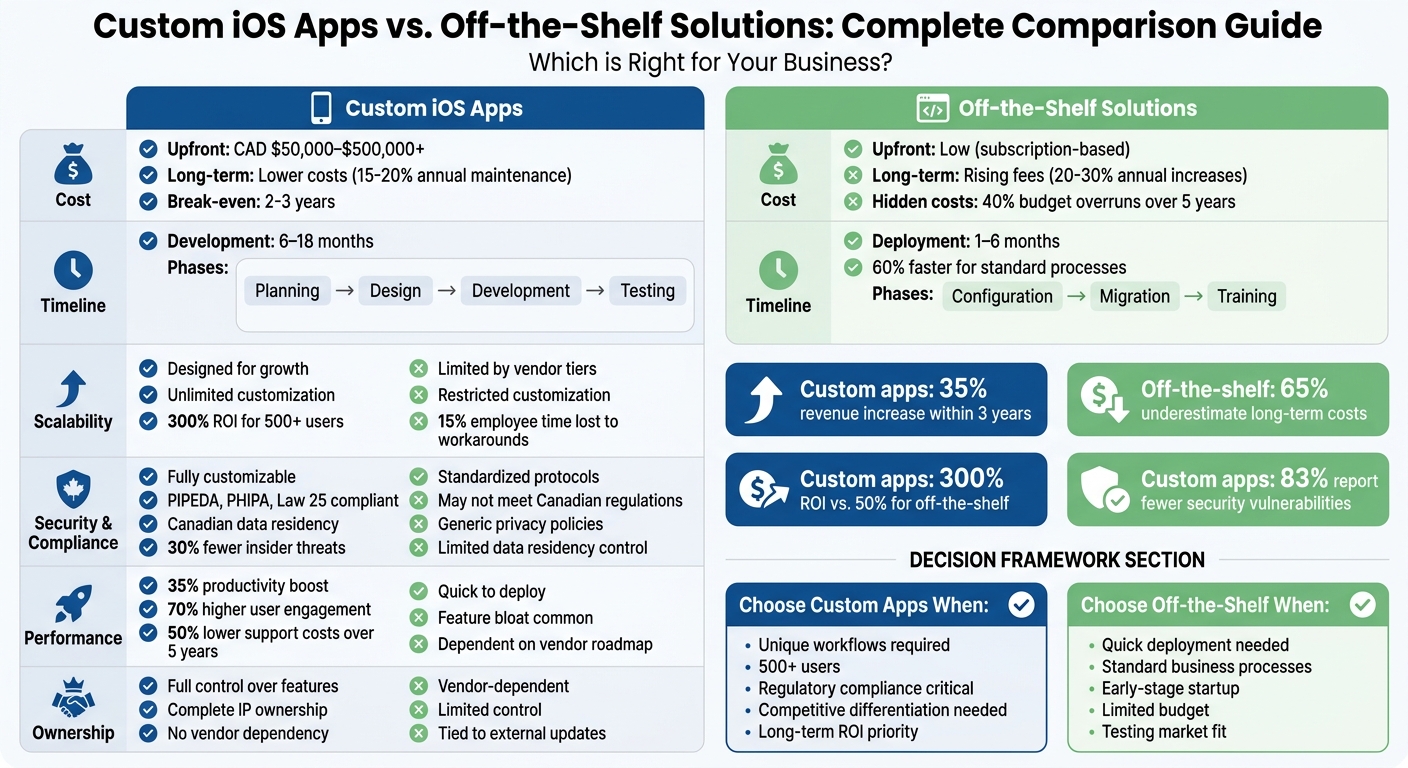
When deciding between custom iOS apps and off-the-shelf solutions, the choice boils down to control vs. convenience. Custom apps are built specifically for your business, offering tailored features, better integration, and long-term savings. Off-the-shelf solutions, on the other hand, are quick to deploy, cheaper upfront, but may require costly adjustments to fit your needs.
Key considerations include:
- Cost: Custom apps have higher upfront costs (CAD $50,000–$500,000+), but off-the-shelf tools can become expensive over time due to rising subscription fees.
- Scalability: Custom apps grow with your business, while off-the-shelf tools often hit limitations tied to vendor plans.
- Security: Custom apps meet specific Canadian privacy laws (like PIPEDA and PHIPA), whereas off-the-shelf tools may not offer the same flexibility.
- Timeline: Custom apps take 6–18 months to develop, while off-the-shelf solutions can be implemented in weeks.
Quick Comparison:
| Feature | Custom iOS Apps | Off-the-Shelf Solutions |
|---|---|---|
| Cost | High upfront, lower long-term costs | Low upfront, rising subscription fees |
| Scalability | Designed for growth | Limited by vendor tiers |
| Security | Customizable for Canadian regulations | Standardized, may not meet all needs |
| Timeline | 6–18 months to develop | 1–6 months to deploy |
| Ownership | Full control over features and IP | Dependent on vendor |
For businesses prioritizing long-term ROI, unique workflows, or compliance, custom apps are often the better choice. Off-the-shelf tools work well for quick, general-purpose needs.
Custom iOS Apps vs Off-the-Shelf Solutions: Complete Comparison Guide
Custom vs. off-the-shelf software
sbb-itb-fd1fcab
What Are Custom iOS Apps?
Custom iOS apps are designed from the ground up to align perfectly with a business’s operations and workflows. Unlike pre-made software that uses generic templates, these apps are tailored to meet specific business needs and processes.
The key distinction lies in purpose and ownership. Custom apps are built to support long-term growth and provide a competitive edge, while off-the-shelf solutions are often aimed at quick deployment or testing a Minimum Viable Product (MVP). With custom apps, you retain full ownership of the source code and intellectual property, giving you the freedom to update or modify the software without depending on external vendors. This control is especially important for Canadian businesses that must comply with strict regulatory standards.
Features of Custom iOS Apps
Custom apps are crafted to fit seamlessly into your workflows, removing unnecessary features and improving how data flows between systems. They can integrate with ERP systems, APIs, and databases, enhancing operational efficiency by as much as 30%. For instance, a construction company might require real-time project tracking linked to a custom CRM, while a healthcare provider may need a PHIPA-compliant patient portal with secure, role-based access. These tailored solutions ensure that every feature supports your operations.
The modular architecture of custom apps offers the flexibility to adapt as your business grows. You’re not tied to a vendor’s development schedule – whether you need to scale for more users, add AI-powered features, or expand into new markets, the app evolves alongside your needs. This adaptability is particularly valuable for Canadian businesses navigating provincial regulations or serving bilingual markets.
Benefits of Custom iOS Apps
Businesses that invest in custom mobile solutions often see a productivity boost of up to 35% and a 50% drop in support and maintenance costs over five years compared to those using off-the-shelf software. Custom interfaces also deliver a 70% higher user engagement rate, as they’re designed around real user requirements rather than generic templates.
From a financial perspective, companies using custom solutions report a 35% revenue increase compared to those relying on standard software. Although the upfront cost typically ranges between $50,000 and $250,000, custom apps often generate a 300% return on investment (ROI) within three years, compared to just 50% for off-the-shelf options. Long-term savings come from lower licensing fees, reduced maintenance expenses (15–20% less over time), and avoiding the costly adjustments needed to make generic software work for your unique processes.
Security is another standout benefit. Custom apps allow for tailored encryption and role-based access controls, which can lower insider threat incidents by 30%. Additionally, 83% of businesses report fewer security vulnerabilities with custom platforms compared to generic alternatives. This is especially crucial for Canadian companies managing sensitive data under strict privacy laws.
Next, we’ll explore off-the-shelf solutions and their potential drawbacks.
What Are Off-the-Shelf Solutions?
Off-the-shelf solutions are pre-built applications designed to address a variety of common business needs. Unlike custom apps, which are tailored to specific requirements, these solutions come with standardized workflows, making them quick to implement. Managed by third-party vendors, they handle hosting, security updates, bug fixes, and future upgrades, so businesses can focus on using the tool rather than maintaining it.
These tools are built to solve widespread business challenges, such as customer relationship management (CRM), project management, accounting, and time tracking. For instance, while a custom iOS app might include advanced features like refined haptic feedback – boosting user interaction by up to 50% – or deep Spotlight indexing to enable direct content searches (a feature used by only 35% of top apps), off-the-shelf apps often stick to basic system defaults.
"Off the shelf software is great when you need speed and low upfront cost. Custom software wins when your processes are unique, your team is wasting time on workarounds, and you want long term return on investment."
- Kelson Erwin, Owner/Founder, Ksense
Features of Off-the-Shelf Solutions
One of the standout features of off-the-shelf software is its immediate availability. You can often start using it within minutes – just sign up, log in, and follow a simple setup process. This might include adding team members, importing data, or connecting the app to other tools using pre-built integrations.
However, this convenience comes with limitations. These solutions are designed for general use, which means they may not align perfectly with your unique business processes. For example, off-the-shelf apps often rely on basic interface defaults rather than the polished, user-friendly interactions seen in custom solutions. They may also lack advanced features, such as modern navigation patterns or contextual permission requests, which custom apps use to address common issues like the 70% permission denial rate at launch.
These trade-offs influence both the affordability and effectiveness of these tools, creating a mix of benefits and challenges.
Benefits and Drawbacks
Off-the-shelf solutions are attractive for their affordability and ease of use. Their subscription-based pricing – typically monthly or annual fees – makes them accessible for startups, small businesses, or teams without in-house developers. If a tool meets 70–80% of your needs, it’s often a cost-effective choice, especially for businesses in their early stages.
That said, these solutions come with some challenges. Subscription costs can rise by 20%–30% annually as you add features, storage, or users, which can strain budgets – especially for Canadian small businesses navigating local regulations. Additionally, you’re tied to the vendor’s roadmap, meaning you have little control if a feature is removed or pricing changes. Over-customizing these apps can also lead to higher maintenance costs.
Another issue is feature bloat. Many off-the-shelf apps include unnecessary functionalities, making them harder to adopt and frustrating for employees to learn. As Sara MacQueen, Founder and President of Big Fish, explains:
"Off-the-shelf apps are often bloated with features you’ll never use, which can make them harder to adopt and frustrating to train people on."
This excess can leave you paying for features you don’t need while missing out on strategic ones – like custom Home Screen Quick Actions or Password AutoFill integration – that could genuinely improve efficiency . To see how these efficiencies translate into financial gains, you can use a workflow automation savings estimator to calculate potential ROI.
These factors highlight the balance businesses must strike between cost, flexibility, and functionality when choosing off-the-shelf solutions.
Cost Comparison: Custom iOS Apps vs. Off-the-Shelf Solutions
Initial Investment
In Canada, the cost of custom iOS app development can range widely, from CAD $25,000 for basic tools to over CAD $500,000 for more intricate enterprise platforms. Most standard custom iOS apps fall between CAD $35,000 and CAD $180,000, with backend infrastructure and APIs typically accounting for 30–40% of this cost.
On the other hand, off-the-shelf solutions require little upfront investment – usually limited to subscription fees.
However, the picture changes when you consider long-term expenses. As Jake Randall, CEO of Modall, explains:
"SaaS licensing for a 200-person company can run $50,000 to $150,000+ per year, increasing annually. Custom software has a higher upfront cost but no per-seat licensing. After year two or three, the economics often flip".
This shift highlights the importance of considering both long-term costs and ROI when choosing between these options.
Long-Term Costs and ROI
While initial costs are a major factor, ongoing expenses and potential tax savings can significantly influence the overall value of each option. Over a 3–5 year period, custom apps often prove to be more cost-effective. Maintenance for custom software usually runs 15–20% of the initial cost per year, covering essentials like security updates, performance improvements, and feature upgrades. For example, a custom app that costs CAD $100,000 might incur annual maintenance fees of around CAD $15,000–$20,000.
Off-the-shelf solutions may look cheaper upfront, but subscription fees can rise as businesses add users, features, or storage. In fact, about 65% of enterprise clients underestimate the long-term costs of off-the-shelf software, leading to budget overruns of up to 40% over five years. Hidden costs, such as integration fees, can further erode savings. For instance, the cost of middleware needed to connect generic software with existing systems – sometimes referred to as the "integration tax" – can surpass the initial licensing fee.
Custom software, on the other hand, offers measurable operational and financial benefits. Businesses report a 35% improvement in operational efficiency and a 20% increase in revenue within three years of implementing custom solutions. Internal-use mobile apps can cut manual processes by an average of 22% in just the first year. Canadian companies can also take advantage of government programs like SR&ED (a 35% refundable tax credit) and OIDMTC (a 40% refundable tax credit in Ontario), which together can offset 35–60% of labour costs.
For many businesses, the break-even point for custom development comes after 2–3 years. After that, the lower ongoing costs and full ownership of the software typically lead to significant savings and long-term benefits.
Scalability and Performance
Custom Apps: Built for Growth
Custom iOS apps are designed with scalability in mind, allowing businesses to seamlessly add modules, features, or integrations as they expand – without needing disruptive migrations. With complete control over performance, you can tailor database structures, caching, and other optimizations to match your specific needs as you grow.
These apps also offer impressive ROI potential. For companies with over 500 users, custom software has been shown to deliver a 300% higher ROI compared to generic solutions. This is because custom solutions align perfectly with your unique workflows. As Kris Nicolaou from Brain Box Labs points out, off-the-shelf software often struggles to integrate with other tools, leading to "data silos" because it wasn’t designed for seamless interoperability.
Consider Walmart as an example. The company developed a custom app using the React Native framework to manage its massive global operations. This solution integrated effortlessly with Walmart’s inventory and logistics systems, enabling real-time updates and supporting scalable expansion into new markets. These capabilities are often out of reach for generic software. Off-the-shelf solutions simply don’t offer the same level of flexibility or scalability.
Off-the-Shelf: Limited by Design
On the other hand, off-the-shelf solutions often come with inherent scalability limitations. Growth is constrained by the vendor’s predefined tiers or feature sets, forcing businesses to pay for costly upgrades or rely on third-party middleware. This rigidity can lead to inefficiencies; businesses using poorly suited off-the-shelf software lose an average of 15% of employee time to manual workarounds.
Performance is another sticking point. With off-the-shelf tools, you’re tied to the vendor’s roadmap, which may not align with your specific workload. Many companies attempt to bridge these gaps with plugins or automation tools like Zapier, but this often results in a "Frankenstein" stack – a disjointed collection of tools that can create more problems than it solves.
For example, an e-commerce company once relied on a patchwork of automations, which required hiring three contractors just to manage the system. After switching to a custom order management solution, the company saw a 34% revenue increase in the next quarter. This highlights how custom solutions can eliminate inefficiencies and enhance efficiency and unlock growth potential that off-the-shelf tools simply can’t match.
Security and Compliance
Custom Apps: Tailored Security
Custom iOS apps offer Canadian businesses the ability to fully control their security and compliance measures. Unlike generic software, these apps can be designed from the ground up to align with specific federal and provincial regulations, such as PIPEDA (Personal Information Protection and Electronic Documents Act), PHIPA in Ontario for healthcare data, or Quebec’s Law 25, which enforces stricter consent guidelines and mandatory privacy impact assessments starting September 2024.
"Compliance is not an afterthought you bolt on at the end. It needs to be architected into the software from day one." – Modall
With custom apps, businesses can ensure data residency by hosting information on Canadian cloud platforms like AWS Canada Central or Azure Canada East, avoiding the risks associated with U.S. data storage. Additionally, Apple’s hardware-backed security features, such as Keychain Services and the Data Protection API, provide secure ways to store credentials – critical for industries where U.S.-based data hosting is a non-starter. These apps are distributed privately via Apple Business Manager, ensuring that sensitive business data is accessible only to authorized users.
Custom apps also offer precise control over permissions. Unlike off-the-shelf software that often requests unnecessary access to data like contacts or location, custom apps are designed to request only the permissions required for specific workflows. Advanced features like certificate pinning ensure secure communication with trusted servers, reducing the risk of man-in-the-middle attacks. For instance, in 2025, Wenco implemented a custom iOS personnel management app that centralized employee data, streamlined workflows, and incorporated secure access controls built with native iOS technologies to maintain data integrity.
In comparison, off-the-shelf solutions often rely on generic security measures, which can fall short in meeting these tailored needs.
Off-the-Shelf: Standardized Security
Off-the-shelf solutions, while convenient, rely on standardized security protocols that may not meet Canada’s specific compliance requirements. Many U.S.-hosted SaaS platforms conflict with Canadian data residency laws. Their privacy policies are often generic, failing to align with regulations like PIPEDA’s 72-hour breach notification rule or Quebec’s stricter consent mandates.
"Off-the-shelf software rarely handles multi-jurisdictional compliance natively. A Canadian data residency requirement alone can disqualify most US-hosted SaaS products." – Modall
These solutions typically offer standard access controls and audit logging, which may not meet the detailed requirements of sectors like finance or government. While they are quicker to deploy, they lack the adaptability to keep up with evolving Canadian regulations. This limitation poses a significant risk for industries such as healthcare, finance, and public services, where compliance is non-negotiable.
Implementation Timeline and Deployment Speed
Custom Apps: Development Phases
Developing custom iOS apps typically takes 6–18 months and involves distinct stages: planning, design, development, and testing. While this timeline may seem lengthy, it ensures the final product aligns closely with the business’s unique needs.
For example, TechFlow Financial, a FinTech company with 200 employees, invested 8 months and $650,000 to create a custom algorithmic trading system. This project, completed around 2024/2025, involved a 12-person team and achieved microsecond latency – a feature unavailable in off-the-shelf alternatives. Similarly, Airbnb‘s founders opted for a 12-month custom development process to build unique host-guest interaction features, which became a defining aspect of their platform.
AI tools like GitHub Copilot are helping to streamline this process, cutting development time by 30–40%. This makes custom solutions increasingly competitive with off-the-shelf options, especially when the focus is on creating features tailored to specific business processes rather than adapting workflows to fit pre-made software.
While the development timeline for custom apps is longer, it prioritizes building a solution that aligns perfectly with business goals.
Off-the-Shelf: Instant Deployment
Off-the-shelf software solutions are often promoted as "plug-and-play", with deployment times ranging from 1 to 6 months, including configuration and minor customizations. This makes them 60% faster to roll out compared to custom-built apps for standard business processes.
For instance, the e-commerce startup GrowthCart, with 50 employees, implemented Salesforce Professional Edition CRM in just 6 weeks. This timeline covered data migration and a 40-hour user training program, costing $85,000 during the first year. However, challenges like data migration, third-party integrations, and employee training can introduce delays. Moreover, businesses often encounter an "integration tax" – losing 15% of employee time to manual workarounds when the software doesn’t fully meet their needs.
Although off-the-shelf solutions offer quick deployment, their speed advantage may diminish over time if scalability and performance limitations arise.
| Feature | Custom iOS App | Off-the-Shelf Solution |
|---|---|---|
| Typical Timeline | 6–18 months | 1–6 months |
| Primary Phases | Planning, design, coding, QA | Configuration, migration, training |
| Speed Advantage | Low (long-term focus) | High (immediate need) |
| Deployment Focus | Building the right features | Fitting the business to the software |
Decision Framework: Choosing the Right Solution
Factors to Consider
When deciding between custom iOS apps and off-the-shelf solutions, there are five main factors to weigh: competitive differentiation, total cost of ownership, integration needs, timeline constraints, and long-term scalability goals.
Competitive differentiation is a key factor. As the TechVinta Team aptly states:
"Is this function a source of competitive advantage or a cost of doing business? Build the first. Buy the second."
If the app directly impacts customer experience, improves profit margins, or sets your business apart, custom development is likely the better choice. On the other hand, for standard operations like accounting or payroll, off-the-shelf options are usually sufficient.
Total cost of ownership should be evaluated over a five-year horizon, not just the upfront costs. For custom solutions, the formula is: (Build cost × 1.5) + (annual maintenance at 15–20% for five years) + infrastructure costs. For off-the-shelf tools, calculate: (monthly cost × number of users × 60) + integration fees, workaround costs, and projected price increases. Research shows that 65% of enterprise clients underestimate long-term integration and licensing costs, leading to budget overruns of up to 40% over five years. Additionally, businesses forced into generic workflows lose an average of 15% of employee time to manual workarounds.
Integration requirements are another critical consideration. Custom apps can be designed to integrate seamlessly with legacy systems like ERPs and CRMs. In contrast, off-the-shelf solutions often struggle with deep integration. If your team frequently resorts to spreadsheets or manual data entry because existing tools don’t align with your workflow, it may signal the need for a custom solution.
Timeline and budget constraints also play a significant role. Custom development typically costs between CAD $50,000 and CAD $500,000+ and can take 3–12 months to complete. Meanwhile, off-the-shelf solutions range from CAD $10 to CAD $300 per user per month and can be implemented within days or weeks. However, custom projects, when scoped properly, often achieve cost parity with off-the-shelf options within 18 to 24 months and can deliver up to 300% higher ROI for companies with 500+ users.
These factors collectively shape the decision-making process, helping businesses identify the best approach for their unique needs.
Business Scenarios and Recommendations
The ideal solution depends on the type of business and its strategic goals.
For startups testing market fit, off-the-shelf tools are ideal for quick deployment and minimal upfront costs. This allows businesses to experiment and refine their model before committing to larger investments.
For mid-sized businesses with unique processes, custom development often delivers greater value. Take TechFlow Financial, for example – a 200-employee FinTech company. They invested CAD $650,000 over eight months to develop a custom algorithmic trading system with a dedicated 12-person team. The result? A 40% boost in processing speed, CAD $2.1 million in annual operational savings, and an 85% increase in customer acquisition, with a three-year ROI surpassing 300%.
Regulated industries, like healthcare and finance, often require custom apps to meet stringent compliance standards (e.g., HIPAA, GDPR, SOC 2). These apps are designed with security and regulatory needs in mind, unlike generic off-the-shelf tools.
Similarly, government agencies and public sector organizations often face unique requirements, such as integrating with proprietary hardware (e.g., Bluetooth-enabled equipment). In these cases, custom development is usually the best option. However, for standard administrative functions, off-the-shelf solutions can cut costs and speed up implementation.
A cautionary tale comes from DataMerge Corporation, which initially chose an off-the-shelf warehouse software. The tool couldn’t handle their specific inventory granularity, leading to CAD $400,000 in unplanned customisation costs. After 18 months – and a total loss of CAD $1.2 million, including lost productivity – they switched to a custom solution that met their needs within a year. This example underscores the hidden costs of forcing generic solutions onto unique workflows.
| Business Type | Recommended Solution | Key Reason |
|---|---|---|
| Early-Stage Startups | Off-the-Shelf | Quick validation; lower upfront cost |
| Growing Companies (500+ users) | Custom | Better ROI and scalability |
| Regulated Industries | Custom | Built-in compliance and security |
| Standard Back-Office Tasks | Off-the-Shelf | Lower cost for routine operations |
| Unique Customer-Facing Workflows | Custom | Supports differentiation and tailored needs |
Conclusion
Deciding between a custom iOS app and an off-the-shelf solution isn’t about picking the "best" option – it’s about finding the right solution for your business needs. Experts agree that custom apps are worth the investment when protecting proprietary workflows or intellectual property is a priority.
Your decision will depend on factors like strategic goals, budget, and timeline. If the app is central to your competitive edge or customer experience, custom development is likely the better choice. On the other hand, for routine tasks such as payroll or basic accounting, off-the-shelf tools often provide a practical and cost-efficient alternative. This trade-off between cost and speed highlights the importance of evaluating long-term benefits.
In terms of ROI, custom solutions often pull ahead over time. While they come with higher upfront costs, they typically match the expense of off-the-shelf tools within 18 to 24 months and can deliver up to 300% higher ROI for businesses with over 500 users. Off-the-shelf solutions, however, shine in terms of speed, enabling deployment up to 60% faster for standard applications – making them a great choice for startups or businesses working under tight deadlines.
Sometimes, a hybrid approach works best. By combining the efficiency of off-the-shelf tools with custom features tailored to specific needs, businesses can strike a balance. In fact, companies that use this blended strategy are 2.5 times more likely to achieve top-tier financial performance.
FAQs
How do I know if my workflows are “unique enough” to justify a custom iOS app?
To figure out if your workflows call for a custom iOS app, consider whether you need specific features, integrations, or automation that standard apps just don’t offer. Custom apps can streamline operations, match your unique processes, and potentially cut costs over time. However, if your workflows are fairly standard or easily handled by existing apps, investing in a custom solution might not be worth it. The key is determining whether your requirements go beyond what generic apps can deliver.
What hidden costs should I budget for with off-the-shelf software?
When planning your budget for off-the-shelf software, it’s important to account for costs that may not be immediately obvious. Beyond the upfront purchase or subscription fee, you might face recurring licensing charges, expenses for custom integrations to align the software with your specific needs, and potential inefficiencies caused by poor compatibility with your existing systems. Additionally, keeping the software secure and up to date through patches, upgrades, and compliance-related adjustments can lead to unexpected expenses. Over time, these factors can drive up the total cost of ownership, making custom software development a more tailored and scalable alternative for many businesses.
How can a custom iOS app meet Canadian data residency and privacy laws?
A custom iOS app can meet Canadian data residency and privacy laws by following regulations such as PIPEDA (Personal Information Protection and Electronic Documents Act). This includes ensuring that any data collected is stored within Canada or in locations with comparable privacy protections.
To further protect sensitive information, the app should incorporate strong security measures that comply with both provincial and federal standards. This might include encryption, secure authentication protocols, and regular security audits to maintain data integrity and confidentiality.