
Predictive ETA Models: A Guide to Accuracy and Speed

The fastest path to accurate, production-ready ETAs is a hybrid system: keep your routing engine for the physical route logic, then bolt on a machine learning layer that corrects its systematic errors. This is the architecture behind Uber’s DeepETA, and it’s the sane starting point for most logistics operations, not just ride-hailing.
Here’s the short version:
- Start hybrid. Routing engine for the route, ML residual model for the correction.
- Benchmark against MAE, not just raw ETA accuracy, since that’s what production teams actually optimize.
- Check latency early. CompactETA hits accurate inference in roughly 100 microseconds, showing how far compact models can push speed without gutting accuracy.
Statistic to remember: DeeprETA’s post-processing approach treats the routing engine’s output as a noisy baseline and predicts only the leftover error, which is a fraction of the modeling problem full end-to-end systems try to solve.
Your first move should be a small pilot: pull recent trip data, compute the gap between routing-engine ETA and actual arrival, and train a residual model on that gap. If the MAE drops, you have your business case.
Key Takeaways
Hybrid post-processing, pairing a routing engine with a residual correction model, delivers measurable MAE gains without the engineering cost of rebuilding routing logic from scratch.
| Point | Details |
|---|---|
| Start with hybrid architecture | Correct routing-engine ETA with a residual model instead of rebuilding routing logic. |
| Watch latency budgets | CompactETA hits ~100 microsecond inference, a useful benchmark for high-QPS serving needs. |
| Prefer probabilistic outputs | Report expected ETA plus a confidence range so dispatch systems can weigh risk. |
| Profile residuals early | Compute routing-engine ETA minus observed arrival before building any model. |
| Get expert help scoping the pilot | Digitalfractal’s AI Audit & Opportunity Assessment scopes data readiness and pilot design before full engineering commitment. |
Table of Contents
- What Type of Predictive ETA Model Should You Use?
- Why Hybrid Post-Processing Is the Current Best Practice
- What Data Do You Need to Build an ETA Model?
- Which Model Architecture Fits Your Use Case?
- How Do You Evaluate an ETA Model in Production?
- How Long Does It Take to Build a Predictive ETA System?
- What Mistakes Derail Predictive ETA Projects?
- Why Start With Hybrid Post-Processing
- How an Integration Partner Speeds Up an ETA Pilot
- Where to Read More on ETA Model Research
- Frequently Asked Questions
- Sources
What Type of Predictive ETA Model Should You Use?
Three architectural families cover almost every real-world case, and picking the wrong one wastes months.
Routing-engine-only ETA relies purely on map data, road speeds, and shortest-path logic. It’s fast and cheap to run, but it treats every driver, every dwell time, and every dispatch quirk as identical. Accuracy plateaus quickly.
Hybrid post-processing keeps the routing engine but layers a model on top that learns the residual, the gap between predicted and observed arrival. This is where DeeprETA lives, and it’s the approach most logistics teams should adopt first.
End-to-end ML or GNN systems replace much of the routing logic with a learned model that reasons over the road graph directly. Google Maps runs a version of this at scale, but it demands serious map-level engineering and infrastructure that can sustain high query volume.
- Pick hybrid if you already run a routing engine and want lower error without rebuilding your maps stack.
- Pick end-to-end only if you have unusual map gaps or the engineering capacity to maintain a learned routing layer long-term.
Pro Tip: *Don’t skip hybrid post-processing to chase an end-to-end architecture just because it sounds more advanced.
Why Hybrid Post-Processing Is the Current Best Practice
Production evidence backs this up more than theory does. Uber’s own framing treats routing-engine ETA as a noisy baseline and trains a model to predict just the correction, which sidesteps the need to reengineer routing logic entirely.
DeeprETA’s architecture uses a shallow encoder-decoder with feature hashing to manage geospatial cardinality, and it was built specifically for low-latency, high-throughput serving, not academic benchmarks. CompactETA pushes that further, showing that compact learned representations paired with a simple MLP decoder can cut inference latency by more than 100x against a strong baseline. Meanwhile, Google’s GNN-based ETA work demonstrates that graph structure helps when topology genuinely matters, though it requires stabilizing techniques like MetaGradients and exponential moving averages to behave well in production.
- Post-processing improves MAE without touching map logic.
- Compact architectures prove latency and accuracy aren’t mutually exclusive.
- GNNs earn their complexity only when road topology is a major error source.
A route rarely has one true travel time. Different drivers, different traffic windows, and different dispatch conditions produce a spread of outcomes, and modeling that spread with a confidence interval gives dispatch systems more to work with than a single guess.
That’s the case for probabilistic outputs: report an expected ETA plus a variance or quantile range, and let downstream systems decide how much buffer to add.
What Data Do You Need to Build an ETA Model?
Your model is only as good as the trip history feeding it. At minimum, you need historical GPS traces, route segment traversal times, map segment IDs, and timestamped traffic signals. Stop and dwell events matter more than most teams expect, since a five-minute loading delay looks identical to traffic congestion if you don’t tag it separately. Weather and calendar features (holidays, local events) add marginal but real lift.
Feature engineering deserves real attention here. Bucketize time-of-day into meaningful windows rather than raw timestamps, quantile-bin continuous variables like distance and speed, and use geospatial hashing or learned embeddings instead of raw lat/long pairs. Sequence-level cumulative distance features help models track progress mid-route.
Before training anything, run this quality checklist:
- Remove duplicate GPS pings and deduplicate overlapping trip records.
- Check your GPS-to-road snapping rate; a low rate signals map mismatch problems.
- Flag and handle missing segment labels rather than silently dropping rows.
- Correct time-zone inconsistencies and clock drift across your fleet devices.
- Detect extreme outliers (a trip logged as three seconds or ninety hours is a data error, not a signal).
Pro Tip: Compute your routing-engine residual (predicted ETA minus observed arrival) as one of your very first steps, before any modeling. Profiling that distribution’s skew and tail length tells you more about your data quality than any dashboard.
Which Model Architecture Fits Your Use Case?
Once your data is clean, the architecture decision comes down to your latency budget and your team’s engineering capacity.
Tree ensembles like XGBoost, LightGBM, or CatBoost remain a strong baseline for residual prediction on tabular features. They’re fast to train, easy to deploy, and forgiving of smaller datasets, which makes them a sensible first model before you invest in anything heavier.
Sequence models and attention architectures capture ordered dependencies between route segments that trees miss. DeeprETA’s shallow encoder-decoder is a documented example of this working at scale, and attention-based spatiotemporal models that focus on relevant historical speed patterns consistently outperform architectures that only look at raw neighboring links.
Graph neural networks model road topology explicitly, which is why Google Maps leans on them for multi-horizon predictions where the network structure itself drives the error. They’re powerful, but they come with real training instability that needs active management.
Compact low-latency systems like CompactETA solve a different problem entirely: how to serve accurate predictions in microseconds by compressing spatial and temporal dependencies into a small representation decoded by a lightweight MLP.
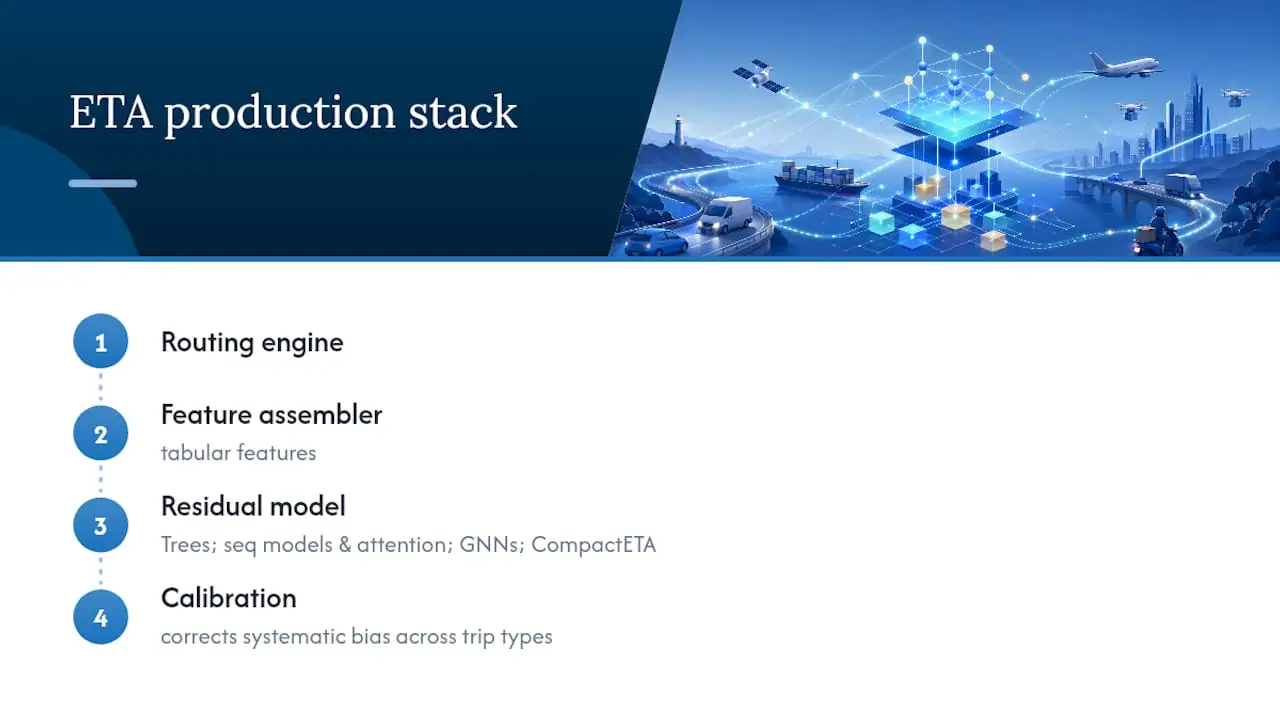
A few design notes worth internalizing: use quantile or distributional outputs when uncertainty matters to your dispatch decisions, apply asymmetric loss functions to handle skewed residuals and outlier trips, and add a calibration layer to correct for systematic bias across different trip types. Picture your production stack as four stages: routing engine, feature assembler, residual ML model, and post-calibration.
Pro Tip: Ensembling a tree model with a neural residual predictor, weighted by a simple fusion layer, has won competitive ETA benchmarks by combining the robustness of trees with the pattern-capture of neural nets.
How Do You Evaluate an ETA Model in Production?
Three metrics anchor most evaluation frameworks. MAE tells you operational accuracy in minutes, which is what dispatchers actually care about. RMSE penalizes large errors more heavily, useful when a handful of badly wrong predictions cause outsized downstream problems. MAPE normalizes for route length, which matters when your fleet runs both short urban hops and long-haul routes. If you’re outputting distributions, track calibration metrics too, not just point-estimate error.
Offline metrics only tell half the story. Run A/B tests measuring real impact: on-time delivery rate, customer wait time, and whether downstream dispatch systems actually behave better with tighter ETAs.
Production constraints deserve equal weight to accuracy:
- Set a realistic latency budget. Most dispatch systems need millisecond-level response, not the microsecond target CompactETA was built for under extreme query volume.
- Weigh CPU versus GPU serving costs against your query throughput.
- Build fallbacks for when the model is unavailable, plus monitoring for data drift and concept shift.
- Define a caching strategy for repeated queries on common routes.
Statistic to remember: CompactETA’s benchmark shows inference latency reduced by more than 100x versus a strong baseline, which is the kind of number that should set your expectations for what “fast enough” looks like at scale.
How Long Does It Take to Build a Predictive ETA System?
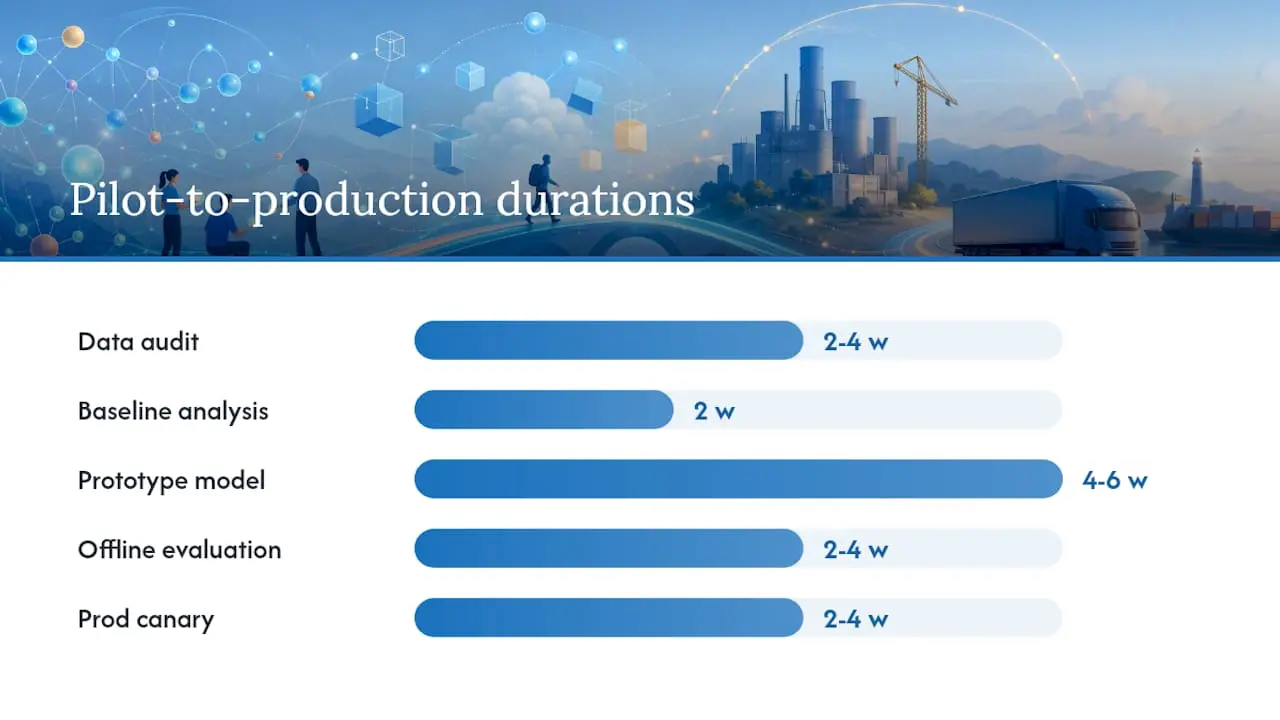
A realistic pilot-to-production timeline runs about three to four months for most mid-size fleets. Here’s the rough sequence:
- Data audit and ingestion (2 to 4 weeks): inventory GPS traces, traffic feeds, and map segment data; fix obvious gaps.
- Baseline metrics and residual analysis (2 weeks): measure current routing-engine MAE and profile where it’s biased.
- Prototype residual model (4 to 6 weeks): train and tune your first tree or sequence model on the residual signal.
- Offline evaluation and A/B test design (2 to 4 weeks): validate against holdout trips and plan your online rollout.
- Production integration and canary rollout (2 to 4 weeks): deploy behind a feature flag to a small percentage of traffic first.
- Monitoring and retraining pipeline (ongoing): automate drift detection and set a retraining cadence, daily or weekly depending on how fast your operations shift.
For staffing, a typical pilot needs one to two engineers (one data, one ML) plus roughly half a product owner’s time over three months. Budget separately for training compute versus serving infrastructure. Training runs are bursty and can use spot capacity; serving needs steady, low-latency infrastructure sized to your query volume.
Pro Tip: Treat the canary rollout stage as non-negotiable, even under schedule pressure. A residual model that looks great offline can still misbehave on live traffic patterns your holdout set never captured.
What Mistakes Derail Predictive ETA Projects?
Most failures trace back to a handful of repeat offenders.
- Treating routing-engine ETA as ground truth. It’s a noisy baseline, not a target. Build a residual model and profile where that baseline is systematically wrong instead of assuming it’s correct.
- Ignoring distributional uncertainty. A single point estimate hides real variance. Output quantiles or a variance estimate and calibrate them against holdout data.
- Data drift and seasonality shifts. Traffic patterns change with construction, weather, and demand seasonality. Set up automatic drift alerts and a scheduled retraining cadence rather than retraining reactively after complaints roll in.
- Overfitting to rare outliers. A three-hour trip caused by a breakdown shouldn’t drag your loss function around. Use asymmetric loss or clip extreme values, and bucketize continuous features so the model generalizes across trip types instead of memorizing edge cases.
Why Start With Hybrid Post-Processing
Hybrid post-processing wins because it minimizes disruption. You’re not tearing out a routing engine your operations team already trusts, you’re adding a correction layer that can be updated independently as conditions change. That flexibility matters more than raw model sophistication in most fleets.
Digitalfractal’s own AI readiness audits consistently show the same pattern: teams that pilot narrow, well-scoped improvements reach production in around 90 days, while teams chasing a full rebuild often stall before they ship anything measurable.
How an Integration Partner Speeds Up an ETA Pilot
Building a predictive ETA system alone means juggling data audits, model prototyping, and production integration on top of your regular workload. That’s where a focused partner earns its keep: Digitalfractal runs the data audit, builds the first residual model prototype, and sets up the monitoring and retraining pipeline so your internal team isn’t starting from a blank page.

The value isn’t generic consulting, it’s a scoped engagement that hands your team a working pilot and the knowledge to maintain it. Instead of spending months evaluating architectures in the abstract, you get a data-backed recommendation tied to your actual trip history and dispatch constraints. If you’re weighing whether your routing setup can support a residual model, or you just need a second set of eyes on your data quality before committing engineering time, an AI Audit & Opportunity Assessment is the practical starting point. It scopes the pilot, flags data gaps early, and gives you a clear go or no-go before you commit a full engineering quarter.
Where to Read More on ETA Model Research
- DeeprETA arXiv paper: read first if you’re an engineer building the residual model.
- Uber’s DeepETA blog: best starting point for managers scoping a project.
- CompactETA paper: essential for latency-constrained deployments.
- Google Maps GNN notes: read if topology-heavy routing is your bottleneck.
- NOAA’s Eta glossary entry: clarifies that meteorology’s “Eta Model” has nothing to do with logistics ETAs.
Frequently Asked Questions
What are predictive ETA models used for?
Predictive ETA models estimate arrival times for deliveries, rides, or dispatched vehicles by combining routing data with machine learning corrections, improving accuracy over routing-engine estimates alone.
Is a hybrid model always better than end-to-end machine learning?
Not always. Hybrid post-processing suits most fleets with an existing routing engine, but end-to-end systems can outperform it when map data has significant gaps or when topology-level learning is worth the added infrastructure.
What metric should I use to evaluate ETA accuracy?
MAE is the standard for operational accuracy, RMSE for penalizing large errors, and MAPE when comparing fleets with widely varying route lengths.
How often should an ETA model be retrained?
It depends on how fast your traffic patterns and operations shift. Many teams retrain weekly, with some moving to daily cadence during high-drift periods like seasonal demand spikes or road construction.
Do predictive ETA models require GPU infrastructure?
Not necessarily. Compact architectures like CompactETA are designed to run efficient inference with lightweight decoders, which keeps serving costs manageable even at high query volume.
Sources
- DeepETA: How Uber predicts arrival times using deep learning
- DeeprETA: An ETA post-processing system at scale
- CompactETA: A fast inference system for travel time prediction
- NOAA National Weather Service glossary: ETA