HS Code Classification with AI: A Guide for Canadian Importers

AI can read a product description, an image or a spec sheet and suggest an HS code in seconds. It cannot yet be trusted to declare the final Canadian code on its own. The practical model for Canadian importers is AI for candidate codes and flagged uncertainty, a trained person for the decision, and a written rationale you can hand to the Canada Border Services Agency (CBSA) if it asks. This guide explains how that works, how accurate current tools are, and how to wire them into your logistics workflow.
TL;DR
- AI classification tools suggest candidate HS codes from text, images or structured product data. In Canada the declared code still has to reach the 10-digit level, and the importer or broker is responsible for it.
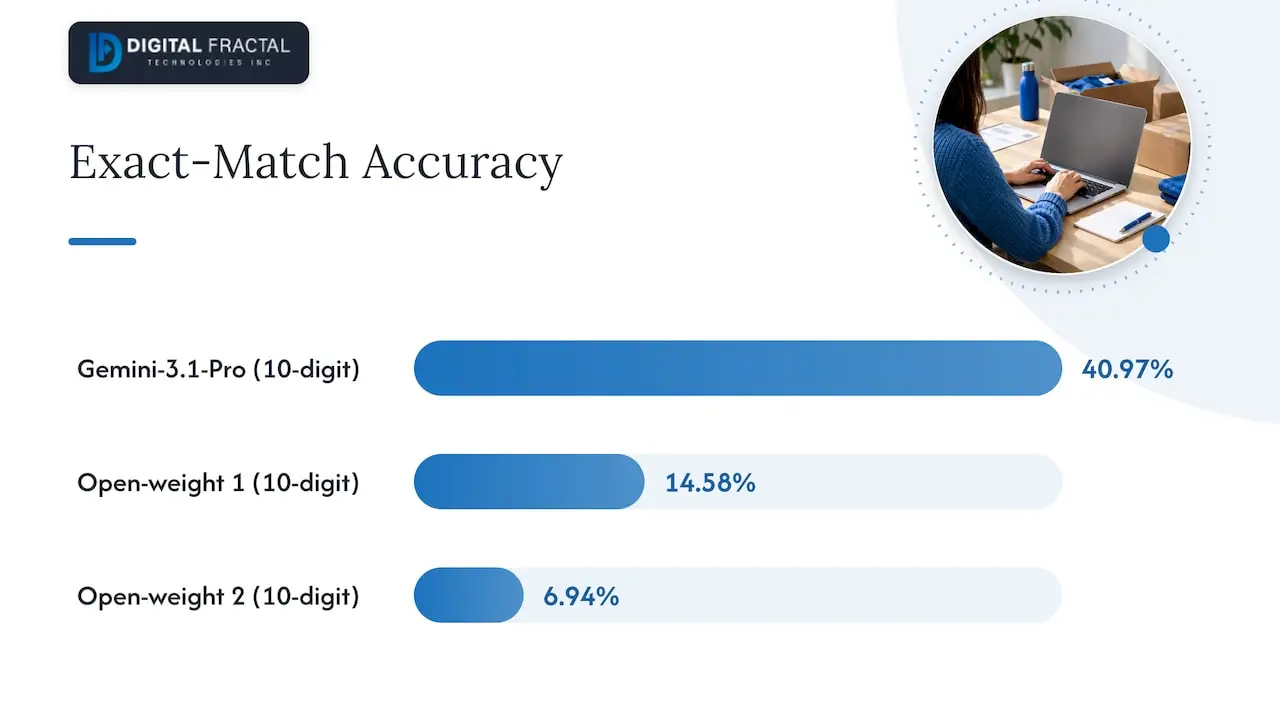
- Accuracy depends on the product. A 2026 University of New Brunswick study found the best model matched the exact 10-digit code only 40.97% of the time on 3,300 expert-labeled records.
- The safe pattern is human-in-the-loop: AI proposes, a reviewer confirms, and every decision is logged with its reasoning.
- For high-value, repeat or ambiguous goods, a CBSA advance ruling gives certainty, but you must apply at least 120 days before importing.
- The biggest gains come from integrating classification into your ERP and customs-entry workflow, not from a standalone lookup box.
Table of Contents
- What AI HS code classification actually does
- From the six-digit HS code to a Canadian tariff item
- What information an AI system needs from you
- How accurate is automated classification?
- Where AI suggestions go wrong
- Your accountability under CARM
- A review workflow that keeps AI suggestions defensible
- When to ask for a CBSA advance ruling
- Integrating classification into ERP and logistics workflows
- Our perspective
- Find your first automation opportunity
- FAQ
- Sources
What AI HS code classification actually does
The Harmonized System (HS) is the international product nomenclature that customs administrations use to assign duties, statistics and controls. AI classification tools try to map a free-text description, a photo, a barcode or a record in your product master to a position in that nomenclature.
Most tools work in one of three ways:
- Language models read the description and predict the code, often with an explanation.
- Rule-based or expert systems ask you questions about the product and walk through classification logic step by step.
- Agentic or ensemble approaches run several models, compare their answers and ask for clarification when they disagree.
The third approach is where research is heading. The University of New Brunswick team found that many wrong predictions come from unresolved ambiguity rather than random model behavior. Their consensus-based agentic framework asks targeted follow-up questions about the missing attributes most likely to change the code, such as material, intended use, construction or completeness.
An academic view of the field, in a paper in the World Customs Journal, reaches a similar conclusion. Assistive classification has real potential for compliance and lower classification costs, but it depends on how well a tool understands HS-relevant characteristics, the quality of its data and how it was trained.
That is the key distinction. AI produces a suggestion. A classification is a legal declaration, and the CBSA’s guide to tariff classification is clear that it does not replace the legislation, regulations or the D-memoranda that govern it.
From the six-digit HS code to a Canadian tariff item
Many tools advertise “HS codes” and stop at six digits. Canada needs more. The CBSA’s Memorandum D10-13-1 sets out the structure of the Customs Tariff:
| Level | Digits | Example | Set by |
|---|---|---|---|
| Heading | 4 | 95.07 | International (HS) |
| Subheading | 6 | 9507.90 | International (HS) |
| Tariff item | 8 | 9507.90.10 | Canada |
| Statistical suffix | 10 | 9507.90.10.00 | Canada |
The first six digits are shared by countries using the HS. Canada adds the eight-digit tariff item for domestic classification purposes and a statistical suffix as the final two digits. A global tool that returns a correct six-digit subheading has done roughly the easy part. The Canadian-specific levels are where duty rates, trade remedies and permit requirements are often decided, and where a model trained mostly on international data tends to be weakest.
When you evaluate any tool, ask first which tariff schedule it uses, how often that schedule is refreshed, and whether it returns the full 10-digit Canadian code or only the international prefix.
What information an AI system needs from you
The quality of the suggestion is capped by the quality of the input. A description such as “cable assembly” gives any system, human or machine, too little to work with. Strong inputs state:
- What it is made of, including the predominant material and any composite structure.
- What it does and who uses it, since principal use or function decides many headings.
- How it is presented: assembled or unassembled, complete or incomplete, retail packaging or bulk, set or single item.
- Technical specifications: dimensions, voltage, capacity, grade, or embedded software.
- Images, datasheets and manufacturer part numbers as supporting evidence.
This is a data problem as much as an AI problem. If your product master holds one-line descriptions copied from supplier invoices, even a strong model will guess. Cleaning and enriching that data is usually the first job in any serious project, which is why we start engagements with an enterprise data readiness review. If your product data arrives on supplier PDFs, AI document extraction can turn those sheets into structured attributes a classifier can use.
How accurate is automated classification?
Accuracy varies sharply with the type of goods, and anyone quoting a single figure is hiding that.
The University of New Brunswick study is the clearest Canadian benchmark. On 3,300 records labeled by domain experts, the strongest model, Gemini-3.1-Pro, reached 40.97% exact-match accuracy at the whole 10-digit level. Two open-weight models scored 14.58% and 6.94%. The authors conclude that exact 10-digit classification remains difficult even for advanced language models.
Broker and industry commentary points the same way. A Canadian customs-services firm reports that most brokers treat AI suggestions as research aids rather than production-ready classifications, because a single-digit error can lead to administrative monetary penalties (AMPS) or duties under the Special Import Measures Act (SIMA). The same source says suggestions line up with manual classification most of the time for straightforward consumer goods with stable HS placements, but the error rate climbs for industrial components, machinery with embedded software, dual-use goods and goods subject to SIMA anti-dumping duties.
So the working rule is:
| Product type | What to expect from AI |
|---|---|
| Simple consumer goods, clear descriptions | Useful first-pass suggestions, spot-check a sample |
| Technical manufactured goods | Candidate codes only, reviewer confirms every record |
| Principal-use or principal-function cases | Treat as a question for a classification specialist |
| Goods possibly under SIMA or trade remedies | Always verify against CBSA sources before declaring |
These figures describe the field in general, not any one tool. Test whichever system you adopt on your own catalogue, scored against codes your broker has already confirmed.
Where AI suggestions go wrong
Knowing the failure modes lets you design controls around them.
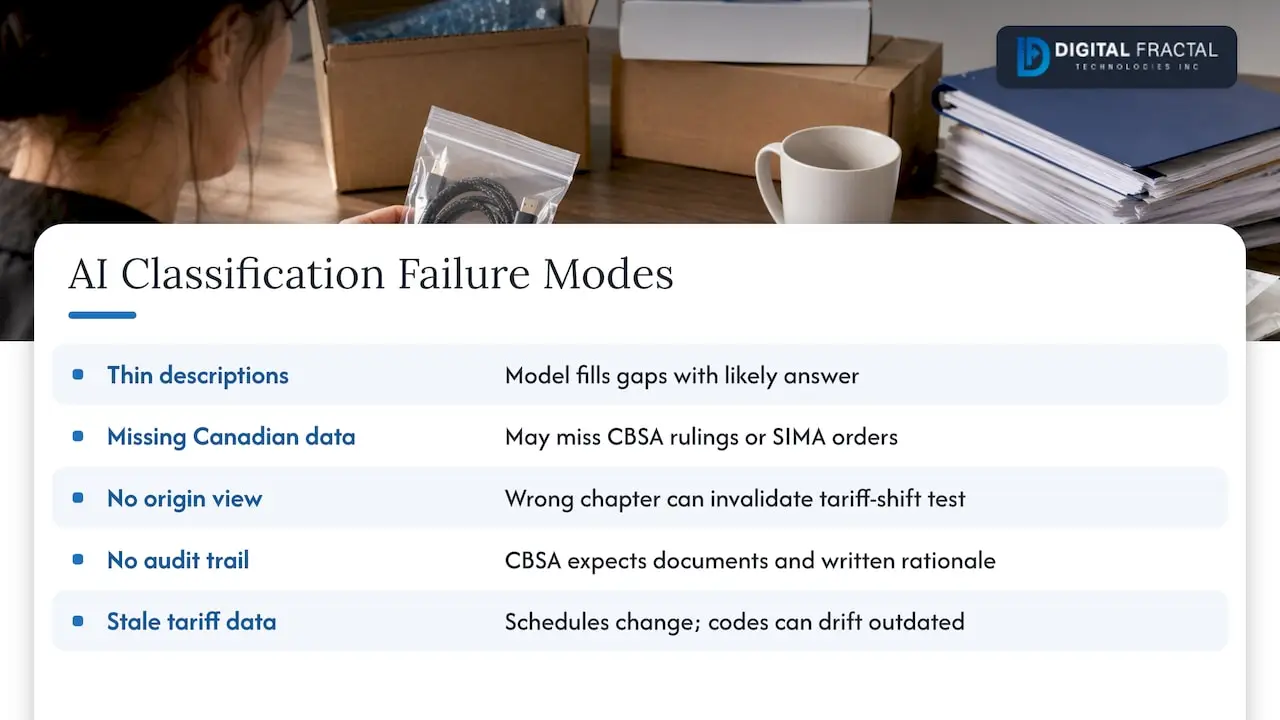
Ambiguous or thin descriptions. The model fills gaps with the most statistically likely answer. That is why systems that ask clarifying questions outperform those that always answer.
Missing Canadian rulings and trade remedies. A tool can miss CBSA rulings or SIMA orders unless it was built on Canadian trade remedy data, according to CanFlow Global’s analysis.
No view of origin. The same source notes that a code suggestion does not assess origin. A CUSMA or CETA preferential claim depends on product-specific rules of origin tied to the chapter. If the code lands in the wrong chapter, the tariff-shift test changes and the preferential claim can fail, leaving the importer with MFN duty plus interest on the difference.
No audit trail. When the CBSA verifies a declaration, it expects technical documentation and a written explanation of why the code is correct. The Grainger paper makes the same point from the research side: users need assurance a code is right, and a report explaining the characteristics, General Rules of Interpretation, legal notes and rulings behind it is desirable.
Stale tariff data. Schedules change. A tool that is not tied to a refresh process drifts out of date quietly, so ask who owns that update.
Your accountability under CARM
Responsibility for the code sits with the importer. The CBSA Assessment and Revenue Management system (CARM) is now, in the Agency’s words, the official system of record for importers and trade chain partners to assess and pay duties and taxes. According to CanFlow Global, CARM Release 3, launched on October 21, 2024, moved accounting functions into the CARM Client Portal. The portal does not auto-populate classifications, so you or your broker declare the code, and the CBSA can verify that declaration for up to four years under section 32.2 of the Customs Act.
Four years is a long time to be asked “why this code?” for a shipment you cleared in a hurry. That is the strongest argument for logging the reasoning at the moment of classification.
A review workflow that keeps AI suggestions defensible
This is the pattern we recommend building around any classifier. It follows the same logic as our guide to human-in-the-loop AI.
- Capture structured product data. Material, function, form, specifications, images and supplier part numbers, stored against the SKU.
- Generate candidates. The model returns the top codes at the full 10-digit Canadian level, each with a confidence score and the attributes it relied on.
- Route by risk. High-confidence, low-value, repeat items go to a light sampling review. Low confidence, disagreement between models, high duty rates or flagged categories go to a classification specialist or your licensed customs broker.
- Ask for missing facts. If the system cannot decide, it asks the buyer or product owner a targeted question rather than guessing.
- Record the rationale. Store the chapter and section notes applied, the General Rules of Interpretation relied on, and any ruling or D-memorandum consulted.
- Check origin and trade remedies separately. Preferential claims and SIMA exposure are decided on their own evidence.
- Audit on a schedule. Re-test a sample of past classifications each quarter, correct errors retroactively and feed corrections back into the system. Grainger notes that organisations relying on automatic classification must regularly audit, keep updating and training the software, and if necessary make retrospective corrections.
It is a compact process. Done well, it makes the human review faster rather than redundant, because reviewers see only the records that need judgment and see them with the evidence already assembled.
When to ask for a CBSA advance ruling
For goods where the stakes justify certainty, an advance ruling removes the guesswork. The CBSA’s Memorandum D11-11-3 sets the rules:
- An application must be made at least 120 days before the proposed date of importation, and the CBSA has a 120-day service standard for issuing a ruling once it has sufficient information.
- A ruling is optional. You do not need one to import.
- It is honoured as long as the material facts, circumstances and Canadian law have not changed, you have acted in accordance with it and it has not been revoked.
- The CBSA may review a ruling at any time and can modify or revoke it where it rests on an error of fact or in the classification.
Good candidates are high-volume products, goods where AI tools and brokers disagree, new product lines with an uncertain placement, and items where the duty rate or a preferential claim hinges on the code. A useful habit is to use AI to prepare the application: it can assemble the descriptions, specifications and images the CBSA will want, so the submission is complete the first time. Because timing matters, build the 120 days into your product launch plan.
Integrating classification into ERP and logistics workflows
A standalone classifier forces someone to copy and paste. The value comes when classification sits inside the flow of work:
- At product onboarding. When a new SKU is created in your ERP, the system proposes a code and flags incomplete data before the item is ever ordered.
- At document intake. Commercial invoices and packing lists arrive as PDFs. Invoice data extraction can pull line items, descriptions and part numbers, then check each against the stored classification and flag mismatches.
- Before entry transmission. A validation step compares the code on the declaration with the approved code for that item and holds anything that differs.
- After clearance. Reconciling duties billed against expected duties catches misclassification early. Our work on freight invoice audit automation follows the same reconciliation logic.
Two design points matter. First, keep the tariff schedule as a versioned data source with a named owner, so updates are applied deliberately and old classifications can be re-tested against the new schedule. Second, log every suggestion, override and approval with a timestamp and user. That log is your audit trail, and it also becomes training data that makes the system better on your own catalogue. For the plumbing, workflow automation connects the ERP, extraction, review queue and broker hand-off into one process.
Our perspective
Most businesses ask us whether AI can “do” their HS classification. We think that is the wrong first question. The better one is: which part of your classification workflow is repetitive, and which part needs judgment?
Gathering attributes, reading supplier documents, proposing candidates, checking them against previous decisions and assembling the file are repetitive. Confirming a principal-use call on a complex product is judgment. A well-designed system automates the first group so your people and your broker spend their time on the second.
That is why we do not offer off-the-shelf tools. Our approach is to tailor the solution to your workflows, systems and goals, and to build in the review step and the audit trail from the start. For a logistics firm or importer, that means the classifier fits your ERP, your document flow and your broker relationship, rather than sitting beside them.
We aim to deliver tangible change within 90 days, and we begin with an assessment of where automation will pay off first, because the right first project is rarely the most glamorous one.
Souhail
Find your first automation opportunity
If classification is one of several manual steps slowing your imports, the quickest way to see what is worth automating is our AI Readiness Audit. It is a one-off engagement priced at $2,500 to $10,000, and it maps your processes, data and systems to the automation opportunities most likely to save time and money.
From there, we can scope AI implementation and build-out or workflow automation for your customs and logistics processes. You can also read how the audit works in our practical guide.
FAQ
Can AI replace a customs broker for HS classification?
No. The importer is responsible for the declared code, and CARM expects you or your broker to declare it. AI shortens research and prepares the evidence, while a licensed broker or classification specialist makes the call on complex goods and handles origin and trade remedy questions.
Is a six-digit HS code enough to import into Canada?
No. The first six digits are international, but Canada adds an eight-digit tariff item and a ten-digit statistical suffix, as set out in CBSA Memorandum D10-13-1. Check that any AI tool returns the full Canadian code, not just the international prefix.
What data do I need before using an AI classifier?
At minimum, a clear description with material, function, form and technical specifications, plus images or datasheets where you have them. The more attributes you store per SKU, the fewer clarifying questions the system needs and the more consistent its suggestions are.
How long does a CBSA advance ruling take?
The CBSA has a 120-day service standard once it has sufficient information, and an application must be made at least 120 days before the proposed importation. A ruling is optional. It stays valid while the facts and Canadian law on which it is based do not change.
How do I keep AI classifications audit-ready?
Log each suggestion, who approved it and the reasoning behind it, including the chapter notes and rules applied. The CBSA can verify a declaration for up to four years, so keep the technical documentation with the record. Re-test a sample of past classifications on a regular schedule.
Sources
- CBSA: Guide to tariff classification for Canadian imports
- CBSA: Memorandum D10-13-1, Tariff Classification of Goods
- CBSA: Memorandum D11-11-3, Advance Rulings for Tariff Classification
- CBSA: 2025 to 2026 Departmental Plan
- University of New Brunswick: Consensus-based Agentic LLM Framework for HTS classification
- World Customs Journal: Customs Tariff Classification and the Use of Assistive Technologies
- CanFlow Global: AI Classification Tools for HS Code Assignment