
Enterprise MLOps: Architecture First, Metadata for Production in 90 Days

Enterprise MLOps is the discipline of running machine learning like a production system: reproducible, monitored, governed, and recoverable, not a research notebook someone deployed on a Friday. Done right, it delivers faster time-to-value, auditable decisions, and models that survive contact with real data drift. The immediate move for any technology leader reading this is simple: run a maturity assessment against a proven checklist, then pick exactly one pipeline to productionize as a pilot.
TL;DR:
- Enterprises need to focus on metadata, lineage, and execution consistency, as most pipelines break when the inner loop and outer loop environments differ.
- Scaling MLOps requires policies for compute quotas, artifact management, and alert tuning to prevent bottlenecks and metadata sprawl across increasing teams and models.
- Building a modular, architecture-first reference system helps avoid rework for different workloads like NLP, computer vision, or fraud detection, rather than relying solely on vendor tools.
- Critical capabilities include feature stores for consistent feature computation, model registries for lineage, and automated monitoring based on data shifts and performance metrics.
- A phased 6 to 12 month rollout, starting with a pilot pipeline and expanding shared infrastructure, yields better results than a big-bang implementation.
Table of Contents
- What Is MLOps for Enterprises, Exactly?
- How Mature Is Your MLOps for Enterprises? A Nine-Area Checklist
- Which Reference Architecture Fits Your Workload?
- What Core Capabilities Does Enterprise MLOps Actually Require?
- Who Should Own What in Your MLOps for Enterprises Setup?
- What Security and Governance Controls Does Production ML Need?
- What’s a Realistic Rollout Timeline for Enterprise MLOps?
- How Digitalfractal Fits Into This Roadmap
- How Does MLOps Connect to Your Existing Data Infrastructure?
- What Breaks When MLOps Scales Across the Enterprise?
- How Do You Control Costs Across an Enterprise MLOps Platform?
- How Should Enterprises Evaluate MLOps Tools and Vendors?
- Why Does Enterprise MLOps Fail Without Culture Change?
- The Priority Leaders Keep Getting Backwards
- Turn Your Readiness Gaps Into a Working Pilot
- Sources
- FAQ
What Is MLOps for Enterprises, Exactly?
Most vendors sell MLOps as a tooling problem. It isn’t. It’s a lifecycle problem, and the Practitioners Guide to MLOps from Google frames it correctly: MLOps unifies ML development and ML operations into seven integrated, iterative processes that never really stop running.
Those seven processes are:
- Experimentation, where data scientists test hypotheses and model architectures
- Data processing, which cleans, transforms, and validates inputs at scale
- Model training, the actual fitting of parameters against curated datasets
- Model evaluation, benchmarking against holdout sets and business metrics
- Model serving, exposing predictions through APIs or batch jobs
- Online experimentation, running A/B or shadow tests against live traffic
- Model monitoring, watching for drift, latency, and accuracy decay in production
Two loops sit inside this cycle. The inner loop belongs to data scientists: experimentation, feature engineering, and training iterations that happen mostly in notebooks or local environments. The outer loop belongs to ML engineers and infrastructure teams: packaging, deployment, monitoring, and rollback. Confusing the two is where most enterprise pipelines break, because a data scientist’s laptop environment rarely matches a production Kubernetes cluster.
The piece that ties both loops together, and the piece most enterprises underinvest in, is metadata. A metadata and artifact repository tracks every dataset hash, model version, hyperparameter set, and code commit tied to a prediction. This is what makes point-in-time recovery (PITR) possible: if a model starts misbehaving in production, you need to know exactly which data and code produced it, and you need to roll back to a known-good state in minutes, not days. Without lineage, debugging a production incident becomes archaeology.

How Mature Is Your MLOps for Enterprises? A Nine-Area Checklist
Before buying another platform or hiring another vendor, run your organization against the checklist AWS Prescriptive Guidance publishes for enterprise MLOps maturity. It groups readiness into nine components, and grading yourself honestly against each one turns vague anxiety about “we need better MLOps” into a concrete backlog.
- Data-centric management. Do you version datasets and track lineage from raw source to training set?
- Experimentation. Can a data scientist reproduce last quarter’s experiment from logged parameters alone?
- Observability and model management. Do you have a single place to see every model’s version, owner, and current status?
- Pipelines and promotions. Is there a defined process to move a model from staging to production, or does someone just copy files?
- Continuous integration (CI). Does code, data, and schema get validated automatically before merge?
- Continuous delivery (CD). Can you deploy a new model version without manual intervention?
- Continuous training (CT). Does the pipeline retrain automatically when triggered by drift or schedule?
- Continuous monitoring. Are you tracking prediction quality and infrastructure health in the same dashboard?
- Governance. Can you produce an audit trail for any recent prediction made?
Map your answers to four stages: initial (manual, ad hoc, one hero engineer holds the knowledge), repeatable (documented process, still largely manual execution), reliable (automated pipelines with monitoring, but siloed by team), and scalable (shared platform components serving multiple teams with consistent governance). Most enterprises land somewhere between initial and repeatable on governance and CT, even when their experimentation tooling looks polished. Whatever scores lowest becomes your first backlog item, not the flashiest gap.
Which Reference Architecture Fits Your Workload?
Architecture decisions made before tool decisions save enterprises years of rework. The MLOps v2 reference architectures published by Azure break the system into four modular components, and that modularity is deliberate: it lets you swap a component without rebuilding the whole pipeline.
- Data estate. The lakes, warehouses, and feature pipelines feeding every downstream model.
- Administration and setup. Identity, networking, and environment provisioning, ideally templated and version controlled.
- Model development (inner loop). Experiment tracking, training jobs, and evaluation harnesses.
- Model deployment (outer loop). Packaging, serving infrastructure, and rollback mechanisms.
The components stay stable, but the details shift by workload. Classical ML (fraud scoring, churn prediction, demand forecasting) tends to be the simplest case: tabular data, lighter compute, and batch retraining on a schedule. Computer vision workloads need heavier GPU provisioning for training and often benefit from edge deployment patterns if inference has to happen close to a camera or sensor, which matters for construction site monitoring or logistics yard inspection. NLP workloads, especially anything built on large language models, shift the cost center toward inference serving and prompt or fine-tuning management rather than training from scratch.
A systematic mapping study of MLOps architectures found that practitioners consistently lack consolidated architectural knowledge, and tool adoption clusters heavily around storage and CI/CD while other components get neglected. That’s the modular trap: teams buy a slick CI/CD tool and assume the rest of the architecture will sort itself out. It won’t.
For orchestration, separate environments cleanly (dev, staging, production) with distinct access controls, apply CI/CD to the pipelines themselves, not just the models, and settle on one deployment pattern per workload type rather than letting each team invent its own.
What Core Capabilities Does Enterprise MLOps Actually Require?
Four capability areas do the heavy lifting in any serious enterprise MLOps setup, and skipping any one of them is where “we tried MLOps” projects quietly die.
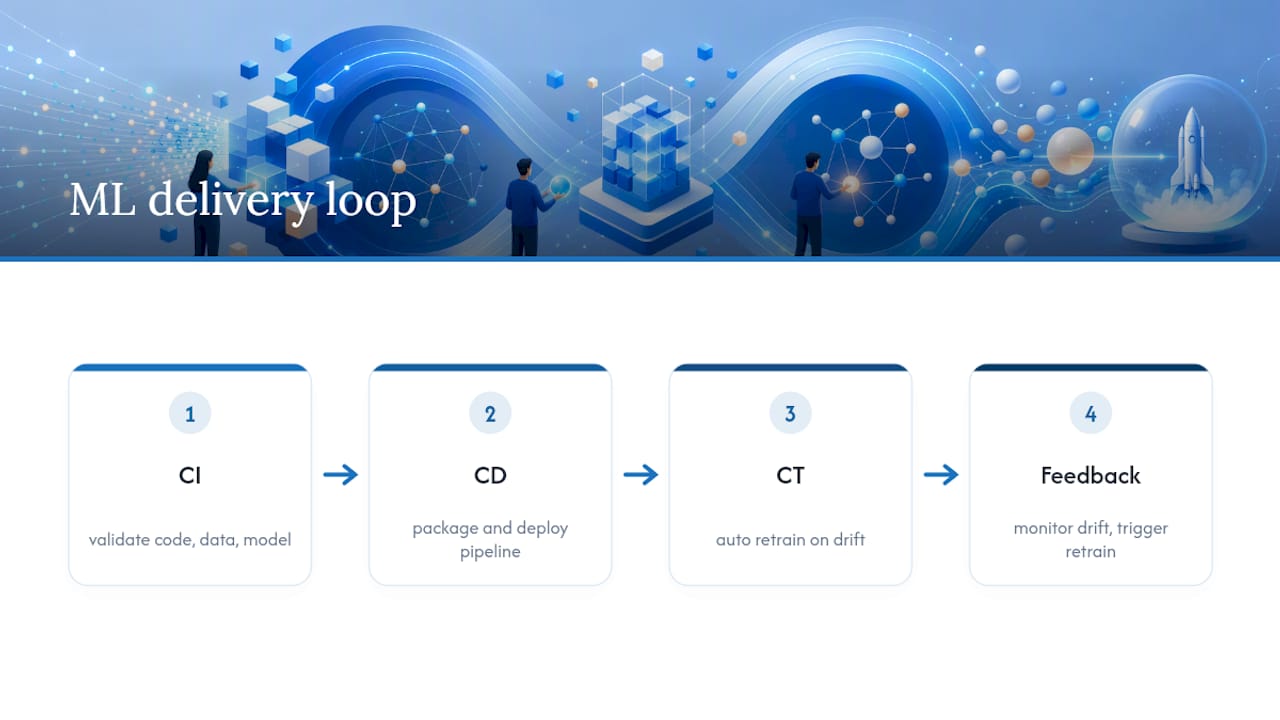
CI/CD/CT for machine learning looks different from standard software CI/CD. According to Google Cloud’s architecture guidance, CI must validate code, data, and schema, and it must test the model itself, not just check that the code compiles. CD packages and deploys entire pipelines and serving infrastructure, not a single artifact. CT, continuous training, is the piece most non-ML engineers have never heard of: it automates retraining when data drifts or performance degrades, without a human kicking off the job manually.
Feature stores solve a specific and expensive problem: training-serving skew, where a feature computed one way during training gets computed a different way in production. A feature store centralizes feature definitions so both training and real-time serving pull from the same logic. Batch feature computation works fine for models like monthly churn scoring; real-time serving is mandatory for anything like fraud detection where a prediction has to happen in milliseconds.
Model registries and artifact versioning are the practical implementation of the lineage principle covered earlier. Every model version gets a unique ID tied to its training data hash, code commit, and hyperparameters, which is what makes PITR possible when something goes wrong in production.
Monitoring and observability closes the loop. You need drift detection (is the input data distribution shifting?), performance alerting tied to service-level objectives, and automated retraining triggers. The Databricks Big Book of MLOps recommends a unified data catalog approach specifically because it simplifies root-cause analysis when a model’s accuracy suddenly drops and nobody can tell if it’s the data, the code, or the infrastructure. Our own breakdown of ML pipeline observability practices covers what that looks like in a live environment.
Pro Tip: Set retraining triggers based on data-distribution shifts or performance metrics rather than fixed calendar schedules. A model that only retrains monthly regardless of drift wastes compute on stable periods and reacts too slowly during volatile ones.
Who Should Own What in Your MLOps for Enterprises Setup?
Handoff friction kills more enterprise ML projects than bad models do. Getting the roles right matters as much as getting the architecture right.
- Data scientists own experimentation, feature engineering, and model evaluation logic.
- ML engineers own the inner-to-outer loop transition: packaging, deployment automation, and serving infrastructure.
- Data engineers own the pipelines feeding data into the data estate, and they own data quality gates.
- SRE and infrastructure teams own uptime, scaling, and incident response for serving infrastructure.
- Security and compliance own access controls, audit logging, and regulatory sign-off.
- Product owners own the business KPI the model is supposed to move, and they own the go/no-go call on deployment.
For structure, most enterprises do better with a platform team that builds and maintains shared infrastructure (registries, feature stores, CI/CD templates) serving multiple federated business-unit teams, rather than either a fully centralized team that becomes a bottleneck or fully independent teams that each reinvent the same tooling. Set a clear RACI for deployment approvals and incident response before your first pilot goes live, not after the first 2 AM page.
What Security and Governance Controls Does Production ML Need?
Explainability and audit trails aren’t optional extras bolted on for compliance theater. Every production prediction needs a logged trail back to the exact model version, training data, and code that produced it, because regulators, auditors, and your own incident responders will eventually ask for it. This is the same lineage discipline that makes PITR possible, applied to compliance instead of engineering recovery.
- Log every prediction with its model version, input hash, and timestamp
- Enforce role-based access controls on training data, model artifacts, and production endpoints
- Manage secrets (API keys, database credentials) through a dedicated vault, never hardcoded in pipeline configs
- Harden staging and production environments separately, with different credentials for each
- Run bias and fairness checks as a validation gate before promotion, not as a post-hoc audit
- Document model intent, limitations, and known failure modes for every production model
Our guide to automating compliance in cloud-native pipelines walks through how to bake these gates into deployment automation rather than treating them as manual checklist items someone forgets under deadline pressure.
What’s a Realistic Rollout Timeline for Enterprise MLOps?
A 6 to 12 month phased rollout beats a big-bang platform purchase almost every time, largely because it forces prioritization instead of letting a vendor’s feature list dictate scope.
- Phase 0, discovery (weeks 1 to 4). Inventory existing data sources, pipelines, and current KPIs. Run an AI readiness audit to surface where reproducibility, governance, or monitoring gaps actually sit.
- Phase 1, pilot (weeks 5 to 16). Pick one business-critical pipeline and build it out fully: CI/CD, model registry, and monitoring, end to end. Resist the urge to pilot three pipelines at once.
- Phase 2, platformize (months 4 to 12). Extract the reusable components (feature store, metadata repository, CI/CD templates) from the pilot and offer them as shared services to other teams, expanding governance coverage as you go.
Track time-to-deploy, model uptime, drift incident count, and the specific business metric the pilot was meant to move. If time-to-deploy doesn’t improve by phase 2, something in the platformization step is missing.
Pro Tip: Choose your pilot pipeline based on political visibility, not just technical simplicity. A boring but high-visibility win builds the organizational buy-in you’ll need for phase 2 far faster than a technically elegant project nobody outside the team notices.
How Digitalfractal Fits Into This Roadmap
An AI readiness audit can be built around a nine-area checklist: it inventories your data infrastructure, pipelines, and current KPIs, then hands back a prioritized backlog mapped to real gaps, not generic recommendations. That backlog becomes your Phase 1 pilot selection. The audit process targets a working transformation within 90 days, translating readiness findings directly into implementation. Whether to hire outside help or build this in-house usually comes down to bandwidth: if your platform team is already stretched thin on day-to-day production support, an outside audit accelerates the discovery phase without diverting your engineers from existing work.
How Does MLOps Connect to Your Existing Data Infrastructure?
MLOps pipelines don’t replace your data lake, warehouse, or ETL jobs. They sit on top of them, and the integration points are usually where enterprise projects stall.
Feature stores need to pull from the same warehouse tables your BI team already trusts, not a separate shadow copy that drifts out of sync. If your organization runs a lakehouse pattern, model training pipelines should read directly from the unified catalog rather than exporting flat files that nobody remembers to refresh. This is the data-centric architecture approach the Databricks guidance referenced earlier pushes for: one source of governed truth feeding both analytics and ML, which cuts down on the “which dataset is correct” arguments that eat weeks of engineering time.

Existing orchestration tools (Airflow, dbt, whatever your data engineering team already runs) should extend into the ML pipeline rather than get replaced by a parallel ML-specific scheduler. Duplicate orchestration layers are a common source of the tool fragmentation the systematic mapping study flagged earlier: two schedulers means two places for a job to silently fail.
Legacy systems complicate this further. A lot of enterprise data still lives in systems that predate any lake or warehouse strategy, and connecting those to a modern MLOps pipeline often needs custom integration work rather than an off-the-shelf connector. Our breakdown of AI integration challenges in legacy systems covers the practical patterns for bridging that gap without a full systems replacement.
Get the integration layer wrong and every downstream MLOps capability, from feature freshness to monitoring accuracy, inherits the problem.
What Breaks When MLOps Scales Across the Enterprise?
A pipeline that works cleanly for one team’s model often buckles under the weight of ten teams’ models running through the same shared infrastructure. Scaling problems in enterprise MLOps tend to show up in three specific places.
Compute contention is the first. When multiple teams schedule training jobs against the same GPU cluster, without resource quotas or priority queues, the team with the most urgent deadline ends up waiting behind a lower-priority batch job. Solving this usually means introducing a resource scheduler with quotas per team, not just adding more hardware.
Registry and metadata sprawl is the second. A single team’s model registry is manageable by hand. A hundred models across a dozen teams, each with multiple versions, needs enforced naming conventions, ownership tags, and automated cleanup of stale artifacts, or the registry becomes as unreliable as the manual spreadsheet it replaced.
Monitoring noise is the third, and the sneakiest. As model count grows, so does alert volume, and teams that don’t tune alert thresholds per model end up drowning in false positives until they start ignoring the dashboard entirely. The fix is setting service-level objectives per model criticality tier, not one blanket threshold for every model in the fleet.
The common thread: none of these are solved by buying more infrastructure. They’re solved by platform-level policies (quotas, naming standards, tiered SLOs) that scale independently of headcount.
How Do You Control Costs Across an Enterprise MLOps Platform?
Compute is the obvious cost driver, but it’s rarely the biggest one once a platform matures. Idle infrastructure, redundant retraining, and duplicated tooling usually cost more over a year than the training runs themselves.
The retraining trigger choice from earlier in this guide is a direct cost lever: scheduling every model to retrain nightly regardless of drift burns compute for no accuracy gain, while metric-based triggers only spend money when there’s an actual reason to. For models with stable input distributions, quarterly retraining schedules often perform identically to weekly ones at a fraction of the cost.
Shared infrastructure components (a single feature store, one model registry, common CI/CD templates) cut costs by eliminating the duplicate tooling that federated teams tend to build independently when no shared platform exists. This is the platformization argument from the roadmap section applied directly to budget: every component you build once and share is a component five other teams don’t rebuild badly.
Right sizing serving infrastructure matters just as much as training costs. A model serving predictions for a low-traffic internal tool doesn’t need the same always-on GPU endpoint as a customer-facing recommendation engine handling thousands of requests per second. Batch inference for non-time-sensitive predictions is almost always cheaper than real-time serving, and plenty of enterprise use cases default to real-time serving out of habit rather than actual latency need.
Finally, track cost per prediction, not just total platform spend. A model costing more per prediction than the business value it generates is a candidate for retirement, deprioritization, or a cheaper architecture, and you won’t spot that without per-model cost attribution.
How Should Enterprises Evaluate MLOps Tools and Vendors?
Choosing tools before choosing architecture is the single most common and most expensive mistake in enterprise MLOps for organizations building this out. Fix the reference architecture first (the data estate, inner loop, outer loop split covered earlier), then evaluate tools by the specific component gap they fill, not by feature checklist length.
A useful evaluation runs through a few concrete filters. First, does the tool integrate with your existing data estate, or does it require exporting data into a proprietary format? Second, does it support the lineage and metadata tracking your governance requirements demand, or does it treat that as an afterthought bolted on later? Third, what’s the actual operational burden of running it, meaning does it need a dedicated specialist team, or can your existing platform engineers maintain it alongside everything else?
Open source components (feature stores, orchestration frameworks, experiment tracking tools) reduce lock-in risk but shift maintenance burden onto your own team. Managed platform offerings reduce that maintenance burden but concentrate risk with a single vendor’s roadmap and pricing decisions. Neither answer is universally correct. It depends on whether your organization has the engineering bandwidth to run open source infrastructure reliably, or whether that bandwidth is better spent on the actual ML problems the business needs solved.
Whatever you choose, insist on evaluating against the nine-area checklist covered earlier, not the vendor’s own feature list.
Why Does Enterprise MLOps Fail Without Culture Change?
Technology rarely kills enterprise MLOps initiatives. Organizational habits do. The Practitioners Guide to MLOps makes a point worth sitting with: maturing past the pilot stage is as much a cultural shift as a technical one, and many organizations stall out because they automate a workflow without changing how the organization actually operates around it.
The clearest example is treating models like static software releases instead of living products. A model deployed once and left alone degrades as the world it was trained on changes, and teams that don’t build in ongoing ownership, monitoring responsibility, and retraining cadence end up right back at manual firefighting within a few months.
The second cultural shift is accepting that data scientists and ML engineers need genuinely different incentives and success metrics. A data scientist rewarded purely for model accuracy in a notebook has no organizational reason to care about deployment latency or monitoring overhead. Building shared ownership, where both roles are measured against the same production SLOs, changes that dynamic more effectively than any tooling mandate.
Resistance shows up predictably: teams that built ad hoc pipelines resent being asked to migrate to shared platform components, because it feels like losing autonomy. The practical fix is proving value on the pilot first (faster deployment, fewer 2 AM incidents) before mandating adoption elsewhere. Nobody adopts a platform because a slide deck told them to; they adopt it because the team next door stopped getting paged.
The Priority Leaders Keep Getting Backwards
Most enterprise ML programs invest in the model first and metadata as an afterthought. That’s backwards. A mediocre model with full lineage, monitoring, and PITR is recoverable when it breaks. A brilliant model with none of that is a black box you can’t debug at 2 AM, and eventually you will be debugging it at 2 AM.
The cultural shift matters just as much as the tooling: treat models as products with owners and SLOs, not one-off deliverables a data scientist ships and walks away from. If you take one thing from this guide, make it this: commission a readiness audit or sponsor a single pilot with full CI/CD and monitoring before you buy another platform license.
— Souhail
Turn Your Readiness Gaps Into a Working Pilot
An AI readiness audit can serve as a practical entry point to everything covered in this guide: it maps your organization against the same nine-area checklist, data management, experimentation, monitoring, governance, and the rest, and comes back with a prioritized backlog instead of a generic slide deck.
The audit’s deliverables translate directly into a roadmap: which pipeline becomes your Phase 1 pilot, which gaps need closing before CI/CD gets automated, and where governance controls are currently missing entirely, drawing on practical examples from the AI use cases by role and industry to guide decisions. Because the process is built to move fast, findings typically convert into a working pilot within a 90-day window rather than sitting in a strategy document. If your team is weighing whether to build this capability in-house or bring in outside help to accelerate discovery, start with the AI Readiness Audit and let the findings decide the rest. For teams ready to move straight into implementation, AI integration consulting picks up where the audit leaves off.
Sources
- Practitioners Guide to MLOps (Google)
- MLOps checklist (AWS Prescriptive Guidance)
- MLOps v2 reference architectures (Azure)
- An analysis of MLOps architectures: a systematic mapping study
FAQ
Is MLOps in high demand right now?
Demand is strong and climbing as more enterprises move ML from pilot projects into regulated, revenue-critical production systems that need dedicated operational discipline. Roles spanning ML engineering, platform engineering, and MLOps specifically are among the fastest-growing categories in enterprise technology hiring.
Is MLOps just DevOps for machine learning?
No. MLOps borrows CI/CD principles from DevOps but adds capabilities DevOps never needed, including data versioning, model registries, drift monitoring, and continuous training triggered by data changes rather than code changes alone.
What does an MLOps role typically pay?
Compensation varies widely by region, seniority, and industry, and no single reliable figure applies across markets, so treat any specific number you see quoted elsewhere with skepticism. Enterprises typically position these roles between senior data engineering and senior ML engineering pay bands given the cross-functional skill set required.
What’s the future of MLOps for enterprises?
Expect tighter integration between MLOps and data governance platforms, more emphasis on metadata and lineage as regulatory scrutiny of AI systems increases, and growing demand for modular, architecture-first approaches over single-vendor platform lock-in.
Do enterprises need a dedicated MLOps platform team?
Most enterprises benefit from a small platform team maintaining shared components (registries, feature stores, CI/CD templates) that federated business-unit teams consume, rather than either full centralization or fully independent team-by-team builds.