
Launch Safe LLMs in 90 Days: Practitioner Defense in Depth Plan

Safe LLM implementation comes down to one architectural choice: layering prompt-level constraints, retrieval-grounded generation, output guardrails, and operational monitoring into a single pipeline rather than treating any one control as sufficient on its own. This defense-in-depth approach is what separates production-grade deployments from demos that fall apart under adversarial pressure. The immediate next step is establishing risk tiers for each use case and building one validation set per tier before you write a single guardrail rule, using a framework like the NIST AI RMF to structure the governance layer around it.
TL;DR:
- Layered defenses, including prompt controls, retrieval grounding, output guardrails, and monitoring, are essential for resilient and secure LLM deployment.
- Common risks like prompt injection, hallucinations, retrieval poisoning, and data leaks often compound, requiring comprehensive mitigation strategies.
- Validating thresholds and using a risk-tiered approach with continuous calibration reduce false positives, false negatives, and improve safety.
- Guardrails should be implemented at four lifecycle points—input, retrieval, execution, and output—using both centralized and embedded solutions for maximum effectiveness.
- An AI Readiness Audit accelerates deployment by identifying governance, architecture, and tooling gaps, enabling a monitored, safe rollout within 90 days.
Table of Contents
- What Are the Biggest Risks in LLM Implementation?
- How Do the Three Layers of LLM Risk Mitigation Work Together?
- Which Guardrail Patterns Actually Work in Production?
- How Do You Deploy and Operate LLMs Securely at Scale?
- How Should You Test and Monitor an LLM in Production?
- How Digitalfractal Turns This Into a 90-Day Rollout
- Author Perspective: Two Pitfalls That Wreck Otherwise Solid Deployments
- Get a Structured Path to Safe LLM Deployment
- Authoritative Resources to Consult Next
- Sources
- FAQ
What Are the Biggest Risks in LLM Implementation?
Every safe LLM implementation strategy starts with an honest inventory of what can actually go wrong. Most teams underestimate how many of these failure modes compound each other. A prompt injection that succeeds can trigger a hallucinated tool call, which then leaks data through a permission gap nobody tested for.
Prompt injection and malicious inputs top the list because they’re cheap to execute and hard to fully block. Attackers embed instructions in user text, uploaded documents, or even web pages an agent retrieves, hoping the model treats attacker text as a system command. Quick detection signals include unexpected shifts in output format, sudden refusal-bypass language, or retrieved content that contains imperative phrasing aimed at the model itself.
Hallucinations and factual errors matter most in high-stakes applications: legal research, medical triage support, financial reporting, or any workflow where a wrong answer has real consequences. Retrieval-augmented generation reduces this risk substantially by grounding answers in verified source documents, but only if the retrieval layer itself is trustworthy.
Retrieval poisoning is the risk teams miss most often. If your knowledge base accepts unverified uploads or scrapes external content without provenance checks, an attacker (or just a stale document) can corrupt what the model treats as ground truth.
Tool-invocation and supply-chain risks grow as agentic systems chain function calls together. A model that can call a payment API, a code executor, or a third-party integration needs the same scrutiny you’d give a human employee with those permissions. Projects like ToolSafe show why reasoning over interaction history, not just the current call, catches issues that single-step checks miss.
Data leakage and compliance exposure round out the list:
- Vector stores that don’t enforce document-level permissions can surface confidential content to the wrong user.
- Logging pipelines that capture full prompts and outputs create a new data-retention liability if they’re not encrypted and access-controlled.
- Fine-tuning on customer data without a clear consent basis creates regulatory exposure under privacy laws that treat model weights as a potential data-extraction vector.
- Cross-border data residency requirements can be violated silently when a hosted model endpoint routes requests through infrastructure in another jurisdiction.
How Do the Three Layers of LLM Risk Mitigation Work Together?
A layered mitigation architecture works because no single layer catches everything. Prompt-level controls stop the obvious attacks. Architectural controls ground the model in truth. Behavioral controls catch what slips through both. Treating these as one integrated pipeline, rather than three disconnected tools, is what a three-layer mitigation framework recommends for teams that need something maintainable long-term.
Prompt-level defenses come first because they’re the cheapest to iterate on. Constrained system prompts define exactly what the model is allowed to discuss and in what format. Input/output engineering wraps every request in structural checks before it reaches the model and after it leaves. Refusal-aware instruction tuning trains the model to recognize when a request falls outside its authorized scope and decline gracefully instead of improvising.
Architectural defenses ground the system in verifiable data:
- RAG configuration matters more than most teams realize. Setting the right top-k retrieval count and similarity threshold determines whether the model sees genuinely relevant context or noise that increases hallucination risk.
- Verified semantic caching can bypass full inference entirely for queries with a semantic match above 80% against curated, pre-approved content. That’s a real win on two fronts: lower hallucination risk and lower latency and compute cost.
- Permission-aware vector stores enforce access control at the retrieval layer itself, so a document a user isn’t cleared to see never enters the model’s context window in the first place.
Behavioral defenses are the last line before output reaches a user. Targeted fine-tuning on domain-specific refusal patterns teaches the model your organization’s actual risk boundaries, not generic ones. Contrastive decoding techniques, including approaches like Dynamic PMI, adjust token probabilities to favor grounded, source-backed phrasing over confident-sounding fabrication. Requiring the model to extract a direct quote or citation before answering, and escalating to a human reviewer when retrieval confidence is low, closes most of the remaining gap.
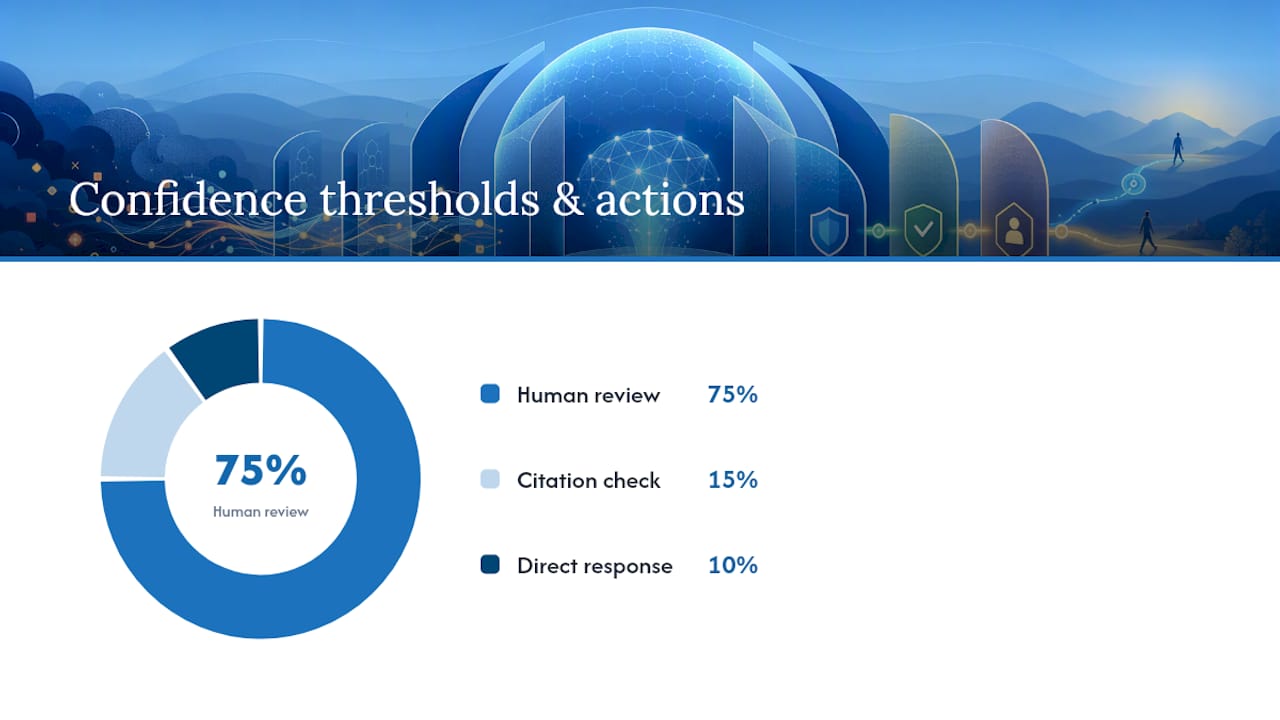
Calibration ties all three layers together. A workable starting point: treat confidence scores below 0.75 as automatic escalation to human review, scores between 0.75 and 0.90 as requiring a citation check before release, and anything above 0.90 as eligible for direct response, adjusted per risk tier.
Pro Tip: Don’t set these thresholds once and walk away. Run them against a held-out validation set monthly and retune based on where false positives and false negatives actually land for your specific domain.
The trade-off across all three layers is consistent: tighter controls mean higher latency and more false refusals. A verified semantic cache helps offset that cost by skipping full inference when it’s safe to do so, but there’s no configuration that eliminates the tension entirely. Budget for it explicitly rather than discovering it in production.
Which Guardrail Patterns Actually Work in Production?
Guardrails work best when applied at four distinct points in the request lifecycle, not bolted on as a single filter at the end. This lifecycle-oriented view, rather than a monolithic checkpoint, is central to how systematic guardrail design approaches the problem, and it needs multidisciplinary input from security, legal, and domain experts to get right.
- Input rails screen prompts before they reach the model, catching injection patterns, PII in user input, and off-policy requests.
- Retrieval rails validate documents before they enter context, checking provenance, freshness, and permission scope.
- Execution rails gate tool and function calls, enforcing least-privilege limits on what an agent can actually do.
- Output rails review generated text before it reaches the user, checking for policy violations, leaked secrets, or unsupported claims.
Two integration patterns dominate real deployments. A proxy guardrail layer sits between your application and the model API, intercepting every call. It’s easier to update centrally and works across multiple model providers, but it adds a network hop. In-process wrappers embed checks directly in your application code, which cuts latency but means every service that calls the model needs its own guardrail logic kept in sync.
Taint-tracking and provenance labeling deserve special mention. Tagging context segments as USER, WEB, INTERNAL_DOC, or TOOL_OUTPUT lets your enforcement logic adapt automatically based on where content originated, tightening restrictions on a session the moment untrusted content enters it.

For sample configurations: use a verification cache for high-volume, repetitive query types like customer support FAQs, and reserve full inference with output rails for novel or high-stakes requests. When evaluating an open-source toolkit, look at latency overhead per request, how easily you can add custom rail logic, and whether decisions are explainable enough to satisfy an auditor. NVIDIA’s NeMo Guardrails is a useful reference point for this evaluation because it exposes input, retrieval, execution, and output rails as separately configurable stages rather than one opaque filter.
One data point worth internalizing: that 80% semantic match threshold for cache bypass isn’t arbitrary. It reflects the point where curated, pre-verified responses reliably outperform fresh generation on both accuracy and cost for repetitive query patterns.
How Do You Deploy and Operate LLMs Securely at Scale?
Secure deployment starts with treating your LLM pipeline as software that goes through the same rigor as any other production system, not a special case that skips code review because “it’s just a prompt.” A secure SDLC adapted for AI walks through five stages, each with concrete checklist items.
- Specification: Define risk tier, data sensitivity classification, and acceptable failure modes before writing any prompt or choosing a model.
- Design: Map out which layer (prompt, retrieval, execution, output) handles each identified risk, and document trust boundaries between components.
- Integration: Wire guardrails, RAG pipelines, and logging into the application, with taint labels attached at every context boundary.
- Verification: Run adversarial test suites and validation sets against defined thresholds before anything ships.
- Release: Deploy with monitoring active from minute one, not added after an incident forces the issue.
Infrastructure choice depends on your risk tier. Hosted API endpoints from major providers work fine for low-sensitivity, high-volume use cases where speed to market matters most. Private cloud deployment makes sense once you’re handling regulated data and need contractual control over where inference happens. Air-gapped, on-premises deployment is reserved for the highest-sensitivity workloads, government, defense, certain healthcare and financial applications, where no external network connection is acceptable at any point in the pipeline.
Access control needs the same discipline you’d apply to any sensitive system. Encrypt data at rest and in transit, use a proper key management service rather than hardcoded secrets, and rotate credentials on a schedule instead of only after an incident. Apply role-based access control separately to the model endpoint and the vector store. A user with permission to query the model doesn’t automatically need permission to see every document in the retrieval index.
Network segmentation and least-privilege tool execution close the loop. An agent that can execute code or call external APIs should run in a sandboxed environment with only the permissions its specific task requires, and data residency rules need to be checked against wherever your hosted endpoint actually processes requests, not just where your application server sits.
How Should You Test and Monitor an LLM in Production?
Testing an LLM system safely means building validation sets before deployment, not discovering failure modes from user complaints. Start by defining metrics that matter for your specific application: factual accuracy against source documents, format compliance for structured outputs, and refusal rate for out-of-scope requests. Build a separate validation set for each risk tier, since a customer-facing chatbot and an internal research assistant need very different bars for what counts as acceptable.
Threshold calibration should be data-driven, not intuitive. Rather than a blanket moderation rule applied everywhere, optimize thresholds using confusion-matrix evaluation on your own validation data, tuning the false-positive and false-negative balance to match the actual cost of each error type in your domain. Run A/B tests comparing threshold settings against real traffic samples before committing to a production value, then revisit that number quarterly as your data and usage patterns shift.
Adversarial testing needs to cover three attack surfaces specifically:
- Prompt injection suites that try known jailbreak patterns and novel variations against your specific system prompt.
- Retrieval poisoning tests that inject manipulated documents into a test knowledge base to confirm your provenance checks catch them.
- Tool-invocation fuzzing that sends malformed or boundary-pushing inputs to any function-calling capability your agent has.
Production monitoring keeps the whole system honest after launch. Log provenance data for every response so you can trace exactly which documents and which model version produced it. Schedule weekly human sampling of a random slice of live outputs, not just the ones flagged by automated systems. Set up alerting for anomalies like refusal-rate spikes or sudden drops in citation confidence, and write an actual incident runbook before you need one.
Pro Tip: Treat mitigation as an ongoing quality-control pipeline, not a one-time configuration. The teams that get burned are the ones who tune thresholds once at launch and never look at them again.
A practical end-to-end testing checklist for ML pipelines gives a good starting structure for building these validation stages if you’re setting this up for the first time.
How Digitalfractal Turns This Into a 90-Day Rollout
An AI Readiness Audit maps directly onto the risk-tiering and architecture work this guide describes, compressed into a defined engagement rather than an open-ended consulting retainer. The audit assesses governance maturity, data quality and access controls, your existing architecture’s readiness for RAG and guardrails, and whether monitoring and incident response are already in place or need to be built from scratch.
A short checklist any team can run internally before engaging outside help: confirm you’ve defined risk tiers for every LLM use case, confirm your RAG pipeline has provenance and permission checks, confirm guardrails exist at input, retrieval, execution, and output stages, and confirm you have a monitoring dashboard and an incident runbook that someone has actually read. Case studies in Digitalfractal’s project archive show how this checklist translates into deployed systems across logistics and construction workflows.
Author Perspective: Two Pitfalls That Wreck Otherwise Solid Deployments
The first mistake teams make is stitching together point solutions instead of a lifecycle pipeline. A guardrail library here, a RAG setup there, no shared session state between them. The fix is enforcing outcomes into a persistent session with taint-tracking, so a flag raised at the retrieval stage actually restricts what the execution stage is allowed to do.
The second mistake is picking thresholds by gut feeling and applying one blanket moderation rule everywhere. Build a confusion matrix from real validation data instead, and calibrate per risk tier. If you’re stitching this together for the first time, that’s usually the moment to bring in an outside integration partner. Building it in-house works once you already have the validation infrastructure; before that, you’re paying for the mistakes an experienced team has already made once.
— Souhail
Get a Structured Path to Safe LLM Deployment
Most organizations trying to implement this framework alone spend months rebuilding the same guardrail infrastructure other teams have already stress-tested. Digitalfractal’s AI Readiness Audit exists specifically to skip that rebuilding phase: a structured assessment of your data, architecture, and governance gaps, followed by a tailored implementation roadmap built for your actual risk profile rather than a generic checklist.
Such engagements typically run on a defined timeline rather than an open-ended retainer. They start with an audit of current systems and risk tiers, move into a roadmap for the specific guardrail and RAG architecture the use case needs, and target a working, monitored deployment within a 90-day window. This structure matters especially for logistics or construction operations trying to automate document-heavy workflows safely, since generic consulting rarely accounts for the specific tool-invocation and data-residency issues some industries face. If your team is ready to move past planning documents, start with the AI Readiness Audit and get a concrete roadmap instead of another framework to read.
Authoritative Resources to Consult Next
For governance structure, start with the NIST AI Risk Management Framework. For mitigation architecture, the ACL 2026 findings on defense-in-depth and the MDPI tutorial on layered hallucination mitigation both offer implementation-ready detail. For guardrail design specifically, review the position paper on building LLM guardrails and try NeMo Guardrails hands-on. For ongoing multi-model evaluation, BabyLoveGrowth’s Multi-LLM Audit tool is a useful sanity check across providers.
Sources
- Findings ACL 2026 (defense-in-depth guidance)
- Dynamic PMI / Verified semantic cache (2026 preprint)
- MDPI tutorial (2025) on multi-layered hallucination mitigation
- NIST AI Risk Management Framework
FAQ
What Is Safe LLM Implementation?
Safe LLM implementation means deploying large language models with layered defenses, prompt constraints, retrieval grounding, output guardrails, and monitoring so no single failure point can cause a serious error or security breach
How Do You Reduce Hallucinations in LLMs?
Retrieval-augmented generation grounds answers in verified documents, and requiring the model to cite a direct source before answering, with escalation to a human when retrieval confidence is low, cuts hallucination risk substantially in high-stakes use cases.
What Are the Main Security Risks in LLM Deployment?
Prompt injection, retrieval poisoning, unsafe tool invocation, and data leakage through unprotected vector stores are the primary risks. Most incidents happen when these risks compound rather than occur in isolation.
How Much Does Digitalfractal’s AI Readiness Audit Cost?
The AI Readiness Audit pricing varies depending on project scope, delivered as a one-off engagement rather than an ongoing retainer.
When Should You Escalate an LLM Response to a Human Reviewer?
Escalate when confidence scores fall below roughly 0.75 on a calibrated validation set, or whenever retrieval confidence is low enough that the model cannot produce a direct citation to support its answer.