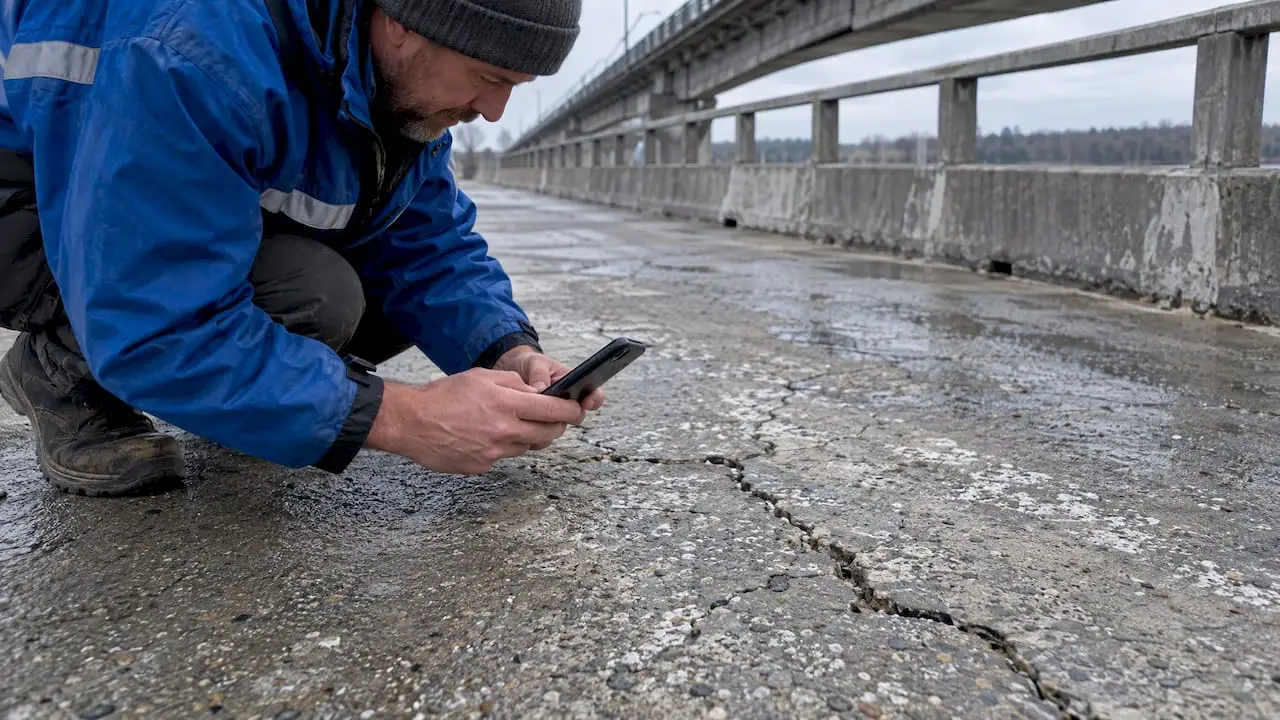
Concrete Crack Detection: What AI Can and Can’t Do

Concrete crack detection means finding cracks, measuring their width and length, and deciding whether they matter. Inspectors have done this by eye, with crack gauges and with ultrasonic tools for decades. Computer vision now automates the first step, spotting and mapping surface cracks in photos, video and drone footage. It does not automate the last step, judging severity. That still belongs to a structural engineer.
This guide covers how cracks are classified, which tools confirm them, where AI helps and where it fails, and how to run a pilot on your own assets without buying hype.
TL;DR
- Width is the first screen: cracks under 0.3 mm are often shrinkage-related, while severe exposure can call for limits near 0.1 mm.
- Computer vision is good at finding and mapping surface cracks at scale. Recent YOLO-based models report accuracy above 70% in rain, wind and fog, so expect false positives and misses.
- AI flags. Engineers decide. Severity depends on crack orientation and load path, not width alone.
- Gauges and ultrasonic tools supply the ground truth that validates any AI system.
- A 90-day pilot on your own images is the safest way to test whether automation fits your inspection workflow.
Table of Contents
- How cracks are classified before any tool comes out
- Why width alone is the wrong question
- The classic toolkit: what confirms a crack
- What computer vision does well
- Where it fails, and why that matters on a real site
- Where the field is heading: fusing more than pictures
- Our perspective: detection is a workflow problem, not a model problem
- How to pilot AI crack detection on your assets
- Start with a readiness audit
- Quick field checklist for a suspicious crack
- FAQ
- Sources
How cracks are classified before any tool comes out
A crack is a fracture within the cement and aggregate of a structure. It can be a surface crack or pass completely through the member, and observing cracks is the most common job in concrete condition work, as IN Engineering notes in its guidance on concrete deficiencies.
The usual width bands used in engineering practice, per the same source, are:
| Class | Width | Typical reading |
|---|---|---|
| Hairline | under 0.1 mm | Often cosmetic, watch in severe exposure |
| Narrow | 0.1 to 0.3 mm | Often shrinkage, may still need monitoring |
| Medium | 0.3 to 1.0 mm | Needs a diagnosis |
| Wide | over 1.0 mm | Escalate to an engineer |
The exposure matters as much as the number. The same source says severe environments, such as marine or freeze-thaw, may require widths kept below 0.1 mm, while mild exposure tolerates about 0.3 mm. That second figure shows up in design codes too: Hilti’s engineering notes state that crack widths under ACI 318 and CSA A23.3 are assumed to be about 0.3 mm in non-seismic cases and about 0.5 mm for seismic loading, with reinforcement controlling width.
For Canadian owners, freeze-thaw is not an edge case. Parking structures, bridge decks and exterior slabs in Alberta, Ontario and Quebec all sit in the severe-exposure column for much of the year. A crack that would be shrugged off in a heated basement slab deserves a second look on a salted deck.
Why width alone is the wrong question
Most people ask how big a crack can be before it is a problem. Engineers ask where it runs and what it does to the load path.
According to PCCI’s field workflow for dam owners, the most overlooked step is working out the crack’s orientation and path relative to the load. A longitudinal crack on top of a flange has very different implications from a 45-degree shear crack in a web. Accurate assessment means mapping the crack against the structural drawings to see whether it interrupts the intended load path.
The same workflow assesses severity on three axes:
- Structural: does it affect capacity or load transfer?
- Durability: does it let water, chlorides or carbonation reach the steel?
- Watertightness: does it leak where the structure has to hold water?
A visually alarming crack can sit within the expected behaviour of the design, for example flexural cracks in an under-reinforced element. The reverse also happens: a thin crack in the wrong place gets missed because nobody measured it against the drawing. This is exactly where a detection system needs to be framed carefully. Its job is to surface candidates for professional review, not to issue verdicts.
The classic toolkit: what confirms a crack
Before AI, and still alongside it, inspectors use a small set of tools. The research on asset assessment of concrete structures, published in 2023, describes the range from simple visual aids to precision instruments:
- Crack comparator cards or template gauges for quick width readings on site.
- Tell-tale crack monitors and caliper gauges fixed across a crack to track movement over time. Products such as the Avongard crack monitor exist because monitoring changes in width helps determine the cause of a crack, and most cracks are of little consequence but a few are the first sign of a serious defect.
- Ultrasonic detectors that estimate crack depth and concrete integrity, which tells you whether a surface line actually penetrates the member.
- Structural drawings, which are not a tool in the hardware sense but are essential to read a crack in context.
For long-term monitoring, photographs are rarely enough. Mechanical tell-tales or digital calipers on fixed pins track microscopic movement, and those manual readings are the ground-truth data you need to validate or calibrate any automated monitoring system. If a vendor offers AI crack monitoring without a plan for ground-truth checks, that is a red flag.
What computer vision does well
Deep learning models learn what a crack looks like from thousands of labelled images, then find and outline cracks in new photos. The appeal is obvious: a drone or a phone camera covers a bridge deck, a parkade level or a tilt-up wall far faster than a person with a comparator card, and it produces a consistent, timestamped record.
The research is moving quickly. A 2025 paper on an enhanced YOLO architecture for concrete cracks reports detection accuracy above 70% in varied conditions including wind, rain and fog, with architecture improvements such as multi-scale feature aggregation adding between 2.4% and 7.9% over baseline versions in benchmark tests. Read that number honestly. It is strong for a hard visual problem and still means a meaningful share of cracks or non-cracks will be misjudged. In practice that pushes you toward using AI as a triage layer: it ranks and flags, and a person reviews the flagged set.
Where automation earns its keep:
- Coverage: screening thousands of images of decks, slabs, walls or tunnel linings that nobody has time to review frame by frame.
- Consistency: the same model applies the same threshold to every image, which removes some inspector-to-inspector variation.
- History: every flagged crack is georeferenced or tied to an image, so you can compare the same location year over year.
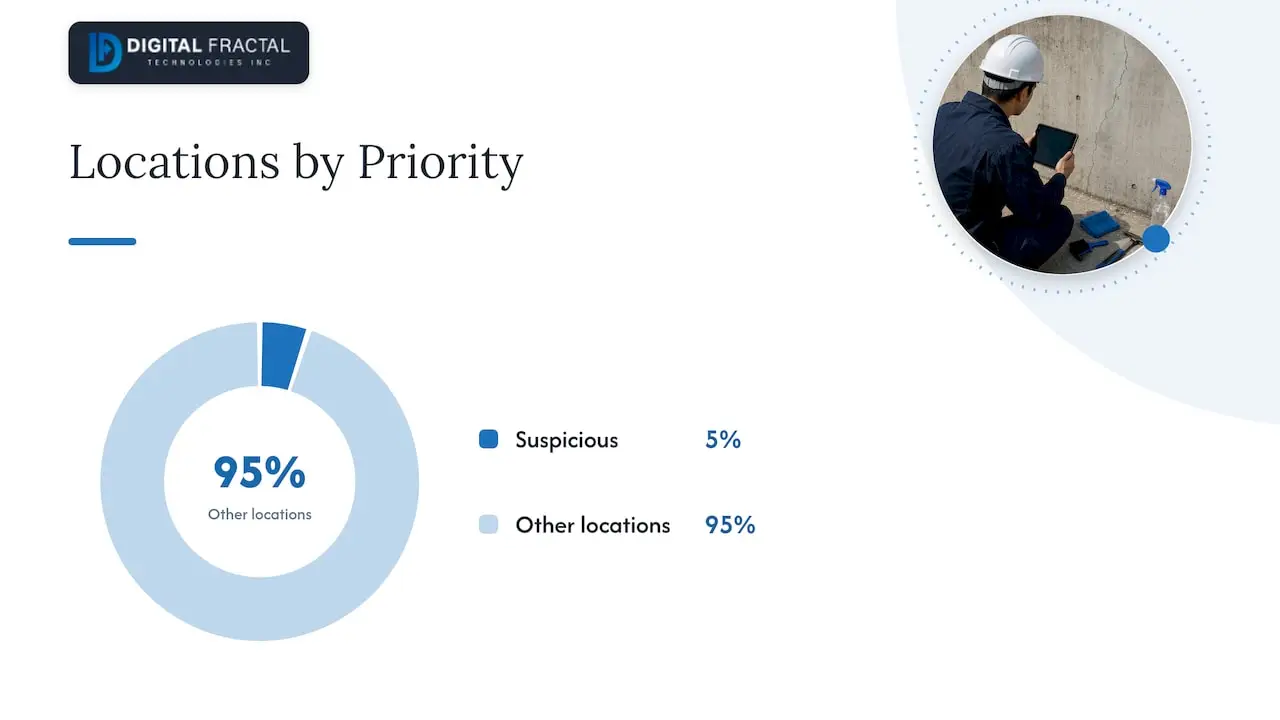
- Prioritization: engineers spend their hours on the 5% of locations that look suspicious, not on scrolling through the other 95%.
Where it fails, and why that matters on a real site
Practitioners and researchers agree on the limits. A 2025 review of automated defect detection in infrastructure points to low robustness in complex real-world scenes with shadows, debris and changing light. It also flags a lack of standardized datasets that train models to assess how serious a crack is, rather than just whether one exists.
In the field that shows up in a few predictable ways:
- Crazing and surface shrinkage lines get flagged as structural cracks.
- Shadows, form-tie marks, stains and debris look like cracks to a model trained on clean images.
- Depth is invisible. A camera sees the surface. Practitioners pair visual AI with handheld ultrasonic detectors or tell-tale gauges to confirm whether a crack penetrates or is merely cosmetic, as IN Engineering describes.
- Models do not transfer cleanly. A model trained on bridge decks in good light can fall apart on a wet, dark parkade ceiling.
Open datasets and GitHub repositories are a fine way to learn. A model trained on a public surface-crack dataset of cropped, centred images is a long way from a production inspection system that has to cope with your site’s lighting, finishes and camera angles.
Where the field is heading: fusing more than pictures
The more promising direction is multimodal. Researchers writing in 2026 argue that intelligent structural health assessment lies in combining computer vision with other sensing, such as thermal, acoustic or vibration data, 3D LiDAR and ground-penetrating radar. Surface imagery alone cannot see inside the member, and fused data gives a deeper picture of internal integrity.
For an owner, the takeaway is practical: do not design your program around one camera. Design it around a data pipeline that can accept more sources later, with a clean way to store images, measurements and engineer decisions together.
Our perspective: detection is a workflow problem, not a model problem
We build AI for construction, logistics and industrial clients, and the pattern repeats. Teams ask which model is most accurate. The better question is what happens to a flagged crack the next morning.
A useful crack detection system answers four things. Who reviews the flag? What evidence do they see, the image, the location, the previous inspection? What do they record, and where does it go? And how does a confirmed ground-truth reading, from a gauge or an ultrasonic test, feed back to improve the model?
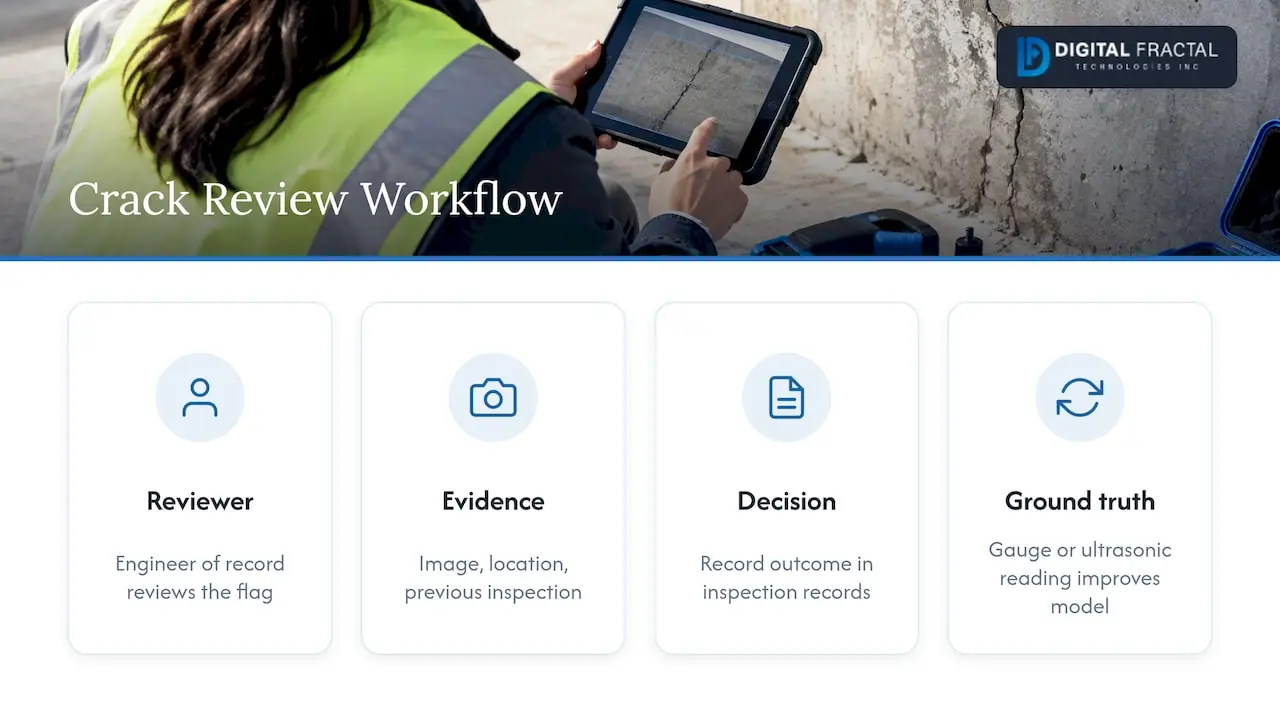
That is why we treat this as workflow automation wrapped around computer vision. The model is one component. The rest is capture standards, review queues, integration with the inspection records you already keep, and a clear line that the engineer of record makes the call. If a project cannot name that engineer and that line, we would rather scope it down than ship a dashboard that looks authoritative and isn’t.
We also push for a bounded start. Our approach is tailored to your workflows, systems and goals, not an off-the-shelf tool, and we aim to show tangible results within 90 days. For crack detection, that usually means one asset class, one capture method, and a measured comparison between the model’s flags and your inspectors’ findings.
— Souhail
How to pilot AI crack detection on your assets
A practical sequence for a facilities, construction QA or infrastructure team:
- Pick one asset type. A parkade, a bridge deck, a precast yard. Mixing environments in the first pilot muddies the results.
- Define what counts as a finding. Use width bands, exposure class and your engineer’s criteria, not the model’s default labels.
- Standardize capture. Fix camera distance, resolution, lighting and overlap. Most model failures start with inconsistent photos.
- Build a ground-truth set. Have inspectors measure a sample of cracks with comparators and gauges, and use ultrasonic checks where depth matters.
- Run the model against that set. Track missed cracks and false alarms separately. Missed cracks are the costly error.
- Decide the review path. Every flag goes to a named reviewer, and severe or unclear cases go to the structural engineer.
- Compare cost and time. Measure hours per inspection before and after, then decide whether to expand.
If you want to see how this looks in construction workflows, our pages on the AI construction defect detection workflow, AI video analytics for construction sites and a vendor-neutral 90-day construction QA pilot go into more detail. For the technology side, see our computer vision AI solutions.
Start with a readiness audit
If you are not sure whether your photos, records and inspection process are ready for automation, the AI Readiness Audit is where we begin. It is a one-off engagement priced from $2,500 to $10,000, and it identifies where automation fits across your operations, including construction and inspection workflows. You come out with a prioritized list of opportunities and a clear view of data gaps before you commit to a build. If you already know you want to move, our AI consulting and machine learning solutions cover discovery, implementation and computer vision work.
Quick field checklist for a suspicious crack
Whether or not AI is in the picture, a short routine keeps decisions defensible:
- Photograph the crack with a scale reference and note the date, location and exposure (interior, exterior, de-iced surface).
- Measure the width with a comparator card and mark the ends of the crack so you can see if it grows.
- Note orientation relative to the member and any signs of water, rust staining or efflorescence.
- Install a tell-tale or caliper monitor if movement is suspected, and record readings on a fixed schedule.
- Escalate to a structural engineer if the crack is wide, growing, in a shear zone or near a critical connection, and for any crack in a structure where failure has life-safety consequences.
PCCI describes a five-step field workflow: observe, classify, diagnose, assess severity, decide response. For a typical crack pattern it reports 60 to 90 minutes of work. AI can speed up the first two steps. It does not remove the last three.
FAQ
How do you detect cracks in concrete?
Start with a visual survey and measure widths with a crack comparator. Use ultrasonic detectors to check depth and tell-tale gauges to track movement. Computer vision can screen large surfaces in photos or drone footage and flag candidates for these checks.
How do you know if a concrete crack is serious?
Width, growth, location and orientation all count. Wide cracks, cracks that keep opening, shear-type diagonal cracks and cracks in severe exposure deserve an engineer’s review. A thin crack can still be serious if it crosses the load path.
How big of a crack is acceptable in concrete?
It depends on exposure and the structure. General practice treats cracks under 0.3 mm as often shrinkage-related, while severe exposure such as freeze-thaw or marine conditions may need limits near 0.1 mm. Your engineer or the governing code sets the limit for a specific element.
Can computer vision replace a structural engineer for crack assessment?
No. Current models detect surface cracks but struggle with shadows, debris and severity assessment, and standardized datasets for severity are still lacking. Use AI to triage and document, and keep the engineer responsible for diagnosis and response.
Sources
- Concrete Deficiencies: When do I need an inspection? (IN Engineering Ltd.)
- What is cracked concrete? (Hilti Engineering Center Canada)
- Concrete Crack Diagnosis: 5-Step Field Workflow (PCCI)
- Asset Assessment of Concrete Structure
- Avongard Crack Monitor (Berntsen)
- CGSW-YOLO: Enhanced YOLO Architecture for Automated Crack Detection (MDPI Symmetry)
- Automated defect detection in infrastructure review (Taylor & Francis)
- Multimodal structural health assessment (SciOpen)