Quantity Takeoff AI: What It Can and Can’t Do for Estimators

AI quantity takeoff uses computer vision and machine learning to read construction drawings and pull counts, lengths, areas and volumes out of them, so an estimator reviews a draft instead of measuring every sheet by hand. It works best as an assistant: it produces a fast first pass, and a qualified estimator confirms the scope, adds what is not drawn, and owns the number that goes into the bid. This guide explains how it works, where it breaks, what to ask before you buy or build, and how a Canadian contractor can test it without betting the estimating department on it.
TL;DR
- AI takeoff automates the measuring step: it extracts quantities from PDF or CAD drawings so estimators spend their time on pricing and risk.
- It produces a draft, not a bid-ready number. Scope that lives in specifications, addenda and site conditions still needs a human.
- Insist on traceability: every quantity should point back to the exact line, symbol or schedule it came from.
- General chat tools are not takeoff tools. They lack the spatial reasoning and unit logic that drawings demand.
- The practical route is a short, bounded pilot on your own drawings and your own estimating workflow, not a generic rollout.
Table of Contents
- What a quantity takeoff is, and why it is called that
- How AI takeoff works
- Where AI takeoff falls short
- The trust gap: from draft quantities to bid-ready numbers
- Traceability: the feature that decides adoption
- What a Canadian estimating team should check before starting
- Buy, build or customize
- A 90-day way to test it
- Our perspective
- Where takeoff fits in a wider automation plan
- Start with an AI readiness audit
- FAQ
- Sources
What a quantity takeoff is, and why it is called that
A quantity takeoff is the step in estimating where the estimator quantifies the materials, labour and equipment a project needs by measuring the drawings. Canadian cost consulting guidance treats it as the foundation of the whole project budget: get the quantities wrong and every price built on them is wrong too.
The name is literal. The estimator “takes off” quantities from the drawings and turns them into a list of requirements: linear metres of footing, square metres of drywall, number of light fixtures, cubic metres of concrete. Pricing, labour productivity and markups come afterwards.
Traditionally that means a person with plans, a scale or a digitizer, and a lot of patience. It is accurate when the estimator is experienced, and it is slow. It also repeats itself: every addendum or revision sends someone back through the sheets.
How AI takeoff works
AI-based takeoff takes a drawing set, usually PDFs and sometimes CAD files, and does three things.
- Reads the sheet. Computer vision identifies the drawing type, the scale, the legend and the symbols.
- Detects and measures. Models recognize walls, rooms, doors, fixtures, pipe runs or slabs, then count, measure lengths and compute areas and volumes.
- Organizes the output. Quantities are grouped into categories the estimator can export to a spreadsheet or estimating system.
The quality of each step depends on the drawing. Clean vector PDFs with consistent legends are the easy case. Scanned sheets, hand markups, overlapping hatches and legends that do not match the symbols on the plan are the hard cases.
What it is genuinely good at
- Counting repeated items. Fixtures, devices, doors, columns and similar objects are the classic win, because the work is repetitive and the symbol is consistent.
- Measuring areas and lengths. Floor areas, wall lengths and roof outlines are tedious by hand and well suited to automation.
- Re-running after revisions. When a new drawing set arrives, a tool can compare and re-extract faster than a person can re-measure.
- Consistency. It applies the same rules on sheet 80 as on sheet 1, at the end of a long day or on a Friday before a bid closes.
Industry commentary also stresses that AI is no longer just for simple counting. The Canadian Construction Association describes construction technology as a way to help firms respond to housing and infrastructure pressure by automating routine tasks, which frees senior people for risk analysis and pricing strategy.
Where AI takeoff falls short
The limits matter more than the demos, because they decide whether the tool saves you money or just moves the work around.
The drawings do not contain the whole scope
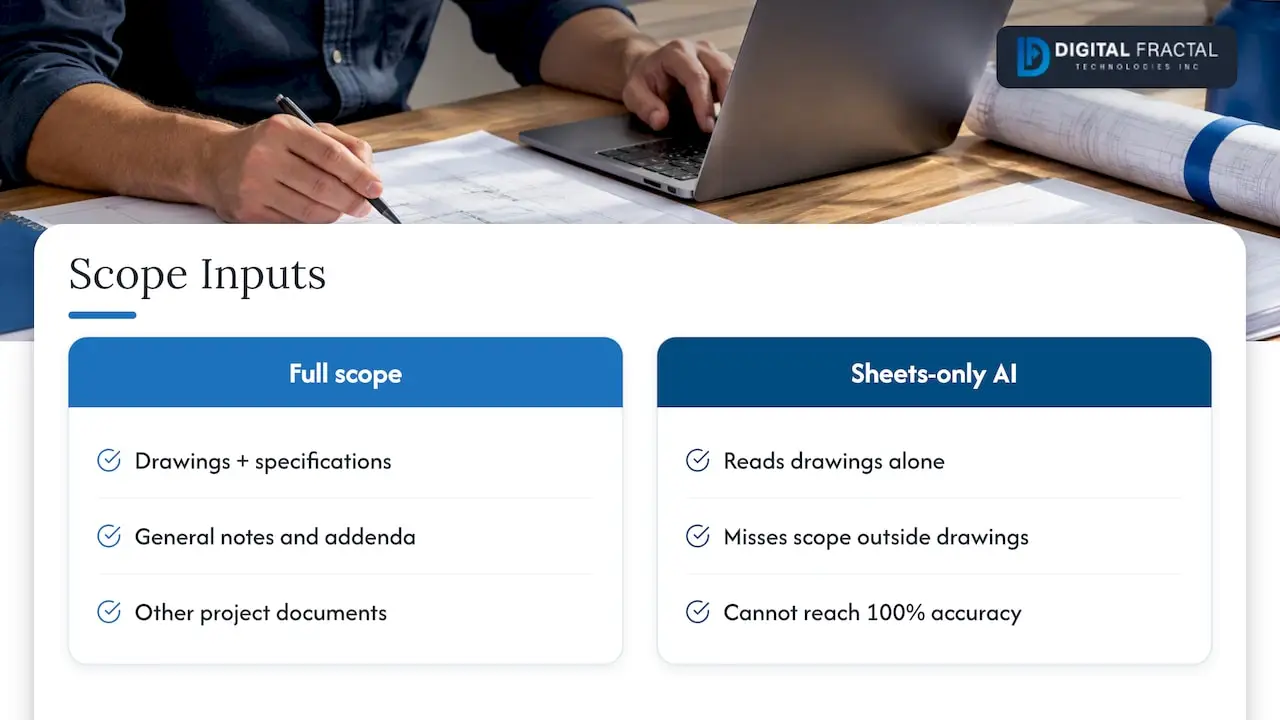
Critical scope information often sits in specifications, general notes, addenda and other project documents outside the drawings. A tool that only reads the sheets has a performance ceiling, and the gap is the reason purely automated systems do not reach 100% accuracy. A case study from a consultant who worked with a steel frames manufacturer describes this plainly: the model depends on human-made takeoff breakdowns to learn, and those only exist once the work has been done.
Implied work is not drawn work
Experienced estimators build a takeoff in the order the work is actually built, from footings to roof. That discipline catches items that are implied but never drawn, such as cleanup, temporary protection or site-specific conditions. A practical estimating guide from Gordian makes the same point from the estimator’s side: study the contract documents and visit the site so you understand what the job is really trying to accomplish. An AI reading a drawing does not visit the site.
Waste and allowances are judgment calls
Net quantities from a drawing are not purchase quantities. Framing lumber, for example, needs a waste factor for bad stock and jobsite error, and the right percentage is debated. Building Science Corporation’s work on advanced framing frames the question as whether 5% or 15% is reasonable. That is a decision made by someone who knows the crew, the supplier and the design, not a number a model should guess.
Chat assistants are not takeoff engines
General-purpose language models cannot reliably do construction takeoffs. They lack the spatial reasoning, unit conversion logic and knowledge of CAD and PDF drawing conventions that accurate measurement needs. They can help you draft a checklist or explain a term. They should not be the thing that produces the quantities you bid on.
The trust gap: from draft quantities to bid-ready numbers
Construction technology analysts describe a “trust chasm” between the AI’s draft quantities and numbers an estimator will sign off. Professional review is what crosses it. The sensible mental model, according to analysis published alongside a University of Kansas comparison study, is an estimating assistant rather than an estimator replacement.
That has a practical consequence for how you evaluate any tool, bought or built: measure the time to a reviewed takeoff, not the time to a first draft. A tool that produces a draft in minutes and needs three hours of untangling saves you nothing.
Traceability: the feature that decides adoption
The single most useful requirement you can set is that the tool shows its evidence. Practitioners warn against “black box” tools that return a total without saying where it came from. A takeoff you can trust shows, for every quantity, the specific line on the drawing or schedule it was taken from, so the estimator can audit the logic in seconds instead of recalculating from scratch. The same case study makes this a condition of commercial viability.
In practice, ask for:
- A visual overlay on the sheet showing what was counted or measured.
- A link from each line item back to its source sheet and region.
- A clear flag for anything the system was unsure about, rather than a silent best guess.
- A change log between drawing revisions.
- Export into the spreadsheet or estimating system your team already uses.
What a Canadian estimating team should check before starting
Canadian projects bring their own wrinkles, and a tool tuned for another market may stumble on them.
- Units. Many Canadian drawing sets mix metric and imperial, depending on the discipline and the owner. Test the tool on a set that does both.
- Drawing conventions. Different consultants, and different provinces, use different legends and standards. Run it on your own recent projects, not a vendor sample.
- Who signs off. Where a professional quantity surveyor or cost consultant is involved on a project, their review does not disappear. AI changes how the draft is produced, not who is accountable.
- Data handling. Drawings can be confidential owner or government documents. Ask where files are stored and who can access them before uploading a live bid.
- Pricing model. Some off-the-shelf tools charge per sheet with annual volume commitments. If your volume swings by season, model what a slow quarter costs before you sign.
Buy, build or customize
There are three realistic routes, and the right one depends on how standard your drawings and workflows are.
| Route | Fits when | Watch for |
|---|---|---|
| Off-the-shelf takeoff product | Your drawings are fairly standard and you want to start fast | Fit with your assemblies, cost codes and export format; per-sheet fees; limited control over the model |
| Custom AI built around your workflow | You estimate specialized work (industrial, civil, prefabricated components) or want the output to feed your own systems | Needs a clear scope, representative sample drawings and a human review step designed in |
| Hybrid | You want a product for counting plus automation around it for checklists, addendum comparison and handoff to pricing | Keeping the pieces connected so estimators do not re-key data |
The real cost of a takeoff is rarely just the measuring. It is also the handoff: moving quantities into cost codes, pricing sheets, bid packages and the project system after you win. That is where custom workflow automation often earns more than the takeoff step itself.
A 90-day way to test it
A short, bounded pilot beats a long evaluation. Here is a structure that keeps the risk small.
- Weeks 1 to 2: pick the scope. Choose one trade or one project type, such as interior finishes on commercial fit-outs, and gather five to ten completed projects with their final takeoffs.
- Weeks 3 to 5: baseline. Record how long your estimators take today and where the takeoffs have historically been corrected.
- Weeks 6 to 9: run in parallel. Produce the AI draft, have an estimator review it, and compare against the manual takeoff. Log every discrepancy and its cause: missed symbol, legend mismatch, scope outside the drawings.
- Weeks 10 to 12: decide. Measure time to a reviewed takeoff, error types and how easily the estimator could audit the output. Keep, adjust or stop.
Published benchmarks from takeoff vendors are marketing as much as evidence, so treat them as a reason to test and not a figure to plan around. Your own drawings will give you the only number that matters.
Our perspective
We work with construction and logistics firms on AI integration, and the pattern we see is consistent: the firms that get value from AI do not start with the tool, they start with the workflow.
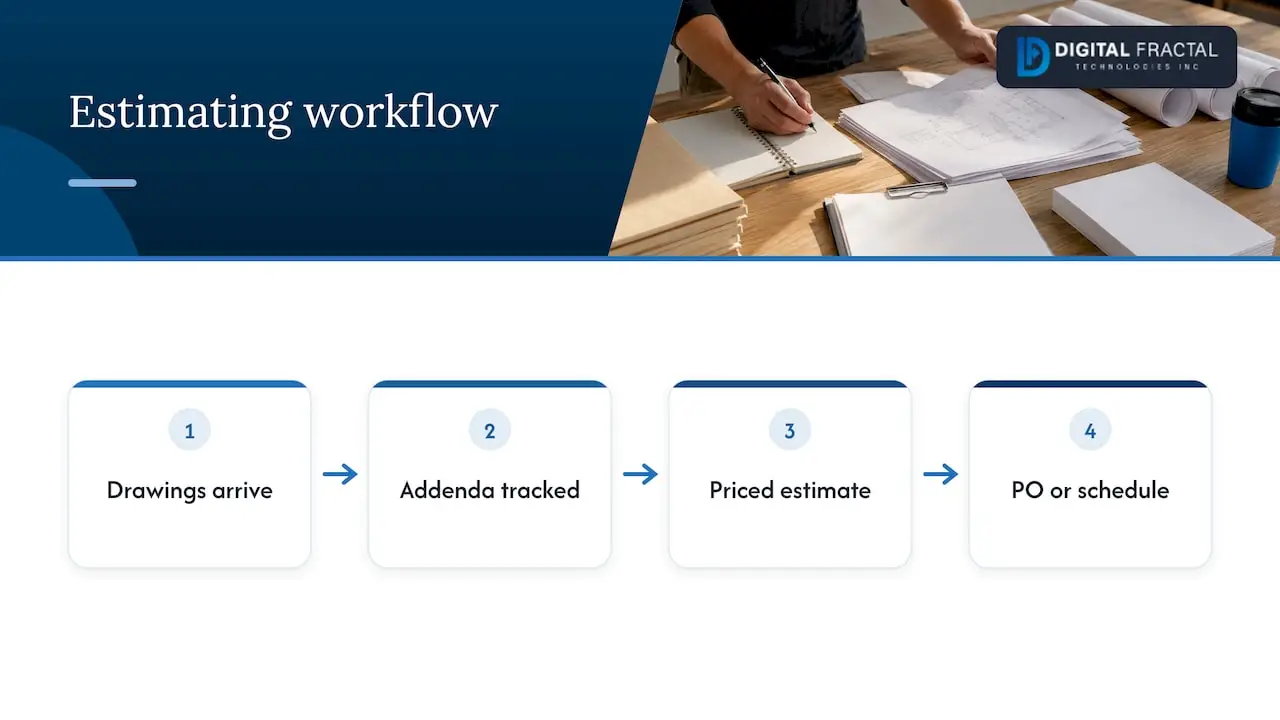
Takeoff is a good example. The measuring is the visible pain, but the savings come from the whole chain: how drawings arrive, how addenda are tracked, how quantities become a priced estimate, and how that estimate becomes a purchase order or a schedule. Fix only the measuring and the bottleneck moves to the next step.
We also believe in treating AI output as a draft that earns trust. That is why we design review steps and evidence trails into the systems we build, so an estimator can see where a number came from and correct it quickly. Generic consulting that hands you a slide deck about “AI strategy” does not help an estimating desk on a bid deadline. Tailored automation fitted to your drawings, your systems and your goals does, and a 90-day horizon keeps everyone honest about whether it is working.
— Souhail
Where takeoff fits in a wider automation plan
Once quantities are reliable, the neighbouring steps become easier to automate. Our own write-ups cover several of them:
- Construction automation use cases that deliver real ROI shows where time is usually lost between estimate and execution.
- Contract review automation helps catch scope and risk language that never appears on the drawings, which is exactly the gap takeoff tools cannot see.
- Submittal tracking with AI follows the work after award.
- Jobsite progress tracking closes the loop by comparing what was estimated with what is being built.
Before any of this, check that your data is usable. Drawings, specs and past estimates stored in inconsistent folders will limit any model, which is why we start with enterprise data readiness.
Start with an AI readiness audit
If you are weighing takeoff automation and are not sure where to begin, our AI Readiness Audit maps your estimating and project workflows, identifies the repetitive work worth automating, and tells you whether a ready-made product, a custom build or a hybrid fits. It is a one-off engagement priced from $2,500 to $10,000, and it is how most of our client work begins. If the audit points to automation around estimating, handoffs or document control, we build it through our workflow automation service.
FAQ
Can ChatGPT do construction takeoffs?
Not reliably. General-purpose language models lack the spatial reasoning, specialized unit conversions and understanding of CAD and PDF drawing conventions that accurate measurement requires. They are useful for drafting checklists or explaining terms, but quantities you bid on should come from a tool built for drawings, reviewed by an estimator.
Will AI replace estimators?
The evidence points to assistance, not replacement. Professional review is what turns draft quantities into bid-ready numbers, and scope found in specifications, notes and site conditions still needs a person. Firms that use AI to automate the routine measuring free senior estimators for risk analysis and pricing strategy.
How do you do a quantity takeoff?
You review the drawings and specifications, measure counts, lengths, areas and volumes for each work item, and organize them in the order the work is built, from footings to roof. Then you add waste allowances and implied work such as cleanup. AI speeds up the measuring, and the estimator still checks the sequence and the scope.
What should I look for in an AI takeoff tool?
Traceability first: each quantity should link to the exact place on the drawing it came from. Then test it on your own recent projects, including mixed metric and imperial sets, and measure the time to a reviewed takeoff. Check export formats and how files are stored and protected.
Does AI help with construction cost estimation beyond takeoff?
Yes, mainly in the steps around the takeoff: comparing addenda, checking contract scope, moving quantities into cost codes and keeping estimates connected to purchasing and schedules. Pricing judgment, productivity assumptions and risk allowances remain human decisions.
Sources
- CACQS Best Practices Guide
- Canadian Construction Association: how construction technology can help Canada
- A Case Study in the Limits of Takeoff Automation
- University of Kansas study on AI and traditional takeoff
- Gordian: How to Estimate Thoroughly and Accurately for Every Project
- Building Science Corporation: Advanced Framing