
Logistics Leaders: Cold Chain Monitoring AI Pilot and Audit Controls

AI-powered cold chain monitoring is worth adopting when your operation ships temperature-sensitive goods across more than a handful of lanes and manual logging keeps missing excursions until it’s too late. It works by turning raw temperature telemetry into predictive alerts, catching problems hours before a human would notice. The payoff shows up in three places: fewer spoiled shipments, faster corrective action, and audit records regulators actually trust.
TL;DR:
- Conduct a readiness audit to assess sensor data quality and coverage before investing in AI platforms, as poor data halts progress.
- Start with a pilot on two or three high-risk lanes, focus on defining success metrics, and validate model performance with human review.
- Use explainability and audit trail features, such as cryptographic hashes and override logs, to ensure AI decisions are transparent and compliant.
- Track key KPIs like detection lead time, false alert rate, and energy consumption to measure the AI system’s effectiveness beyond basic excursion reduction.
- Avoid sensor placement and data silos issues by selecting appropriately accurate sensors and ensuring comprehensive data collection across the entire shipment.
Table of Contents
- What Cold Chain Monitoring AI Actually Solves
- The Technical Stack Behind Predictive Cold Chain AI
- Building a Pilot That Proves Value Before You Scale
- Making Every AI Decision Auditable
- KPIs That Tell You If the AI Is Actually Working
- What Most Teams Get Wrong Before They Get It Right
- Get a Readiness Audit Before You Commit to a Platform
- Sources
What Cold Chain Monitoring AI Actually Solves
Most cold chain failures aren’t dramatic. They’re a compressor cycling a little too long, a door left open at a cross-dock for six minutes, a sensor drifting out of calibration nobody caught for a month. AI closes the gap between “the temperature was wrong” and “we knew it was about to go wrong.”
Forecasting models built on LSTM networks (a type of neural network suited to time series data) learn a shipment’s normal temperature curve and flag deviations minutes or hours before a hard excursion, not after. Peer-reviewed research combining LSTM forecasting with autoencoder-based anomaly detection shows this pairing catches both slow drift and sudden shocks that rule-based thresholds miss entirely.
That shift matters most at handoffs. Industry reporting on cold transportation points to ports, rail yards, and air cargo hubs as the spots where AI-driven visibility turns reactive tracking into real-time decisions, exactly where freight changes custody and risk spikes.
The measurable wins cluster around four areas:
- Predictive alerts that shorten lead time from hours to minutes before a corrective window closes
- Anomaly detection for sensor drift, humidity spikes, and unplanned route deviations
- Automated compliance reporting that removes manual spreadsheet reconciliation
- Energy optimization, where predictive control of cooling set-points cuts consumption across a fleet or facility network
Pro Tip: Run your first anomaly-detection model on your worst-performing lane, not your best one. You’ll see value faster, and the false-positive tuning happens on data that actually has problems to find.
The Technical Stack Behind Predictive Cold Chain AI
Four layers make this work, and skipping the boring one (sensors) is the fastest way to sink a promising AI project.
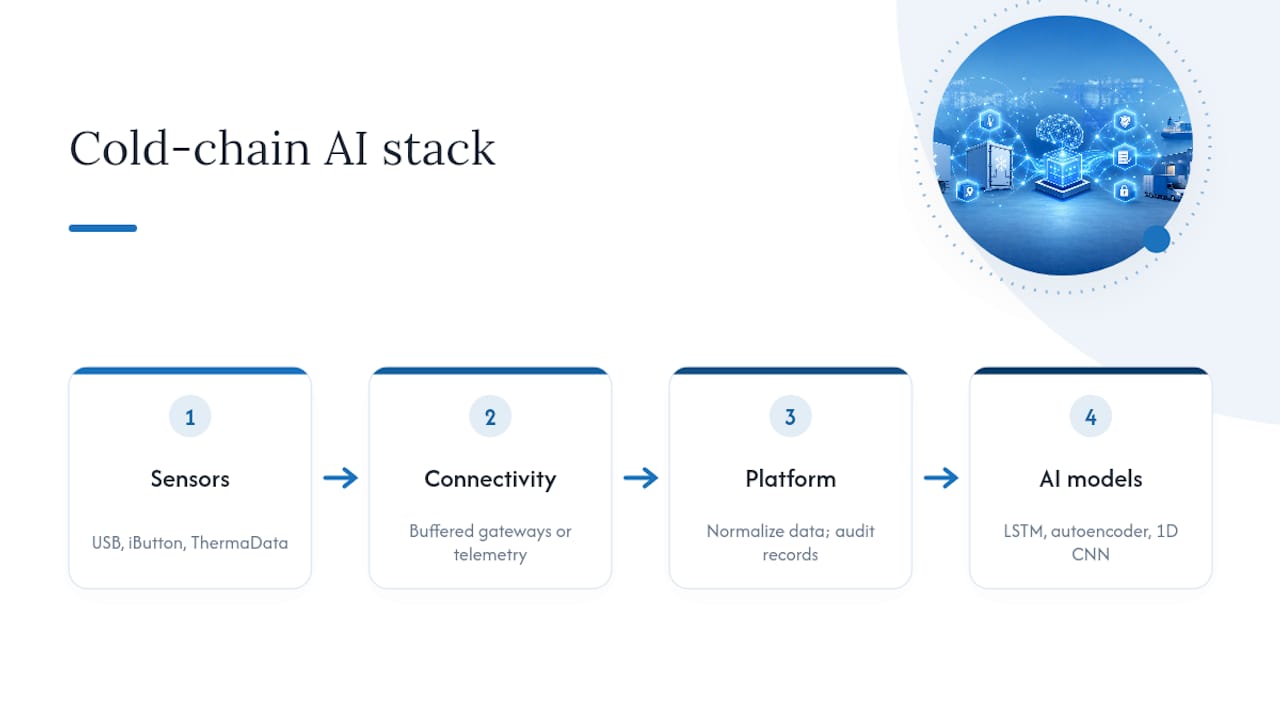
Sensors and data loggers come in a range of formats: single-use USB loggers for one-way shipments, reusable iButton-style devices for reverse logistics, and higher-precision instruments like the ThermaData SSTPro for validated pharmaceutical lanes. What matters is matching accuracy, sampling rate, IP rating, and battery life to the actual risk profile of the product, not buying whatever’s cheapest per unit.
Connectivity splits into two patterns: buffered edge gateways that store readings locally and sync in bursts (better for remote or low-signal routes), and continuous telemetry over cellular or satellite for high-value shipments where every minute of visibility counts. Partner resources on IoT sensor and gateway design cover the tradeoffs between these approaches in more depth.
The platform layer normalizes data from mixed sensor fleets, enforces role-based access, and exports audit-ready records on demand. Vendor platforms like TrueCold market these exact capabilities, which gives buyers a useful checklist even if they end up building or integrating a different stack.
AI models split by job: LSTM networks forecast, autoencoders detect anomalies, and 1D convolutional networks classify event types (door open, compressor fault, transit delay). Explainability matters at every layer, since a black-box alert nobody can justify to an auditor is barely better than no alert at all. Integration with ERP, TMS, and QMS systems is what turns a standalone dashboard into something operations teams actually check.
Building a Pilot That Proves Value Before You Scale
Skip the enterprise-wide rollout. Research on predictive AI adoption in cold chain operations backs the pilot-first approach: narrow scope, fast validation, lower risk of the whole initiative stalling on bad data from a lane nobody was watching.
A workable sequence looks like this:
- Run a readiness audit to baseline current data quality and identify where sensor coverage is thin or inconsistent.
- Pick two or three lanes with a mix of risk profiles, not just your easiest route.
- Define success metrics up front: target excursion reduction percentage, detection lead time, and false-alert tolerance.
- Run the pilot for a fixed window, typically 60 to 90 days, long enough to see seasonal or route variation.
- Validate the model with human-in-the-loop review, tuning alert thresholds so operators aren’t drowning in noise.
- Update SOPs and retraining cadence before scaling, since a model trained on three lanes needs revalidation before it governs thirty.
A pilot-first playbook for predictive maintenance covers similar validation logic if you’re building the governance framework internally. Scaling from there means locking down data hygiene, formalizing API integrations, and setting device lifecycle SLAs before adding lanes 4 through 40.
Making Every AI Decision Auditable
Regulated cold chains, pharmaceuticals, biologics, temperature-sensitive food, don’t get to treat AI outputs as a black box. Auditors want to see not just what the temperature was, but why the system flagged or didn’t flag an event.
Immutable logging is the foundation. That means tamper-evident hardware, cryptographic hashes on raw sensor data, and signed audit exports rather than editable spreadsheets. The deep learning and Ethereum blockchain framework referenced earlier stores critical events on-chain specifically so nobody, including the vendor, can quietly edit a temperature record after the fact.
For the AI layer specifically, keep:
- Explainability records showing which features triggered each alert
- Human override history, so every manual dismissal of an alert has a name and timestamp attached
- Versioned model metadata, tracking which model version made which call and when it was last retrained
A complete guide to AI audit trail systems walks through building this kind of traceability if your current setup can’t answer “why did the model do that” on demand. Device registration, calibration schedules, and certificate management round out the operational side auditors will ask about regardless of how good your AI is.
KPIs That Tell You If the AI Is Actually Working
Excursion rate and spoilage percentage are the headline numbers, but they lag. Watch mean time to detect and predictive alert lead time to know if the model is doing its job before a shipment is already lost. Research on predictive placement algorithms in cold chain networks found measurable reductions in temperature deviations when forecasting drove scheduling decisions, not just monitoring.
Track these against a pre-pilot baseline:
- Excursion rate and spoilage percentage, compared month over month
- Sensor uptime and data completeness (a model is only as good as the feed it gets)
- False-alert rate, which tells you if operators will trust the system or start ignoring it
- Energy consumption per pallet or per cubic meter of cold storage
The Council of Supply Chain Management Professionals publishes benchmarking frameworks worth cross-referencing when you present these numbers to stakeholders who want context beyond your own four walls. Build your dashboard around a simple alert hierarchy: critical excursions surface immediately, drift warnings get a daily digest, and energy metrics roll up weekly.
What Most Teams Get Wrong Before They Get It Right
The failure pattern I see most often isn’t the AI model, it’s the sensor placement decided six months before anyone thought about AI. A logger stuck at the front of a pallet instead of the thermal center produces clean-looking data that means nothing, and no model fixes that after the fact.
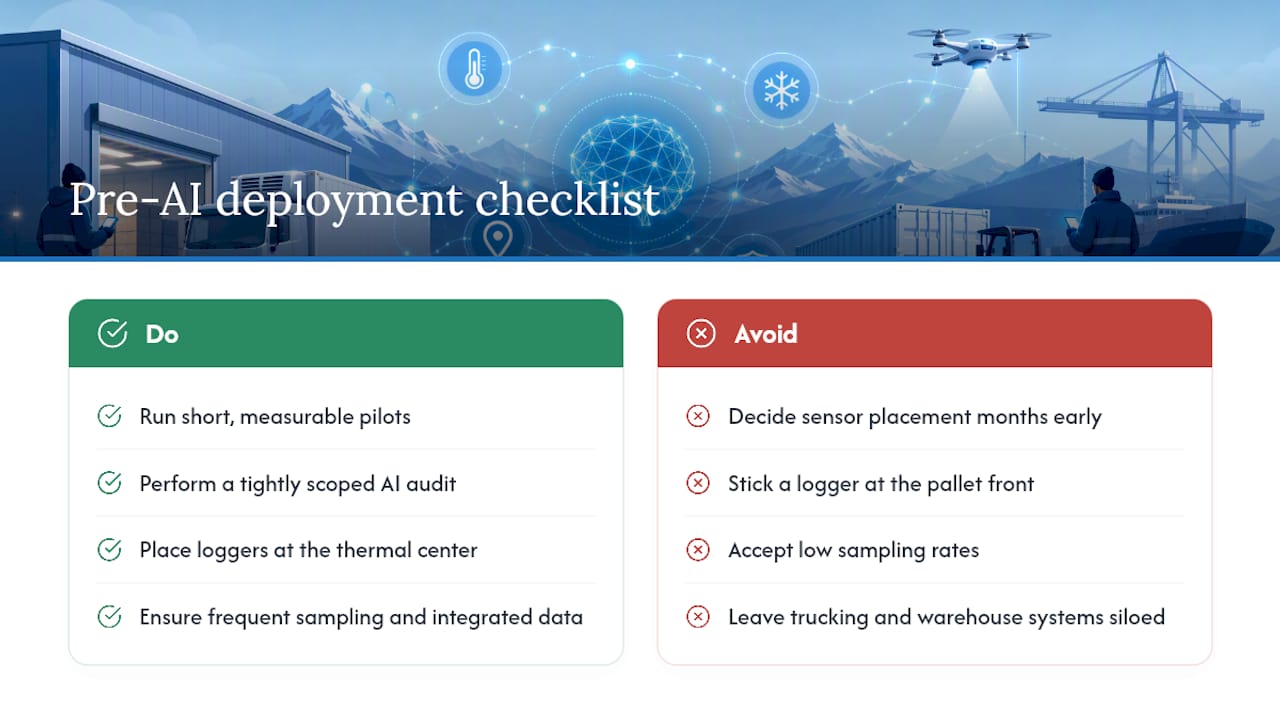
Low sampling rates cause the same problem in slow motion. Data silos between the trucking partner’s system and the warehouse’s platform quietly starve the model of the context it needs to tell a real anomaly from a routine handoff delay.
Short, measurable pilots fix this faster than committees do. A tightly scoped AI readiness audit surfaces exactly where your data quality and sensor coverage stand before you commit budget to a model that will inherit those gaps.
— Souhail
Get a Readiness Audit Before You Commit to a Platform
Buying a cold chain AI platform before checking whether your sensor data is even clean enough to model is how pilots stall for months. Digitalfractal runs an AI Readiness Audit first, specifically to find the automation opportunities in your logistics operation that will actually move the numbers, rather than handing you a generic vendor comparison.
Most engagements follow a 90-day arc: audit, pilot design on two or three lanes, model validation with your team in the loop, and a clear scaling plan by the end of the quarter. That timeline gives you a real answer, backed by your own data, on whether predictive monitoring earns its cost before you sign anything larger. Start with the AI Readiness Audit to see where your cold chain stands today.
Sources
- Secure, Predictive, and Transparent Cold-Chain Logistics using Deep Learning and Ethereum Blockchain
- AI is Transforming Cold Transportation
- Computers & Industrial Engineering — AI for cold chain efficiency
- TrueCold | AI-Powered Cold Chain Monitoring Platform