Top AI Tools for DevOps Automation | Digital Fractal

AI tools are transforming DevOps by automating repetitive tasks, reducing errors, and improving efficiency. From predictive monitoring to anomaly detection, these tools help teams manage complex environments like Kubernetes, CI/CD pipelines, and cloud-native architectures. Here’s a quick glance at the top AI-powered platforms reshaping DevOps workflows:
- AWS CodeGuru: Automates code reviews and performance profiling, focusing on security and efficiency in AWS environments.
- Amazon Q Developer: Uses generative AI to simplify IaC creation, troubleshoot AWS services, and optimize CI/CD workflows.
- Dynatrace: Provides real-time root-cause analysis and automated remediation with its Davis AI engine, ideal for multi-cloud setups.
- Datadog: Combines observability, anomaly detection, and AIOps to streamline monitoring and alerting across systems.
- Sysdig: Focuses on Kubernetes security and runtime monitoring, offering container-specific insights and compliance tools.
- Atlassian Intelligence: Built into Jira and Confluence, it automates ticketing, documentation, and incident management.
- Kubikk: Specializes in Kubernetes optimization, offering real-time analytics and resource management.
- Harness: Simplifies deployments with ML-driven verification, anomaly detection, and automated rollbacks.
- Digital Fractal Technologies Inc: Offers custom AI solutions tailored to Canadian industries, bridging gaps in compliance and legacy systems.
These tools integrate with popular platforms like Jenkins, GitHub, GitLab, AWS, and Azure, making them compatible with existing workflows. Whether you’re managing microservices or scaling CI/CD pipelines, these solutions can help improve deployment speed, reduce downtime, and cut costs. Below, we dive deeper into their features, use cases, and pricing to help you decide which is right for your team.
1. AWS CodeGuru
AI-driven automation capabilities
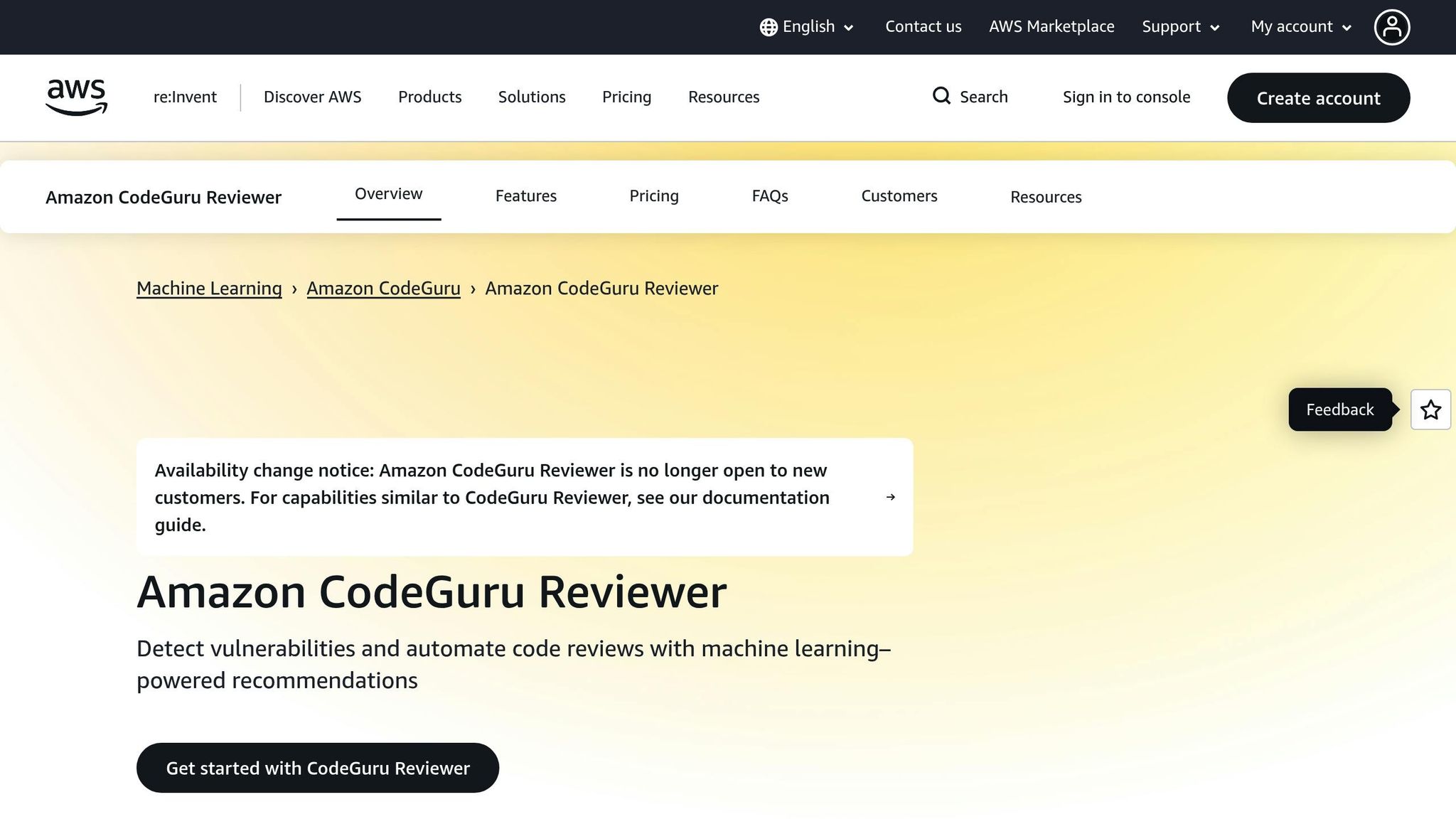
AWS CodeGuru harnesses machine learning to review code and analyse live application performance. It consists of two main components: CodeGuru Reviewer, which scans pull requests to detect security risks, concurrency issues, resource leaks, and coding anti-patterns; and CodeGuru Profiler, which monitors live performance to identify CPU-heavy methods, latency bottlenecks, and inefficient resource usage. Both tools provide actionable recommendations, enabling DevOps teams to address problems early – before they hit production. This reduces reliance on manual reviews and fine-tuning, making it a valuable addition to DevOps pipelines.
Use cases in DevOps (e.g., CI/CD, monitoring, troubleshooting)
In Canadian CI/CD workflows, teams often integrate CodeGuru Reviewer with repositories like GitHub, Bitbucket, or AWS CodeCommit. Each pull request prompts an AI review, with results appearing as comments directly on the pull request. These comments highlight issues such as hard-coded credentials or unsafe input handling. On the monitoring and troubleshooting side, CodeGuru Profiler continuously tracks production microservices, identifying methods or call stacks that cause performance spikes during incidents. For example, teams might discover that a poorly optimised serialization routine is consuming excessive CPU resources under heavy load. Refactoring based on Profiler’s insights often leads to noticeable cost savings on AWS bills – measurable in CAD.
Integration with DevOps tools and platforms
CodeGuru integrates seamlessly with tools like AWS CodePipeline, CodeBuild, Jenkins, GitHub Actions, and GitLab CI through repository triggers or APIs. Many Canadian enterprises, particularly in regulated sectors such as public services or energy, incorporate CodeGuru into their broader observability and automation strategies. For example, partners like Digital Fractal Technologies Inc often include CodeGuru in digital transformation projects. These integrations help organisations transition from reactive processes to proactive DevOps automation by embedding CodeGuru into existing CI/CD, security, and monitoring workflows.
Scalability and customization options
As a managed AWS service, CodeGuru scales automatically to accommodate growing codebases, additional repositories, and increased review volumes. Teams can customise their usage by selecting specific repositories, adjusting recommendation settings, or fine-tuning sampling rates for diagnostics. This flexibility allows Canadian organisations – from national retailers to public-sector platforms – to start small, focusing on critical services, and then expand as their deployment needs increase.
2. Amazon Q Developer
AI-driven automation capabilities
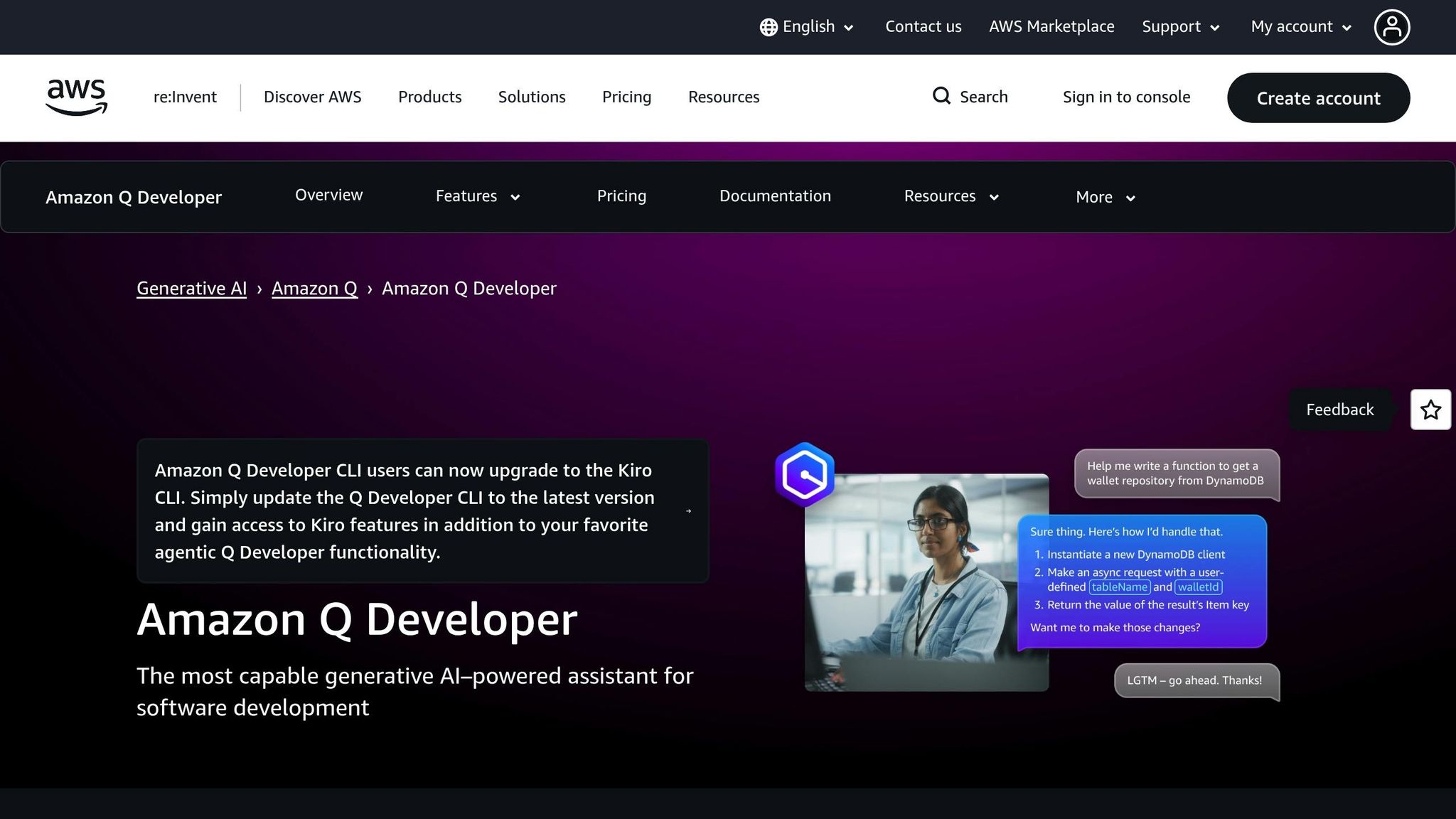
Amazon Q Developer takes automation a step further by incorporating generative AI into the mix, building on the foundations set by CodeGuru’s code and performance reviews. This AWS tool simplifies tasks like code generation, Infrastructure as Code (IaC) templates, and troubleshooting, all through natural language prompts. It can create configurations for CloudFormation, CDK, and Terraform, reducing manual coding work by as much as 55%. For DevOps teams, this means they can describe their needs and let the tool handle creating CI/CD pipeline configurations, unit tests, and deployment scripts. On top of that, it identifies security vulnerabilities and offers code suggestions, helping teams address issues before they reach production.
Use cases in DevOps (e.g., CI/CD, monitoring, troubleshooting)
Amazon Q Developer proves its worth in CI/CD workflows by generating pipeline configurations for tools like AWS CodePipeline and GitHub Actions based on simple conversational inputs. For instance, a fintech company managed to automate 70% of its CI/CD tests, slashing deployment times from hours to mere minutes. The tool also provides root-cause analysis through chat, delivering actionable insights for deployment failures. It can analyse logs and metrics to predict issues before they occur. In one example, a team working with microservices used natural language queries to correlate logs across Kubernetes clusters, significantly reducing their mean time to resolution. According to AWS, teams using Amazon Q Developer have seen code reviews completed 30-50% faster and a 25% drop in production bugs, showcasing AI’s growing impact on DevOps efficiency.
Integration with DevOps tools and platforms
Amazon Q Developer integrates seamlessly with a range of tools and platforms, including popular IDEs like VS Code and JetBrains, the AWS Management Console, and services such as CodeCatalyst and Cloud9. What sets it apart is its ability to provide environment-specific suggestions, such as creating CloudWatch alarms, IAM policies, or Lambda configurations, using existing code and documentation as context. For businesses working with Digital Fractal Technologies Inc – an expert in AI consulting and workflow automation – Amazon Q can help design CI/CD templates tailored to meet Canadian regulatory and data residency requirements, particularly in regions like ca-central-1. These integrations make it easier for organisations to adopt scalable and customised automation solutions.
Scalability and customization options
As a managed AWS service, Amazon Q Developer automatically scales with your infrastructure, starting at C$19 per user per month. Teams can further personalise the tool by fine-tuning its models with their proprietary codebases, creating custom agents for specific workflows, or embedding its functionality into existing pipelines via APIs. For Canadian enterprises, the flexibility to start with essential services and expand as required makes it a practical choice. Additionally, with options to configure IAM roles and monitor usage through CloudWatch, teams can ensure the service remains scalable and reliable, meeting the demands of growing deployments.
3. Dynatrace
AI-Driven Automation Capabilities
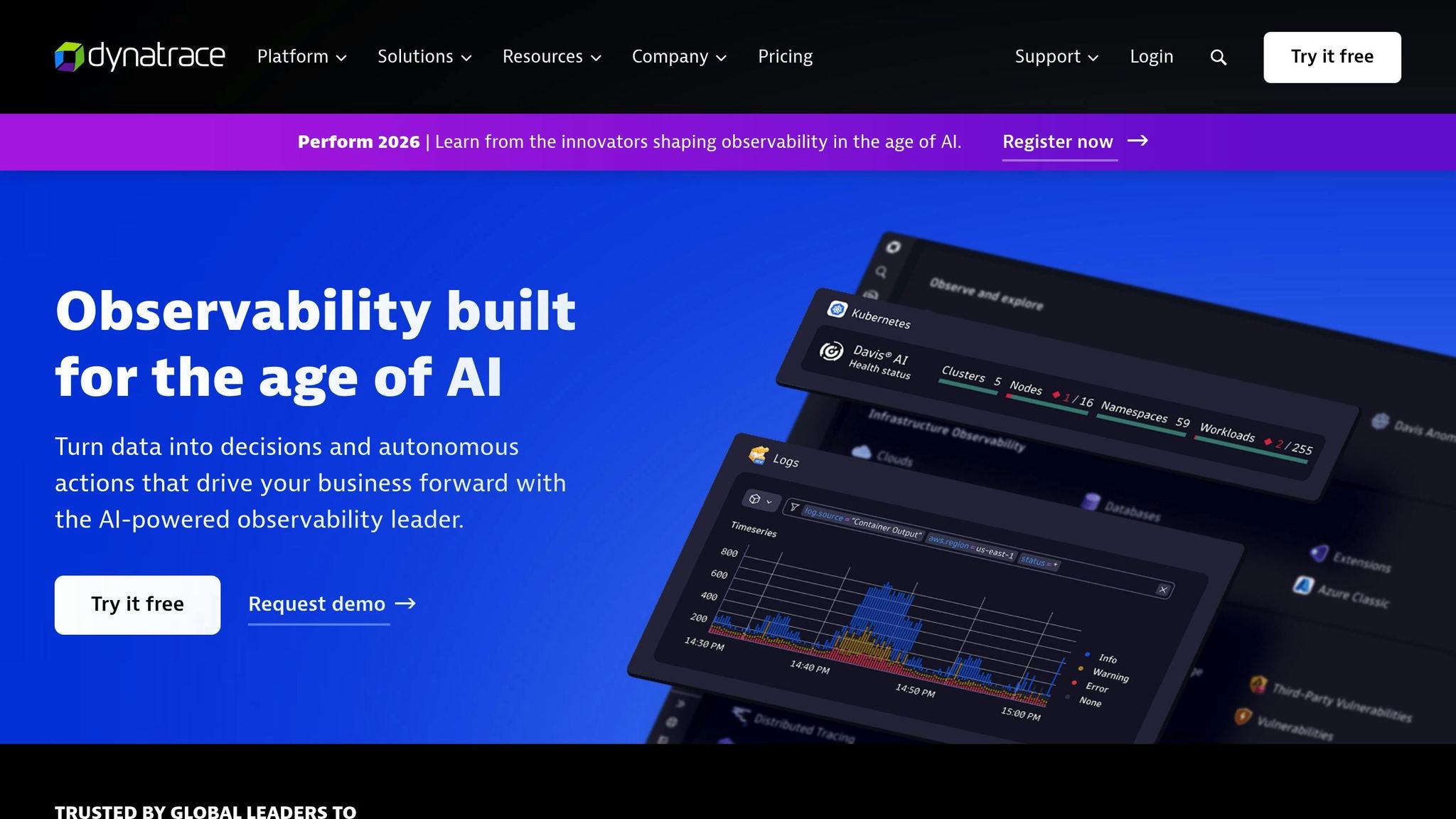
Dynatrace brings something special to the table with its AI engine, Davis. This engine doesn’t just skim the surface; it dives deep into complex system dependencies in real time. What does that mean for you? It identifies root causes with precision, cuts through the noise of endless alerts, and even automates fixes across DevOps setups. Instead of relying on correlation-based alerts like older monitoring tools, Davis uses causal AI to deliver razor-sharp diagnostics. This makes troubleshooting much less of a headache. Plus, with Davis CoPilot, users can create and validate DQL queries using simple natural language. This feature makes the platform more accessible, even for those without heavy technical expertise. It’s a game-changer for running smooth DevOps operations.
Use Cases in DevOps
Dynatrace offers full-stack observability, which means it keeps an eye on every part of your cloud-scale applications. It’s designed to catch issues early – long before they can disrupt your users. When problems do arise, Davis steps in to handle root cause analysis and even automates fixes. For Kubernetes environments, this can slash mean time to resolution by up to 90%. In CI/CD workflows, Dynatrace integrates observability directly into the pipeline, enabling smoother deployments and better resource management, even in sprawling, complex environments. Its ability to handle microservices, containers, and multi-cloud setups makes it a strong ally for modern DevOps teams.
Integration with DevOps Tools and Platforms
Dynatrace doesn’t just monitor – it fits seamlessly into your existing DevOps toolkit. It integrates with popular CI/CD platforms like Jenkins, GitLab, and CircleCI, as well as major cloud providers like AWS, Azure, and Google Cloud. Using its APIs, you can embed observability right into your workflows. Deployment is straightforward too, thanks to its OneAgent, which automatically instruments your entire stack with minimal setup. This level of integration simplifies processes and keeps everything running smoothly.
Scalability and Customisation Options
As your DevOps practices grow and evolve, Dynatrace grows with you. It supports multi-cloud and hybrid environments, offering automatic instrumentation that adapts to changes. For customisation, you’ve got options like APIs for building tailored integrations, Davis CoPilot for natural language query tweaks, and AI models that learn the unique quirks of your infrastructure. These features ensure the platform remains flexible and effective as your needs change over time. Whether your setup is just starting out or already highly advanced, Dynatrace adjusts to keep up.
4. Datadog
AI-Driven Automation Capabilities
Datadog offers a powerful suite of automation tools tailored for DevOps teams, combining smart alerting, anomaly detection, and root cause analysis through its advanced machine learning capabilities. By integrating monitoring, application performance management (APM), logging, and security into a single platform, Datadog provides complete visibility across systems. Its machine learning engine processes billions of dependencies every day, cutting down alert noise by up to 80%. This helps teams identify and address potential problems early – before they escalate into user-facing issues. The result? A smoother, more efficient DevOps workflow.
Use Cases in DevOps
Datadog plays a pivotal role throughout the software development lifecycle by offering real-time insights powered by AI. Features like anomaly detection and custom thresholds provide immediate feedback on performance. The platform’s AI-driven root cause analysis and live monitoring significantly reduce the time spent troubleshooting, making incident resolution faster and more efficient. Integrated into CI/CD pipelines, Datadog tracks performance metrics and sends timely alerts, ensuring teams can focus on innovation rather than firefighting. With full-stack observability, engineers can shift their attention to creating and improving, rather than maintaining outdated systems.
Integration with DevOps Tools and Platforms
Datadog’s vast ecosystem of integrations simplifies workflows by connecting with over 600 technologies. This includes popular CI/CD tools like Jenkins, CircleCI, and GitLab, as well as major cloud providers such as AWS, Azure, and Google Cloud Platform. By unifying data across your entire tech stack, Datadog ensures seamless visibility and automation, giving teams a centralised hub for managing their operations. This compatibility makes it easier to adopt and scale DevOps practices without worrying about fragmented tools.
Scalability and Customisation Options
Designed for complex, dynamic cloud environments, Datadog scales effortlessly to meet the needs of enterprise-level operations. Teams can customise models, set tailored thresholds, and create dashboards and alerts that align with their unique workflows. Its real-time analysis capabilities handle billions of dependencies, ensuring the platform evolves alongside growing infrastructure demands. Whether managing a local setup or a large-scale Canadian cloud environment with intricate CI/CD automation, Datadog delivers the reliability and flexibility teams need to stay ahead.
5. Sysdig
AI-Driven Automation Capabilities
Sysdig brings AI-powered tools to the world of DevOps, offering a platform tailored for cloud-native security and monitoring in containerised environments like Kubernetes. By continuously analysing system calls, network traffic, and application behaviour, Sysdig identifies runtime threats, flags anomalies, and improves resource efficiency. Its machine learning models sift through logs, metrics, and traces to minimise alert noise, helping teams focus on incidents that genuinely impact availability or compliance. Beyond detection, Sysdig simplifies policy creation by automatically generating Kubernetes Pod Security rules or runtime allowlists based on observed baseline behaviours, significantly cutting down on manual configuration efforts.
Use Cases in DevOps
For Canadian DevOps teams managing microservices on platforms such as Amazon EKS, Google GKE, or OpenShift, Sysdig’s AI-driven insights are invaluable in ensuring security and reliability across clusters and regions. Within CI/CD pipelines, Sysdig Secure integrates seamlessly with tools like GitHub Actions, GitLab CI, and Jenkins. It scans container images during builds, halts pipelines when critical vulnerabilities or misconfigurations are identified, and produces compliance-ready reports for standards such as SOC 2 or PCI DSS. This is particularly useful for regulated industries like public services and energy. Additionally, Sysdig’s forensic tools allow engineers to replay system activity – such as system calls and network traffic – during incidents, enabling quick isolation of container-level issues. This functionality addresses the stringent security and compliance demands of industries across Canada.
Integration with DevOps Tools and Platforms
Sysdig is built to work effortlessly with Kubernetes and major managed services like Amazon EKS, Azure Kubernetes Service, and Google GKE. It deploys through Helm charts or operators that automatically instrument nodes and workloads. The platform also integrates with CI/CD tools like Jenkins, GitHub Actions, GitLab CI, and CircleCI, enabling automated container image scans and policy checks during build and deployment phases. For observability, Sysdig supports data export and ingestion from tools such as Prometheus and AWS CloudWatch, allowing teams to unify dashboards and alerts without disrupting existing workflows. These integrations make Sysdig a flexible choice for teams looking to streamline operations across various environments.
Scalability and Customisation Options
Sysdig is designed for multi-cluster and multi-cloud setups, centralising telemetry and security data in a unified backend capable of handling large volumes of metrics, logs, and traces. Organisations can customise detection rules, alert thresholds, compliance policies, and data retention settings to align with their specific risk management strategies and regulatory requirements. With role-based access control (RBAC) and multi-tenant views, Canadian businesses operating across multiple provinces or business units can maintain centralised governance while keeping data segmented. Additionally, Sysdig’s analysis of both real-time and historical metrics offers recommendations – like optimising CPU and memory usage or refining autoscaling settings – that can lead to substantial cost savings in CAD.
6. Atlassian Intelligence

Atlassian Intelligence brings a fresh approach to workflow management and communication, showcasing how AI can simplify DevOps automation.
AI-Driven Automation Capabilities
Atlassian Intelligence is a generative AI feature built directly into Atlassian Cloud products like Jira and Confluence. It uses large language models and your organisation’s data to provide smart, context-sensitive assistance. This includes generating summaries, creating documentation, and automating repetitive tasks – helping teams cut issue triage times by 20–30%.
For DevOps teams, this means automatic summarisation of tickets in Jira, AI-generated change descriptions, and risk notes for change-management workflows. It even allows natural-language queries, turning plain English into Jira Query Language (JQL). Beyond ticketing, the AI can pull key actions from meeting notes, draft runbooks, and structure incident postmortems, making it a valuable tool for improving coordination and documentation.
Use Cases in DevOps
Canadian DevOps teams can use Atlassian Intelligence across various stages of the CI/CD pipeline, as well as for monitoring and troubleshooting. For example, Jira’s integration with Bitbucket or GitHub enables the automatic creation and updating of issues, with AI summarising release notes and updates. When paired with observability tools like Datadog or Dynatrace, Jira Service Management or Opsgenie can turn alerts into incidents, which the AI can summarise, group, and route to the right on-call engineers.
AI-powered virtual agents in Jira Service Management have been shown to resolve up to 50% of support requests without human help, easing the workload for operations and SRE teams. Additionally, teams can rely on the AI to draft and polish runbooks or post-incident reviews in Confluence, ensuring operational consistency and repeatability.
Integration with DevOps Tools and Platforms
Atlassian Intelligence integrates seamlessly with popular Git repositories and collaboration tools like Slack and Microsoft Teams. It can turn conversations into Jira issues or Confluence pages, making it easier to track tasks and updates. When connected to Bitbucket or GitHub, Jira’s development panel links surface branches, pull requests, and build statuses directly in work summaries.
For incident management, integrations with tools like Opsgenie and Jira Service Management allow the AI to process alerts from platforms such as Datadog, Dynatrace, and Sysdig. This helps teams streamline incident triage and communication, ensuring better traceability and coordination.
Scalability and Customisation Options
Designed for teams of all sizes, Atlassian Intelligence adapts effortlessly to both small businesses and large enterprises across Canada. With role-based permissions and project-level configurations, teams can adopt AI selectively while meeting local data residency requirements.
Administrators can customise Jira workflows, issue types, and automation rules, ensuring that the AI aligns with local terminology and team processes. Confluence spaces and templates can also be tailored to maintain consistent documentation across departments. Importantly, Atlassian Intelligence respects existing data boundaries, ensuring users only access content they’re permitted to see. This balance of flexibility and control makes it a reliable choice for teams looking to enhance their operations.
sbb-itb-fd1fcab
7. Kubikk
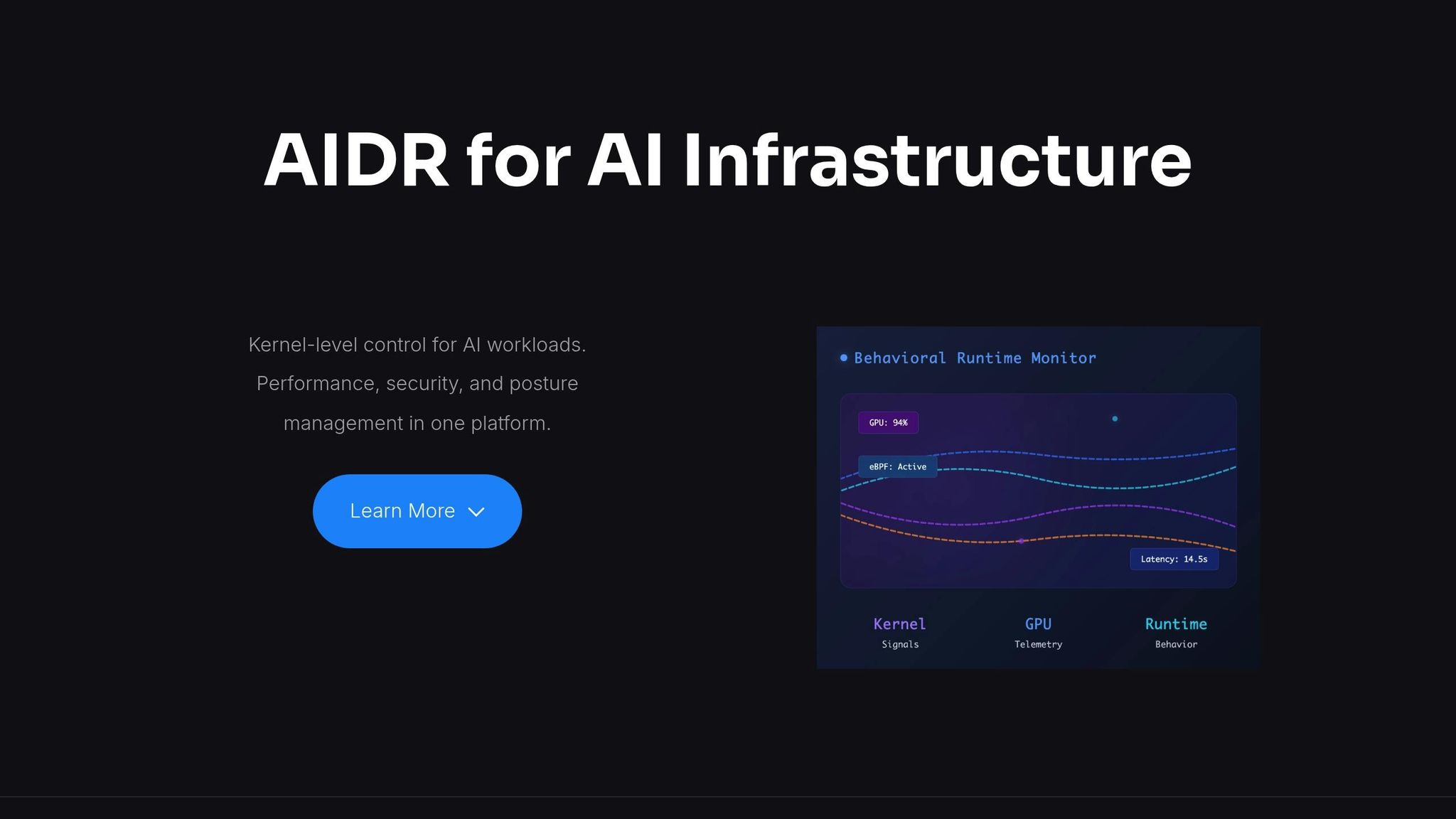
Kubikk is an AI-powered platform designed specifically for monitoring Kubernetes deployments. It tackles the complexities of managing containerized workloads by offering real-time analytics and automated troubleshooting to keep systems running smoothly. This tool adds another layer of AI-driven automation to container management, complementing the other solutions we’ve discussed.
At its core, Kubikk continuously tracks cluster performance, using AI to identify and resolve issues before they become critical. By spotting performance bottlenecks, resource inefficiencies, and potential failures as they happen, it minimizes downtime and helps manage operational costs effectively.
For DevOps teams, Kubikk provides actionable insights into cluster health and performance. While it doesn’t directly tie into CI/CD pipelines, its ability to optimize resource allocation ensures smoother deployments and faster recovery during incidents.
Kubikk integrates seamlessly with major cloud platforms like AWS, Azure, and Google Cloud. Its user-friendly interface, featuring customisable alerts and signals, allows Canadian DevOps teams to adapt Kubernetes monitoring and alerting to their specific needs as their infrastructure grows. This focus on Kubernetes highlights how AI tools are refining DevOps processes for better automation and efficiency.
8. Harness
Harness is a DevOps platform designed to simplify software delivery with AI-powered automation. By reducing the need for manual scripting and repetitive tasks, it streamlines deployment pipelines with the help of machine learning.
AI-Driven Automation Capabilities
One of Harness’s standout features is Continuous Verification, which uses machine learning to monitor logs, metrics, and APM data after every deployment. Instead of relying on static thresholds or manual checks, it creates a baseline of normal application behaviour. New deployments are then compared against this baseline to identify performance issues or error spikes. If anomalies are detected, Harness can automatically roll back to a previous version, helping to minimise risks in production.
Harness also supports intelligent deployment strategies like canary and blue-green deployments. These strategies automatically adjust traffic flow based on real-time health checks. Its Cloud Cost Management module uses AI to pinpoint idle or over-provisioned resources across AWS, Azure, and Google Cloud, helping Canadian teams save on cloud costs in CAD. According to Harness’s case studies, customers have seen up to a 75% drop in change failure rates and a threefold increase in deployment frequency. These features make deployments more reliable and efficient.
Use Cases in DevOps
In Canadian cloud-native setups, Harness typically handles the continuous deployment (CD) phase, while tools like Jenkins or GitLab CI manage the build process. A typical workflow might involve Jenkins creating container images and publishing them to a registry. Harness then picks up the new image tag, deploys it to Kubernetes using Helm or native manifests, and runs automated verifications by pulling metrics from tools like Datadog or Prometheus and logs from Splunk. If health checks fail or error rates exceed acceptable levels, Harness rolls back the deployment. If the deployment is successful, notifications are sent to Slack or Microsoft Teams.
Beyond CI/CD, Harness provides post-deployment monitoring and troubleshooting. It continuously links regressions to specific releases or configuration changes. For example, if higher latency or an increase in 5xx errors is detected, Harness identifies the root cause – whether it’s a faulty service, pod, or API endpoint – helping teams resolve issues faster. For fintech companies navigating Canadian financial regulations, this means multiple safe production releases per day without compromising compliance.
Integration with DevOps Tools and Platforms
Harness integrates seamlessly with popular CI platforms like Jenkins and GitLab CI, allowing teams to keep their existing build pipelines while managing deployments through Harness. It also connects with major cloud providers like AWS, Microsoft Azure, and Google Cloud Platform, making it ideal for multi-cloud environments commonly used by Canadian businesses. For observability, Harness works with tools such as Datadog, Prometheus, New Relic, and Splunk, using their logs and metrics for its AI-driven verification. Integration with collaboration tools like Slack ensures deployment updates and alerts are delivered in real time, fitting smoothly into existing workflows.
Scalability and Customisation Options
Harness is built to handle a variety of deployment needs, from startups to enterprises managing hundreds of microservices. Teams can create reusable deployment templates, customise pipelines, and set environment-specific configurations for development, testing, staging, and production. Features like role-based access control, policy-as-code, and approval gates can be tailored to meet enterprise governance requirements and Canadian regulatory standards. Verification strategies can also be fine-tuned – teams can decide which metrics to monitor, how long to observe, and what defines a failure, adjusting risk tolerance for specific services or environments.
For Canadian organisations looking to extend Harness’s capabilities, partners like Digital Fractal Technologies Inc offer support in designing custom CI/CD architectures, integrating Harness with existing CRMs or business tools, and building dashboards tailored to deployment needs. This kind of collaboration is especially useful for aligning AI-driven pipelines with the specific needs of industries like public services, energy, or construction.
9. Digital Fractal Technologies Inc
Digital Fractal Technologies Inc specializes in creating custom AI-powered automation solutions designed to address the unique needs of Canadian organisations. Their approach focuses on tailoring solutions to specific workflows, compliance requirements, and DevOps environments. Unlike off-the-shelf tools, Digital Fractal’s solutions fill operational gaps and tackle compliance challenges faced by industries like public services, energy, and construction – sectors often dealing with complex regulations and operations. By integrating seamlessly with platforms like AWS, Azure, Kubernetes, and popular CI/CD tools, they provide automation layers that overcome the limitations of standard solutions, offering a personalized approach across the entire DevOps lifecycle.
AI-Driven Automation Capabilities
The company excels in workflow automation, leveraging machine learning to create tools such as developer portals, deployment dashboards, and incident management systems. Their automation capabilities include intelligent ticket routing, predicting deployment issues based on historical data, and suggesting rollout strategies – like blue-green or canary deployments – for cloud-native applications. For Canadian organisations, these solutions come with audit-ready features, including detailed logs and approval workflows, ensuring compliance with strict industry regulations. Every automated action is designed to be transparent and defensible, meeting the needs of regulators and auditors.
Use Cases in DevOps
Digital Fractal brings AI-driven enhancements to DevOps workflows. For instance, within CI/CD pipelines, their tools dynamically adjust test scopes based on the risk level of code changes, flagging risky commits and suggesting rollback plans when production metrics show signs of degradation. In monitoring, their anomaly detection tools analyse logs, metrics, and traces to trigger automated fixes, reducing downtime. Troubleshooting is made easier with AI assistants that correlate data from Kubernetes clusters, cloud resources, and application logs to pinpoint root causes and recommend next steps. A typical implementation might involve self-service environments for developers, complete with infrastructure-as-code, automated deployment pipelines with policy checks, and operational dashboards combining observability data with AI-driven insights. These tailored solutions integrate seamlessly into existing DevOps setups.
Integration with DevOps Tools and Platforms
Digital Fractal enhances existing DevOps ecosystems rather than replacing them. Their AI components integrate via APIs, webhooks, and SDKs, working alongside CI/CD tools and cloud platforms. For Kubernetes environments, they incorporate AI that processes cluster metrics and logs from observability tools, enabling automation through Kubernetes operators or GitOps workflows. This tool-agnostic approach ensures that organisations can preserve their current investments in DevOps tools while improving operational efficiency and reducing manual effort. Their focus on seamless integration positions them as a partner for building domain-specific automation solutions.
Scalability and Customisation Options
Digital Fractal’s solutions are designed to grow with an organisation’s needs. They tailor AI models using historical data, set custom risk thresholds, and implement role-based access controls to meet Canadian regulatory standards. Their scalable, containerised architectures can handle increasing workloads and include feedback loops to refine automation over time. Configuration options allow for organisation-specific policies within CI/CD gates and ensure data residency in Canadian regions. Moreover, DevOps and SRE teams can adjust or override AI decisions, ensuring that automation evolves alongside changing business goals and application architectures. This flexibility ensures their solutions remain aligned with organisational priorities.
Feature Comparison
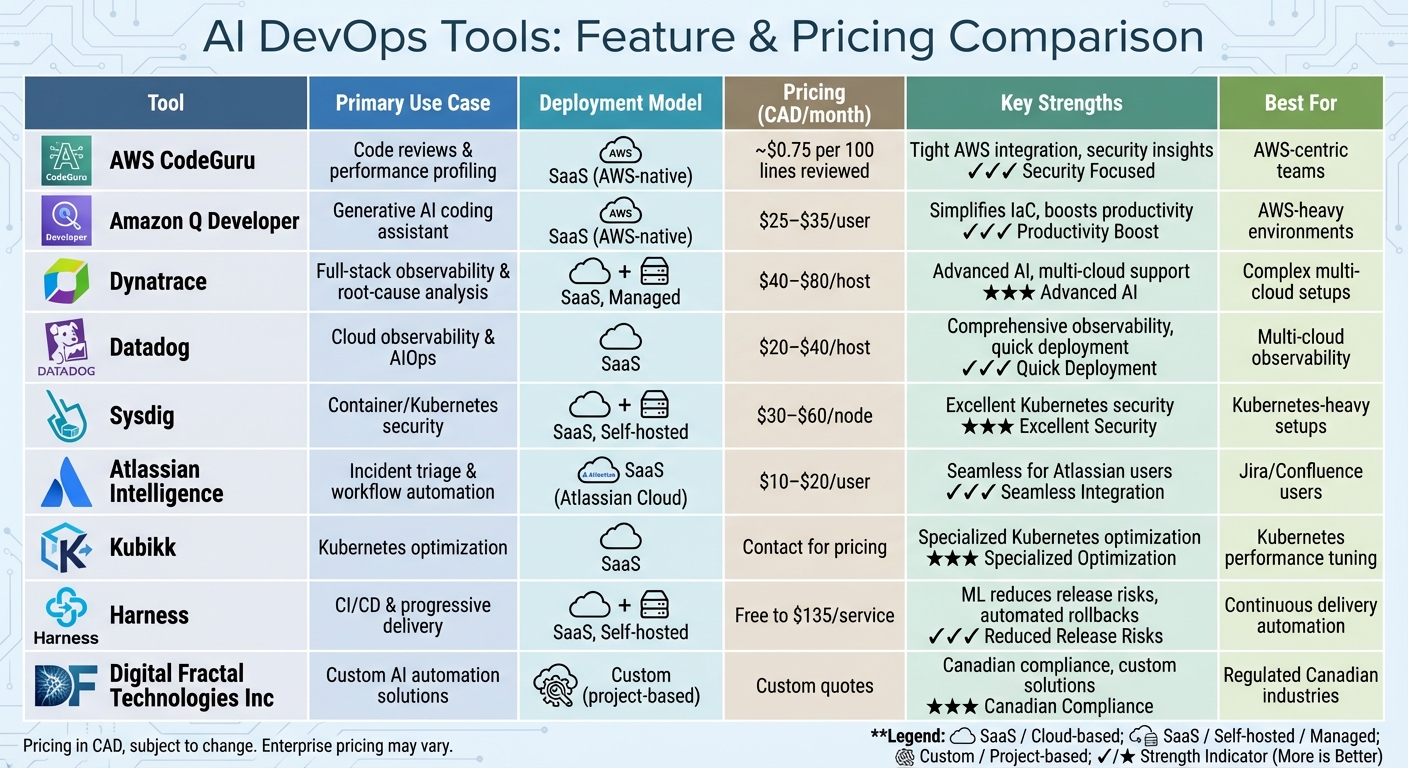
AI DevOps Tools Comparison: Features, Pricing, and Use Cases
When evaluating AI tools for DevOps automation, it’s essential to consider their primary use cases, AI capabilities, deployment models, integrations, pricing (in CAD), and their strengths alongside any limitations. Here’s a detailed comparison to help Canadian teams make informed decisions:
| Tool | Primary DevOps Use Case | AI Capabilities | Deployment Model | Supported Environments | Key Integrations | Typical Pricing (CAD) | Strengths | Limitations |
|---|---|---|---|---|---|---|---|---|
| AWS CodeGuru | Automated code reviews, performance profiling, security findings | ML-driven insights for code quality and performance | SaaS (AWS-native) | AWS (Lambda, EC2, ECS, on-prem via CodeBuild) | CodeCommit, GitHub, Bitbucket, CloudWatch, CodePipeline | Pay-as-you-go: ~CAD$0.75 per 100 lines reviewed; ~CAD$0.005 per profiling hour | Tight AWS integration; easy onboarding; actionable security insights | Limited value outside AWS; noisy recommendations for older codebases; team buy-in needed |
| Amazon Q Developer | Generative AI assistant for coding, IaC generation, AWS troubleshooting | Natural-language code generation, AWS-specific guidance, IaC templates | SaaS (AWS-native) | AWS Console, IDEs (VS Code, JetBrains), CLI | AWS services (Lambda, S3, RDS), GitHub, GitLab | Per-user subscription: ~CAD$25–CAD$35/user/month | Simplifies IaC creation; reduces AWS learning curve; boosts productivity | Best suited for AWS-heavy environments; AI-generated code governance concerns |
| Dynatrace | Full-stack observability, root-cause analysis, automated remediation | AI for anomaly detection, causal inference, and natural-language queries | SaaS, Managed (hybrid) | Multi-cloud (AWS, Azure, GCP), Kubernetes, on-prem | Kubernetes, Jenkins, GitLab CI, Slack, ServiceNow, PagerDuty | Per-host or per-compute-unit: ~CAD$40–CAD$80/host/month (annual contracts) | Advanced AI; deep automation for complex setups; strong multi-cloud support | Higher cost and complexity; requires substantial implementation effort |
| Datadog | Cloud observability (metrics, logs, traces), AIOps | Forecasting, anomaly detection, log clustering, alert noise reduction | SaaS | Multi-cloud (AWS, Azure, GCP), Kubernetes, serverless | Kubernetes, GitHub Actions, Azure DevOps, Slack, Jira, Terraform | Per-host or per-GB: ~CAD$20–CAD$40/host/month plus add-ons for logs/security | Comprehensive observability; quick deployment; robust integrations | Costs can escalate with data volume; requires tuning to reduce alert fatigue |
| Sysdig | Container/Kubernetes security and monitoring | ML-powered runtime threat detection and anomaly insights | SaaS, Self-hosted | Kubernetes, AWS, Azure, GCP, on-prem containers | Kubernetes, Prometheus, Jenkins, GitLab, Slack | Per-node: ~CAD$30–CAD$60/node/month (volume discounts available) | Excellent Kubernetes security and threat detection; container-focused | Narrower scope compared to broader AIOps tools; may need additional tools for full coverage |
| Atlassian Intelligence | Incident triage, runbook generation, workflow automation | Generative AI for ticket summaries, issue linking, and natural-language queries | SaaS (Atlassian Cloud) | Jira, Confluence, Bitbucket, Opsgenie | Jira, Confluence, Bitbucket, Slack, Microsoft Teams | Bundled in many Cloud plans; ~CAD$10–CAD$20/user/month for premium tiers | Seamless for Atlassian users; improves incident documentation | Limited to Atlassian products; depends on ticket and page data quality |
| Kubikk | AI-driven Kubernetes optimisation and troubleshooting | Real-time performance tuning, resource allocation, and issue detection | SaaS | Kubernetes on AWS, Azure, GCP | Kubernetes, Prometheus, Grafana, cloud cost APIs | Tiered pricing by clusters/nodes – contact for CAD pricing | Specialised for Kubernetes; effective troubleshooting and cost optimisation | Niche focus; requires mature Kubernetes setups and SRE processes |
| Harness | CI/CD, progressive delivery, deployment verification | ML-backed deployment verification, anomaly detection, automated rollbacks | SaaS, Self-hosted (Enterprise) | Multi-cloud (AWS, Azure, GCP), Kubernetes, on-prem | Kubernetes, Jenkins, GitHub Actions, GitLab CI, Datadog, Dynatrace, Jira | Tiered: Free (basic), Team (~CAD$135/service/month), Enterprise (custom annual contracts) | Simplifies continuous delivery; ML reduces release risks; supports rollbacks | Migration and process changes required; learning curve for non-SaaS teams |
| Digital Fractal Technologies Inc | Custom AI-powered DevOps automation and compliance-ready workflows | Bespoke ML models for deployment risk, ticket routing, anomaly detection, and IaC generation | Custom (project-based) | Multi-cloud (AWS, Azure, GCP), Kubernetes, on-prem, legacy systems | Tool-agnostic: APIs, webhooks, SDKs for CI/CD, observability, and cloud platforms | Project-based or retainer: custom CAD quotes | Tailored solutions with Canadian compliance; legacy system integration; bilingual support | Project-based costs; longer timelines than off-the-shelf tools; success depends on collaboration |
Key Takeaways for Canadian Teams
AWS CodeGuru and Amazon Q Developer are perfect for AWS-centric teams, offering smooth integration and ease of use, though their benefits are largely confined to the AWS ecosystem. Dynatrace and Datadog shine in multi-cloud environments, delivering advanced observability and automation but requiring careful cost control. For Kubernetes-heavy setups, Sysdig and Kubikk are excellent, with Sysdig focusing on runtime security and Kubikk excelling in performance optimisation. Atlassian Intelligence is a natural fit for teams already using Jira and Confluence, while Harness simplifies continuous delivery with its ML-driven features.
For instance, a Kubernetes-focused SaaS startup in Toronto or Vancouver might pair Kubikk or Sysdig with Datadog and Harness for comprehensive automation. A multi-cloud enterprise in the financial sector could benefit from Dynatrace, complemented by Sysdig and Atlassian Intelligence. Meanwhile, a public-sector agency with strict data residency requirements might combine Atlassian Intelligence with custom solutions from Digital Fractal Technologies Inc to bridge modern DevOps practices with legacy systems.
Pricing spans pay-as-you-go, per-user, and project-based models, offering flexibility for Canadian teams to match their budget and scale.
Conclusion
AI tools are reshaping the DevOps landscape by automating repetitive tasks, minimizing errors, and speeding up release cycles. Teams leveraging platforms like AWS CodeGuru, Dynatrace, Datadog, Sysdig, Harness, and Kubikk are seeing tangible benefits, including faster deployments, reduced mean time to recovery (MTTR), and fewer production issues. Generative AI assistants such as Amazon Q Developer and Atlassian Intelligence further boost productivity by allowing engineers to focus on strategic initiatives rather than routine troubleshooting.
To make the most of these tools, it’s essential to choose solutions that address your specific bottlenecks in the CI/CD pipeline. For instance, if Kubernetes stability is a concern, tools like Kubikk or Sysdig could be a good fit. On the other hand, if safer rollouts are your priority, Harness offers AI-driven deployment verification. When selecting tools, consider how well they integrate with your existing platforms – such as GitHub, GitLab, Jenkins, AWS, or Azure – and ensure they meet your data residency requirements.
Start small by piloting a tool with a single team or service, and measure key metrics like deployment frequency, incident rates, and time savings. This approach not only demonstrates the value of the tool but also helps prevent tool sprawl. For Canadian organisations dealing with regulatory or legacy system challenges, tailored integrations can address these hurdles effectively.
Companies like Digital Fractal Technologies Inc specialize in crafting AI-driven workflow automation and DevOps solutions tailored to meet the compliance, security, and operational needs unique to Canadian industries. This strategic approach ensures AI enhances every stage of DevOps automation, driving both efficiency and innovation.
FAQs
How can AI tools enhance automation and efficiency in DevOps?
AI tools play a transformative role in DevOps by handling repetitive tasks, streamlining workflows, and improving resource management. With the help of machine learning and AI-powered analytics, these tools deliver real-time insights that help teams pinpoint bottlenecks, minimize errors, and enhance overall efficiency.
By speeding up deployment cycles and improving system reliability, AI tools pave the way for quicker advancements and increased productivity. They allow teams to shift their focus from tedious manual tasks to strategic objectives, driving both operational efficiency and progress.
How do AWS CodeGuru and Amazon Q Developer differ?
AWS CodeGuru is an AI-driven tool that helps developers fine-tune their application code by spotting inefficiencies and suggesting ways to boost performance. On the other hand, Amazon Q Developer is all about building and deploying conversational AI solutions like chatbots and virtual assistants, aimed at improving user engagement and enhancing customer experiences.
How do AI-powered tools like Dynatrace and Datadog improve visibility in multi-cloud environments?
AI-driven platforms like Dynatrace and Datadog bring clarity to multi-cloud environments by delivering real-time monitoring and centralized analytics across various cloud platforms. By leveraging AI, these tools can automatically spot anomalies, anticipate potential problems, and offer actionable recommendations – allowing teams to tackle issues before they affect system performance.
By simplifying the management of intricate cloud setups, these tools help maintain system reliability, strengthen security, and boost efficiency, making them an essential part of modern DevOps workflows.