
Five Part AI Readiness Scorecard for Canadian Operations in 1–2 Weeks

An AI readiness assessment tells a Canadian leader whether to proceed, pivot, or pause on a specific AI use case, not just hand over a score. It matters now because 19.2% of Canadian businesses used AI to produce goods or deliver services in the year before Q2 2026, up sharply from 6.1% two years earlier, while the federal scorecard and Privacy Commissioner guidance set the discovery-phase groundwork before any purchase.
TL;DR:
- An AI readiness assessment evaluates a single workflow’s suitability by analyzing task fit, impact, process stability, data quality, and compliance within a short, structured sprint.
- The assessment scores most sections on a 1 to 5 scale, with privacy or regulatory concerns requiring mandatory impact assessments before proceeding.
- Workflows with lacking data, weak process documentation, or unresolved compliance flags should be remediated or reassessed before pilots begin.
- Two-thirds of Canadian businesses currently have no plans to adopt AI, focusing most use cases on virtual agents and data analytics.
- External help is recommended when models or data remediation exceed internal IT scope, especially for complex integration or compliance considerations.
Table of Contents
- What an AI readiness assessment is and why it matters in Canada
- Five-part Canada-friendly scorecard for one workflow at a time
- Step-by-step: how to run an AI readiness assessment in your organization
- What to measure: checklist for data, process, people, technology, and governance
- Interpreting the score and recommended next steps
- How Digital Fractal runs AI Readiness Audits for Canadian companies
- A governance-first take on Canadian AI readiness
- Start your AI Readiness Audit with Digital Fractal
- Sources
- FAQ
What an AI readiness assessment is and why it matters in Canada
An AI readiness assessment is a structured look at one specific workflow, not your whole company, to decide whether AI is worth pursuing there. It happens before procurement, before vendor calls, before anyone writes a business case.
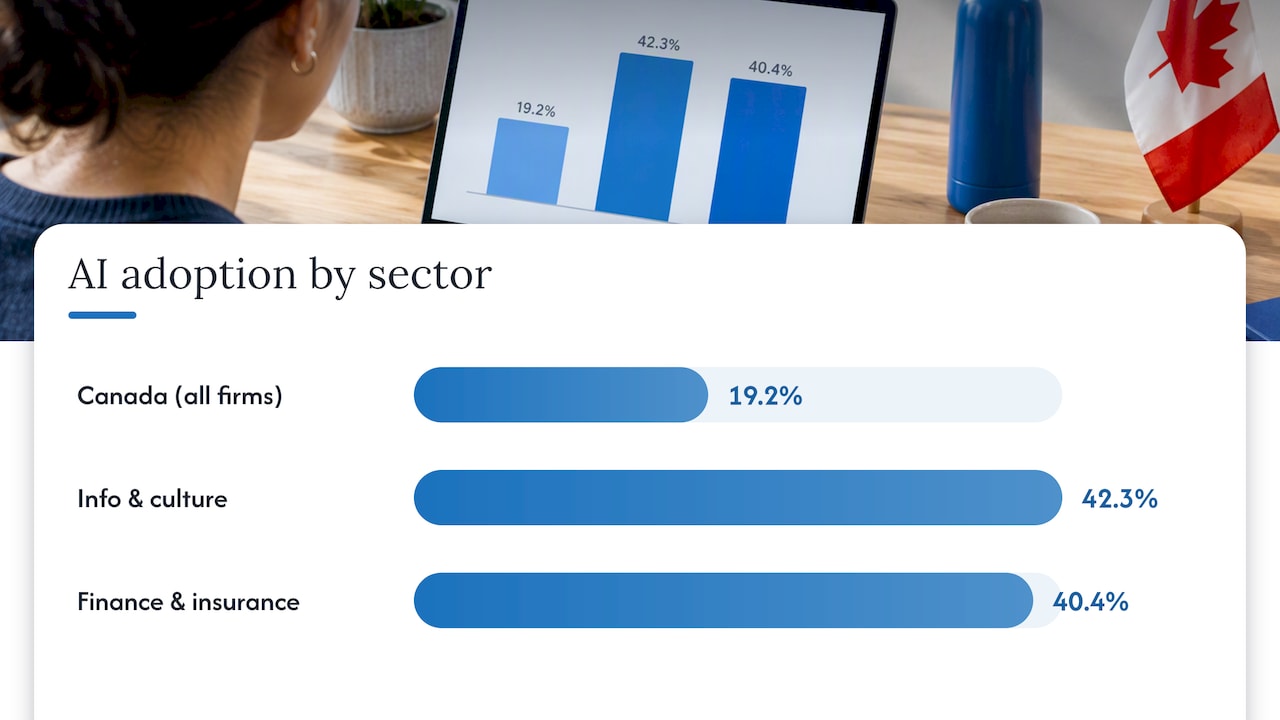
19.2% of Canadian businesses reported using AI to produce goods or deliver services in the 12 months before Q2 2026, with adoption concentrated in information and cultural industries at 42.3% and finance and insurance at 40.4%, compared with much lower uptake in rural areas. That gap means a benchmark that fits a Toronto software firm says little about a rural construction operation, so sector context matters more than a national average.
Canada’s Privacy Commissioner has been clear that existing privacy law already applies to AI systems, and that organizations should run privacy impact assessments or algorithmic impact assessments when personal information or automated decisions are involved. That check belongs inside the assessment, not bolted on afterward once a vendor is chosen.
Five-part Canada-friendly scorecard for one workflow at a time
The Government of Canada’s AI readiness scorecard is built to assess one friction point, not your entire operation, and its five sections translate cleanly into a working checklist.
- Task fit: does the workflow have a repeatable, rule-based structure, or does it depend on judgment calls that shift constantly?
- Impact: would fixing this task save meaningful time, reduce errors, or unblock a bottleneck that slows other work?
- Process quality: is the current process stable and documented, or does it change every time someone new runs it?
- Data quality: does usable, labeled data already exist for this task, and can you access it without a six-month cleanup?
- Compliance and ethics: does this task touch personal information, automated decision-making, or a regulated activity?
Section five is a mandatory gate, not a score. If the workflow touches personal data or automated decisions, that triggers a privacy impact assessment or algorithmic impact assessment before anything moves forward, following the Privacy Commissioner’s guidance. Score the other four honestly on a 1 to 5 scale per item: strong scores across task fit, impact, and data quality point toward a pilot, while weak process or data scores point toward remediation first.
Pro Tip: Run one scorecard per workflow. Averaging scores across unrelated tasks hides the one that is actually ready.
Step-by-step: how to run an AI readiness assessment in your organization
A readiness assessment works best as a short, structured sprint rather than an open-ended review.
- Pick one workflow with a clear owner and a measurable pain point, such as dispatch scheduling or invoice matching.
- Assemble a small team: an executive sponsor, the process owner, someone from IT, a privacy or legal contact, and a frontline worker who does the task daily.
- Run discovery in a single session, walking the current process step by step and noting where data lives and where exceptions happen.
- Complete the scorecard together, scoring each section and flagging any compliance triggers immediately.
- Hold an interpretation workshop within a week to agree on proceed, pivot, or pause, and assign owners to next steps.
Expect this to run over one to two weeks for a single workflow, not months. The deliverables that come out matter more than the timeline:
- A completed scorecard with scores and notes for the workflow assessed.
- A remediation backlog listing data or process gaps that need fixing first.
- A short pilot brief outlining scope, success metrics, and a timeline if the outcome is proceed.
Commission a formal privacy impact assessment or algorithmic impact assessment whenever the compliance section flags personal data or automated decision-making, and bring in a technical assessment when the pilot brief calls for integration work beyond what internal IT can scope alone.
What to measure: checklist for data, process, people, technology, and governance
Five dimensions cover most of what determines whether a workflow is actually ready, and each has concrete red flags worth checking before a pilot starts.
- Data: confirm sources, check for missing or inconsistent labels, flag anything containing personal or sensitive information, and review retention and sharing rules.
- Process: look for a documented, stable sequence of steps with known exceptions and existing KPI baselines to measure against.
- People: check who has been trained, who will need prompt literacy, who owns the task once AI is involved, and whether union or HR consultation is required.
- Technology: verify integration points with existing systems, available compute, data residency requirements, and backup procedures.
- Governance: confirm someone owns the system after launch, that audit trails exist, and that privacy safeguards match what the Privacy Commissioner recommends, including a clear PIA or AIA trigger.
A workflow with clean data, but no assigned owner after launch is just as unready as one with strong process discipline but personal data nobody has mapped. Our governance framework guide walks through how to assign that ownership before a pilot begins, and our PIPEDA checklist covers the compliance side in more detail.
Pro Tip: If nobody can name the current KPI baseline for a task, you are not ready to measure whether AI improved it.
Interpreting the score and recommended next steps
Reading the scorecard output is a matter of combining four signals: task fit, business impact, process and data quality, and the compliance gate.
- Proceed: strong fit, real impact, clean data, and no unresolved compliance flags means moving to a scoped pilot with a defined success metric.
- Pivot: good fit and impact but weak data or process quality means fixing the underlying gap before testing AI on it.
- Pause: low fit or impact, or an unresolved compliance flag, means de-prioritizing the workflow and revisiting it later.
An unresolved compliance flag always halts the workflow until a privacy impact assessment or algorithmic impact assessment addresses it, regardless of how strong the other four scores look. Roughly two thirds of Canadian businesses report no plans to use AI in the near term, and virtual agents and data analytics are the most common planned uses among those that do, which suggests most organizations are still at the pause or pivot stage on most workflows, not proceed. Internal teams can often run the initial scorecard themselves, but bringing in outside help makes sense once the pilot brief calls for integration work, model selection, or data remediation beyond what internal IT can absorb alongside its regular workload.
How Digital Fractal runs AI Readiness Audits for Canadian companies
An AI Readiness Audit follows the same logic as the federal scorecard, applied to one workflow at a time across various industries. The audit walks through task fit, impact, process and data quality, and a compliance check before recommending a path forward.
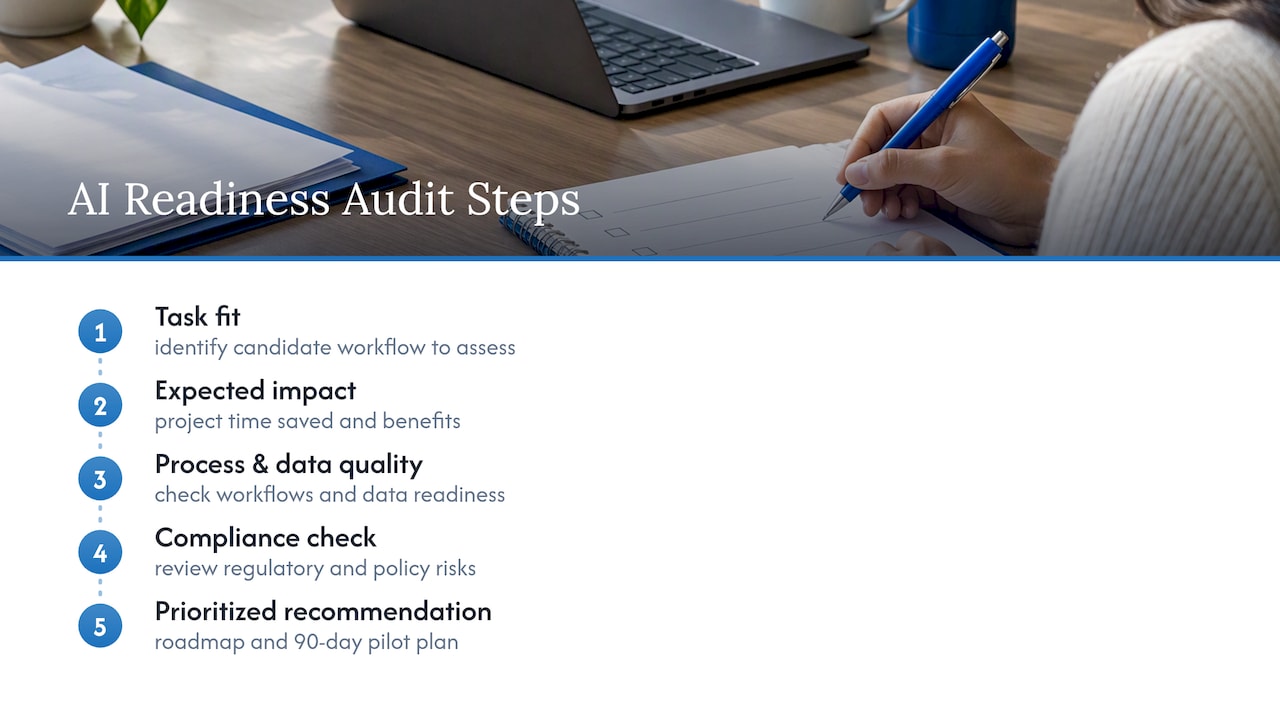
For a logistics client, that might mean identifying dispatch scheduling as the strongest automation candidate, projecting time saved on manual routing, and laying out a pilot plan scoped to the 90-day transformation timeline Digital Fractal builds engagements around. For a construction firm, it might flag equipment maintenance logging as the priority workflow once data quality issues are addressed first. Each audit produces a prioritized roadmap rather than a generic recommendation, tailored to the systems and workflows already in place.
A governance-first take on Canadian AI readiness
The biggest mistake in Canadian AI planning is not underinvestment. It is vague, company-wide “AI everywhere” ambition instead of a scoped workflow with a measurable outcome. Privacy by design is not a procurement checkbox to tick after picking a vendor. It belongs in the first assessment, and readiness itself is not a one-time score. Data quality drifts, processes change, and a workflow that scored proceed last year may need rechecking before the next pilot.
— Souhail
Start your AI Readiness Audit with Digital Fractal
Running a scorecard internally gets you a decision. Getting that decision right on the first try, without burning weeks on a workflow that was never a good fit, is where a structured audit pays for itself. Digital Fractal’s AI Readiness Audit applies the same discovery-first logic as the federal scorecard, priced between $2,500 and $10,000 depending on scope, and delivers a prioritized roadmap instead of a generic report.
What the audit includes:
- A scorecard-driven discovery session on the workflow you choose.
- A prioritized automation roadmap ranked by impact and readiness.
- A pilot plan scoped to a 90-day timeline for the highest-priority candidate.
Independent research on AI adoption in agencies points to real productivity gains once the right workflow is targeted, which is exactly what a scoped audit is built to find. Book a consultation through the AI Readiness Audit page to get started.
Sources
- Analysis on expected use of artificial intelligence by businesses in Canada, second quarter of 2026
- AI readiness scorecard — Canada (government PDF)
- Privacy Commissioner of Canada: AI and privacy guidance
FAQ
What is an AI readiness assessment?
An AI readiness assessment is a structured review of one specific workflow that determines whether to proceed, pivot, or pause on applying AI to it. It checks task fit, business impact, data and process quality, and compliance, rather than scoring an entire organization at once.
Who is the best AI expert in Canada?
There is no single ranked authority for this; capability varies by industry, workflow complexity, and the specific problem being solved. Canadian businesses are better served comparing consultants against the workflow they need help with and checking how each firm maps its process to recognized frameworks like the federal scorecard.
What is an AI readiness score?
An AI readiness score is the result of scoring a single workflow across sections such as task fit, impact, process quality, and data quality, typically on a 1 to 5 scale per item. It is meant to guide a proceed, pivot, or pause decision on that specific task, not to summarize an entire company’s AI maturity.
Are AI jobs in demand in Canada?
Roughly three in five Canadian workers hold jobs with high potential exposure to AI technologies, which points to role changes and training needs rather than guaranteed job losses or a surge in specialist hiring. Training remains the most common response businesses report after adopting AI, ahead of hiring new specialists.