
Mobile App Network Optimization: Best Practices for 2025

By 2025, mobile app users demand fast and reliable performance. Apps that crash, freeze, or lag lose users quickly, with 53% of users abandoning apps that take longer than 3 seconds to load and 60% uninstalling after repeated crashes. To meet these expectations, optimizing your app’s network performance is essential.
Key challenges include battery drain from inefficient network use, latency issues across 5G, 4G, and Wi-Fi, and poor third-party SDK management. AI-driven strategies, dynamic load balancing, and real-time monitoring tools are helping developers tackle these problems. Here’s what you need to focus on:
- Reduce Latency: Keep API response times under 200ms and optimize for 5G while ensuring fallback for slower networks.
- Save Battery Life: Batch data transfers and minimize frequent network calls to prevent excessive power consumption.
- Use AI for Performance: Predictive analytics and machine learning detect anomalies and adjust resource allocation in real time.
- Monitor Metrics: Track latency, throughput, crash rates, and user session data to identify and fix issues proactively.
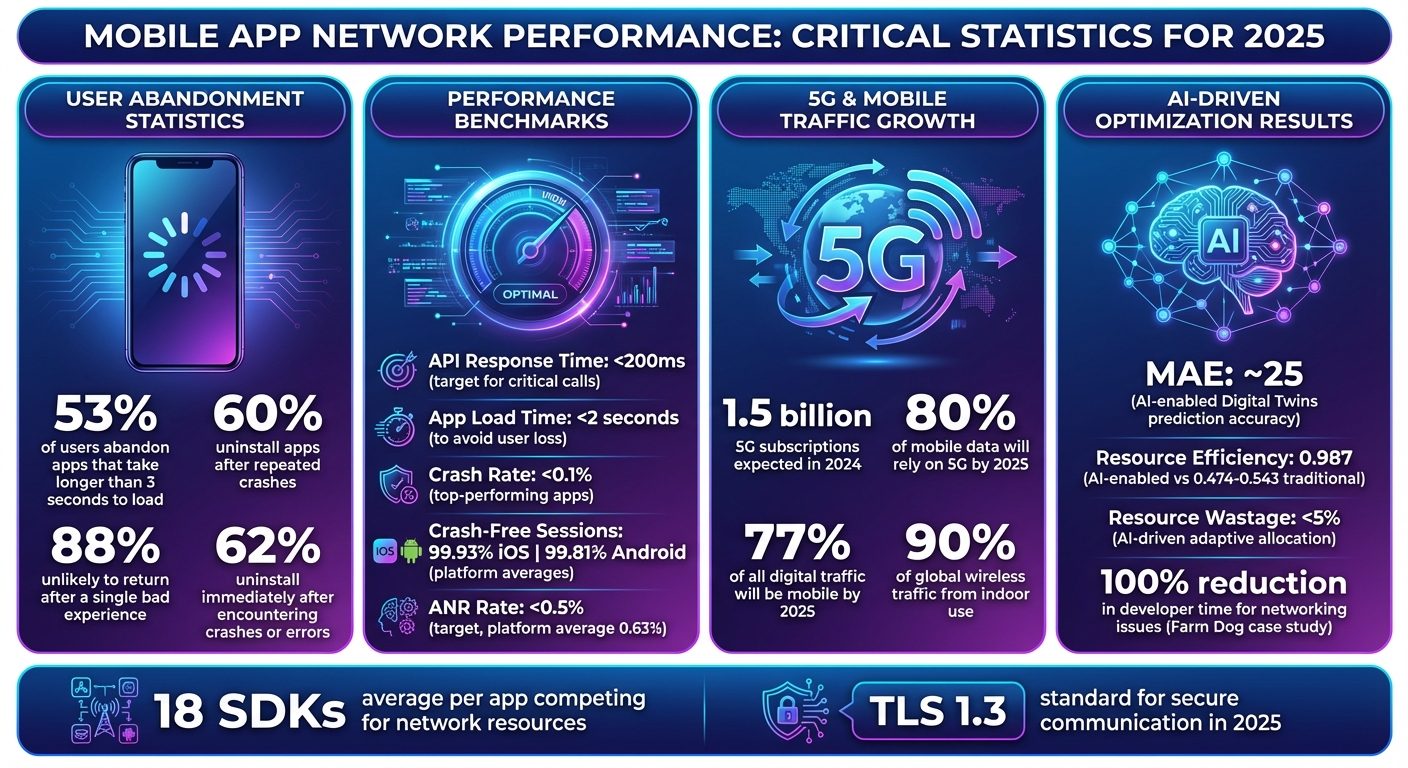
Mobile App Network Performance Statistics and User Behavior in 2025
Core Techniques for Optimizing Mobile App Networks
Optimizing mobile app networks is all about achieving better battery efficiency, reducing latency, and managing traffic effectively. In Canada, this challenge is unique, given the range of network environments – from the dense 5G coverage in downtown Toronto to the more remote areas of Northern Ontario.
Dynamic Load Balancing
Dynamic load balancing is the process of distributing user traffic across multiple servers based on real-time conditions. By monitoring factors like latency and the number of active requests, connections can be assigned dynamically using algorithms such as Least Outstanding Requests or flow-hash-based approaches. For example, the Least Outstanding Requests method works well when requests vary in complexity, as it directs traffic to servers with fewer active tasks. On the other hand, apps that handle millions of requests per second benefit from flow-hash-based approaches at the transport layer (Layer 4), which offer better performance.
Load balancers also take on CPU-heavy tasks like SSL/TLS processing. To reduce network latency, it’s smart to position load balancer backends close to regional user hubs – think Vancouver, Calgary, or Montreal. Additionally, modern protocols like HTTP/3 (QUIC), supported by Android Cronet and iOS by default, are excellent for managing global traffic. Another useful tip: instead of keeping connections open indefinitely, set limits like a maximum connection lifetime of 10–20 minutes or a request cap of 1,000–2,000. This allows for network reoptimization as conditions change.
These techniques create a strong foundation for managing traffic effectively, leading into the next focus: prioritizing critical app functions.
Quality of Service (QoS) Prioritization
QoS prioritization ensures that essential app functions – like video calls or real-time notifications – get the bandwidth they need, especially during network congestion. This involves categorizing traffic into groups, such as user-initiated tasks versus background processes, and applying specific rules to each.
For Android developers, the TrafficStats API is a powerful tool. It lets you tag sockets as USER_INITIATED, APP_INITIATED, or SERVER_INITIATED, providing insights into how different types of traffic consume network resources. To preserve bandwidth for active sessions, non-critical updates can be restricted through traffic shaping. For real-time services, QoS uses Differentiated Services Code Point (DSCP) marking to minimize jitter and latency, ensuring smooth performance.
"The application should acknowledge user input within hundreds of milliseconds; see Speed, Performance, and Human Perception." – Ilya Grigorik, Author, High Performance Browser Networking
Deep Packet Inspection (DPI)
Deep packet inspection (DPI) takes network optimization a step further by analyzing packets in real time. Operating at the application layer (Layer 7) of the OSI model, DPI doesn’t just monitor traffic – it categorizes it. This enables dynamic rerouting and adds a layer of security through reputation-based filtering, which blocks connections to known malicious endpoints.
DPI is especially useful for identifying inefficiencies in third-party SDKs. For instance, if an analytics library is making too many network calls or using poor retry logic, DPI tools can flag these issues. Developers can then address the problems before they lead to noticeable slowdowns. This is particularly relevant as apps in 2025 often rely on around 18 third-party SDKs, all competing for limited network resources.
For companies like Digital Fractal Technologies Inc, especially those working in sensitive fields like finance and healthcare, DPI is critical. It not only improves performance but also ensures compliance and protects sensitive data.
AI-Driven Strategies for Network Optimization
Artificial intelligence is reshaping how mobile apps handle network resources. By predicting potential issues, adjusting to current network conditions, and automatically distributing resources, AI has become a game-changer. For developers in Canada, where network environments range from cutting-edge 5G in urban hubs to spotty coverage in remote areas, these capabilities are especially important. Let’s break down how predictive analytics, machine learning, and adaptive resource allocation are improving mobile app performance.
Predictive Analytics for Traffic Management
Predictive analytics leverages historical data to forecast traffic patterns before they even happen. By analysing past trends, AI can anticipate surges in traffic and adjust bandwidth preemptively. Digital Twins – virtual replicas of physical networks – are often used to simulate these conditions and fine-tune responses.
For instance, Long Short-Term Memory (LSTM) networks excel at capturing complex traffic patterns, enabling more precise predictions. A study in October 2025 showed that integrating AI into Digital Twins reduced the Mean Absolute Error (MAE) to about 25, outperforming traditional methods.
"Embedding AI capabilities within Digital Twins paves the way for fully autonomous, adaptive, and high-performance network management in future mobile networks." – John Sengendo, Co-author of AI-Enabled Digital Twins Study
Machine Learning for Anomaly Detection
Machine learning (ML) algorithms continuously monitor network behaviour, comparing real-time data with historical trends to detect anomalies. This automated system replaces the tedious process of manual profiling, which often misses subtle issues. With users quick to notice glitches and crashes, ML-based anomaly detection ensures potential problems are addressed before they escalate.
Tools like Firebase Performance Monitoring and HeadSpin use AI to identify bottlenecks, predict crashes, and suggest fixes. These systems can even pinpoint the exact causes of performance issues, saving developers both time and effort.
Adaptive Resource Allocation
AI-driven adaptive resource allocation dynamically adjusts bandwidth and server capacity based on real-time demand. Unlike static setups that need manual adjustments, AI systems learn optimal configurations through reinforcement learning. The latest advancements, such as Agentic AI, can autonomously tweak parameters for peak efficiency.
For example, AI-enabled Digital Twin frameworks have achieved a median resource efficiency of 0.987, far surpassing traditional static methods, which range between 0.474 and 0.543. These systems also keep resource wastage under 5% while maintaining near-optimal utilisation. For mobile apps, bundling data transfers into single bursts – rather than sending small, frequent requests – minimizes battery drain caused by radio state transitions. With 90% of global wireless traffic expected to come from indoor use, prioritising WiFi offloading for large data transfers is becoming increasingly important.
"AI-driven strategies can help development teams overcome the limitations of traditional networking practices, which are often insufficient for the scale, complexity and sophistication of today’s IT environments." – IBM Think
By integrating these AI-driven approaches with existing network optimization techniques, developers can ensure reliable and efficient mobile performance across Canada’s diverse network landscapes.
Digital Fractal Technologies Inc., a leader in AI consulting and custom mobile app development, brings expertise in machine learning and workflow automation. They’ve successfully implemented predictive analytics, anomaly detection, and adaptive resource allocation across sectors like public services, energy, and construction, where dependable network performance is non-negotiable.
Measuring and Monitoring Network Performance
You can’t fix what you don’t measure. Tracking network performance metrics gives you a clear picture of how your app behaves in real-world conditions – whether users are browsing on 5G in downtown Toronto or struggling with spotty LTE in rural Saskatchewan. Without continuous monitoring, critical issues can slip through the cracks. This constant oversight is the backbone of real-time adjustments.
Here’s why it matters: 53% of users abandon a mobile app if it takes longer than 3 seconds to load, and 88% are unlikely to return after a single bad experience. Even worse, 62% will uninstall an app immediately after encountering crashes or errors. With mobile traffic expected to make up 77% of all digital traffic by 2025, these stats underscore how essential performance monitoring is.
Key Performance Metrics
Focus on the metrics that directly influence user satisfaction. For example:
- Latency (response time): Keep it under 200 milliseconds for critical API calls to maintain a snappy user experience.
- Data throughput: This determines how fast media and content load.
- Packet loss: Even small losses can lead to stuttering or failed requests.
- App load time: Aim for under 2 seconds to avoid losing users.
Crash rates are another crucial metric. Top-performing apps keep crash rates below 0.1%, with crash-free session rates averaging 99.93% on iOS and 99.81% on Android. Similarly, the Application Not Responding (ANR) rate should stay below 0.5%; the Android platform average is around 0.63%.
"Performance is not only a technical aspect but also an element of trust in your business." – Michael, Head of Mobile Department, WEZOM
Testing on real devices is non-negotiable. Emulators often fail to capture real-world variables like actual network latency, hardware-specific quirks, and thermal throttling. To ensure your app holds up under weak connections or high latency, test across a range of devices, including budget models. Once you’ve identified the key metrics, the next step is to leverage effective monitoring tools.
Best Tools for Real-Time Monitoring
With essential metrics in place, the right tools can provide actionable insights. For Canadian businesses, these tools must perform reliably across a diverse range of network conditions.
- Firebase Performance Monitoring: Great for identifying slow startup times and network requests across different devices and locations – and it’s free to get started.
- New Relic and AppDynamics: These tools dig into backend processes and API delays, giving you a clear view of server-side performance.
- UXCam: Rated 4.7 stars on G2, this tool captures user interactions and generates heatmaps to pinpoint where users face challenges.
- HeadSpin: Perfect for testing across Canada’s varied network landscape, it specialises in global device infrastructure and 5G performance measurement.
- Apache JMeter and Gatling: These tools simulate different network conditions, from 2G to 5G, to identify breaking points before users encounter them.
Continuous monitoring with synthetic data helps catch problems before they affect real users. Tools that offer session replays can be especially valuable, allowing you to see exactly what users were doing at the moment of a crash – insights that raw logs simply can’t provide. And with T-Mobile now delivering median download speeds of over 100 Mbps in all tested metropolitan markets, user expectations for app speed and responsiveness are higher than ever.
Companies like Digital Fractal Technologies Inc. incorporate these monitoring solutions into their custom mobile apps. Serving clients in industries like public sector, energy, and construction, they combine real-time analytics with AI-driven insights to identify and resolve issues before they disrupt operations. This approach is a prime example of how monitoring can ensure apps meet the performance standards users demand.
sbb-itb-fd1fcab
5G-Specific Optimization Strategies
With 1.5 billion 5G subscriptions expected in 2024 and predictions that 80% of mobile data will rely on 5G by 2025, optimizing for this technology has become a priority. Unlike 4G’s hardware-focused architecture, 5G introduces a cloud-native, Service-Based Architecture (SBA), offering new possibilities for flexibility and scalability. For Canadian developers working across varied landscapes – from bustling urban hubs to remote industrial sites – tapping into 5G’s capabilities is key to staying competitive.
AI-driven technologies further enhance 5G’s potential, enabling smarter and more efficient network performance.
AI-Powered Network Tuning for 5G
Artificial intelligence is transforming how networks adapt to shifting demands. Intent-Based Networking simplifies the process by letting users define desired outcomes – like ultra-low latency for a video conferencing app – without diving into complex manual configurations. The network then automatically adjusts to achieve those goals. This is especially important when up to 90% of business operations depend on reliable network performance.
Another game-changer is Self-Organizing Networks (SON), which dynamically adjust network parameters based on factors like usage patterns, time of day, and application priorities. For instance, during peak hours in downtown Vancouver, the system can allocate more bandwidth to critical business applications while limiting less urgent background activities. AI tools also monitor radio frequency (RF) metrics such as Signal-to-Interference-plus-Noise Ratio (SINR) to identify trends, predict potential failures, and make proactive adjustments before users even notice issues.
Network slicing is another key innovation. It divides a single physical network into multiple virtual slices, each tailored to specific needs. This ensures that traffic surges in one area don’t compromise performance for essential services elsewhere.
Predictive Capacity Planning
Predictive analytics take network management to the next level by using real-time performance data to anticipate infrastructure needs before problems arise. This approach complements AI-based tuning, ensuring networks can meet growing demands without disruption. By analysing trends in memory usage, connection anomalies, and RF performance, machine learning models can detect early warning signs of equipment failures and recommend timely interventions. This is especially crucial for industries like energy and construction in Canada, where downtime can lead to significant financial losses.
Deploying User Plane Functions (UPFs) at the network edge further reduces latency for real-time applications like autonomous vehicles or remote equipment monitoring. However, this requires a scalable, distributed infrastructure capable of adapting to fluctuating demand. Cloud-native 5G cores built with containerised microservices (managed via Kubernetes) allow networks to scale seamlessly, updating without interruptions. This adaptability is vital for industries with unpredictable traffic, such as emergency services or construction projects requiring flexible connectivity.
At Digital Fractal Technologies Inc, we incorporate these advanced 5G optimisation techniques into our custom mobile app solutions, ensuring reliable and scalable performance across Canada’s diverse environments.
Implementation Best Practices
This section breaks down a practical, step-by-step approach to implementing network optimization in mobile apps, using proven techniques to achieve meaningful results.
To start, conduct a thorough audit of resource usage, traffic patterns, and peak activity times to identify bottlenecks. Then, deploy monitoring tools like mobile monitoring SDKs in your production environment. These tools gather essential data, such as network requests, crashes, and device metrics, providing the visibility needed to make informed decisions.
Once you have this visibility, categorize traffic into three types: user-initiated, app-initiated, and server-initiated. This classification allows you to apply specific optimization strategies to each category. For example, non-urgent tasks can be deferred using platform-native schedulers like Android’s WorkManager, which delays requests until the device is charging or connected to Wi‑Fi. These foundational steps set the stage for more precise integrations, which we’ll explore next.
A Real-World Example: Farm Dog’s Success Story
Farm Dog, an agricultural tech company, serves farmers in areas with limited connectivity. In 2025, they implemented network monitoring tools and achieved remarkable results. Developer troubleshooting time dropped to zero, and user complaints disappeared entirely, thanks to robust offline functionality.
"Embrace helped us reduce developer time spent on networking problems by 100%. We have completely eliminated user complaints and support tickets to fix broken experiences stemming from poor network connections."
Additionally, setting up threshold-based alerts for performance regressions, such as slow endpoints or client-side errors, can catch issues that backend monitoring might overlook. Testing on real devices under different conditions – varying battery levels, OS versions, and connectivity scenarios – is equally critical.
Step-by-Step Integration Process
- Bundle and Batch Requests: Combine non-urgent requests to reduce radio state transitions and improve efficiency.
- Adaptive Prefetching: Adjust prefetching based on network generation. For instance, prefetch more aggressively on 5G and LTE compared to 3G to utilize higher bandwidth.
- Intelligent Caching: Use caching for static resources to avoid unnecessary downloads.
- AI Tools: Leverage AI for predictive capacity planning and automated anomaly detection.
- Decouple UI from Network Operations: Ensure user input is acknowledged within milliseconds, even if the network request is delayed. This keeps the app responsive despite connectivity issues.
These steps provide a structured path to optimize network performance while maintaining a seamless user experience.
AI Techniques vs. Traditional Methods
The table below compares traditional methods with AI-driven approaches, highlighting the advantages of modern tools.
| Feature | Traditional Methods | AI-Driven Methods |
|---|---|---|
| Latency Reduction | Reactive: manual caching with fixed polling | Predictive: analytics prefetch data in advance |
| Throughput Gains | Static: fixed data transfer sizes | Adaptive: dynamic burst sizes based on bandwidth |
| Scalability | Manual: thresholds adjusted by engineers | Automated: machine learning handles scaling |
| Complexity | Lower: standard techniques like batching | Higher: requires advanced data platforms |
Traditional methods work well for simpler scenarios but often require ongoing manual adjustments as your app scales. AI-driven approaches, while more complex and resource-intensive upfront, offer long-term benefits by automating processes and delivering better performance across varied network conditions.
Conclusion and Key Takeaways
Optimizing network performance has become a non-negotiable priority in the mobile world of 2025. Consider this: 60% of users uninstall apps after just a few crashes, and 51% abandon them after a single crash. The strategies discussed here aim to help developers meet the high expectations of today’s users by delivering smooth, reliable experiences.
The evolution from traditional methods to AI-driven approaches represents a major leap forward. Older techniques, which depended on manual tweaks and fixed configurations, have given way to AI systems capable of dynamically responding to real-world conditions. These systems can reroute traffic and identify issues proactively – often before users are even aware of a problem.
To get started, focus on client-side monitoring. This ensures you capture a complete view of your app’s network performance, including issues that may never reach your backend servers. From there, implement key practices like bundling requests to reduce battery-draining radio transitions, using intelligent caching for static resources, and leveraging platform-native schedulers like WorkManager to handle non-essential tasks. These steps not only deliver immediate improvements but also lay the groundwork for advanced optimizations.
Security remains a critical consideration. TLS 1.3 has become the standard for faster and more secure communication in 2025. For industries like finance or healthcare, certificate pinning provides an added layer of protection against breaches. Additionally, with the average app using around 18 different SDKs, closely monitoring third-party network activity is essential to avoid unnecessary strain on both networks and device batteries.
Adopting these strategies offers clear benefits. Combining traditional methods with AI automation not only enhances performance metrics but also reduces developer workload and cuts down on support tickets. For example, Farm Dog reported a 100% reduction in networking-related developer time after implementing these practices.
At Digital Fractal Technologies Inc, we’re dedicated to integrating these advanced techniques into our mobile solutions. Our goal is to ensure top-tier performance and deliver exceptional user experiences, setting a high standard for 2025 and beyond.
FAQs
How does AI enhance network performance in mobile apps?
Artificial intelligence (AI) is transforming how mobile app networks perform by enabling smarter, real-time decisions based on data. By analysing massive amounts of information – like device activity, network traffic, and usage patterns – AI can predict and address potential problems such as congestion, weather-related interruptions, or hardware failures before they impact users. This kind of proactive response helps networks stay reliable and reduces delays.
AI also plays a key role in improving Radio Resource Management (RRM). It automatically adjusts factors like channel assignments, transmission power, and antenna positioning to cut down on interference while boosting network capacity. For mobile app developers, integrating AI-driven network tools – like those from Digital Fractal Technologies Inc – means apps can adapt to varying connection quality, conserve battery life, and provide a smoother experience for users across Canada.
What are the most important metrics to track for optimizing mobile app network performance?
To improve your mobile app’s network performance, pay close attention to key metrics like network latency (round-trip time), bandwidth usage (throughput), and error rates such as 4xx/5xx responses or connection timeouts. Monitoring request-response times – including time-to-first-byte and total response time – is equally important, along with tracking retry and failure rates.
You should also consider data usage and its effect on battery life, as both play a critical role in shaping the user experience. By regularly analysing these metrics, you can pinpoint performance issues and ensure your app runs smoothly, even as technology continues to evolve in 2025.
Why is optimizing mobile apps for 5G essential?
Optimizing mobile apps for 5G is crucial because this technology brings faster speeds, ultra-low latency, and the capacity to handle more connected devices than ever before. These advancements pave the way for real-time, data-heavy experiences such as augmented reality (AR), virtual reality (VR), Internet of Things (IoT) applications, and edge computing.
With 5G, mobile apps can offer smoother performance, quicker response times, and improved user experiences. But to take full advantage of these benefits, apps must be tailored to meet the specific requirements of 5G networks. This ensures they run efficiently and reliably in this cutting-edge environment.