
Inventory Record Accuracy With AI: How It Works

AI improves inventory record accuracy by finding the mismatches between what your system says is on the shelf and what is physically there, then correcting the record before the error turns into a stockout, a mis-pick or a wasted trip. It does this with three things: better capture (cameras, RFID, scanners), models that infer where records are probably wrong, and rules that route corrections back into your inventory system. For a logistics firm or warehouse operator in Canada, the hard part is rarely the model. It is the data, the integration with your existing systems and a way to prove the improvement. That is why we start with an assessment of your own workflows rather than a generic tool.
TL;DR
- Record accuracy is the match between your system’s on-hand quantity and the physical count, by location and by SKU. AI raises it by detecting likely errors and capturing counts more often, not by replacing your warehouse management system (WMS).
- Published results are real but specific: RFID tracking has shown accuracy gains of up to 13% in some cases, and an AI-and-drone counting pilot reported 10x productivity versus traditional counting.
- AI is only as good as the data behind it. Clean, complete, joined-up data comes before any model.
- Measure with a before-and-after comparison run independently of the team that built the fix, and keep humans supervising.
- A scoped audit and a staged pilot alongside current processes is the safest route to production.
Table of Contents
- What inventory record accuracy actually means
- Why records drift in the first place
- Four ways AI raises accuracy
- The data you need before any model
- How to measure whether accuracy improved
- A staged path to put it in production
- Risks to plan for
- Our perspective
- Where to start with Digital Fractal
- FAQ
- Sources
What inventory record accuracy actually means
Inventory record accuracy is how closely your recorded quantity and location for an item match reality. If the system shows 12 units in bin A-14 and a person finds 9, that record is inaccurate by three units, and every decision built on it (replenishment, promising stock to a customer, picking routes) inherits the error.
Two details matter for how you measure it. First, accuracy is usually tracked at the SKU-location level, because a correct total can hide units sitting in the wrong place. Second, it should be reported as a share of records that match within an agreed tolerance, not only as a dollar variance, because a few high-value items can mask widespread small errors.
If you run a distribution centre, a parts store for a construction fleet or a depot for an oil and gas operation, the stakes look different but the mechanics are the same. A record that is wrong costs you either a stockout you did not see coming or capital tied up in stock you cannot find.
Why records drift in the first place
Records rarely go wrong in one dramatic event. They drift through ordinary friction:
- Receiving errors. A pallet is booked against the wrong item code or the wrong quantity.
- Put-away and picking slips. Stock goes to a nearby bin and the scan is skipped or recorded against the intended bin.
- Unrecorded loss. Damage, theft or shrinkage never reaches the system.
- Returns and adjustments. Stock comes back and is booked late or not at all.
- Unit-of-measure confusion. Cases, eaches and pallets get mixed.
The scale can surprise teams. Target’s engineering team reported that physical audits showed half of its out-of-stocks were unknown to its systems, meaning the shelf was empty while the record said otherwise. You can read the account in Target’s write-up on solving product availability with AI. Target’s setting is retail, but the pattern, a record that quietly disagrees with the floor, is the same one a warehouse faces.
Periodic manual counts catch these errors late. An annual wall-to-wall count finds a drift that began months earlier, and by then the downstream cost has already been paid.
Four ways AI raises accuracy
1. Capturing counts more often and with less labour
The most direct route is automating the count. DHL’s Omer Rashid told Inside Logistics that the most common way to improve inventory management is automated cycle counting, and that AI helps by automating data gathering and putting it on an inventory dashboard for real-time decisions, as reported in Inside Logistics’ feature on smarter warehouses.
A concrete example comes from CEVA Logistics, which ran a pilot in Chile that combined drones and AI. The drones captured high-resolution images of racking, the AI identified racks, pallets and labels, converted the images into counts and compared the result against the theoretical records. CEVA reported a 10x productivity improvement versus traditional methods in its account of the AI and drone inventory accounting pilot. The figure comes from one pilot at one site, so read it as evidence that the approach works, not as a number to promise your own board.
2. Better tagging and tracking
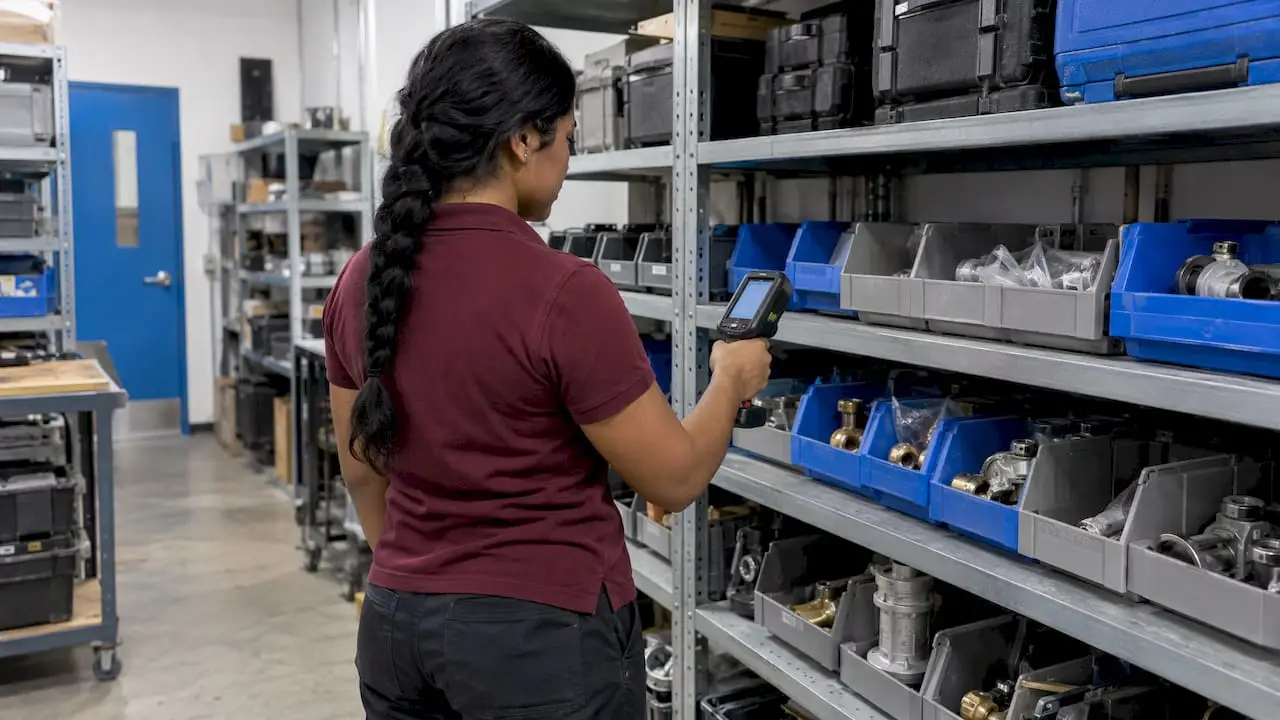
RFID, which uses radio tags that can be read without line of sight, updates records as items move. Inside Logistics reports that RFID for inventory management has shown accuracy improvements of up to 13% compared with conventional tracking and manual assessments in some cases, in the same smarter warehouses feature. AI sits on top by reconciling tag reads, images and transactions.
3. Inferring where records are probably wrong
Not every error can be seen by a camera, and cameras are expensive to maintain at scale. Target’s approach is instructive: an ensemble of thousands of machine learning models, tuned by category, infers items that are likely out of stock but unknown to the system, then passes corrections to its inventory ledger, which triggers replenishment. That ledger handles up to 360,000 inventory transactions per second at peak. Target also reports it ultimately dropped sensors and cameras as the detection mechanism because they were costly to maintain at scale. All of this is in Target’s engineering post.
The lesson for a mid-sized operator is not to copy Target’s scale. It is that your own transaction history already contains the signal: items that should have sold but did not move, locations that never show a pick, adjustments that cluster around a shift or a supplier. A model trained on that history can rank the records most likely to be wrong, so your counters check those first.
4. Closing the loop into replenishment
A corrected record only pays off if it triggers action. When the model flags a mismatch, the correction should flow into the inventory system and into replenishment or reslotting logic. Inside Logistics also reports that using AI for demand forecasting has led to a 25% decrease in surplus inventory, which is the other side of accurate records: when on-hand figures are trustworthy, forecasts built on them are too. For a deeper look at the forecasting side, see our guide to AI inventory optimization for supply chain managers.
The data you need before any model
Accuracy projects fail more often on data than on algorithms. The IEOM Society’s paper on AI in inventory management lists what the models need: current and complete sales data, inventory details, supplier information, market trends and sometimes economic or climate factors, combined across systems, then cleaned and preprocessed. It matches techniques to the problem, for example random forests or neural networks for demand forecasting and reinforcement learning for inventory optimization, validated through cross-validation. The full paper is AI in Inventory Management.
In practice, that means checking five things before you spend on a model:
- One item master. The same product should not carry three codes across your WMS, ERP and spreadsheets.
- Transaction history with timestamps. Receipts, put-aways, picks, adjustments and counts, each with a user and a location.
- Location structure. Bins, racks and zones defined consistently.
- Count history. Past cycle counts are your labelled examples of where the record was right or wrong.
- Access. The data has to be reachable through exports or APIs, not locked in a screen.
In the IEOM paper, data cleaning and preprocessing are the most sensitive phase. If your data sits in silos, budget for unifying it. DHL’s Rashid makes a related point in the Inside Logistics piece: for generative AI to be effective in warehousing, data from every process is needed so the system can learn and help automate decisions.
How to measure whether accuracy improved
This is the question most vendor pages skip, and it decides whether your project is judged a success. A few rules keep the number honest.
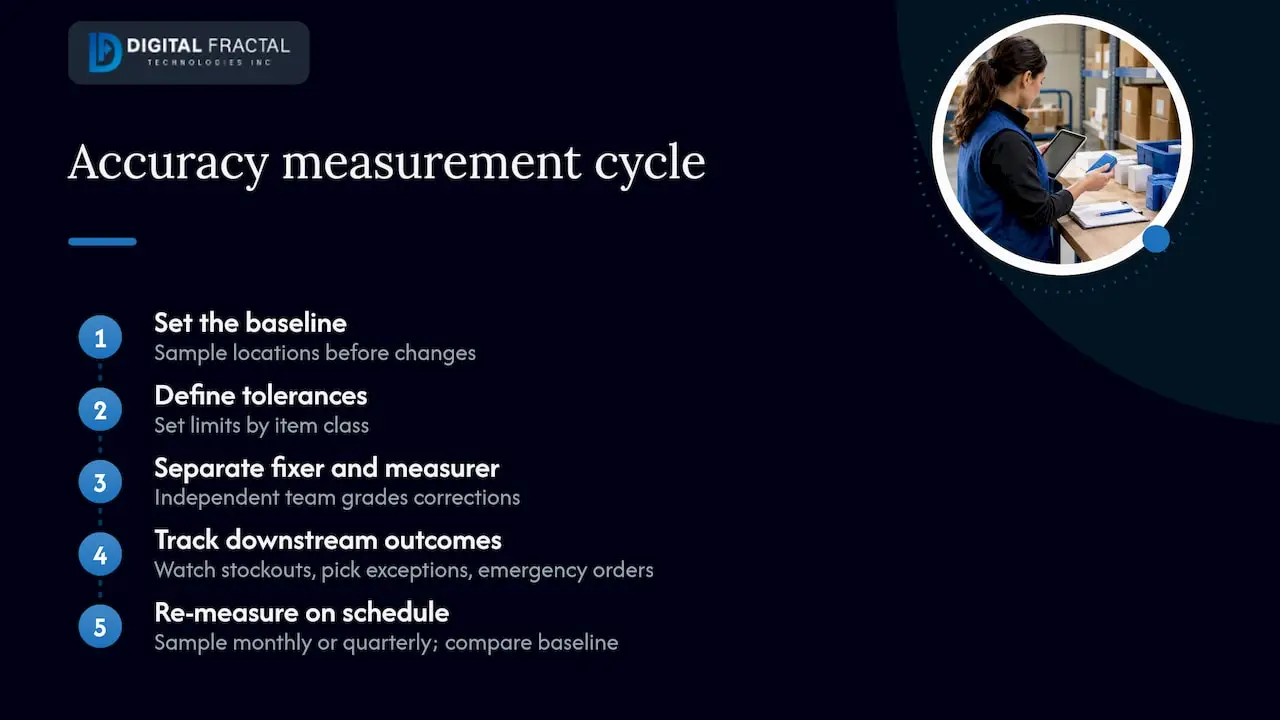
Set the baseline first. Run a count on a representative sample of locations before anything changes. Record the share of SKU-locations that match within tolerance.
Define tolerance by item class. A fast-moving, high-value item may need an exact match. A bulk fastener may tolerate a few percent.
Separate the fixer from the measurer. Target’s team found that decoupling its inventory systems from the methods that detect inaccuracies was key to scaling safely. A separate team performed strategy-agnostic before-and-after measurements, and an arbitration engine chose among competing correction signals. You can borrow the principle at any size: the people who build the correction should not be the only people who grade it.
Track the downstream numbers. Record accuracy is a means. Watch stockouts, pick exceptions, emergency orders and time spent on counting. If accuracy rises and those do not move, the corrections are not reaching the process.
Re-measure on a schedule. Accuracy decays. Sample monthly or quarterly, and compare with the baseline.
A staged path to put it in production
The IEOM paper outlines a sequence that holds up well for operators: review the existing system and define goals, collect and clean the data, build and validate models, integrate through interfaces or middleware between the AI system and your current inventory systems, test the integration thoroughly, pilot alongside existing processes, and roll out gradually, starting with less sensitive areas.
Here is how that looks in a logistics or warehouse setting, and where each step tends to go wrong.
- Pick one problem with a number attached. For example: bin-level accuracy in the fast-pick zone is below target and causes short picks. Projects that start with “improve inventory” have no finish line. This is the step our AI Readiness Audit is built for: it identifies where automation will pay off in your operation, and it is priced as a one-off at $2,500 to $10,000.
- Audit the data. Score the five items above. The common failure is discovering mid-project that adjustments are not timestamped or that two systems disagree on item codes.
- Choose the capture method to fit the site. Fixed cameras, handheld scanning, RFID or drones each suit different layouts. Computer vision is one of our service lines, and our piece on how AI vision systems work in order picking explains what the technology sees and what it needs from the site.
- Integrate through your existing systems. Corrections must land in the WMS or ERP automatically. We build API integrations as part of our services, so the model’s output reaches the system your team already uses. A practical case from the IEOM-referenced research: Leon’s deployment of Captis robots from Cypher Robotics needed minimal infrastructure changes and integrated with the existing WMS for real-time data synchronization.
- Pilot in parallel. Run the AI-assisted process next to the current one in a single zone. Compare results against your baseline.
- Expand in stages. Move to more sensitive areas, such as high-value or regulated stock, only after the pilot holds.
Our stated aim is tangible business change within 90 days, with solutions customized to your workflows, systems and goals. If your constraint is the people-and-process side, workflow automation covers the repetitive tasks around counts and adjustments.
Risks to plan for
The IEOM paper stresses that AI accuracy depends heavily on training data quality, and recommends building both trust in the system and healthy skepticism of it, with human supervision kept in place. Translate that into operating rules:
- Let the model propose corrections, and require a human sign-off for high-value items until the error rate is known.
- Log every automated adjustment so an auditor can trace it.
- Review exceptions weekly in the pilot, because the exceptions teach you what the model misses.
- Plan for the physical environment. Reflective racking, poor lighting and metal-heavy stock can degrade camera and tag reads, so test on your own floor.
In Canada, Robert Khachatryan of Freight Right Global Logistics observes that automated warehouse management is mostly found in e-commerce and retail, driven by online retail growth and omnichannel fulfillment. Operators in construction supply, industrial parts and oil and gas often have less tooling in place, which makes a clear data audit even more valuable.
Our perspective
Most inventory AI projects we are asked about start with a tool and end with a disappointment, because nobody agreed on what “accurate” means for that site. We think the order should be reversed: define the number, check the data, then choose the technology.
We build tailored, industry-specific AI for logistics, construction and oil and gas rather than generic consulting, because a cycle-count problem in a parts room is not the same as a pick-accuracy problem in a distribution centre. The model, the capture method and the integration all depend on the workflow.
That is why our engagements usually begin with an AI Readiness Audit, then move to implementation of automation shaped around your systems. We aim for a visible result inside 90 days, and we would rather prove it on one zone than promise it across a whole network.
If you also want to see how this plays out inside a custom system, read how AI improves custom inventory systems.
Souhail
Where to start with Digital Fractal
If your records and your floor disagree and you want a plan grounded in your own data, begin with our AI Readiness Audit. It is a one-off engagement priced from $2,500 to $10,000 that identifies where automation fits your operation, across industries including logistics and construction. From there we can implement tailored solutions, from computer vision to workflow automation and API integrations into your current systems.

You can also review our AI implementation projects to see the kind of work we deliver, or explore our AI consulting and machine learning solutions.
FAQ
Can AI track inventory and improve record accuracy?
Yes. AI can automate counts through cameras, drones or RFID reads, and it can infer which records are likely wrong from transaction patterns. Published examples include RFID accuracy gains of up to 13% in some cases and a drone-and-AI counting pilot with a reported 10x productivity gain. Results depend on your data and site.
What data does an AI inventory accuracy project need?
You need a consistent item master, timestamped transactions for receipts, picks and adjustments, a defined location structure, past count results and system access through exports or APIs. The data must be current, complete and cleaned before models are trained. Silos across systems are the most common obstacle.
How do I evaluate whether the AI is accurate?
Set a baseline with a sample count, define tolerance by item class, and compare after the change. Ideally a separate team runs the before-and-after measurement, as Target’s engineers did. Then watch downstream numbers such as stockouts, pick exceptions and counting hours, and re-sample on a schedule.
Do I need to replace my WMS to use AI for inventory accuracy?
No. The usual approach is to connect the AI through interfaces or middleware to your current inventory system, test the integration, and pilot alongside existing processes. Rollout then expands gradually, beginning with less sensitive areas.
Sources
- Building smarter warehouses, Inside Logistics
- AI & drones for improved inventory accounting, CEVA Logistics
- Solving for Product Availability with AI, Target Tech Blog
- AI in Inventory Management, IEOM Society