
Feature Store Explained: Architecture, Use Cases and Tools

A feature store is the system that turns raw data into model-ready features once, stores them, and serves the same values to training jobs and to live predictions. Its main job is to keep what a model learned from and what it sees in production consistent. If your team has more than one model, or a model that needs fresh data at request time, it is usually the piece that removes the most repeated work. This guide covers how it works, how it differs from a warehouse, and how to choose a tool. It also covers how a Canadian team can decide when it is ready for one.
TL;DR
- A feature store is an ML-specific data layer: it runs the transformations, stores the results and serves them for both training and inference.
- Its core design is two stores fed by one set of definitions: an offline store for history and an online store for the latest value per entity.
- A data warehouse stores facts for analytics; a feature store stores model-ready features with the metadata and serving guarantees models need.
- Feast is open source and leaves compute and infrastructure to you; Tecton is a managed platform that also computes features, including streaming ones.
- Readiness matters more than tooling: clear data ownership, a few reusable features and a real serving need come first.
Table of Contents
- What a feature store is and the problem it solves
- Feature store architecture: how the pieces connect
- Feature store vs data warehouse
- Designing a feature store for batch and real-time use
- Feast vs Tecton: choosing a feature store
- Do you actually need one yet?
- How we help
- Our perspective
- FAQ
- Sources
What a feature store is and the problem it solves
A feature is a measurable input to a model: a customer’s average order value over 30 days, a truck’s engine temperature trend, a shipment’s delay count this week. Data scientists build features in notebooks, and engineers rebuild them in production code. The two versions drift apart, and the model quietly behaves differently live than it did in testing. That gap is called training-serving skew.
According to the Feast project’s explanation, a feature store is a data system that runs pipelines to transform raw data into feature values, stores and manages them, and serves them consistently for training and inference. Defining a transformation once, then calculating and serving its values the same way in development and production, is what prevents skew.
Microsoft’s Azure Machine Learning documentation lists four problems a feature store solves:
- Searching for and reusing existing features.
- Creating features with transformations.
- Operationalizing feature engineering pipelines.
- Keeping online and offline data consistent to avoid skew.
Databricks describes the same idea as a centralized system for storing, managing and sharing features across models and teams, with support for discovery, documentation and governance. IBM’s overview frames it the same way: one place where feature values are defined once and used consistently from model training to production.
In practice, you feel the benefit in three places:
- Reuse. A second model team starts from the catalog instead of rewriting the same aggregation.
- Consistency. The value a model trained on is computed the same way as the value it receives at prediction time.
- Governance. Someone can answer where a feature came from, who owns it and which models depend on it.
Feature store architecture: how the pieces connect
Most designs share the same skeleton. Raw data arrives from batch sources (warehouse tables, files) and sometimes streams. Transformations produce features. Those features land in two places, and a registry keeps track of what exists.
The offline store
The offline store holds the history. Per the Feast overview, it typically keeps months or years of feature data for building training sets, in a warehouse or lake such as S3, BigQuery, Snowflake or Redshift. When you train a model, you pull a dataset from here.
The online store
The online store holds only the latest value per entity (a customer, a vehicle, a shipment), in a key-value system built for low-latency reads, such as DynamoDB, Redis or Cassandra, according to the same source. When a prediction request arrives, the model service looks up its features here in milliseconds.
Materialization and the registry
The Feast architecture documentation explains how the stores connect. Materialization loads features from the offline store into the online store. The registry persists the feature definitions. The SDK builds training datasets from the offline store and retrieves online features through a feature server. A full deployment in that documentation also includes a stream processor (experimental, for Kafka), a compute engine for materialization and an authorization manager.
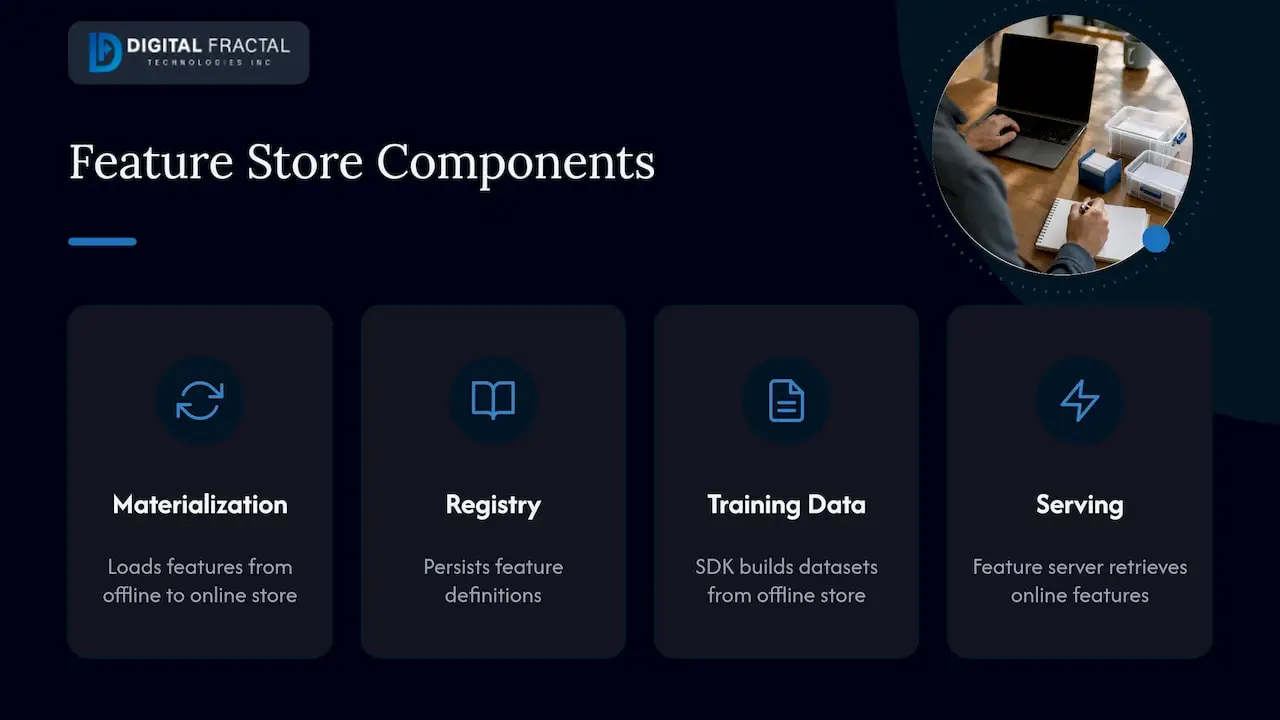
The Feast blog groups the functions into five components: transformation, storage, serving, monitoring and the feature registry.
How managed platforms package it
The same pattern shows up everywhere, with different packaging. Snowflake’s documentation describes feature views that wrap a Python or SQL pipeline, an online store on a managed serving layer, and stream feature views whose end-to-end freshness is typically under 200 ms at P50. H2O’s architecture page describes an offline engine that holds metadata in PostgreSQL and an online engine using Redis or PostgreSQL, with syncing between them. HubSpot’s engineering team, in a post published in November 2026, describes a registry, an online store on Apache HBase and an offline store on Apache Iceberg.
The lesson is that the three roles (registry, offline, online) matter more than the brand of each component.
Feature store vs data warehouse
A feature store uses database technology, but it solves a different problem. Databricks puts it this way: a feature store manages transformed data suited to direct use in models, not the raw data being transformed.
A peer-reviewed paper by Lamer et al. draws the line precisely. A warehouse stores cleaned, standardized, fine-grained data in a normalized, row-oriented format for all purposes. A feature store stores aggregated, cleaned, standardized features in a denormalized, column-oriented format for a prespecified purpose. The paper adds that a feature store keeps all feature versions, which supports reproducibility.
| Data warehouse | Feature store | |
|---|---|---|
| Main purpose | Analytics and reporting | Training and serving ML models |
| Data shape | Fine-grained, normalized | Aggregated features, denormalized |
| Typical latency | Seconds to minutes | Online reads in milliseconds |
| Training-serving consistency | Not built in | Core design goal |
| Versioning | Depends on how you model it | Feature versions kept for reproducibility |
The latency row comes from a glossary entry on feature stores, which cites sub-10 ms online latency for feature stores against seconds to minutes for a warehouse. Treat the figures as typical, not guaranteed: they depend on the stack.
The two are partners, not rivals. The warehouse is very often the offline store or the source feeding it. If you are weighing platforms for that layer, our Snowflake vs Databricks guide for Canadian enterprises covers the trade-offs.
Designing a feature store for batch and real-time use
Design decisions flow from one question: how fresh must each feature be when the model uses it?
Sort features by freshness need
Features like a customer’s lifetime spend can refresh nightly through batch jobs. Features like a vehicle’s last five minutes of sensor readings need streaming or request-time computation. Tecton’s documentation names these three modes: batch, stream and realtime feature views. Sorting your candidate features into these buckets early keeps you from paying for streaming everywhere.
Get time right
Training data must reflect what was known at the moment of each historical event. For every training row, you fetch the feature value as it stood at that row’s timestamp, never a later one. This is called a point-in-time correct join, and it is one of the main things a feature store handles for you. Skip it, and future information leaks into training and the model looks better offline than it performs live.
Avoid duplicating data
HubSpot’s team describes serving some values directly from their source at read time when the data already lives in operational systems and needs only light transformation. For teams already on Apache Iceberg, a pattern of plugging existing tables into the offline store avoids ingestion entirely, and 23% of their features fall into that category (same HubSpot post). That figure is one company’s experience, not a benchmark, but the principle holds: do not copy data you do not need to copy.
Best practices that pay off quickly
- Name an owner for every feature. Unowned features rot.
- Document each feature’s definition and source. A catalog is only useful if people trust it. Our guide to data catalog tools for enterprise teams shows how that layer fits around a feature registry.
- Test the full pipeline, not only the model. Our walkthrough of end-to-end testing for ML pipelines covers the checks.
- Monitor features in production. Drift in a single input can degrade a model with no error message. See how we approach ML observability for production pipelines.
- Start with the features reused most, not the whole catalog.
Feast vs Tecton: choosing a feature store
These two come up most in searches, and they represent two different philosophies.
Feast is an open-source feature store that delivers structured data to AI and LLM applications during training and inference. A professional comparison notes it is free with no paid edition, but you pay for and operate the online store, offline compute and materialization jobs. It supports offline stores including BigQuery, Snowflake, Redshift, Spark and Parquet files, and online stores including Redis, DynamoDB, PostgreSQL and SQLite. The same comparison marks vector search in the online store as alpha and the registry web UI as experimental. Feast provides storage, registry and retrieval over stores you supply; the transformation pipelines are yours to build.
Tecton is built for real-time machine learning at scale: it transforms raw data into features, serves them with ultra-low latency and automates feature pipelines so teams avoid maintaining custom infrastructure. Its feature views cover batch, streaming from Kafka or Kinesis, and request-time computation, with transformations in Python, Pandas, SQL, PySpark and Snowflake SQL. It is a commercial product, so its pricing is a conversation with the vendor.
For teams that want Feast with enterprise support, Canonical announced Charmed Feast in July 2025, a distribution with long-term security maintenance and optional round-the-clock SLAs.
| Criterion | Feast | Tecton |
|---|---|---|
| Licence | Open source, Apache 2.0 | Commercial |
| Computes features | No, you bring pipelines | Yes, including streaming |
| Infrastructure | You run and pay for the stores | Managed platform |
| Best fit | Teams with platform engineers and batch-heavy needs | Teams that need real-time features without building the plumbing |
How you decide:
- List your features by freshness. Mostly nightly? Feast’s model fits. Many streaming features? Weigh a managed platform.
- Count the engineers you can dedicate. Open source costs no licence but does cost operating time.
- Check your existing stack. If your data already lives in a cloud warehouse, a warehouse-native feature store may be the shortest path. Our cloud ML deployment cost guide helps estimate the running costs.
- Match the choice to the use case, not the other way round.
Do you actually need one yet?
A feature store earns its keep when several of these are true: more than one model shares inputs, features are rebuilt by hand in production, predictions are served live, or audits require lineage. With one batch model and a single data scientist, a well-organized warehouse table can be enough for now.
That judgment is really a readiness question: are the data sources reliable, are owners named, is there a use case worth the infrastructure? Our guide to enterprise data readiness walks through how to assess it. Logistics, construction and oil and gas teams often have the data (telematics, sensor streams, job records) but not yet the shared definitions that make it usable. If your inputs come from machines in the field, our notes on edge versus cloud for AI workloads show where features should be computed.
How we help
The AI Readiness Audit is where our engagements usually start. It looks at your data, workflows and systems and identifies where AI and automation will pay off. It is a one-off engagement priced at $2,500 to $10,000, and the findings tell you whether a feature store belongs in your first 90 days or later. From there, our AI Implementation & Build Out service covers building the tailored solution around your workflows and systems.
Book an AI Readiness Audit to see which of your data and models are ready.
If you want to see the wider scope first, our AI consulting and machine learning solutions page lists what we build.
Our perspective
Most teams ask us which feature store to buy. The better first question is which decisions the model makes, and how fresh the data behind them has to be.
We build tailored, industry-specific solutions, not generic consulting, so we start from your workflows: the dispatch decision in logistics, the maintenance alert on a site, the forecast an operator relies on. Features follow from those decisions. When a feature store is the right answer, it is because the same definitions are being rebuilt in several places and the cost of drift is real.
That is why we begin with a readiness audit rather than a platform choice. The audit shows whether your data is ready, which use cases justify the infrastructure, and what can be delivered inside 90 days. A feature store chosen after that is an engineering decision. One chosen before is a guess.
Souhail
FAQ
What is a feature store in simple terms?
It is a shared library of model inputs. It computes features from raw data once, stores them, and hands the same values to training jobs and to live predictions. That consistency is what keeps a model’s production behavior in line with its testing.
Is a feature store the same as a data warehouse?
No. A warehouse stores fine-grained, normalized data for analytics and reporting. A feature store holds aggregated, denormalized features for a specific ML purpose, with versioning and low-latency serving. Many teams use the warehouse as the feature store’s offline layer.
What are the offline and online stores?
The offline store keeps long feature history, often in a warehouse or lake, and is used to build training sets. The online store keeps the latest value per entity in a fast key-value system for live lookups. Materialization moves values from one to the other.
Should we start with Feast or Tecton?
It depends on freshness needs and engineering capacity. Feast is open source and gives you storage, registry and retrieval over infrastructure you run. Tecton is a managed platform that also computes features, including streaming ones. Map your features and team size first, then choose.
How do you know a team is ready for a feature store?
Look for several models sharing inputs, features rebuilt separately in production, live serving needs and clear data owners. If those are missing, fix data quality and ownership first. A readiness audit can sort this out before you commit to tooling.
Sources
- What is a Feature Store? (Feast blog)
- What is managed feature store? (Microsoft Learn)
- What is a Feature Store? (Databricks)
- What Is a Feature Store? (IBM)
- Feast architecture overview
- Snowflake Feature Store documentation
- H2O Feature Store architecture
- HubSpot engineering: From Data Silos to Feature Serving
- Databricks: A Complete Guide to ML Feature Engineering
- Lamer et al., Data Lake, Data Warehouse, Datamart, and Feature Store (PMC)
- Feature Store glossary entry
- Tecton concepts
- Tecton introduction
- Feast
- Feast vs Tecton comparison
- Canonical: Charmed Feast launch