Synthetic Data for Vision: How to Train Models Without Waiting for Rare Real Images

Synthetic data for vision is artificially created imagery, with labels attached, that you use to train or test a computer-vision model. It works best when real images are rare, costly to label or restricted by privacy, and it works best of all when you pair it with a smaller set of real images. A model trained on synthetic data alone typically loses accuracy on real-world footage, so the winning pattern is a mix, checked against real test data.
This guide is for operations and technology leaders in logistics, construction, energy and manufacturing who are deciding whether synthetic data belongs in a vision project. It covers what the term means, how the data is generated, where it pays off, where it fails, and how to decide.
TL;DR
- Synthetic image data is either real images that are digitally altered or images captured from virtual environments. Both can come with automatic labels.
- It helps most with rare defects, hazardous scenarios, expensive labeling and privacy limits.
- Models trained only on synthetic data usually drop in performance on real data (the domain gap), so plan to fine-tune and test on real images.
- Judge a synthetic dataset by how the finished model performs on real tasks, using precision and recall.
- A short readiness audit tells you whether your data, cameras and workflow can support the project before you spend on generation.
Table of Contents
- What synthetic data for vision actually is
- How synthetic vision data is generated
- Why teams use it: the case for synthetic data
- Where it is already working in Canadian industry
- How to combine synthetic and real data
- Limits you plan for
- Is synthetic data right for your project?
- Privacy and governance in Canada
- Our perspective
- What this looks like in a real workflow
- Work with Digital Fractal
- FAQ
- Sources
What synthetic data for vision actually is
A review of synthetic image data in computer vision defines it as artificially created visuals. They range from digitally manipulated real images to scenes captured entirely inside a virtual environment, and they are used to augment or replace real-world datasets when training a model.
That definition covers two families:
- Synthetic composites. You start with real images and change them: pasting an object into a new background, altering lighting, adding weather or noise.
- Virtual synthetic data. You build a scene, an environment or a whole world in software, then render images from it.
The practical difference from real data is control. In a rendered scene you know exactly where every object is, so labels such as bounding boxes and masks come for free. With real footage, a person has to draw them.
How synthetic vision data is generated
The 2024 review of synthetic data for video surveillance in the International Journal of Computer Vision sorts generation approaches into three groups: generative models, computer graphics engines and image composition. Each suits a different job.
| Approach | How it works | Good for | Watch for |
|---|---|---|---|
| Graphics engine or simulator | You model 3D scenes, materials, lighting and cameras, then render | Precise labels, controlled variation, hazardous or rare scenes | Effort to build realistic assets |
| Generative models | A GAN, diffusion or vision-language model produces new images | Fast variety, filling gaps in a class | Mode collapse, labels that need checking |
| Image composition | Real objects or patches are combined into new scenes | Small real datasets that need more variety | Visible seams and unrealistic context |
Graphics engines and simulation
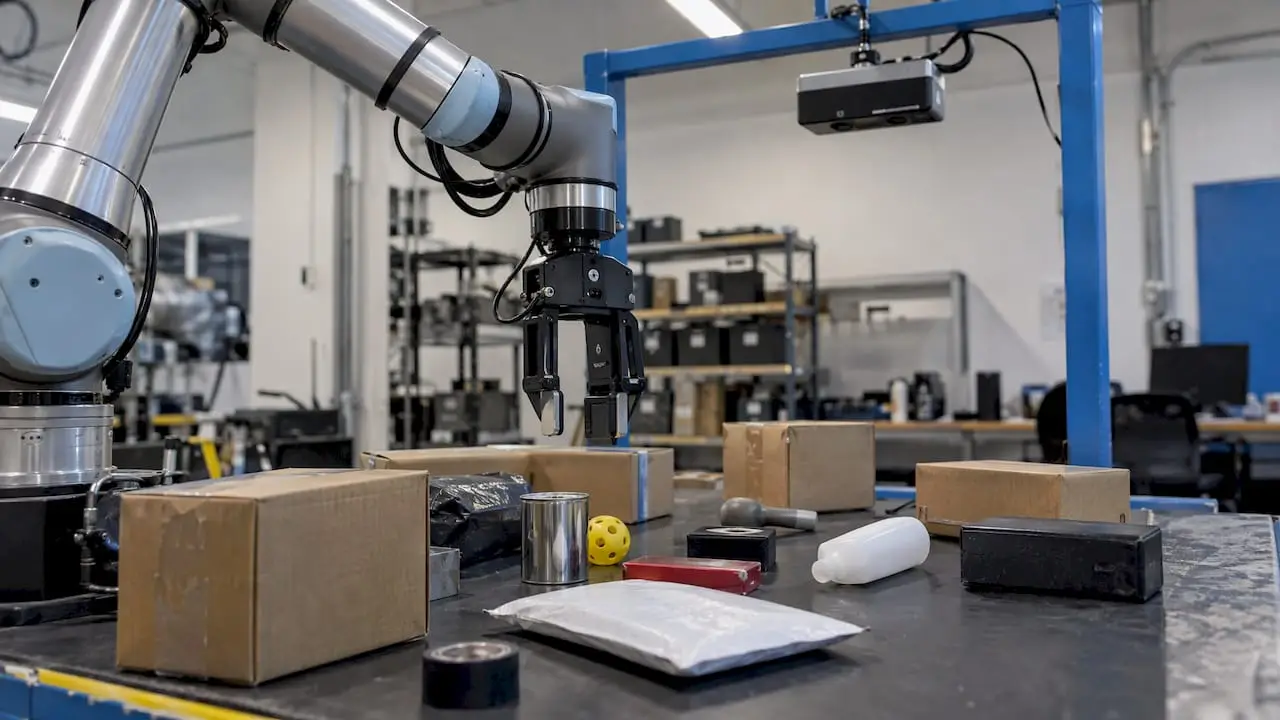
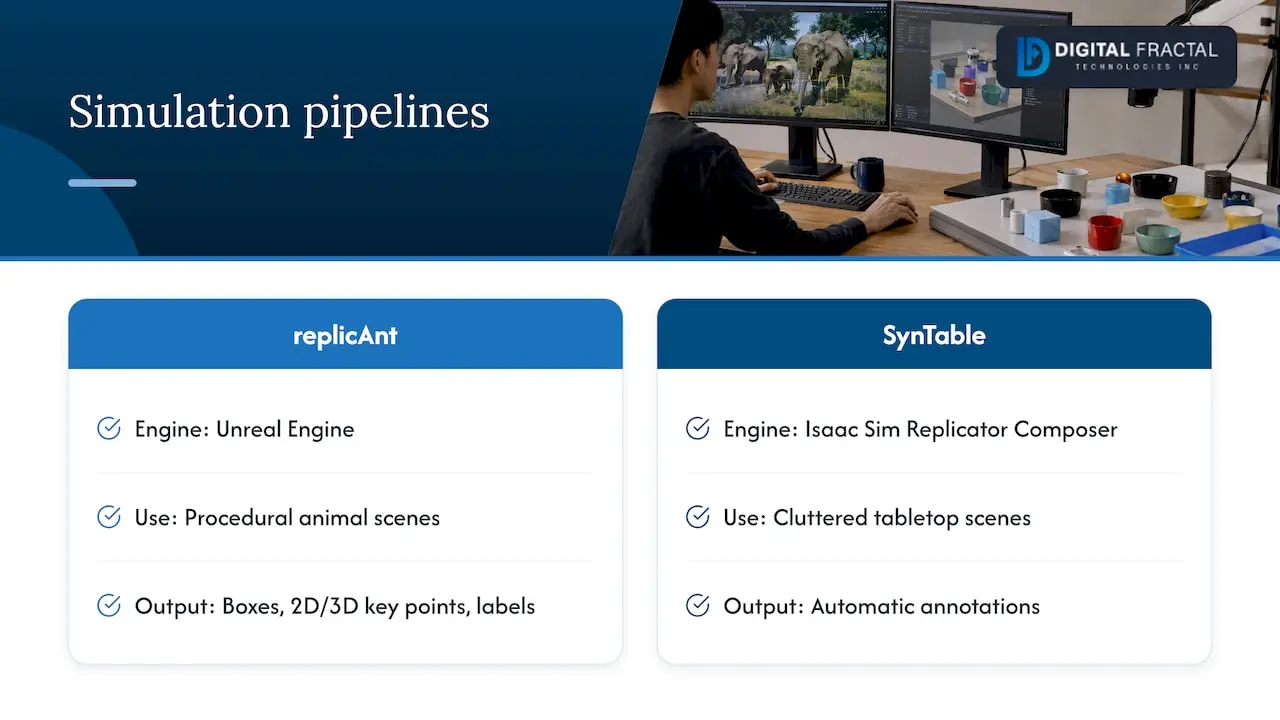
The replicAnt pipeline uses Unreal Engine to produce annotated images of animals in procedurally generated environments. It outputs bounding boxes, 2D and 3D key points, class labels and camera parameters, and it runs on consumer-grade hardware. SynTable takes a similar route for cluttered tabletop scenes. It builds on NVIDIA’s Isaac Sim Replicator Composer, drops objects onto a table with physics simulation, then captures annotations automatically. Bin picking, parcel handling and shelf scenes in a warehouse are close cousins of that setup.
A common tactic inside simulators is domain randomization: varying textures, lighting, backgrounds and camera angles so the model learns what matters and ignores what does not. NVIDIA describes structured domain randomization in Isaac Replicator as a way to narrow the gap between simulated and real images, and reports a case where synthetic indoor scenes were used to train a detector that finds doors in real buildings.
Generative models
Generative approaches can turn a handful of labeled examples into a labeled data factory. NVIDIA’s BigDatasetGAN manually annotates just five images per class across the 1,000 ImageNet classes, then trains a branch on the generator’s features so it outputs labeled data for segmentation models.
Canadian researchers are working in this space too. A group at Université Laval built the Gen4Regen dataset of 2,101 synthetic image and mask pairs with a vision-language model, generating each image and its multi-class segmentation mask in a single inference cycle. The prompts asked the model to give each class its own colour so masks could be read off directly.
Image composition and augmentation
This is the lowest-barrier entry point. If you already own thousands of real images, flips, crops and colour shifts are the simplest form of augmentation. Compositing goes a step further by moving real cut-out objects into new scenes.
Why teams use it: the case for synthetic data
The review of synthetic image data lists the situations where it makes sense: real data that is difficult or costly to obtain or label, or limited by privacy and legal restrictions. In return, generation can be faster and cheaper, gives more control, and improves label accuracy.
Here is how that plays out on the ground.
Rare events. A cracked weld, a collapsed pallet, a worker stepping into a forklift lane: these are the images you least have. If defects are rare, data collection is hard, or a product has no failure history yet, synthetic generation is where a hybrid training strategy starts to pay.
Label quality. The surveillance review points out that manual annotation is a well-known limitation and can introduce errors or inaccuracy in real datasets. A simulator that knows where each object sits produces pixel-level labels automatically, which cuts manual labeling cost for whatever the simulator models.
Changing conditions. The same review notes that synthetic data is especially interesting when cameras are unconstrained and a model has to work across different scenes. Think of a yard camera that sees rain, snow, glare and night in the same week.
Privacy. Footage of people on a site or in a facility raises consent and retention questions. Synthetic scenes avoid putting identifiable people into the training set. For the Canadian legal picture, see the section on privacy below.
Where it is already working in Canadian industry
The published evidence from Canada is mostly in inspection and infrastructure.
- A Mitacs project with SmartInside AI is using synthetic images to adapt a power-grid anomaly-detection solution built on South Korean data to Canadian equipment and weather conditions.
- A 2024 paper in the NDT Canada proceedings generated synthetic digital X-ray images by modelling the intensity distribution of real ones. A model trained on 900 synthetic images reached a mean IoU of 0.93 and a mean Dice coefficient of 0.96 on real unseen radiographs.
- A 2024 arXiv paper on rail defects used a variational autoencoder to expand 50 original samples into a 500-image dataset across five classes. Its abstract reports 98% to 99% accuracy for a Visual Transformer classifier fine-tuned on the synthetic data.
- Canam, a Canadian steel joist maker, describes an assistant welding inspector built on 50,000 tagged images that reached 97% efficiency in checking whether joists had welds. That example is real-image training, and it shows the scale of labeled data that synthetic generation is meant to help you reach faster.
These are research and project results from specific settings, not guarantees for yours. They show the pattern: a small real core, extended with generated images, validated on real ones.
How to combine synthetic and real data
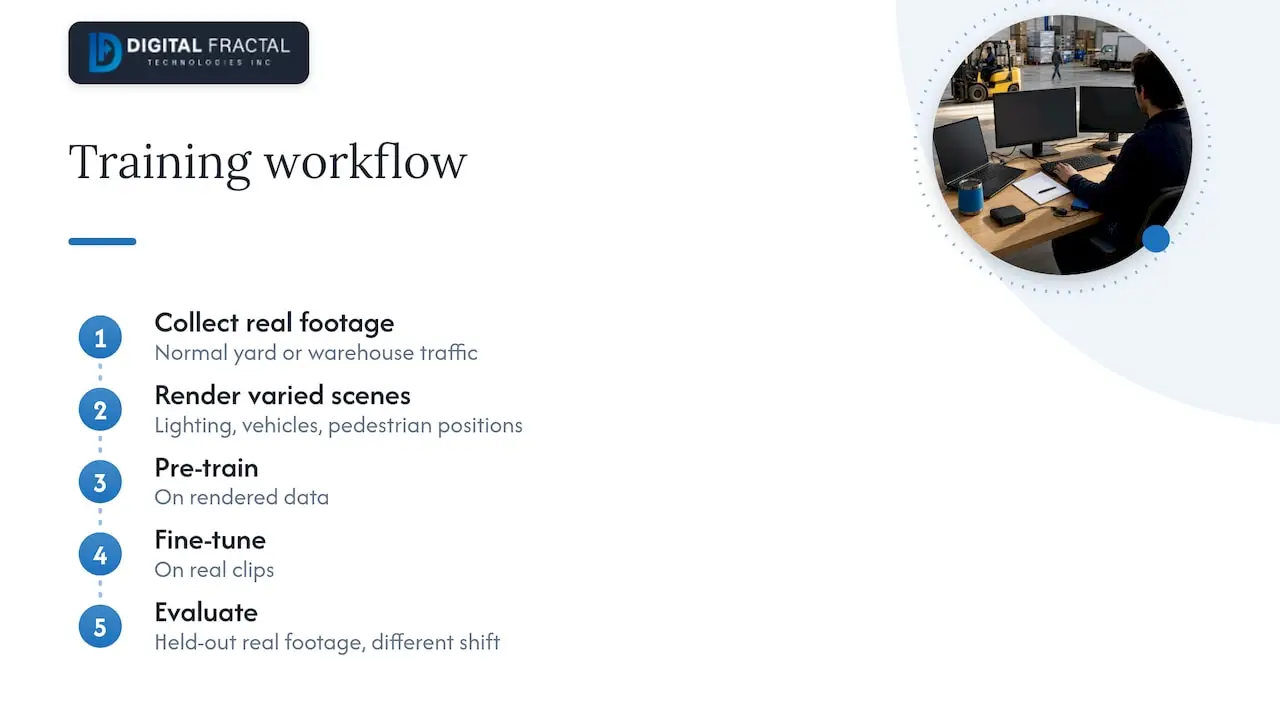
The approach most teams settle on is pre-training on large synthetic sets, fine-tuning on a smaller real set, and evaluating on real-world test data. A workflow that repeats this loop looks like this:
- Collect a real seed set. A few hundred well-labeled real images from your actual cameras, even if they are mostly normal conditions.
- Define the gaps. List the classes, angles, lighting and failure types the seed set lacks.
- Generate to fill the gaps. Match camera height, lens, resolution and compression of your real cameras, or the model learns a look it will never see on site.
- Train on the mix. Pre-train on synthetic, then fine-tune on real.
- Test on real data only. Hold out real images the model never saw, from different shifts, sites and seasons.
- Feed errors back. Where the model fails in the field, add real samples or generate targeted scenes, then retrain. One industry write-up frames synthetic data as a scalable assistant rather than a replacement for real data, with exactly this prototype, validate and retrain cycle.
Limits you plan for
Synthetic data has known failure modes, and a good project plans around them from day one.
The domain gap. Models trained only on synthetic images typically show a significant performance drop on real data. Domain randomization, realistic sensor modelling and a real fine-tuning set are the standard ways to narrow it.
Bias. A generator reproduces whatever assumptions were built into it. If your scenes only show daytime and clean floors, your model learns that world.
Compute. Generating large datasets takes significant computing capacity. That affects whether you render in the cloud or on owned hardware. If you are sizing that, a rundown of GPU cloud providers for AI teams helps frame the infrastructure and staffing side.
Generative model instability. Researchers at Politecnico di Milano note that GANs can suffer from mode collapse and training instability, making it hard to guarantee the data captures the full variability of the real world. The same chapter places generative AI for in-line quality control at an early maturity level, so validation frameworks matter.
The handling is the same each time: treat synthetic images as a training aid, and let real-world test results decide.
Is synthetic data right for your project?
Use these questions as a quick screen.
| Question | If yes | If no |
|---|---|---|
| Are the events you must detect rare or dangerous to stage? | Strong case for synthetic | Real data may be enough |
| Is labeling the bottleneck or the budget line? | Simulation labels are automatic | Keep manual labeling |
| Do privacy rules limit footage of people or sites? | Synthetic scenes reduce exposure | Standard collection works |
| Do you have cameras running now with usable footage? | Build a real seed set and extend it | Start capturing before generating |
| Can you measure success on real images? | Proceed, with a real test set | Fix this first |
To judge results, use task-specific measures. The synthetic images whitepaper recommends validating downstream performance with precision and recall, and judging synthetic data by how useful it proves in the real application. For a warehouse safety model, that means how many real near-misses it catches, and how many false alarms your supervisors have to dismiss.
Privacy and governance in Canada
Synthetic data is often mentioned as a privacy-enhancing technique, but whether a given dataset counts as non-personal information depends on how it was produced. An assessment under Canadian privacy regulations examines how synthetic data generation, use and disclosure fit under PIPEDA and discusses de-identification and re-identification risk thresholds. If your synthetic images are derived from footage of identifiable people, take that into account and involve your privacy officer or counsel.
The January 2026 Datarisk assessment pack for Canadian organizations lists the documentation a reviewer expects: validity and reliability evidence, safety and security controls, privacy by design and lawful authority, and data-quality controls that catch inaccurate, biased or incomplete inputs. Keeping a record of how each synthetic set was generated, what it contains and how it was validated puts you ahead of that checklist.
Our perspective
We see the same pattern in most vision projects: the model is rarely the hard part. The hard part is having the right images, labeled correctly, from the cameras that will actually run in production.
That is why we do not start with a generator. We start by looking at your workflows, your cameras, your existing footage and the cost of a missed detection. Sometimes the answer is to collect two more weeks of real footage. Sometimes it is to render the rare scenes that never show up on a normal shift. Usually it is both.
Our work is tailored to your systems and goals rather than generic consulting, and we aim for visible business results within 90 days. For vision, that means a narrow first use case, a real test set agreed up front, and synthetic data used where it shortens the path to that test.
If you run logistics, construction, energy or manufacturing operations, the best first step is a clear view of your data and workflows. Everything else, including generation, follows from it.
Souhail
What this looks like in a real workflow
Take a yard or warehouse safety camera. The events that matter, such as a pedestrian entering a forklift path, are rare, and staging them is risky. A team can collect real footage of normal traffic, render scenes with varied lighting, vehicle types and pedestrian positions, pre-train on the rendered set, then fine-tune on real clips. Success is measured on held-out real footage from a different shift. Our write-up on computer vision forklift safety and CSA KPIs shows how to tie that kind of pilot to measures a safety manager recognizes.
For inspection, the logic is the same. Our guides to computer vision defect detection for manufacturers and the AI construction defect detection workflow show where defect images come from and why scarce classes are the usual bottleneck. If the model has to run on a camera or gateway with limited connectivity, edge anomaly detection flags issues locally before cloud review. For aerial imagery, where objects are tiny and examples scarce, see our notes on UAV small-object detection models.
Before any of this, check that your data foundations hold up. Our guide to enterprise data readiness explains how to assess storage, labeling, access and quality.
Work with Digital Fractal
If you are weighing synthetic data for a logistics, construction, energy or manufacturing use case, our AI Readiness Audit is the practical starting point. It maps where AI can take over repetitive work in your operation and whether your data and systems can support it. The audit is a one-off engagement priced from $2,500 to $10,000, and you can read how it works in our AI Readiness Audit guide.
When the audit points to a vision build, our team handles discovery, implementation and training through our AI and machine learning solutions, including computer vision, and can wire the results into your apps and workflows. Start with the AI Readiness Audit.
FAQ
Can synthetic data fully replace real images?
Not in most projects. Models trained only on synthetic data typically lose performance on real data because of the domain gap. The usual approach is to pre-train on synthetic images, fine-tune on a smaller real set and evaluate on real test data.
How many real images do I still need?
There is no universal number, because it depends on how varied your scenes are and how costly a miss is. Start with a seed set from your actual cameras that covers normal conditions, then use synthetic generation for the rare cases. Your real held-out test set should come from different shifts and sites than the training images.
How do I know the synthetic data is good enough?
Judge it by what the trained model does on real images. Track task-specific measures such as precision and recall, and review the errors by hand to see whether they cluster around conditions your synthetic scenes got wrong.
Is synthetic data useful beyond cameras, such as for mobile apps?
Yes, wherever an app relies on image recognition, such as scanning parts, reading labels or flagging site hazards. Synthetic images can extend the training set for the vision model behind the app, and the same real-image testing applies on the devices your crews actually use.
Sources
- A Review of Synthetic Image Data and Its Use in Computer Vision
- replicAnt pipeline for annotated images
- SynTable synthetic data pipeline
- Synthetic Data for Video Surveillance Applications of Computer Vision
- Closing the Sim2Real Gap with NVIDIA Isaac Sim and Isaac Replicator
- BigDatasetGAN
- Leveraging Image Generators to Address Training Data Scarcity (Gen4Regen)
- Synthetic Images for AI whitepaper
- Synthetic Data in Computer Vision Annotation
- Mitacs synthetic image generation project
- NDT Canada 2024 synthetic X-ray paper
- Image Generation for Rail Defect Detection
- Canam digital transformation example
- Synthetic Data vs Real Data
- Using Synthetic Data in ADAS Annotation
- On the Use of Generative AI to Support In-Line Process Control
- Synthetic data under Canadian privacy regulations
- Datarisk AI Guidance for Canadian Organizations Assessment Pack
- GPU cloud providers for AI and HPC teams