
Supplier Risk Scoring With AI: How It Works and How to Start

AI supplier risk scoring pulls data from many sources, looks for patterns, and gives each supplier a score that updates as conditions change. It replaces the annual questionnaire and the spreadsheet scorecard with continuous monitoring. The score only creates value when it is tied to a decision: who to qualify as a backup, when to buy early, which shipment to expedite. This guide explains how the scoring works, what your data needs to look like, where the limits are, and what Canadian organizations should have in place before they switch it on.
TL;DR
- AI supplier risk scoring combines news, shipping, financial, weather and your own ERP data into a score that updates continuously, instead of a quarterly check.
- A score estimates likelihood. Business impact depends on your own network, so rate probability and impact separately.
- Clean, mapped, owned data matters more than model choice. Most failed projects stall on siloed records, not algorithms.
- In Canada, plan for privacy (PIPEDA), AI governance and supply chain reporting duties from the first design meeting.
- Start small: a scoped readiness audit on one supplier category, then expand.
Table of Contents
- What AI supplier risk scoring is, and how it differs from the old way
- What data feeds a supplier risk score
- How the score is calculated
- Turning scores into decisions
- Getting your data ready
- Limits of AI scoring, and how to validate
- Canadian privacy, security and governance
- Our perspective
- Start with a scoped audit
- FAQ
- Sources
What AI supplier risk scoring is, and how it differs from the old way
Traditional supplier assessment relies on manual reviews, audits and scorecards. They are slow, fragmented and backward-looking: by the time a questionnaire is filed, the supplier’s situation may have changed. According to Supply Chain Connect, AI-powered risk intelligence ingests several data sources, identifies patterns, generates signals for potential risks, then scores and triages alerts by likely impact.
The practical difference is cadence and coverage. A procurement team might review its top suppliers once or twice a year. A scoring system can watch every supplier, every day, and flag only the few that moved. The same source describes continuous monitoring replacing quarterly checks with a supplier profile that is always current.
“Supplier risk analytics” is the wider term. It covers the scores, the dashboards, the alerts and the reporting on top of them. Scoring is the engine; analytics is how people see and act on what it produces.
What data feeds a supplier risk score
A useful score blends outside signals with your own records. Supply Chain Connect lists news, shipping and customs feeds, financial filings, weather and port-congestion data, and scans of compliance records as inputs.
In practice, group the inputs like this:
| Signal family | Examples | Typical question it answers |
|---|---|---|
| Financial | Filings, payment behavior, credit indicators | Will this supplier stay solvent? |
| Operational | On-time delivery, lead-time drift, cost variance, quality defects | Is performance slipping? |
| Logistics and geography | Port congestion, customs delays, weather, route exposure | Will goods arrive when promised? |
| Compliance and ethics | Audit status, sanctions, labour-practice indicators | Could this supplier expose us to legal or reputational harm? |
| News and open sources | Plant incidents, strikes, ownership changes | Is something happening that we have not heard about? |
The compliance family deserves attention for Canadian buyers. Deloitte Canada notes that modern slavery risk factors include the supplier’s country, the sector’s susceptibility, reliance on temporary workers, and any track record of sanctions or violations. Those are exactly the kinds of fields a scoring model can carry as inputs.
How the score is calculated
The mechanics are less mysterious than the marketing suggests. As one industry description puts it, the system collects and normalizes data from internal and external sources such as ERP, supplier relationship management, news, sensors and social media. It then identifies predictors like on-time delivery, cost variance and sustainability ratings. Regression, decision trees and neural networks turn those predictors into a risk score, shown in dashboards and alerts. Models trained on historical disruptions, supplier performance and macroeconomic data can forecast some risk events days or weeks ahead.
Treat such forecasts as probabilities, not promises. A few design choices decide whether the output is trustworthy:
- Entity matching. The system must know that three differently spelled company names are one supplier, and which parent owns it.
- Weighting. A late delivery from a commodity vendor and a late delivery from the sole source of a critical part are not the same event. Weights should reflect criticality.
- Thresholds. Decide in advance what score triggers a call, a review or a switch to a backup.
- Explanations. Each score should show the signals behind it, so a buyer can judge it rather than obey it.
Likelihood is not impact
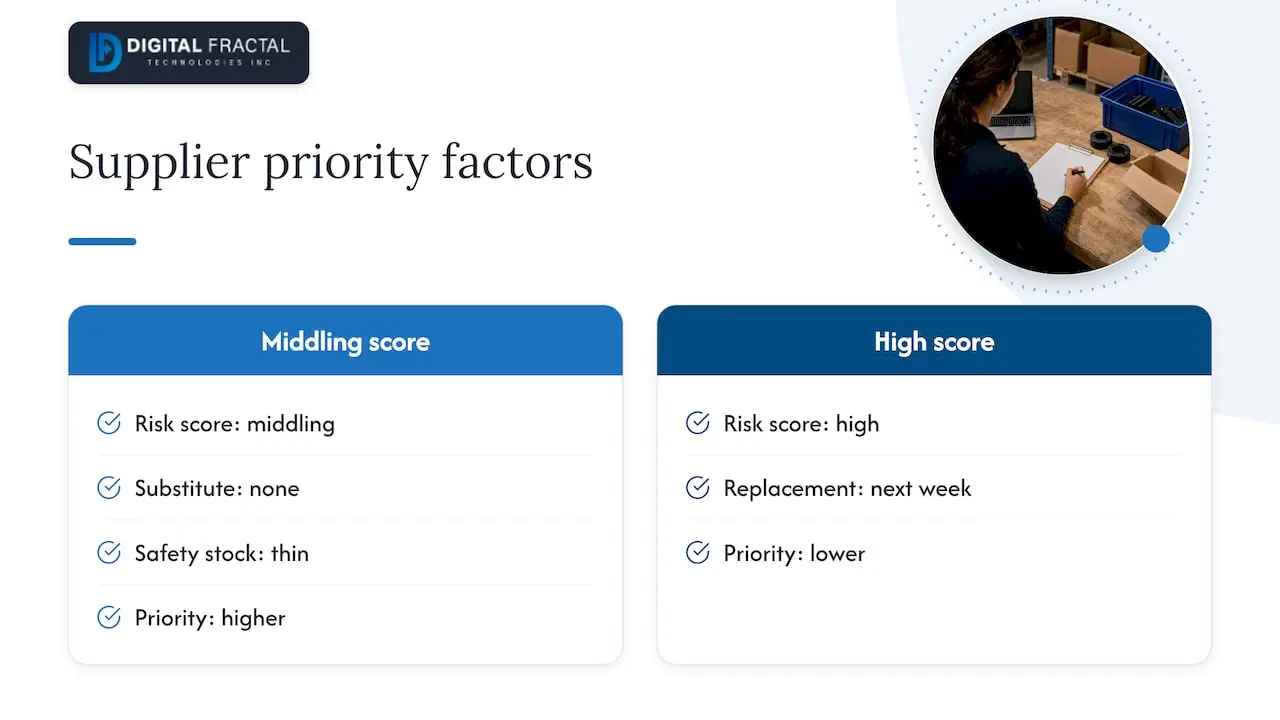
AI scoring generally estimates how likely something is from observed patterns. How much it would hurt depends on your inventory, alternatives and network. Rework recommends mapping probability separately from impact. A simple two-axis grid does this well: a supplier with a middling risk score but no substitute and thin safety stock can deserve more attention than a high-scoring supplier you could replace next week.
Turning scores into decisions
A dashboard that nobody acts on is an expensive report. Academic research on resilience argues that prediction creates value only when it connects to targeted redundancy, supplier collaboration, multi-tier visibility and risk-adjusted total cost. The same work describes the operational responses an alert can trigger: qualifying alternate sources, diversifying supply, changing purchase timing, expediting freight, adjusting safety stock and engaging the supplier directly.
A workable playbook assigns each response to a score band:
- Watch (low change): no action, keep monitoring.
- Elevated: procurement contacts the supplier, confirms capacity and lead times.
- High on a critical item: logistics checks buffer stock, purchasing considers pulling orders forward, sourcing starts qualifying a second supplier.
- Severe: expedite freight, activate the backup, notify operations and finance.
For logistics firms, the same alerts feed route and carrier decisions. For construction and industrial buyers, they inform material purchase timing. If the output touches stock levels, our guide to AI inventory optimization for supply chain managers shows how risk signals can set safety stock more deliberately.
The routing step is where workflow automation earns its keep. When a score crosses a threshold, a ticket should open, the right owner should be notified, and the response should be logged without anyone chasing. Workflow automation is usually what turns a score into a task with an owner.
Getting your data ready
Most of the effort in a supplier risk project goes into data, not models. Supply Chain Connect’s advice is to break down the silos between procurement, logistics, finance and operations records. It also recommends mapping fields such as lead times, payment history and audit status, assigning data owners, applying validation rules and syncing close to real time, all described in its guidance on risk intelligence.
A checklist you can start this week:
- List your suppliers and tag each by criticality (sole source, long lead time, regulated, high spend).
- Pick the five to ten fields that matter most per supplier and find where each lives today.
- Name one owner per field who is accountable for accuracy.
- Decide how often each field must refresh. Payment history may be daily, audit status quarterly.
- Write validation rules: no blank lead times, no duplicate supplier IDs, consistent units.
Our enterprise data readiness guide goes deeper on assessing whether your records can support this kind of model.
A vendor risk model from academic research follows a sensible sequence: segment vendors by criticality and risk, assess likelihood and impact against risk-tolerance thresholds, use scoring models and heat maps, and keep monitoring and reassessing. Start with your critical tier, not your whole supplier base.
Limits of AI scoring, and how to validate
A score can look precise and still be wrong. Research on autonomous supplier evaluation lists the common weak points: incomplete visibility beyond tier one, incorrect entity matching, stale financial information, reporting delays, noisy extracted documents, survivorship bias, model drift and differences between categories.
Practical safeguards:
- Show ranges, not just numbers. One practitioner group warns that a score without calibration or uncertainty ranges can create false precision. Present a band such as “elevated” alongside the evidence.
- Back-test. Run the model against past disruptions you already know about and see whether it would have flagged them in time.
- Review misses and false alarms monthly. Tune weights from real outcomes.
- Keep people in the loop. The model widens what your team can see; buyers and logistics planners still make the call.
- Watch for drift. Supplier behavior and market conditions change, so the model needs scheduled reassessment.
Canadian privacy, security and governance
Supplier scoring often touches personal information (named contacts, owners, directors) and can lean on third-party data providers. That brings Canadian obligations into the design.
Privacy. For organizations subject to PIPEDA, the Office of the Privacy Commissioner’s guidance on assessing third-party service providers recommends confirming purposes for collection, use and disclosure. It also covers checking whether provider data is used to train algorithms and where it comes from, verifying safeguards, assigning breach responsibilities, and monitoring through logs, testing or audits. Our PIPEDA checklist for AI turns this into eight steps.
Responsible AI. For generative AI, the OPC’s principles for responsible, trustworthy AI recommend documenting legal authority, ensuring appropriate purposes, conducting privacy and algorithmic impact assessments, defining accountability roles, offering a way to raise privacy questions or complaints, and regularly reassessing accountability and bias.
Security and lifecycle. Innovation, Science and Economic Development Canada’s implementation guide for managers of AI systems recommends assessing intended, foreseeable and malicious uses. It also covers considering privacy, bias, cybersecurity, compliance and reputational risks, involving diverse stakeholders, running adversarial testing, and keeping incident-response and security monitoring in place. The point is that governance is a lifecycle, not a one-time sign-off. Our AI governance framework for Canadian businesses and AI risk management guide cover how to set that up, and the AI audit trail guide covers logging every score and the action taken on it.
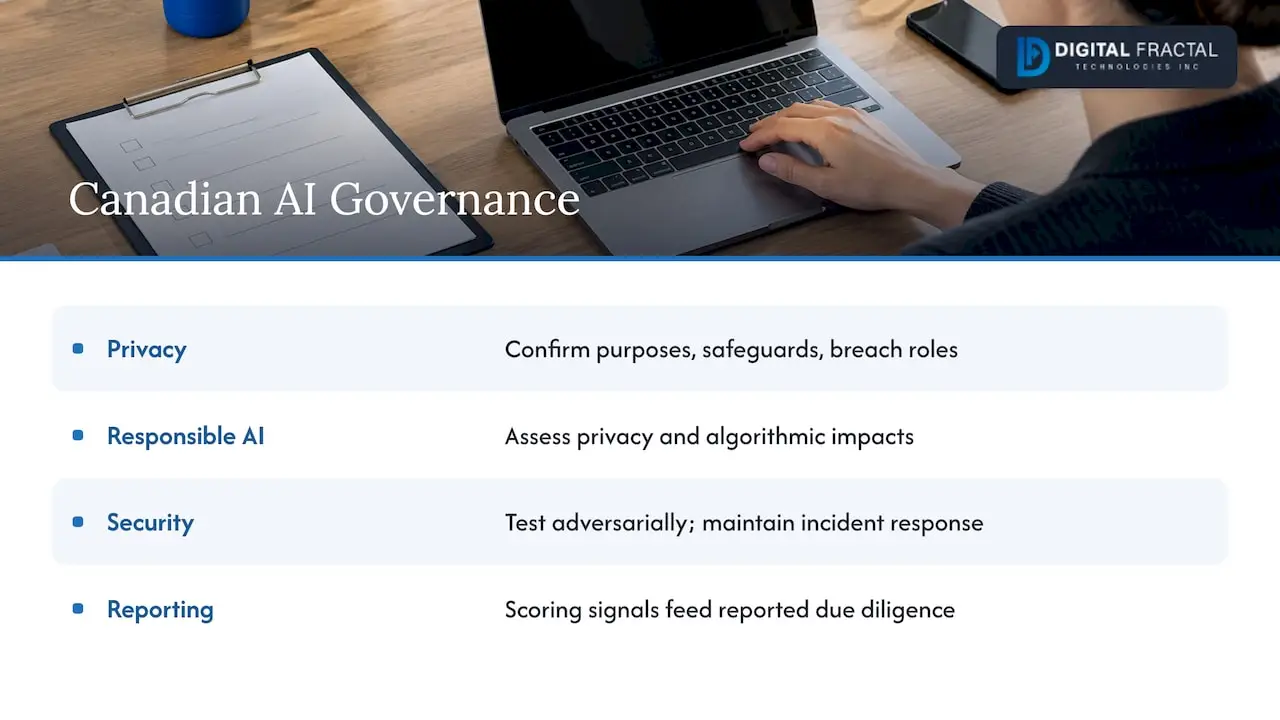
Supply chain reporting. Canada’s Fighting Against Forced Labour and Child Labour in Supply Chains Act received royal assent on May 11, 2023. If it applies to your organization, the compliance and labour-practice signals in your scoring model feed directly into the due diligence you report on. Confirm applicability and current reporting requirements with your legal counsel.
Our perspective
We see the same pattern in logistics and industrial clients: the model is rarely what holds a supplier risk project back. The wall is that lead times sit in one system, payment history in another, and nobody owns either.
That is why we start with an AI readiness audit rather than a tool. We map where supplier data lives, which decisions a score should change, and who acts when it does. A score that cannot trigger a buyer, a planner or a ticket is just a number on a screen.
We also build for your workflows, not around a generic template. Your critical suppliers, your tolerance for disruption and your systems decide how the scoring should work, and we aim to get a tailored solution to a tangible result within 90 days.
Souhail
Start with a scoped audit
If you are weighing supplier risk scoring for a logistics, construction or industrial operation, our AI Readiness Audit is the lowest-risk first step. It is a one-off engagement priced from $2,500 to $10,000, and it identifies where automation and scoring will pay off in your processes. You can see how the pricing logic works in our AI readiness assessment cost guide.
After the audit, we can move into implementation through our AI consulting and machine learning solutions, including integrating scores into your existing systems. Or get in touch to talk through your supplier base.
FAQ
How is AI supplier risk scoring different from a supplier scorecard?
A scorecard is a periodic, mostly manual summary of past performance. AI scoring continuously combines internal records with outside signals such as news, shipping and financial data, and flags changes as they happen. It looks forward as well as back.
What data do we need to begin?
Start with what you already hold: supplier master data, lead times, delivery performance, payment history and audit status. Then assign an owner to each field and set validation rules. External feeds can be added once the internal picture is consistent.
Can we trust the score to make decisions automatically?
Use it to prioritize and prompt action, not to decide alone. Scores estimate likelihood, and your own inventory and alternatives determine impact. Pair every score with its supporting evidence and a named person who reviews it.
Does Canadian privacy law apply to supplier risk scoring?
It can. If the data includes personal information about supplier contacts or owners, and your organization is subject to PIPEDA, you need clear purposes, safeguards and oversight of any third-party data provider. Check specifics with your privacy officer or counsel.
How long does it take to see results?
It depends on the state of your data and the scope. A narrow pilot on your most critical suppliers is the quickest route, and our approach targets a tangible business result within 90 days.
Sources
- How AI-Powered Risk Intelligence Is Transforming Supplier Management (Supply Chain Connect)
- A new era of supply chain transparency (Deloitte Canada)
- AI Supplier Risk Prediction (Zycus)
- AI Supply Chain Risk Management: Scoring Disruption Risk (Rework)
- Advances in Supply Chain Resilience: Predictive Models
- Developing a vendor risk assessment model
- Autonomous Supplier Evaluation and Data Stewardship
- AI Risk Scoring Reliability (Digital Trust Practitioners)
- Guidance on assessing third-party service providers (OPC)
- Principles for responsible, trustworthy and privacy-protective generative AI (OPC)
- Implementation guide for managers of AI systems (ISED)
- Bill S-211 (44-1), LEGISinfo (Parliament of Canada)