
Ultimate Guide to Energy-Efficient Layer 1 Scaling | Digital Fractal, Edmonton, AB

Layer 1 blockchains play a critical role in improving transaction speed and capacity by making changes to their core protocols. However, their energy consumption varies greatly depending on the consensus mechanism used. For example, Proof of Work (PoW) is energy-intensive, consuming as much electricity as entire countries, while Proof of Stake (PoS) reduces energy use by over 99%. This shift is essential for reducing costs and meeting climate goals, especially for Canadian businesses.
Key points:
- Consensus mechanisms like PoW, PoS, and Directed Acyclic Graphs (DAGs) impact energy use. PoS systems, such as Ethereum after "The Merge" in 2022, significantly cut energy consumption.
- Metrics like energy per block and total annual energy use help measure blockchain efficiency. Misleading metrics like "energy per transaction" should be avoided.
- Canada’s low electricity costs ($0.10/kWh) and reliance on clean energy sources (e.g., hydroelectric power) make it a favourable location for efficient blockchain operations.
- Technologies such as sharding, parallel execution, and AI-driven optimizations further reduce energy demand.
- Platforms like Ethereum, Solana, and Algorand demonstrate how energy-efficient Layer 1 solutions can align with business and environmental goals.
This guide highlights how Canadian industries can adopt energy-efficient Layer 1 blockchains to lower costs, reduce emissions, and comply with growing regulatory demands.
How Layer 1 Blockchains Consume Energy
What Drives Energy Usage in Layer 1
The consensus mechanism plays a central role in determining a blockchain’s energy consumption. For example, Bitcoin‘s Proof-of-Work system relies on miners solving complex cryptographic puzzles, which demands significant computational power. This process uses specialized ASIC hardware, with each node consuming around 15,000 kWh annually. In contrast, Proof-of-Stake systems like Ethereum require far less energy. These networks operate on consumer-grade servers, with each node using approximately 100 kWh annually. Instead of expending physical resources, Proof-of-Stake relies on validators staking their own funds to secure the network.
Different Layer 1 blockchains have varying hardware demands. High-throughput networks like Solana, which aim for sub-second transaction finality, require powerful validator nodes consuming about 1,200 kWh per year per node. Meanwhile, Proof-of-Space systems, like Chia Network, adopt a unique approach where "farmers" allocate disk space using k=32 plot sizes (roughly 101.4 GiB). Beyond hardware, network communication also adds to energy usage. Each consensus message, signed vote, and attestation exchanged between nodes requires bandwidth and processing power. These differences highlight the diverse energy profiles of blockchain networks and set the stage for more detailed efficiency metrics.
Metrics for Measuring Energy Efficiency
Accurate metrics are essential for understanding blockchain energy consumption. Two common methods are used for these measurements. Top-down estimates calculate energy use by multiplying the network’s hashrate by the average efficiency of the hardware, a method often applied to Proof-of-Work systems. On the other hand, bottom-up models examine actual node counts, hardware specifications, and power profiles, which are better suited for Proof-of-Stake systems. For instance, in September 2022, the Crypto Carbon Ratings Institute (CCRI) used a bottom-up approach to analyse Ethereum’s transition to Proof-of-Stake. This shift reduced the network’s annual electricity consumption from 21 TWh to just 0.0026 TWh, a reduction of over 99.988%.
Metrics like "energy per transaction" can be misleading since the energy required to validate a block often remains constant, regardless of the number of transactions it contains. More reliable indicators include energy per block, total annual energy consumption (TWh), and carbon intensity (gCO₂e/kWh), which measures emissions based on the energy source. Tools like the Cambridge Blockchain Network Sustainability Index (CBNSI) provide third-party assessments, using methods such as the Armiarma crawler to track active nodes and evaluate hardware configurations.
How Canada’s Energy Grid Affects Blockchain Efficiency
Canada’s energy landscape adds another dimension to blockchain efficiency. The country offers some of the lowest industrial electricity rates in the OECD, averaging just $0.10/kWh, compared to the OECD average of $0.24/kWh. Additionally, energy mixes vary across regions, influencing carbon emissions. For example, New Brunswick’s grid is 80% non-emitting, relying heavily on nuclear and hydroelectric power. Similarly, Quebec and Atlantic Canada benefit from clean energy sources, while Alberta combines competitive pricing with both on-grid and off-grid options.
Canada’s cold climate also provides a natural advantage, reducing the need for energy-intensive cooling systems in data centres. Some operators even make use of mining waste heat, using it to warm greenhouses or supply district heating. In Alberta, mobile mining units are increasingly powered by "flared gas" – natural gas that would otherwise be burned off at oil wells – turning a waste product into a productive energy source. As of early 2024, Canadian crypto mining operations have consumed 4,048 gigawatt hours (GWh) of electricity. However, the carbon intensity of this consumption varies widely, depending on whether the energy comes from Quebec’s hydroelectric power or Alberta’s natural gas resources.
sbb-itb-fd1fcab
Alephium: Scaling Blockchain with Energy-Efficient Sharding & Secure Smart Contracts
Energy-Efficient Consensus Mechanisms and Layer 1 Designs
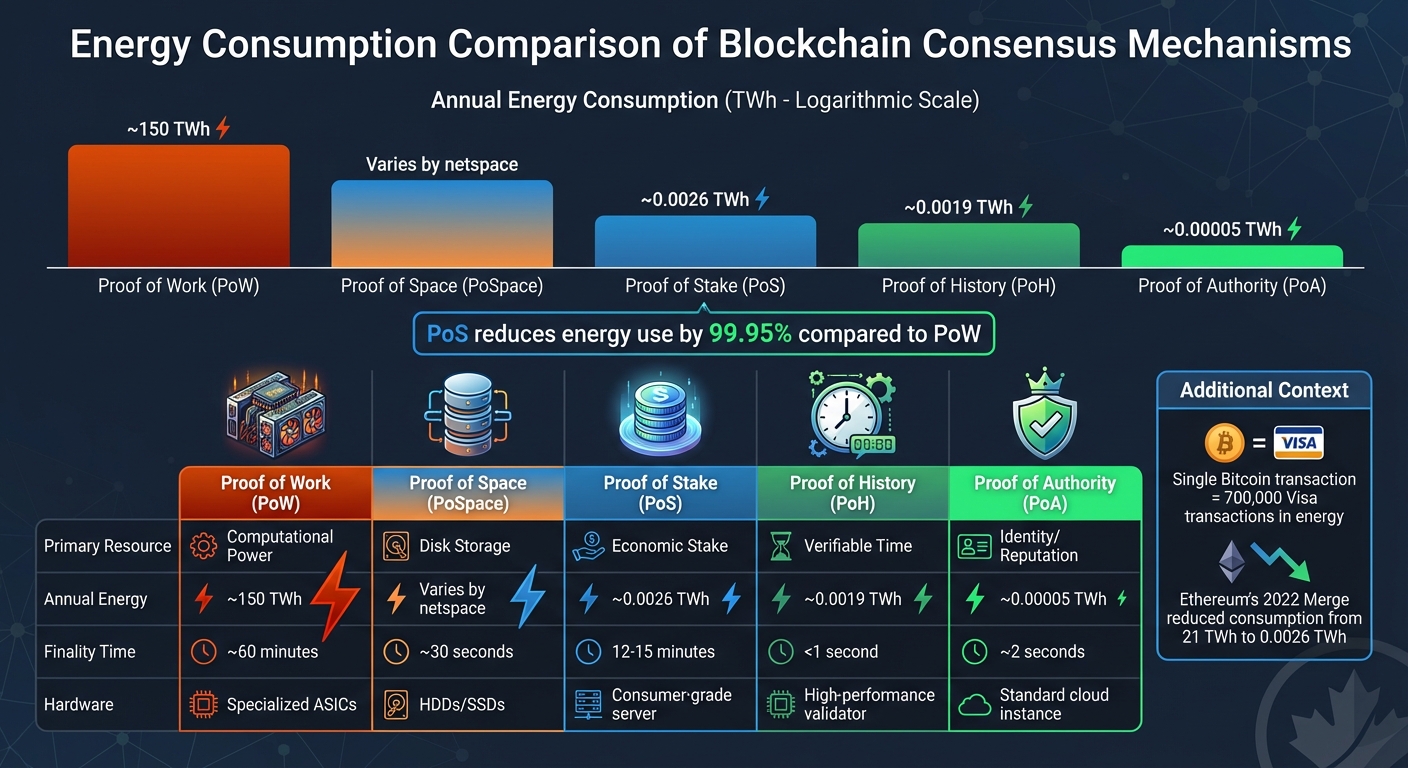
Energy Consumption Comparison of Blockchain Consensus Mechanisms
Comparing Consensus Mechanisms by Energy Use
The choice of a consensus mechanism has a direct impact on a blockchain’s energy consumption. Proof of Work (PoW), for example, depends on "thermodynamic security", where miners solve complex cryptographic puzzles through energy-intensive computations. This process consumes a staggering amount of electricity – Bitcoin’s PoW system alone uses around 150 TWh annually. To put that into perspective, a single Bitcoin transaction requires as much energy as about 700,000 Visa transactions.
On the other hand, Proof of Stake (PoS) operates on cryptoeconomic security rather than physical energy use. Validators stake tokens, and penalties like "slashing" discourage bad behaviour. This eliminates the need for power-hungry mining hardware. After Ethereum transitioned to PoS, its energy consumption plummeted, with a single transaction now using energy comparable to sending an email.
Proof of History (PoH), used by Solana alongside PoS, employs a verifiable delay function (VDF) to timestamp events. This enables nodes to agree on transaction order in under a second while consuming roughly 1,967 MWh of energy annually. Another approach, Directed Acyclic Graphs (DAGs), eliminates the need for blocks entirely. Hedera Hashgraph, for example, uses only about 0.000003 kWh per transaction.
"PoW embodies thermodynamic security – proof through irreversible energy expenditure – making Bitcoin the digital equivalent of gold… PoS, by contrast, replaces physical effort with economic commitment."
– Coinpaper Editorial Board
Other mechanisms, like Delegated Proof of Stake (DPoS) and Proof of Authority (PoA), limit the number of validators to improve efficiency. DPoS allows token holders to vote for a small group of delegates, while PoA relies on pre-approved, trusted validators. These methods require minimal computational power, with PoA achieving transaction finality in about two seconds using standard cloud infrastructure. For private or consortium blockchains, where full decentralization isn’t the main objective, these options provide a highly energy-efficient alternative.
Layer 1 Design Patterns for Lower Energy Use
Beyond choosing efficient consensus mechanisms, architectural innovations can further reduce energy consumption. One key principle is layer separation, which decouples the consensus layer (responsible for ordering blocks) from the execution layer (handling transactions). This design keeps the consensus engine lightweight and energy-efficient.
Sharding is another powerful technique. By splitting the network into parallel chains, sharding distributes the computational workload across multiple validator groups. Instead of requiring every node to process all transactions, each shard handles only a fraction of the activity, significantly lowering energy demands per node. Similarly, parallel execution allows multiple transactions to be processed at the same time, maximizing hardware efficiency without increasing energy use.
Optimizing hardware also plays a critical role. Moving away from high-power ASIC miners to energy-efficient processors like ARM-based systems (e.g., Apple Silicon or AWS Graviton) can dramatically reduce the power consumption of validator nodes. For developers in Canada, this shift offers better performance-per-watt compared to traditional x86 servers. Additionally, consensus clients like Lighthouse and Nimbus are designed to minimize CPU and RAM usage.
Batching and rollup-friendly designs at Layer 1 can also improve energy efficiency. By bundling thousands of transactions into a single consensus operation, the energy cost of a block is spread across a much larger volume of transactions. While rollups are typically associated with Layer 2, applying their principles to Layer 1 can yield substantial benefits. Another energy-saving approach involves using deterministic finality, which reduces the time nodes spend in high-intensity communication states.
"The primary goal is to achieve Byzantine Fault Tolerance – agreement among distributed nodes despite malicious actors – using minimal energy."
– Chainscore Labs
These strategies pave the way for scalable blockchain solutions that align with Canada’s energy-conscious industries.
Consensus Mechanism Comparison Table
Understanding the energy profiles of different consensus mechanisms is crucial for designing efficient Layer 1 systems. The table below highlights the differences in resource requirements and performance across several mechanisms:
| Consensus Mechanism | Primary Resource | Annual Energy (Est.) | Finality Time | Hardware Requirement |
|---|---|---|---|---|
| Proof of Work (PoW) | Computational Power | ~150 TWh | ~60 minutes | Specialized ASICs |
| Proof of Stake (PoS) | Economic Stake | ~0.0026 TWh | 12–15 minutes | Consumer-grade server |
| Proof of History (PoH) | Verifiable Time | ~0.0019 TWh | <1 second | High-performance validator |
| Proof of Space (PoSpace) | Disk Storage | Varies by netspace | ~30 seconds | HDDs/SSDs |
| Proof of Authority (PoA) | Identity/Reputation | ~0.00005 TWh | ~2 seconds | Standard cloud instance |
This comparison showcases the wide range of energy demands and performance capabilities. For Canadian organizations exploring blockchain solutions, these metrics can guide the decision-making process. For example, PoA might be ideal for a consortium of energy companies managing shared data, while a PoS-based system could support a public-facing carbon credit trading platform. Selecting the right consensus mechanism depends on balancing energy efficiency with the specific operational needs of your project.
Real-World Applications of Energy-Efficient Layer 1 Scaling
Case Studies: Energy-Efficient Layer 1 Platforms
Ethereum’s move to Proof of Stake (PoS) was a game-changer for energy efficiency in blockchain. After completing "The Merge" in September 2022, Ethereum’s energy use dropped by a staggering 99.95%. This shift replaced traditional mining with a validator system, where participants stake tokens as collateral. As a result, Ethereum now consumes about 5,024,983 kWh annually, a massive reduction compared to Bitcoin’s immense 159,800,000,000 kWh.
Solana takes a different approach by combining Proof of Stake with Proof of History. This unique setup uses timestamping to allow validators to process multiple transactions simultaneously, avoiding the need to re-verify the entire chain. In 2024, Solana’s energy use was estimated at 8,755 MWh – comparable to the electricity consumption of 833 American homes. A single transaction on Solana uses just 0.00412 Wh, roughly the same as a single online search query.
Algorand stands out with its Pure Proof of Stake (PPoS) mechanism, which keeps energy use incredibly low. Its annual CO₂ emissions are about 265 tCO₂, making it 7× lower than Ethereum PoS and 300,000× lower than Bitcoin. For Canadian businesses, this means Algorand offers a blockchain solution that scales without a proportional increase in environmental impact.
"Claiming sustainability without scalability is a hollow victory"
– Algorand team
Tezos focuses on transparency and refining its efficiency. Between 2020 and 2021, Tezos improved its energy efficiency per transaction by at least 70%. A formal Life Cycle Assessment by PwC verified its carbon footprint at just 2.5 g CO₂ eq. per transaction. This third-party validation offers Canadian companies a clear framework for evaluating blockchain platforms, especially when meeting ESG reporting standards.
These examples highlight how efficient Layer 1 platforms can set the groundwork for broader blockchain adoption while addressing environmental concerns.
Layer 1 vs Layer 2: Energy Trade-offs
These case studies also underline the relationship between Layer 1 and Layer 2 solutions. While Layer 2 technologies, like rollups, can achieve impressive transaction speeds – handling 15,000 to 40,000 transactions per second compared to Ethereum’s 15–30 TPS – they still rely on the underlying Layer 1 for data settlement. If the base layer is inefficient or congested, Layer 2 fees can rise during high-demand periods.
Ethereum’s introduction of EIP-4844 (proto-danksharding) in 2024 highlights this interplay. By enabling "blob" transactions on Layer 1, the upgrade reduced Layer 2 costs by 90–95%. This demonstrates how improvements to the base layer can directly benefit the scalability and affordability of Layer 2 solutions.
"Layer 2 solutions represent the closest thing to a free lunch in blockchain scaling. They inherit Ethereum’s $400+ billion security budget while delivering 10-100x scaling improvements"
– Sankalp Sharma
For Canadian businesses, the choice between Layer 1 and Layer 2 depends on specific needs. Layer 1 platforms excel in high-value, security-critical transactions, while Layer 2 solutions are ideal for use cases like retail payments, gaming, and high-frequency DeFi applications where low fees are critical. Regardless of the choice, an efficient Layer 1 is key to ensuring the overall system operates effectively.
Supporting Canadian Sustainability Goals
Energy-efficient Layer 1 platforms align well with Canada’s sustainability and regulatory objectives. These platforms offer real-time data on energy consumption and carbon footprints, helping businesses meet ESG reporting requirements and comply with international standards like the EU’s Markets in Crypto-Assets (MiCA) regulation. As these standards influence global expectations, Canadian firms will likely face similar demands.
Some Layer 1 platforms even integrate with carbon credit marketplaces, making it easier for businesses to offset their blockchain-related emissions automatically. This feature supports Canada’s carbon reduction goals and helps companies demonstrate measurable environmental responsibility. By adopting energy-efficient consensus mechanisms, businesses can move away from traditional mining while maintaining secure networks.
Canadian firms running validator nodes gain additional benefits from the country’s high renewable energy availability, especially in regions with substantial hydroelectric power. Combining efficient consensus models with clean energy sources creates a strong foundation for blockchain adoption that balances operational needs with environmental priorities.
Building Energy-Efficient Layer 1 Solutions
Best Practices for Developers
Selecting the right consensus mechanism is a critical step toward energy efficiency. Transitioning from energy-intensive models like Proof-of-Work (PoW) to alternatives such as Proof-of-Stake (PoS), Proof-of-Authority (PoA), or Proof-of-Space (PoSpace) can dramatically reduce a blockchain’s energy demands. Beyond this, developers should focus on reducing gas consumption, as it directly impacts computational requirements and energy use in Layer 1 systems.
To cut down on gas usage, developers can batch transactions and refine smart contract code to eliminate unnecessary operations. Leveraging AI-powered static analysers can also identify inefficiencies in storage and redundant calculations before deployment.
For Canadian developers, aligning validator operations with the country’s renewable energy resources is another effective strategy. For instance, scheduling node operations to coincide with hydroelectric power availability can amplify the benefits of energy-efficient consensus mechanisms. These steps not only improve blockchain performance but also support Canada’s broader sustainability objectives. On top of these practices, advanced AI tools can further optimise energy consumption.
Using AI to Improve Energy Efficiency
AI takes energy optimisation a step further by fine-tuning network processes. Machine learning models can analyse historical and real-time network data to optimise transaction batching, ensuring batch sizes are efficient while maintaining throughput. For example, in October 2024, Optimism introduced an AI-driven batching tool that increased average batch sizes by 30%, lowered transaction fees by 22%, and boosted throughput by 15%.
Predictive analytics also play a key role in resource management. Using time series analysis, AI can forecast network congestion and transaction volumes, allowing protocols to scale resources proactively instead of relying on energy-heavy baseloads. This approach has improved resource utilisation rates from the typical 60–70% to 80–90%. In zero-knowledge proof systems, AI can optimise arithmetic circuits, reducing constraints and compressing proofs, which lowers computational costs. For instance, ZKSync‘s October 2024 implementation of machine learning in proof generation led to a 70% reduction in generation time and a 40% cut in computational needs.
AI also improves fee estimation by analysing market trends and network backlogs. This results in transaction cost predictions with an accuracy of ±5%, compared to the ±20% accuracy of traditional methods. Natural Language Processing models can further enhance smart contract development by identifying gas-heavy patterns and suggesting optimisations. Additionally, anomaly detection systems can flag suspicious activity early, saving energy that might otherwise be wasted on dispute resolution.
How Digital Fractal Technologies Can Help

Digital Fractal Technologies provides tailored expertise to help Canadian developers build energy-efficient Layer 1 solutions. Their AI Readiness Audits offer a clear roadmap for reducing energy consumption and operational costs through automation and intelligent systems. These audits help businesses pinpoint which blockchain processes would benefit most from AI-driven optimisations.
The company also delivers custom AI solutions designed to tackle energy efficiency issues directly. These include machine learning models for transaction batching, predictive scaling, and smart contract enhancements. By automating repetitive blockchain management tasks, Digital Fractal reduces the resource burden of manual operations. For sectors like energy and public services, they create custom CRM systems and business management tools that integrate seamlessly with blockchain platforms while maintaining energy efficiency.
With expertise in API integrations and legacy app migrations, Digital Fractal ensures that existing systems can connect to energy-efficient Layer 1 platforms without requiring a complete overhaul. Their approach combines technical implementation with strategic consulting, helping Canadian organisations align blockchain adoption with sustainability goals and ESG reporting requirements. Whether it’s building validator infrastructure optimised for Canada’s renewable energy grid or developing AI-enhanced smart contracts, Digital Fractal provides the tools and expertise to support sustainable blockchain operations across various industries in Canada.
Conclusion
Summary of Energy-Efficient Strategies
Energy-efficient Layer 1 scaling is reshaping blockchain operations in a big way. The shift from Proof-of-Work to Proof-of-Stake has been the most impactful change so far. For instance, Ethereum’s Merge in September 2022 slashed energy consumption by an incredible 99.95%, bringing per-transaction energy use down to almost nothing. This transition moves blockchain security away from physical energy use and towards cryptoeconomic collateral, creating a more practical and affordable solution for Canadian businesses.
On top of that, Layer 2 rollups are driving down energy costs per transaction even further. Other advancements, like smarter contract designs and better hardware – such as ARM-based processors like Apple Silicon and Graviton – boost performance without increasing energy use. Canada’s ample hydroelectric and wind power resources also give local validator operators a reliable and renewable energy supply for round-the-clock blockchain operations.
"Blockchain’s future hinges on reconciling decentralization with sustainability." – Springer Review
With these strategies in place, blockchain technology in Canada is on track to be both eco-friendly and economically attractive.
The Future of Energy-Efficient Blockchain in Canada
Canada is well-positioned to make the most of these efficiency improvements, thanks to its strong renewable energy sector. By adopting these innovations, Canadian businesses can achieve both sustainability goals and economic advantages. With global initiatives like the EU’s MiCA framework and the Crypto Climate Accord pushing for transparent energy practices, early adopters of energy-efficient blockchain strategies will stay ahead of the competition.
The move towards modular blockchain designs is also shaping the future. In this model, Layer 1 focuses on security and settlement, while Layer 2 handles execution, making the system more efficient and scalable. These innovations are opening doors for blockchain to be used in high-demand areas like supply chain management and e-governance. By late 2023, Total Value Locked on Layer 2 solutions had already surpassed $10–15 billion, making the case for sustainable scaling even stronger.
Digital Fractal Technologies is helping Canadian organisations navigate this shift with services like AI readiness audits, tailored blockchain solutions, and strategic guidance. Their focus on aligning technology with sustainability goals and ESG reporting ensures businesses can adopt blockchain in a way that’s both practical and forward-thinking.
FAQs
How do I choose the most energy-efficient consensus mechanism for my use case?
Choosing a consensus mechanism that prioritizes energy efficiency means balancing factors like energy use, security, and scalability. Proof-of-Stake (PoS) and Directed Acyclic Graphs (DAGs) are standout options, cutting energy consumption by over 99% compared to the energy-heavy Proof-of-Work (PoW) model – all while maintaining robust security. If reducing environmental impact is a priority, PoS and DAGs are worth exploring. Additionally, advancements like sharding or Layer-2 solutions can help improve efficiency even further, making them valuable additions to your strategy.
Which energy metrics should I use instead of “energy per transaction”?
To gauge blockchain energy efficiency effectively, it’s better to go beyond "energy per transaction" and focus on broader metrics like kWh per transaction (the energy required for a single transaction) and total energy consumption (measured in TWh annually). These metrics offer a more accurate picture of a blockchain network’s energy usage relative to its activity. This approach is particularly helpful when comparing energy-heavy Proof-of-Work systems with more efficient models like Proof-of-Stake.
Should my project scale on Layer 1 or use Layer 2 rollups?
Choosing between Layer 1 scaling and Layer 2 rollups comes down to what your project prioritizes: cost, speed, security, or decentralization. Layer 1 scaling focuses on improving the main blockchain itself, which can boost performance but might compromise decentralization. On the other hand, Layer 2 rollups handle transactions off-chain to cut costs and improve throughput, though they sometimes incorporate centralised elements. Often, blending both strategies provides a well-rounded solution for building scalable and secure applications.