AR/VR Use Cases in Skill Development | Digital Fractal, Edmonton, AB

AR and VR are changing how industries train workers by creating safe, immersive environments for learning high-risk skills. These tools reduce training time, improve retention, and lower costs across healthcare, construction, and energy sectors.
- Healthcare: VR platforms like Osso VR and PrecisionOS allow medical trainees to practise surgeries with higher accuracy and confidence. AR supports live surgeries, such as remote-guided procedures, improving outcomes and collaboration.
- Construction: AR offers real-time blueprint visualizations, reducing errors and inspection times. VR enables workers to practise dangerous tasks like working at heights, cutting incidents and training costs.
- Energy: High-risk scenarios, like operating high-voltage systems, are safely simulated using VR. This approach improves safety and preserves expert knowledge, ensuring consistent training.
These technologies are not only improving learning outcomes but also addressing labour shortages and workplace safety challenges. For companies, AR/VR provides scalable, cost-effective solutions that prepare workers for critical roles.
Transforming Learning with VR: Skill Immersion Lab
sbb-itb-fd1fcab
AR/VR Use Cases in Healthcare
Healthcare training often requires hands-on experience, but patient safety is always a top priority. Augmented Reality (AR) and Virtual Reality (VR) are reshaping this landscape, allowing medical professionals to practise complex procedures in controlled, risk-free environments.
VR for Surgical Training
VR platforms like Osso VR and PrecisionOS are giving surgical residents the chance to perfect advanced procedures before stepping into an operating room. These simulations cover tasks such as drilling bones, installing screws, and performing knee replacements, enabling trainees to practise repeatedly until they achieve mastery.
In February 2021, the University of Toronto‘s Temerty Faculty of Medicine adopted PrecisionOS to maintain surgical residents’ skills during COVID-19 restrictions. With operating rooms largely unavailable, residents like Dr. Maegan Shields used haptic tools to simulate tasks like resetting broken legs and drilling into fractured hips. Dr. Peter Ferguson, Head of Orthopedic Surgery, spearheaded this initiative.
"If we can decrease that incidence of complications by allowing these individuals to become more competent in this low-stakes environment, it will theoretically improve patient outcomes", Dr. Ferguson noted.
The results are compelling. Research shows that learners trained with Osso VR achieved procedural competence scores up to 300% higher compared to those using traditional methods. Additionally, VR-trained surgeons completed procedures 25% faster and required 67% fewer instructor prompts during real operations. A 2023 study published in Advances in Medical Education and Practice further highlighted VR’s effectiveness. Among 38 medical students, those trained in tibial intramedullary nailing with VR completed tasks faster and with fewer corrections than those using traditional guides (P = 0.05).
AR is also making waves in live surgeries. In March 2021, the Jewish General Hospital in Montreal performed the world’s first remotely guided transcatheter aortic valve replacement using Microsoft HoloLens 2. Dr. Sam Radhakrishnan, based in Toronto, remotely guided the Montreal team through the heart valve procedure in real-time, seeing the operation unfold through the lead surgeon’s perspective.
"We think of it as bringing the operating room to the surgical specialist. Rather than coordinating resources to bring a specialist to another hospital for training, now we can greatly simplify the process", said Dr. Lawrence Rudski, Director of the Azrieli Heart Center.
Emergency Response Training with AR/VR
AR and VR are also transforming emergency response training, offering dynamic and realistic simulations that prepare teams for unpredictable scenarios.
Platforms like iREACT (Immersive virtual Reality Environment for training Acute Care Teams) simulate emergencies such as cardiac arrests, where patient vitals adjust based on the team’s actions. Developed in 2025 by researchers at the University of Michigan Medical School, iREACT requires a four-person team – leader, chest compressor, airway manager, and defibrillator/medication handler – to work in sync. The system tracks performance metrics like eye movement and heart rate for detailed post-session reviews.
In Canada, Bow Valley College has integrated the UbiSim VR platform into its nursing program, training nearly 2,000 students to handle critical situations like opioid overdoses. Nursing student Euphemia Ishola shared how the simulation’s realistic cues, such as cyanotic skin and slowed breathing, helped her confidently administer naloxone.
"UbiSim gives us a lot of flexibility. It lets us expose them to environments and situations so that out in the real world, their response isn’t, ‘I don’t know what this is or how to deal with it,’ but rather, ‘I know exactly what’s going on and how to handle it,’" explained Roger Crowe, Healthcare Simulation Technology Specialist at Bow Valley College.
The impact on learning is clear. In a randomized controlled trial, VR-trained healthcare providers improved their knowledge scores from a pre-intervention mean of 4.20 to 8.66 post-intervention, surpassing both AR (8.19) and traditional training groups (7.98). For international nurses entering Canada’s healthcare system, VR is streamlining onboarding processes. Since October 2023, the University of Manitoba‘s Clinical Competence Assessment Centre has used the Oxford Medical Simulation (OMS) platform to assess 103 international nurses from countries like Ghana, Kenya, and the Philippines. By simulating 300 hours of patient care scenarios, the platform has significantly reduced waiting times for these nurses to begin practising.
"The integration of VR into our assessment processes has significantly reduced the waiting times for newcomers eager to start working in our healthcare systems", said Kimberly Workum, Director of the Clinical Competence Assessment Centre.
AR/VR Use Cases in Construction
The construction industry has long relied on a mix of classroom learning and potentially hazardous on-site training. But with 79% of construction firms struggling to find skilled workers in 2024, AR and VR technologies are stepping in to ease labour shortages. These tools are speeding up onboarding and skill development in safe, controlled environments. They’re also helping to cut down on costly rework, bridging the gap between theoretical learning and practical application, much like they do in healthcare.
AR for Blueprint Visualisation and Building Inspections
AR brings blueprints to life by projecting 3D Building Information Modeling (BIM) data directly onto job sites at a 1:1 scale. This allows engineers and inspectors to identify issues like structural clashes or misalignments in real time. For instance, engineers can spot a duct interfering with a beam, or inspectors can catch discrepancies in column positions or pavement thickness as they happen.
In September 2024, a team led by Professor Chul Min Yeum from the University of Waterloo tested the "Smart Infrastructure Metaverse" system on a 20-metre-long railway bridge in Kitchener. On-site inspectors used AR headsets to view holographic representations of structural issues like spalling, while off-site experts collaborated through VR. The system combined panoramic images with 3D maps to track defects with precision.
"The Smart Infrastructure Metaverse is all about making it easier for onsite and off-site inspectors to work together on structural inspections", said Professor Yeum.
The impact of AR in construction is hard to ignore. Contractors using AR for site monitoring have seen a 35% drop in rework thanks to earlier error detection. AR-assisted inspections also cut inspection times by 45%. Remote site audits using AR platforms have reduced specialist travel by 70% and slashed equipment downtime by 40%. A German construction firm demonstrated this in August 2025, using AR tablets to inspect a commercial tower in Frankfurt. Supervisors conducted floor-by-floor BIM comparisons, logging defects with voice commands that recorded GPS coordinates and severity levels. This approach sped up snag resolution by 60% and allowed the project to finish three weeks ahead of schedule.
VR Training for Working at Heights
While AR enhances real-time inspections, VR immerses workers in high-risk scenarios for training purposes. VR allows construction workers to practise tasks like fall protection, roof work, and emergency rescues in a safe, simulated environment. Advanced simulators even replicate balance, acceleration, and slopes, helping trainees develop the muscle memory needed to operate complex equipment before they ever step onto a live site.
L&T Construction, in partnership with Red Apple Technologies, implemented a VR training platform for riggers and crane operators. This initiative improved workers’ understanding of safety procedures by 80% and cut on-site training incidents by 60%. The platform uses Oculus Go and mobile devices to simulate risks such as crane imbalance and falling materials. Similarly, Toronto Hydro teamed up with VR Vision between 2022 and 2025 to deploy 40 Meta Quest headsets for technician training. This program, designed for high-risk tasks like powerline maintenance, reduced training time by 30% while eliminating real-world hazards during the learning process.
In March 2025, Somero Enterprises collaborated with ForgeFX Simulations to launch a VR simulator for the S-22EZ Advanced Laser Screed. Using Meta Quest hand-tracking, the simulator trains operators on avoiding machine tip-overs and performing pre-start inspections. Greg Meyers, CEO of ForgeFX Simulations, highlighted the transformative potential of VR training:
"Traditional training methods rely on learning in real-world scenarios, where mistakes can be costly, time consuming and hazardous. This simulator transforms the training process by offering a risk-free environment where operators can refine their skills".
Companies using VR safety training have reported a 43% reduction in lost time due to injuries and saved 30% to 70% on training costs by cutting down on physical resources and fuel.
These examples show how AR and VR are reshaping the construction industry, making skill development safer and more efficient. For firms eager to embrace digital transformation, Digital Fractal Technologies Inc (https://digitalfractal.com) offers tailored AR/VR solutions to enhance workforce training and operational efficiency.
AR/VR Use Cases in the Energy Sector
The energy sector grapples with unique challenges: high-voltage equipment, tight spaces, and emergency scenarios that are too dangerous to simulate in traditional training environments. Much like in healthcare and construction, AR/VR technologies are reshaping the way energy companies approach safety and efficiency. By simulating high-risk scenarios, these tools allow workers to train in controlled, risk-free settings. From operating switchgear to maintaining underground vaults, immersive training is cutting training times by 30% to 50% while improving workforce readiness. Here’s how AR and VR are addressing both technical and safety needs in the energy industry.
VR for Electrician Training Programs
Electricians face high-stakes work environments, and VR modules offer a safe way to practise critical skills. These modules let trainees work with high-voltage systems, rehearse emergency shutdowns, and troubleshoot equipment without risking injury or damage. Beyond hands-on practice, VR captures the expertise of retiring professionals, ensuring their knowledge is preserved for future generations. The result? Trainees can repeat complex procedures until they master them, with retention rates hitting 80% a year after training – compared to just 20% one week after traditional methods.
One program reported a 30% reduction in training time for hundreds of workers, all while eliminating real-world hazards. For example, DTEK, Ukraine’s largest energy holding, partnered with Sensorama Lab in August 2024 to create lifelike 3D simulations of thermal power plants. Using Unreal Engine and haptic feedback suits, workers could practise emergency responses and maintenance tasks without disrupting plant operations.
Enel Green Power took a similar approach in 2025, rolling out VR training for renewable energy technicians across North America. Their program focused on wind turbine maintenance, substation walkthroughs, and solar farm operations. The results? A 50% reduction in training time and a 70% improvement in part repair rates, saving an estimated $10 million to $25 million annually.
"With VR, all the tools and materials you need are right there: MC, wire, conduit… We’re not wasting anything and to me that’s real important because students are still learning critical skills, just without waste",
said Johnnie Parker, Subject Matter Expert at Transfr.
Mining Safety Training with AR/VR
Mining remains one of the most hazardous operations in the energy sector, with risks like underground collapses, gas leaks, and equipment failures. AR and VR are stepping in to make safety training more effective. These technologies simulate dangerous environments, allowing workers to practise emergency procedures and safety protocols in a controlled setting. Workers can rehearse responses to gas leaks, explosions, or structural failures without facing real-world danger.
VR also helps identify issues like claustrophobia or acrophobia before workers are exposed to these conditions in the field. The consistency of VR training ensures that every worker receives the same instruction, eliminating discrepancies that can arise with different trainers. Myron Laurent, a Subject Matter Expert at Transfr, highlighted this benefit:
"VR training is very consistently delivered. We wouldn’t have one instructor putting emphasis on one aspect of a task and a different instructor putting emphasis somewhere else. It’s the same every time!"
.
Energy Safety Canada implemented four VR experiences in December 2024, including 360° tours and gamified safety modules. By using ArborXR to manage over 100 headsets, they now train 3,000 students annually. Kelly Johnson, Programme Manager at Energy Safety Canada, shared:
"Using ArborXR has been a game-changer. It’s streamlined our operations, allowing us to manage over 100 headsets efficiently and focus on delivering impactful experiences"
.
These examples show how AR and VR are making energy sector training safer, faster, and more efficient. For companies interested in adopting similar solutions, Digital Fractal Technologies Inc (https://digitalfractal.com) offers custom AR/VR development tailored to the energy industry’s specific needs.
Cross-Industry Benefits of AR/VR Training
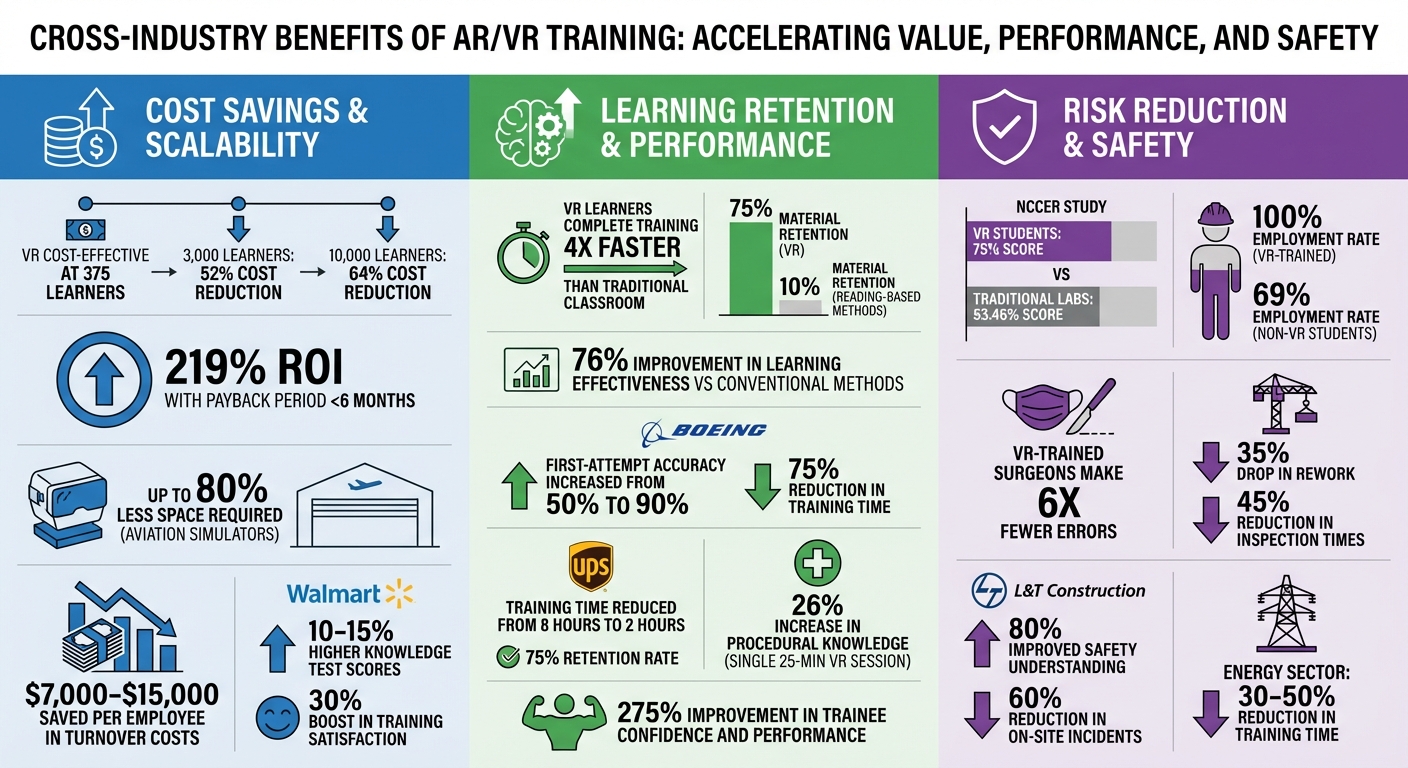
AR/VR Training Benefits: Cost Savings, Retention Rates, and Performance Improvements Across Industries
AR and VR are reshaping how industries approach skill development through digital transformation, offering benefits that go far beyond specific sectors. These technologies cut physical risks, reduce costs, and improve learning outcomes. For example, VR training becomes cost-effective with just 375 learners. At 3,000 learners, costs drop by 52%, and at 10,000, the reduction hits 64%.
But the impact isn’t just financial. Immersive training changes how employees learn. Studies show that VR learners complete training up to four times faster than those in traditional classrooms. Plus, they retain 75% of the material, compared to just 10% with reading-based methods. Companies like Digital Fractal Technologies Inc (https://digitalfractal.com) even offer custom AR/VR solutions tailored to specific training needs.
Lower Training Costs and Better Scalability
One of the biggest advantages of AR and VR is the elimination of logistical expenses. In industries like manufacturing and energy, trainees work with digital twins instead of taking costly equipment offline, saving all shop hours. In aviation, virtual simulators require up to 80% less space than traditional full-motion simulators.
The return on investment (ROI) for enterprise VR training is impressive. For instance, companies have seen a 219% ROI with a payback period of less than six months. Walmart is a great example: in 2026, they replaced an 8-hour onboarding session for Pickup Tower kiosks with a 15-minute VR module. Over a million associates across 4,700 stores completed the program, scoring 10–15% higher on knowledge tests and reporting a 30% boost in training satisfaction.
AR/VR also helps during hiring. Immersive job previews ensure better candidate fits, potentially saving between $7,000 and $15,000 per employee in turnover costs. Once a VR module is developed, it can be scaled globally without the per-person costs of traditional classroom setups.
Beyond saving money, these tools fundamentally enhance how employees absorb and retain information.
Better Learning Retention and Trainee Engagement
VR creates a focused, distraction-free environment that keeps trainees fully engaged. This level of immersion builds stronger emotional connections to the material, leading to higher confidence and better performance. Research from Stanford University found that XR training improves learning effectiveness by 76% compared to conventional methods.
Take Boeing, for instance. They used Microsoft HoloLens AR overlays for complex aircraft wiring, boosting first-attempt accuracy from 50% to 90% and cutting training time by 75%. Similarly, UPS introduced 12 VR modules for road hazard training, reducing training time from eight hours to just two while increasing retention to 75%. Based on these results, UPS invested an additional $345 million in VR and safety tech in 2023.
The medical field also benefits. A single 25-minute VR session led to a 26% increase in procedural knowledge among medical residents. Trainees using VR showed a 275% improvement in confidence and performance. John Bratton, an instructor at ASU Three Rivers, highlighted this shift:
"The students put their phones down, focused on the training simulation, and were able to complete the modules without distraction."
In addition to saving money and improving retention, immersive training significantly reduces risks in dangerous job scenarios.
Risk Reduction for Dangerous Job Training
One of the standout features of VR is its ability to simulate high-risk scenarios safely. Trainees can practise handling arc flash events, electric shocks, or incorrect tool usage without real-world consequences. It’s particularly useful for rare but critical situations, like battery thermal runaways or emergency shutdowns, which are hard to replicate in traditional training.
A study by the National Centre for Construction Education and Research (NCCER) and ABC Illinois showed that students using VR for power tool training scored 75% on assessments, compared to 53.46% in traditional labs. Moreover, the VR-trained group had a 100% employment rate, far surpassing the 69% rate for non-VR students.
In healthcare, DaVita Inc. partnered with Accenture in 2023 to create a digital twin of a dialysis machine. This 12-week project focused on a 47-step procedure called "stringing." The VR module allowed trainees to practise realistic movements, such as reaching and crouching, to build muscle memory. This approach boosted confidence before they transitioned to real patient care. VR-trained surgeons also make six times fewer errors than those trained through traditional methods.
Conclusion
AR and VR are revolutionizing workforce training by replacing conventional classrooms with immersive, hands-on environments. For example, in healthcare, these tools help radiology students avoid radiation exposure during training sessions. In construction, they tackle costly communication errors, which contribute to an estimated $31 billion in rework annually.
These advancements aren’t just about improving training outcomes – they’re also reshaping how industries attract and develop talent. By speeding up and standardizing skill acquisition, immersive training makes it easier for organizations to recruit and prepare employees through custom app and software development services. As Josh Rodgers from Mortenson explains:
"Technology is also not a problem solver in and of itself. You need first to identify which problems you’re struggling with and what type of technology investment will help you improve your daily work."
Through AR and VR, workers can build muscle memory in safe, controlled environments, while teams benefit from consistent, high-quality instruction. AR’s hands-free overlays and VR’s focused learning spaces are redefining how high-risk industries approach workforce development, making them more efficient and forward-thinking.
FAQs
How do I choose between AR and VR for training?
When deciding between AR (Augmented Reality) and VR (Virtual Reality), it all comes down to your training objectives.
AR integrates digital elements into the physical world, making it perfect for training scenarios that involve interacting with real-world environments. Think technical tasks, product training, or on-the-job learning where hands-on interaction is key.
On the other hand, VR creates a fully immersive experience by replacing the real world entirely. This makes it an excellent choice for soft skills development, safety training, or practising in hazardous or high-stakes environments where real-world practice might be too dangerous or impractical.
The choice ultimately depends on the specific context of your training and the outcomes you aim to achieve.
What hardware is needed to run AR/VR training at scale?
Running AR/VR training on a large scale demands the right combination of advanced hardware and infrastructure. High-performance headsets are at the core, providing smooth and immersive environments, which rely heavily on powerful CPUs and GPUs to function effectively. Beyond the headsets, you’ll need to ensure there’s sufficient physical space, dependable power sources, and strong network connectivity to maintain uninterrupted operation.
For larger setups, think about additional requirements like room-scale displays or multi-user systems. These elements are crucial to creating training environments that are both effective and scalable.
How can I measure ROI for AR/VR training in my organization?
Measuring the return on investment (ROI) for AR/VR training means looking at several key metrics, such as cost savings, learning outcomes, and productivity improvements. Start by comparing the expenses tied to traditional training – like materials, instructor fees, and logistics – with the typically lower costs of AR/VR solutions.
Next, evaluate how quickly trainees acquire skills, how well they retain information, and the impact on error rates. Operational benefits, such as faster achievement of competency and reduced mistakes, are also worth tracking.
Finally, gather qualitative feedback from both trainees and leadership. This can provide insight into levels of engagement, confidence, and overall satisfaction with the training. Combining these data points gives a fuller picture of AR/VR’s ROI.