
AI in App Monetization: Personalizing User Offers | Digital Fractal, Edmonton, AB

AI is reshaping how apps make money by tailoring offers to individual users. With 98% of users leaving apps within the first month, personalization is key to balancing revenue generation and user experience. By using AI techniques like machine learning, predictive analytics, and recommendation engines, apps can deliver the right offer at the right time, boosting engagement and revenue. For example, apps using personalized in-app purchases, dynamic pricing, and contextual recommendations often see 10–30% increases in ARPU (Average Revenue Per User).
Key takeaways:
- Machine learning predicts user preferences based on behaviour.
- Predictive analytics optimizes the timing of offers to reduce churn.
- Recommendation engines suggest relevant in-app purchases, increasing conversions.
Apps like Fortnite, generating US$5 billion annually, show how personalization drives success. Canadian developers can benefit by focusing on local pricing (e.g., CAD $4.99) and regional nuances. Metrics like ARPU, retention rates, and conversion rates help measure success. A/B testing ensures these strategies improve performance without alienating users.
AI-powered personalization boosts revenue while improving user satisfaction, making it essential for competitive app monetization.
AI & App Engagement
AI Techniques for Personalizing User Offers
Personalized offers in mobile apps rely on three main AI techniques: machine learning to understand user behaviour, predictive analytics for determining the best timing, and recommendation engines to suggest in-app purchases. These techniques shift monetization strategies from one-size-fits-all approaches to precision-targeted solutions that cater to individual preferences while maximizing revenue. Let’s explore how each technique works to refine personalization.
Machine Learning for User Behaviour Analysis
Machine learning models dig into data like session duration, clickstreams, and purchase history to uncover patterns and predict user preferences. Using clustering algorithms and sequential models, these systems group users into categories – such as casual browsers or power users – and estimate their likelihood of taking specific actions. For instance, after several interactions with premium features, a model might calculate an 80% chance that a user will subscribe to a CAD $4.99/month plan, leading to a timely, targeted offer. Recurrent neural networks (RNNs) take this further by identifying sequential patterns in user navigation. Companies like Digital Fractal Technologies use these methods to create mobile apps that interpret user actions in real time, enhancing the personalization experience.
Predictive Analytics for Offer Timing
Timing is everything, and predictive analytics ensures offers reach users at the perfect moment. By using time-series forecasting models like ARIMA or LSTM, apps analyze historical engagement data to identify peak activity periods. These models also factor in variables like user location, device, and real-time events to fine-tune timing. On top of that, survival analysis helps predict churn risk, enabling apps to send prompts that can improve conversion rates by 20–30% while addressing churn rates that often hit 98% in the critical first month.
Recommendation Engines for In-App Purchases
Recommendation engines play a key role in boosting monetization by tailoring in-app purchase suggestions. They use techniques like collaborative filtering – recommending a CAD $9.99 skin based on similar user behaviours – and content-based filtering to craft highly relevant offers. Many apps now rely on hybrid systems that combine these methods, often enhanced with matrix factorization, which can increase click-through rates by up to 35%. Deep learning models, including transformers, add another layer by ranking offers based on relevance, mimicking the personalization strategies of e-commerce giants. This level of precision has helped some apps generate as much as $5 billion annually from personalized in-app purchases.
Strategies for AI-Driven Personalization
AI technologies have opened up exciting opportunities for personalization, offering businesses a way to drive revenue while enhancing user experience. Three key approaches – personalized in-app purchases, AI-driven dynamic pricing, and contextual offer recommendations – work best when powered by user behaviour data, event tracking, and predictive models.
Personalized In-App Purchases
Personalized in-app purchases use behaviour-triggered offers that feel intuitive and timely. Instead of presenting the same catalogue to everyone, apps rely on propensity models to suggest items tailored to each user’s preferences. For instance, an active user might see a discounted upgrade after completing significant interactions, while a less engaged user could receive a "win-back" bundle to re-engage them. To avoid overwhelming users, it’s crucial to space out offers and limit monetization prompts to one per session. Leveraging in-app event data helps refine the timing of these offers and reduces the risk of user fatigue. For Canadian users, transparency is essential – apps need to clearly explain how personalization works and offer easy opt-out options while still delivering a satisfactory baseline experience.
AI-Driven Dynamic Pricing
Dynamic pricing uses advanced AI techniques like regression models, uplift modelling, or reinforcement learning to adjust prices or discounts based on factors like purchase likelihood, price sensitivity, and revenue goals. The AI calculates the optimal price in CAD to maximize revenue within predefined limits. For example, usage-based pricing ensures costs align with how much a user consumes, making it both fair and profitable. To maintain trust, apps should define strict pricing ranges, avoid using sensitive attributes, and base pricing decisions on transparent criteria like user engagement or loyalty. Clearly labelling time-sensitive promotions or introductory offers ensures users understand price variations.
Contextual Offer Recommendations
Contextual recommendations take personalization a step further by tailoring offers to match the user’s current situation. These recommendations consider factors like the app screen a user is on, session milestones, time of day, device type, network quality, and even geographic location. For example, a photo editing app might suggest a discounted data-saving mode when a user is on a slower network, while an entertainment app could promote a weekend bundle during peak hours. In Canada, aligning offers with local holidays or events – like hockey season, winter activities, or back-to-school campaigns – can make them more relevant. Pricing should always be displayed in CAD with clear tax details, and regional nuances like language preferences or connectivity differences should influence the timing and content of offers. These recommendations are generated and ranked in real time, balancing immediate context with historical user behaviour.
Together, these strategies can boost monetization while maintaining user satisfaction.
| App Category | Recommended Monetization Stack for AI Personalization |
|---|---|
| Mobile Games | In-app purchases, Rewarded video ads, Cosmetic value-added services |
| News & Entertainment | Subscription, Native ads, Interstitial ads |
| Fintech Apps | Embedded finance, Subscription, Premium analytics |
| Education Tools | Freemium, Licensing, Custom B2B modules |
| Health & Wellness | Subscription, In-app purchases, Banner ads |
sbb-itb-fd1fcab
Implementing AI Personalization with Digital Fractal Technologies
Digital Fractal Technologies takes AI personalization to the next level by embedding custom AI models into existing mobile app systems, transforming user experiences and boosting app performance.
Custom AI Models for Mobile Apps
The journey begins with an AI Readiness Audit, where Digital Fractal examines your app’s processes, data, and tools. This audit results in a detailed 6–12 month roadmap tailored to implement AI-driven personalization effectively. Using this roadmap, they create machine learning models designed to analyze user behaviour and predictive analytics to determine the best timing for offers. These solutions are aligned with specific goals, such as increasing in-app purchase conversions and reducing user churn.
Digital Fractal has successfully implemented AI models across various industries. For instance, they’ve enabled personalized features like usage-based subscriptions in energy apps and outcome-focused offers in construction management platforms. Once the models are developed, they integrate these AI solutions seamlessly into your app’s existing architecture.
Integration with Existing App Architectures
One of Digital Fractal’s standout abilities is integrating AI into your current app without requiring a complete rebuild. By using modular frameworks compatible with iOS, Android, and cross-platform tools like Flutter, they embed AI functionalities through APIs and microservices. This approach minimizes downtime and allows for gradual rollouts supported by A/B testing, ensuring you can test AI-driven offers before full-scale implementation.
Recent projects highlight their expertise. For example, they integrated AI into Deeleeo’s mobile system and improved operations for Xtreme Oilfield. These modular integrations not only reduced downtime but also allowed for step-by-step rollouts, ensuring smooth transitions and enhanced functionality. This method ultimately strengthens monetization strategies.
Features for Monetization Optimization
Digital Fractal’s AI solutions are designed to enhance monetization. Their dynamic pricing engines adjust offers in real time, such as introducing a CAD $4.99 premium tier during peak usage. Recommendation systems analyse user behaviour to deliver timely, relevant in-app purchase suggestions, while hybrid monetization tools blend subscriptions with usage-based billing to increase revenue per user.
Apps utilizing Digital Fractal’s solutions have seen impressive results, including up to 45% higher eCPMs through personalized native ads and a significant boost in revenue via ad-free subscription upgrades. These features are built with PIPEDA-compliant data protocols and scalable cloud architectures, ensuring smooth integration without requiring major changes to your app’s core code. Together, these tools drive revenue growth and user engagement, showcasing the power of precise, AI-driven monetization strategies.
Measuring Success and Optimization Metrics
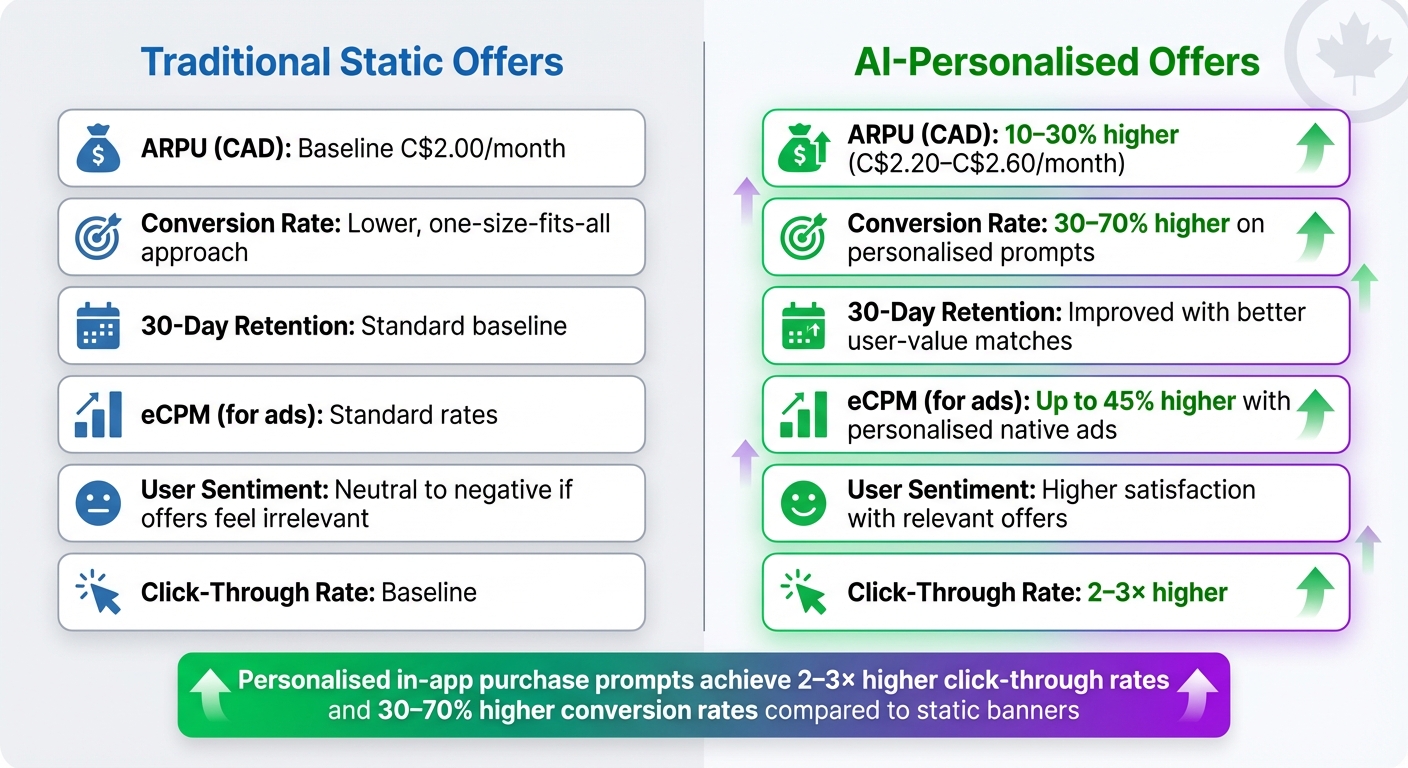
Traditional vs AI-Personalized App Monetization: Performance Metrics Comparison
After exploring AI-driven monetisation strategies, let’s shift the focus to how success can be measured and optimised when it comes to personalisation.
To gauge the effectiveness of AI personalisation, tracking key metrics is essential. For Canadian app teams, revenue metrics like ARPU (Average Revenue Per User) and ARPPU (Average Revenue Per Paying User), both expressed in CAD, are vital. For instance, if your monthly ARPU jumps from C$2.00 to C$2.40, that’s a meaningful revenue boost when scaled across a large user base. Another critical metric is LTV (Customer Lifetime Value), which reflects how AI personalisation can extend user engagement and drive repeat purchases, ultimately increasing the overall value of each customer.
In addition to revenue, it’s important to monitor Day 1, Day 7, and Day 30 retention rates, session frequency, and metrics like offer-level CTR (Click-Through Rate) and CVR (Conversion Rate). These indicators help you assess user engagement and how well your personalisation efforts are working. To maintain user trust over time, keep an eye on churn rates, uninstall rates, and support complaints. These metrics tie revenue performance to the broader AI personalisation strategy discussed earlier.
Key Performance Indicators for Personalised Offers
Establishing a hierarchy of KPIs is crucial. For revenue, focus on ARPU, ARPPU, purchase frequency, and the proportion of in-app revenue driven by AI recommendations. Many apps report a 10–30% uplift in ARPU when switching from static offers to behavioural prompts and personalised pricing. On the engagement side, track metrics like the percentage of users interacting with "Just for You" offers over a 30-day period and session frequency to ensure personalisation is driving meaningful user activity.
In Canada, where privacy expectations are high, user sentiment is another key factor. Monitor opt-in rates for personalisation and data sharing to ensure compliance with PIPEDA and provincial regulations. Short in-app surveys can help capture CSAT (Customer Satisfaction) or NPS (Net Promoter Score) related to offer relevance. Additionally, measure discount efficiency by evaluating the incremental revenue or margin gained per C$1 of discount. This ensures discounts are effectively driving purchases without eating into profits.
A/B Testing Frameworks for AI Strategies
When implementing AI strategies, A/B testing is your go-to method for validation. Start with a clear hypothesis, such as: “AI-timed offers will increase 30-day ARPU by 8% without reducing retention.” Assign users randomly to a control group (static offers or existing rules) and a treatment group (AI-personalised offers). Use power calculations to determine the sample size needed for statistically significant results. Ideally, tests should run for 30 days or more to account for subscription billing cycles and monthly pay periods in CAD. If you need to update the AI model during testing, treat it as a separate experiment to avoid skewing results.
Choose a primary metric, such as ARPU uplift or LTV increase, and monitor guardrail metrics like 7-day retention, churn rate, and complaint rate. Real-time monitoring allows you to stop harmful variants if retention drops or negative feedback spikes. After testing, segment results by acquisition channel, geography (e.g., Canadian users), device type, and user lifecycle stage to identify where AI personalisation delivers the most value. For high-revenue apps, paywall and pricing A/B tests are now standard, and continuous experimentation helps fine-tune offer timing, bundle composition, and pricing rules.
Traditional vs. AI-Personalised Offers Comparison
Comparing traditional static offers to AI-personalised ones reveals just how much more effective dynamic adjustments can be. Traditional methods often apply the same paywall, price, and bundle to all users or broad segments. While simpler to implement, this approach overlooks individual user behaviour and often leaves revenue untapped. On the other hand, AI-personalised offers adapt in real time based on user activity, context, and predicted value, typically resulting in double-digit percentage increases in revenue or conversions.
| Metric | Traditional Static Offers | AI-Personalised Offers |
|---|---|---|
| ARPU (CAD) | Baseline (e.g., C$2.00/month) | 10–30% higher (e.g., C$2.20–C$2.60/month) |
| Conversion Rate | Lower, one-size-fits-all | 30–70% higher on personalised prompts |
| 30-Day Retention | Standard baseline | Improved with better user-value matches |
| eCPM (for ads) | Standard rates | Up to 45% higher with personalised native ads |
| User Sentiment | Neutral to negative if offers feel irrelevant | Higher satisfaction with relevant offers |
Personalised in-app purchase prompts – triggered by events like completing a streak, unlocking a level, or reaching a milestone – often achieve 2–3× higher click-through rates and 30–70% higher conversion rates compared to static banners. Rewarded ad units and personalised bundles can also deliver up to 45% higher eCPMs. To evaluate net revenue impact, compare gains from in-app purchases against any potential drop in ad revenue. Always analyse control and treatment groups over meaningful timeframes (e.g., 7, 30, and 90 days) to capture repeat purchase behaviour and long-term LTV growth.
Conclusion
AI-powered personalization is changing how mobile apps generate revenue while maintaining a positive user experience. By tailoring the right offers, pricing, and timing to each individual user, app teams in Canada can see 10–30% increases in ARPU, along with better retention rates and improved user satisfaction compared to generic strategies. Studies show that apps using machine learning for behaviour analysis, predictive analytics for timing, and recommendation engines for in-app purchases consistently outperform those relying on static paywalls or one-size-fits-all promotions.
To make the most of these benefits, consider an incremental approach to AI implementation. Start with behaviour segmentation, then introduce predictive models to fine-tune offer timing, and finally, incorporate recommendation engines to deliver personalized bundles in CAD. Even simple models that predict short-term conversions can help improve the timing and relevance of offers. Use A/B testing to compare AI-driven flows with your current setup, focusing on metrics like conversion rates, 30-day retention, and lifetime value to measure success.
Ethics play a critical role in Canada. Users demand transparent data practices, explicit consent, and fair pricing – especially when dynamic pricing adjusts offers in real time. Frame AI-driven pricing as a way to align value with usage, offering perks like personalized discounts for loyal users or seasonal bundles during Canadian holidays. Communicate clearly in Canadian dollars, use plain language, and ensure consistent renewal terms to build trust while increasing revenue.
Digital Fractal Technologies Inc specializes in making these strategies actionable. They work as an extension of your team, tailoring AI implementation plans to match your budget, data readiness, and business objectives. Whether you’re enhancing an existing app with predictive analytics or building a new monetization framework from scratch, Digital Fractal brings the technical expertise and local insights needed to deliver results.
FAQs
How does AI help mobile apps retain users with personalized offers?
AI plays a key role in keeping users engaged with mobile apps by analysing their behaviour to craft personalized offers that align with their unique preferences. These customized incentives do more than just appeal to users – they enhance satisfaction, encourage longer app usage, and drive repeat visits.
By diving into user habits and preferences, AI makes sure the offers feel meaningful and relevant. This approach builds loyalty, minimizes churn, and keeps users coming back. Plus, leveraging these data-driven insights can help boost monetization while maintaining strong user engagement.
How does AI enhance app monetization with personalized user offers?
AI is transforming app monetization by creating highly tailored user experiences. Here’s how it works:
- Machine learning helps customize offers by analysing user preferences and behaviour patterns.
- Predictive analytics anticipates user actions, enabling apps to suggest products or services that align with their interests.
- AI-powered segmentation groups users into meaningful categories, making targeted campaigns more precise and effective.
By using these techniques, apps can boost engagement, keep users coming back, and increase revenue by presenting offers that truly connect with individual preferences.
How can Canadian app developers use AI to boost revenue?
Canadian app developers can use AI to craft personalized offers, improve monetization methods, and simplify workflows. By examining user data, AI can deliver customized recommendations, creating a more engaging and relevant experience that helps boost revenue.
Digital Fractal Technologies offers tailored AI-powered solutions, including mobile and web app development as well as workflow automation. These services are designed with Canadian standards in mind, covering currency, measurement systems, and local preferences. This approach helps businesses improve user satisfaction while streamlining operations.