
AI Procurement Checklist for Canadian Businesses

An AI purchase goes well when you define the workflow, the data and the success measure before you talk to any vendor, then hold the vendor to written answers on data use, security, performance, contract terms and exit. This checklist follows that order: readiness first, vendor questions second, contract third, monitoring last. It is written for operations leaders, logistics teams, digital transformation owners and developers adding AI to mobile apps.
The first stage is the one most teams skip, and it decides how good every later answer is. A vendor can only be judged against a problem you have stated. That is why our own work with clients begins with an AI Readiness Audit, which turns a vague wish to “use AI” into a scoped, measurable requirement you can put in front of vendors.
TL;DR
- Write the workflow, the baseline and one success measure before you issue an RFP or book a demo.
- Check your data first. If it is not ready, fix that or start with simpler automation.
- Get vendor answers on data use, subprocessors, security, bias and testing in writing, not from a website.
- Put data ownership, a ban on training with your data, service levels, IP and exit assistance in the contract.
- Plan monitoring and a stop condition before go-live, and review against your baseline.
Table of Contents
- Step 1: Define the problem and how you will measure it
- Step 2: Check that your data and systems are ready
- Step 3: Ask vendors the right questions on data, privacy and security
- Step 4: Test reliability, human oversight and integration
- Step 5: Contract terms to insist on
- Step 6: Know the Canadian regulatory picture
- Step 7: Plan monitoring before you sign
- Quick reference: the whole checklist on one page
- Where an AI Readiness Audit fits
- Our perspective
- FAQ
- Sources
Step 1: Define the problem and how you will measure it
The Government of Canada’s own guidance for departments is a useful model even for private firms. Its Guide on Departmental AI Responsibilities says an AI opportunity should clearly provide business value (better efficiency, effectiveness or productivity), be feasible, and be assessed for scalability, with performance measured across the life cycle.
Turn that into four lines you can write on one page:
- The workflow. Who does what today, from trigger to output. For a logistics firm, that might be dispatch scheduling, exception handling on late loads, or invoice matching.
- The baseline. How long it takes now, how often it goes wrong, what it costs. Without a baseline you cannot prove improvement later.
- One primary measure and one guardrail. For example, minutes per dispatch decision, with error rate as the guardrail. Our guide to AI success metrics shows how to pick and track them.
- The consequence of a wrong answer. A drafting aid that produces a bad paragraph is low risk. A system that approves payments, routes dangerous goods or screens people carries more weight and needs stronger controls.
The Government of Canada’s AI Project Support Toolkit takes the same approach: state the problem, set up an experiment with clear success and failure measures and a comparator such as business as usual, and judge viability on the business case, data availability and quality, technical feasibility, compliance and stakeholder engagement.
Step 2: Check that your data and systems are ready
The federal guide also tells departments to review data governance and maturity first. Where data maturity is not sufficient, it points to less data-hungry tools such as robotic process automation until conditions for AI are in place. Robotic process automation means software that repeats rule-based clicks and data entry without learning.
Before you shortlist vendors, answer these:
- Where does the data the system needs actually live (ERP, TMS, telematics, spreadsheets, a mobile app database)?
- Is it complete and consistent enough to use, and who owns each source?
- Can the AI tool connect to it through an API, or does someone have to export files by hand?
- Are there personal information or customer confidentiality limits on using it?
If any answer is “we don’t know”, you are not ready to compare vendors yet. Our guides on enterprise data readiness and the AI readiness checklist walk through the assessment, and teams connecting AI to an ERP can use the 90-day ERP readiness audit.
Step 3: Ask vendors the right questions on data, privacy and security
This is the core of any vendor checklist. Keep one rule: every answer goes into a file, in writing, with the evidence behind it.
MacEwan University’s AI procurement checklist for third-party systems is a good Canadian reference. It asks whether the supplier’s privacy program and data governance policies have been reviewed, how personal information is safeguarded across the AI life cycle, and what representations the supplier makes about compliance with data, privacy or AI legislation. It also asks about cybersecurity certifications such as ISO 27001 and SOC 2 (independent audits of a vendor’s security management), monitoring for degraded performance, and third-party audits of accuracy, with the findings report in hand.
Data use and training
Not all AI products treat customer data the same way. Canadian law firm McInnes Cooper notes that some products allow customer data to train models while enterprise versions often prohibit it, and that this protection should never be assumed but expressly negotiated. A website privacy policy does not bind the vendor contractually.
Ask:
- Will our prompts, files, outputs, metadata or logs be used to train, test or improve any model?
- Where is data stored and processed, including by support staff, logging tools and underlying model providers?
- How is data deleted at the end of the contract, and how do you prove it?
Security and access
Ask for written commitments on encryption, identity and access management, role-based permissions, audit logs, breach notification, retention, deletion and subcontractor controls. Ask for the full data flow, not a summary diagram.
Bias, explainability and redress
If the system affects people (hiring, driver scoring, customer decisions), ask how the vendor identifies sources of training-data bias, how often it reviews for bias, whether outside auditors have tested it, whether explanations of outputs are available, and whether people affected by an error have a route to redress. For a route-planning or predictive maintenance tool, the same questions shrink to accuracy, failure modes and what the tool does when its inputs are bad.
Who you are actually contracting with
Torys’ guidance on procuring vendor AI points out that the technology provider and the servicing entity can be separate parties under separate agreements. Confirm which company is responsible for what, and ask how other customers have experienced the technology.
Step 4: Test reliability, human oversight and integration
A demo shows the best case. Your checklist should force the worst case into view.
| Question | What a good answer looks like |
|---|---|
| What are the known limitations and worst-case outputs? | Specific failure modes described, with examples from realistic data |
| How was accuracy tested? | Tests on data resembling yours, with results you can read |
| Where does a human approve or override? | Named approval points tied to the consequence of an error |
| What happens when the model is wrong or unavailable? | A fallback process and an escalation path |
| How does it connect to our systems? | A documented API or integration plan with an owner on each side |
| Can we stop it safely? | A defined switch-off that leaves the manual process intact |
Torys flags hallucination (confident but invented output from generative AI) as a specific diligence item, and recommends ending diligence with a documented, risk-based go or no-go decision. Make that a real meeting with a written result.
Logistics, workflow automation and mobile apps
These use cases add three practical checks that follow from the steps above.
- Real-time logistics. Ask what latency the system needs and what happens to a dispatch decision when a data feed (GPS, telematics, a carrier API) drops. Define the manual fallback before go-live. Our outline of a risk-aware AI control tower pilot for logistics shows how a pilot can be scoped so that a human stays in the loop.
- Workflow automation. Map the exceptions, not just the happy path. Most of the cost of an automation sits in the cases the rules did not anticipate, so ask how they are routed to a person.
- AI inside a mobile app. Ask who hosts the model, whether user data leaves the device, which third-party model providers sit behind the feature, and what happens to your app when a provider changes its terms or deprecates a model.
Step 5: Contract terms to insist on
Canada has no AI-specific contract statute, so the contract carries the protection. McMillan’s chapter on technology sourcing notes that Canadian law sets no minimum or maximum term for technology supply contracts, that PIPEDA (the federal private-sector privacy law) requires comparable protection when third-party processors handle personal data wherever they are located, and that these principles apply to AI and machine learning contracts too. Have your lawyer review the final text; the list below is what to bring to that review.
- Data ownership. You keep ownership of everything you upload, and the vendor may use it only to deliver the contracted service. McInnes Cooper also recommends setting retention and deletion terms.
- No training on your data. For confidential, sensitive or personal data, expressly prohibit use of prompts, files, outputs, metadata or logs for model training, testing, benchmarking, analytics or product development without written approval.
- Inputs and outputs. Spell out who owns and may use outputs. Torys advises addressing ownership and use rights for both.
- Performance and service levels. Torys suggests seeking outcome-based performance warranties. On availability, a federal solicitation on CanadaBuys shows one pattern: 98% monthly availability with credits for downtime. McMillan notes service credits are typically a percentage of monthly fees with a monthly cap.
- IP indemnity. Torys recommends indemnities that shift third-party IP claim risk to the vendor, while noting they remain rare in this space, so ask early. McMillan notes parties often use “super caps”, higher liability limits for IP infringement and data breaches.
- Transparency and audit rights. Rights to review the modeling approach, training data and testing, plus notice of material changes to the model or subprocessors.
- Exit. Data return and deletion, transition help, and, where the system is critical, source-code escrow with defined release conditions, as the federal solicitation above contemplates.
- Pricing. Usage caps, clear overage rules and the right to audit billing, so a successful rollout does not produce a surprise invoice.
Step 6: Know the Canadian regulatory picture
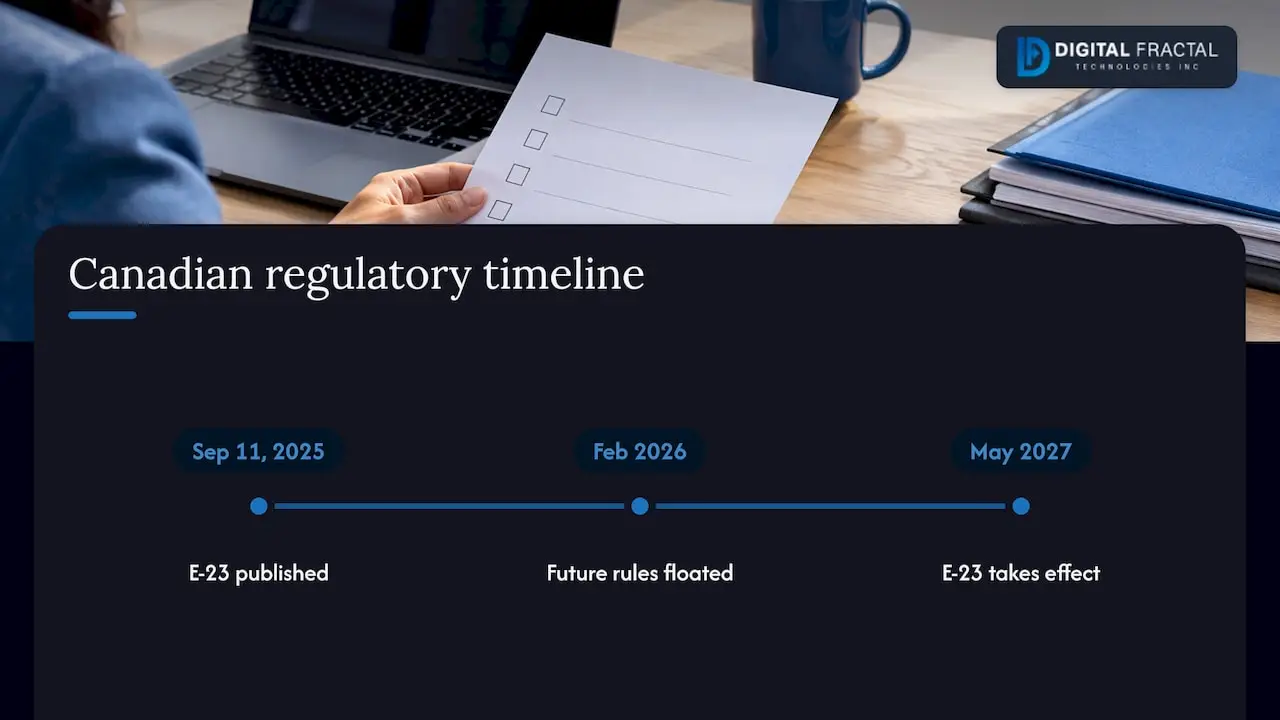
Buyers often wait for a federal AI law before acting. Chambers’ 2026 practice guide describes a country that relies on existing laws and federal soft-law instruments alongside the binding Directive on Automated Decision-Making, which applies to federal institutions. It adds that OSFI Guideline E-23 was published on September 11, 2025 and takes effect in May 2027 for federally regulated financial institutions, and that a February 2026 consultation summary floated possible future rules on safety evaluation, human oversight and traceability.
For your checklist, that means today’s obligations come mainly from privacy law (PIPEDA and provincial equivalents), sector rules and your contracts. Ask each vendor what it represents about compliance with data, privacy and AI legislation, and ask it to commit to notifying you of changes. Because rules are still moving, check the official pages for your sector and province at each renewal.
Step 7: Plan monitoring before you sign
The procurement does not end at go-live. The Treasury Board’s Roadmap to Scale AI Projects in the Public Sector lays out five stages: problem and planning, piloting and observation, adoption and enablement, monitoring and optimization, and decommissioning or renewal. It sets metrics and ROI targets and measures the current state in stage one, sets performance thresholds before full deployment in stage two, and in stage four tracks ROI and service impact against baseline metrics while watching operational performance, risk indicators and cyber resilience.
A workable version for a private business:
- Before launch: record the baseline and set the threshold at which you pause or roll back.
- First 30 to 90 days: review the primary measure and guardrail weekly, log incidents and user complaints.
- Ongoing: monthly review of cost against the usage caps, quarterly review of accuracy and drift, and a review date written into the contract for renewal or decommissioning.
- When targets are missed: change the system, as the roadmap says, or stop it using the exit you negotiated.
Quick reference: the whole checklist on one page
| Stage | Must be true before moving on |
|---|---|
| Problem | Workflow, baseline, one measure, one guardrail written down |
| Data | Sources, owners, quality and access limits known |
| Vendor | Written answers on data use, subprocessors, security, bias and testing |
| Risk | Consequence level set, human approval points defined, fallback agreed |
| Contract | Data ownership, no training on your data, service levels, IP, exit |
| Monitoring | Thresholds, review dates and a stop condition set before go-live |
Where an AI Readiness Audit fits
Steps one and two decide whether the rest of the checklist works. Our AI Readiness Audit is a one-off engagement priced at $2,500 to $10,000. It identifies where automation fits in your operations, including in logistics and construction, so you go to vendors with a defined use case instead of a general ambition. Our approach is built around tailored solutions that aim for tangible results within 90 days, shaped to your workflows, systems and goals. If you want the cost drivers first, read the AI readiness assessment cost guide.
If you already know the workflow you want to automate, our workflow automation service and AI implementation and build-out work cover the build; or start with the audit at digitalfractal.com.
Our perspective
Most failed AI purchases we hear described have the same root: the buyer shopped for a product before defining a problem. A checklist for vendors is necessary, but it only works when the questions are tied to your own workflow, your own data and your own baseline.
That is why we build our work around the AI Readiness Audit. Our solutions are tailored to each client’s workflows, systems and goals, and we do not offer generic, off-the-shelf consulting. When the problem is stated clearly, the vendor questions in this article become easy to answer, and the contract nearly writes itself.
Our aim is a tangible business result inside 90 days: one pilot, a few measures, a clear decision at the end. For logistics teams that means real-time insight on the operations that matter. For developers it means AI capabilities that fit the app and its data flows from the start.
Souhail
FAQ
What should be on an AI procurement checklist?
Cover six areas: the problem and success measure, data readiness, vendor answers on privacy, security, bias and testing, risk and human oversight, contract terms, and post-purchase monitoring. Each item should be answered in writing and filed as evidence.
How do I make sure a vendor will not train its models on my data?
Do not rely on a website privacy policy, which does not bind the vendor. Add a contract clause that limits use of your data to delivering the service and prohibits using prompts, files, outputs, metadata or logs for training or product development without your written approval, as McInnes Cooper recommends.
Is there a Canadian AI law I must comply with when buying AI?
Canada currently relies on existing laws, such as privacy legislation, plus federal guidance and, for federal institutions, the Directive on Automated Decision-Making, according to Chambers’ 2026 guide. Sector rules can add duties, for example OSFI Guideline E-23 for federally regulated financial institutions from May 2027. Ask your lawyer which rules apply to your sector and province.
How long should an AI pilot run before deciding?
Long enough to measure your primary metric against the baseline and to see the exceptions, with a pre-agreed stop condition. We scope our engagements around a 90-day timeline, which gives a pilot enough time to show results.
Who should own AI procurement inside the company?
A business owner of the workflow should lead, with IT, security, privacy and legal each signing off on their part. The workflow owner is the person who defines the baseline and the success measure.
Sources
- Guide on Departmental AI Responsibilities, Canada.ca
- AI Project Support Toolkit, GCcollab
- AI Best Practices Guidelines, MacEwan University
- Before You Buy AI: A Business Guide to AI Vendor Contracts and Risk Management, McInnes Cooper
- Considerations in procuring vendor AI, Torys
- Technology Sourcing, McMillan (ICLG)
- Government of Canada solicitation, CanadaBuys
- Artificial Intelligence 2026: Canada, Chambers
- Roadmap to Scale AI Projects in the Public Sector, Canada.ca