Driver Fatigue Detection: How It Works and How Fleets Use It

Driver fatigue detection is a set of sensors and software that spot early signs of drowsiness, such as long eye closures, yawning, head nodding or drifting in the lane, and warn the driver before a mistake happens. For a logistics firm, the warning is only half the value. The other half is what happens to the data afterward: who sees it, how schedules and coaching change, and whether the signal reaches the tools dispatchers already use. We build AI and workflow automation around that second half, and that is where this guide spends its time.
TL;DR
- Systems read three main sources: the driver’s face and eyes, how the vehicle is steered and driven, and, mostly in research, body signals such as brain or heart activity.
- Camera-based and vehicle-based measures are already common in vehicles, and combining them gives the strongest reported accuracy.
- Field trials in Canadian trucking found that in-cab feedback reduced slow eyelid closures during night driving, and that tuning alerts is the key to driver acceptance.
- Facial and eye data can be treated as biometric information in Canada, so notice, consent and limited retention belong in the design from day one.
- The biggest gains come from connecting alerts to scheduling, coaching and reporting, not from the alert alone.
Table of Contents
- How driver fatigue detection works
- The four measurement families
- How AI reads the signals
- Why design matters as much as the model
- What the field evidence shows
- Turning alerts into operational insight
- Privacy and data handling in Canada
- Where our AI Readiness Audit fits
- Our perspective
- FAQ
- Sources
How driver fatigue detection works
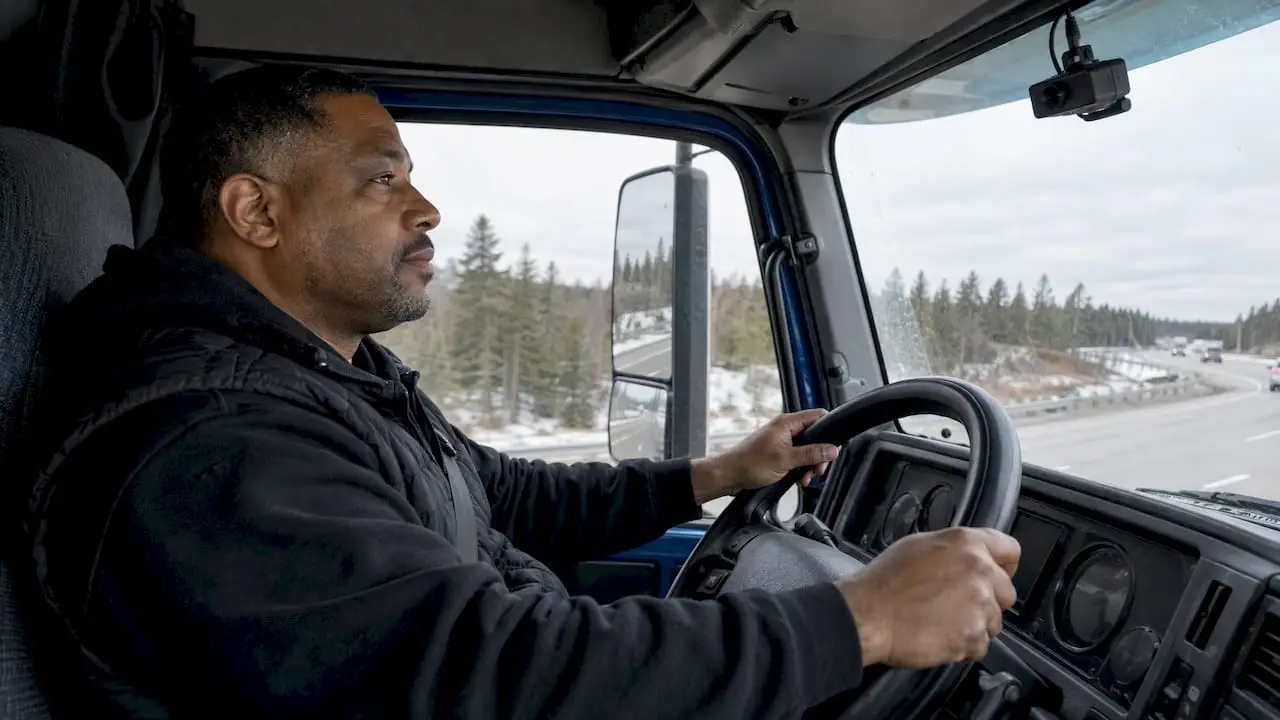
Transport Canada groups these tools under driver monitoring. Some systems watch driving performance: lane keeping, steering, speed, acceleration, pedal use and turn-signal patterns, often checked in the first minutes of a trip. Others use a driver-facing camera that flags eyes closed longer than a blink, or attention away from the road for too long. Many vehicles escalate from a dashboard icon and audio warning to a haptic alert such as seat vibration or a brake pulse if the driver does not respond.
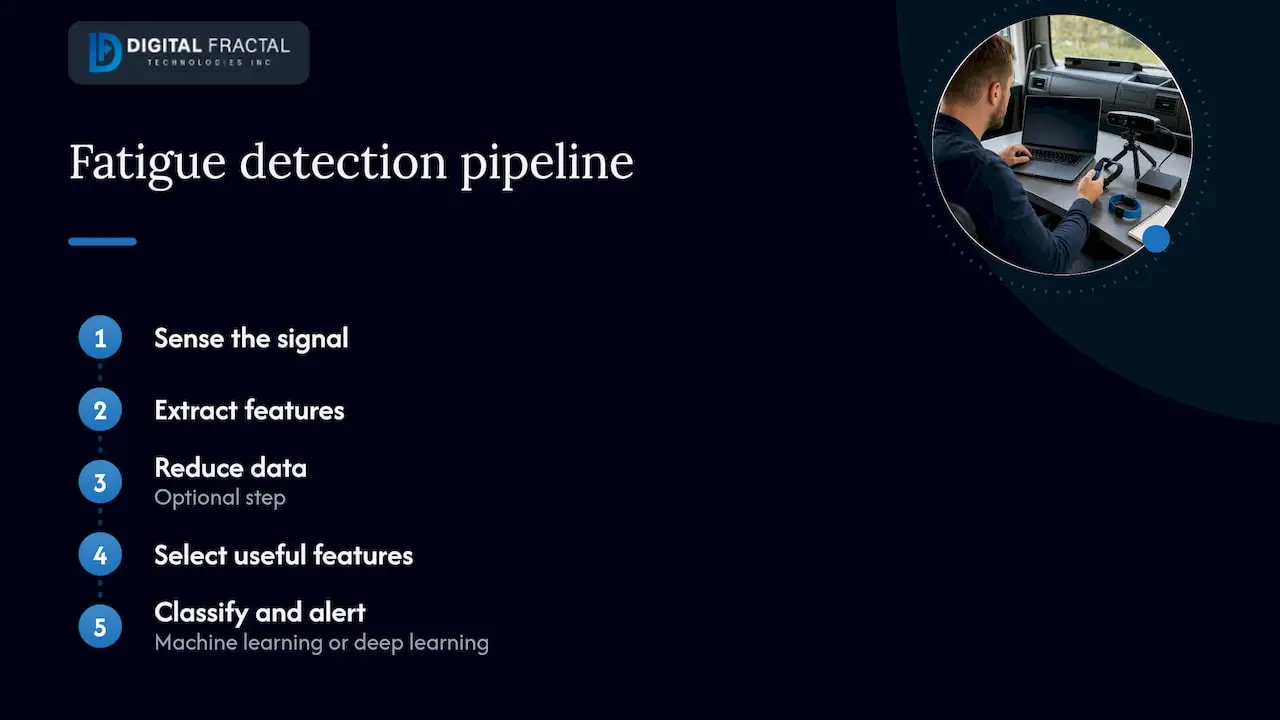
The signs these systems target follow the way drowsiness develops. A 2022 review of drowsiness detection lists difficulty keeping the eyes open, yawning, frequent blinking, trouble concentrating, swerving, delayed reaction to traffic, nodding and unexplained speed changes. Its standard pipeline has five steps: sense the signal, extract features, optionally reduce the data, select the useful features, then classify with machine learning or deep learning and trigger an alarm.
The four measurement families
Researchers at the UK’s Transport Research Laboratory sort driver-state detection into four technical measures. Camera and vehicle-based measures are already common in vehicles. Biological measures mostly remain in research because the sensors are intrusive.
| Measure | What it reads | Where it stands |
|---|---|---|
| Camera-based | Eyes, mouth, head position | Common in vehicles; reported high accuracy for drowsiness |
| Vehicle-based | Steering, lane deviation | Common in vehicles; typically works at extra-urban speeds |
| Biological | Brain or heart signals | Mostly research |
| Hybrid | A combination of the above | Reported high accuracy |
The same report notes that camera-based systems can work at any driving speed, which suits low-speed work such as urban bus driving. Vehicle-based systems can be affected by bumpy roads or side wind. For a fleet running mixed routes, that points toward combining signals rather than relying on one.
How AI reads the signals
A review covering 2014 to May 2024 identifies four input groups: physiological signals, vehicle movement, subjective reporting and facial expressions. Image and video methods use computer vision to follow the face, eyes, mouth or head nodding. Statistical or machine-learning methods look for anomalies in vehicle movement.
In practice, facial analysis is concrete. A 2024 review of intelligent fatigue detection explains that software calculates an eye aspect ratio and a mouth aspect ratio, then derives PERCLOS (the share of time the eyelids cover the pupil), blink frequency, how long the eyes stay closed, and yawn frequency and duration. These methods are popular because they work in real time, cost little and need nothing worn on the body. The same review says fusing several signals can raise accuracy and robustness.
One real-time study with an infrared camera tracked head pose for inattention and eye closure for drowsiness. It defined a drowsy state as closed-eye pixels above a threshold persisting for 50 frames or more, and reported accuracy and precision above 99% on infrared datasets. A 2025 systematic review of 81 deep-learning studies reports median accuracy and F1-score above 0.95 in both simulated and real-world conditions.
Partner technology teams working on similar detection problems, from eye closure and blinking to yawning and head movement, tend to scope them the same way any AI automation is scoped. An AI automation case study shows how that scoping looks in another business.
Why design matters as much as the model
Lab accuracy and fleet accuracy are different things. The same 2025 review points to gaps in demographic diversity, dataset transparency and evaluation metrics. The European Road Safety Observatory notes that there is no reference standard for micro-sleep and no single method commonly accepted for detecting fatigue. That is a reason to design a system around your own drivers, cabs and routes.
TRL lists the conditions that affect camera systems: skin tone, eye aperture, glasses, sunglasses, facial hair, and changes in driver posture or distance. A fleet where drivers wear sunglasses much of the day needs a camera and model setup that handles them. Those are specifications to write down before purchase, and they are the sort of requirements an AI readiness review should capture.
A peer-reviewed study of 12 rural commercial trucks shows why verification and tuning matter. Fatigue events were about half as frequent with cabin alarms on (rate 0.03) as with them off (0.06). Events rose again as the alarm phase continued, a sign of driver habituation, and human review reclassified some events as distraction or false positives. The practical lessons are to vary alert types, review events with people, and feed corrections back into the model.
What the field evidence shows
Canadian trials are the most relevant for a Canadian fleet.
- A Transport Canada-sponsored pilot test of fatigue management technologies with Canadian and U.S. truck drivers found that feedback during night driving significantly reduced slow eyelid closures (p = 0.004), increased an alertness estimate (p = 0.002) and decreased lane-tracking variability (p = 0.007).
- A BC Forest Safety Council evaluation of eye-tracking in BC logging operations found distraction events longer than 2.5 seconds were significantly less frequent once alerts were active. Drivers rated the system effective but too sensitive. The authors conclude that technology is one component of a fatigue-management program and that reducing false alerts is the key to acceptance.
- A 2023 scoping review of 20 studies on in-vehicle drowsiness interventions found most used warnings, mostly auditory, and that interventions overall had a positive effect on sleepiness, driving performance and user evaluations. Long-term effects remain unclear.
Read together, these results say the same thing: detection helps, and the programs that work treat it as part of a wider routine of tuning, coaching and scheduling.
Turning alerts into operational insight
A logistics decision-maker usually asks for three things beyond the in-cab beep.
A usable event record. Each flagged event should carry the clip, time, location and severity, so a safety manager can review it in a minute and mark it as true, false or distraction. That label is the training data that makes the next month’s alerts better.
Pattern views, not single events. One yawn is not a risk. Repeated events by shift, route, depot or time of night are. Summaries that show where fatigue concentrates let you adjust schedules instead of only disciplining drivers. Our piece on crew scheduling AI that cuts fatigue covers the planning side.
Routing into existing tools. Alerts that live in a separate dashboard get ignored. Events that open a coaching task, feed a compliance report or notify the right dispatcher get acted on. That is workflow automation, and it is where most of the effort in a rollout actually goes. The same logic applies in AI-powered safety compliance tools and in computer vision for forklift safety, where the cameras are only as valuable as the process behind them.
For developers building driver apps, the same pattern applies on a smaller scale: the app receives an event, shows the driver a clear prompt, logs the response, and passes the record on through an API.
Privacy and data handling in Canada
Fatigue systems use faces and eyes, and that raises legal questions that are cheaper to answer before rollout. This is general information, not legal advice. Confirm your specific obligations with a privacy lawyer and the privacy regulator for your province.
Two recent decisions show where regulators focus. In Quebec, the Commission d’accès à l’information ordered a Canadian delivery company to limit in-cab image collection to a few seconds around a defined incident, stop recording after the engine is shut off, and destroy excess footage. It found the company had not taken sufficient measures to minimise the intrusion. Earlier, the Privacy Commissioner of Canada’s cases on trucking were summarized in an analysis of always-on monitoring, which found always-on audio recording of drivers difficult to justify and suggested limiting such recording to working hours.
A privacy-aware design usually includes:
- A written purpose: fatigue and safety, not general surveillance.
- Recording tied to events rather than continuous capture, and no capture off-duty or after engine shutoff.
- Clear notice to drivers and consent where the law requires it.
- Defined access rules for who may view footage, and a retention period you can state.
- A review of whether a less intrusive option, such as vehicle-based signals alone for some routes, would meet the goal.
Our note on image recognition ethics and governance goes deeper on these controls.
Where our AI Readiness Audit fits
If you are deciding how fatigue detection should connect to your operation, the AI Readiness Audit is the starting point. It is priced from $2,500 to $10,000 as a one-off and identifies where automation fits your workflows, including in logistics. Our approach is tailored, industry-specific work rather than generic consulting, aimed at tangible results within 90 days. If the audit points to a build, our computer vision and AI implementation services and workflow automation cover the work from design to integration.
Our perspective
Most fatigue projects we hear about start with a camera and end with a dashboard nobody opens. The detection model is the easy part to describe and the hardest part to get value from on its own.
What changes outcomes is the chain around it. An alert reaches the driver at the right moment. The event reaches a person who can judge it. The judgment goes back into the system. The pattern reaches the person who builds the schedule. Each link is a workflow, and workflows are what we design and automate.
We build tailored, industry-specific AI, not off-the-shelf packages, because a log hauler in the BC interior and a last-mile courier in Toronto have different lighting, routes, shift patterns and privacy duties. Our computer vision and workflow automation work is built around those differences, with a target of tangible change within 90 days.
If you are weighing fatigue detection, start by mapping the decisions it should inform. Then choose the signals that serve them.
Souhail
FAQ
How does my car detect driver fatigue?
Most vehicles watch how you drive, including steering, lane position and pedal use, and some add a driver-facing camera that checks for long eye closures or attention away from the road. According to Transport Canada, the first alert is often a dashboard icon with an audio warning, followed by stronger alerts such as seat vibration if you do not respond.
Can AI detect driver drowsiness?
Yes. AI models classify features such as eye closure, yawning and head movement from camera images, and can also analyse vehicle behaviour. Published studies report high accuracy under test conditions, and fleet results improve when alerts are verified by people and tuned to the drivers and routes involved.
Is driver fatigue data private in Canada?
Facial and eye data can be treated as biometric information, so you should plan for notice, consent where required, limited recording and a defined retention period. Regulators in Quebec and at the federal level have ruled on in-cab monitoring, so speak to a privacy lawyer before you deploy.
Do fatigue alerts actually reduce risk?
Field evidence points that way. In a Canadian and U.S. pilot, feedback during night driving reduced slow eyelid closures and lane-tracking variability. Results are best when alerts sit inside a wider fatigue-management program with coaching and scheduling.
Sources
- Driver monitoring, Transport Canada
- A Review of Recent Developments in Driver Drowsiness Detection Systems
- Status of Driver State Monitoring Technologies, TRL (PPR2068)
- Technologies for detecting and monitoring drivers’ states
- Advancements in the Intelligent Detection of Driver Fatigue
- Real-time driver monitoring system with facial landmark estimation
- Drowsiness Detection in Drivers: A Systematic Review
- In-vehicle detection and warning devices, European Road Safety Observatory
- Evaluating the effectiveness of camera-based fatigue and distraction alarms, JOEM
- Pilot Test of Fatigue Management Technologies
- BC Forest Safety Council research report
- Drowsiness Mitigation Through Driver State Monitoring
- Utilisation des données biométriques et de la technologie de reconnaissance faciale, Osler
- Privacy Commissioner finds always-on employee monitoring unreasonable, Dentons
- AI automation case study