
Privacy-Preserving ML: Methods, Use Cases and Mobile

Privacy-preserving machine learning (PPML) lets you train and run models on sensitive data without handing that data to a central pool. In practice it means combining a few techniques: federated learning so raw data stays where it is created, differential privacy so a model cannot give away individuals, and encryption or secure hardware around the exchange. The right mix depends on your data, your partners and your devices, and it is easiest to settle before you build. We design tailored AI systems for logistics, construction and mobile app teams, and the decision below is the one we would walk you through first.
TL;DR
- Privacy-preserving ML is a stack, not one tool: federated learning keeps data at its source, differential privacy limits what a model can leak, and encryption protects the exchange.
- Federated learning alone is not enough: NIST warns that attacks can recover training data from model updates, so a second protection layer belongs in the design.
- The strongest business cases are multi-party logistics forecasting and on-device mobile features such as keyboards, speech and recommendations.
- Decide by asking four questions: who holds the data, how sensitive it is, what accuracy you need and what your devices can run.
- A short, scoped assessment before building saves the most rework.
Table of Contents
- What privacy-preserving machine learning actually covers
- How federated learning works, step by step
- Federated learning use cases that matter to businesses
- Federated learning on Android and mobile
- What to verify before you trust a system
- How to decide whether it fits your organization
- Where we come in
- Our view
- FAQ
- Sources
What privacy-preserving machine learning actually covers
The goal is simple: get the value of a model without exposing the people or companies behind the data. The Turing Way frames it as a responsibility researchers and builders carry toward the people whose data they process. For a business, it is also a way to use data you could not otherwise move, share or centralize.
Three techniques do most of the work.
Federated learning (FL). The Office of the Privacy Commissioner of Canada describes it as keeping original data at its source while copies of a model train on local data and send back analyses, which are combined into a central model in a repeating cycle. Your raw records never travel.
Differential privacy (DP). NIST explains that differentially private training can quantify and bound how much private information leaks from the training data, so the model does not memorize specifics such as one person’s medical history. It does this by adding calibrated noise, for example to each gradient in a method called DP-SGD.
Encryption and secure hardware. These protect updates in transit and during combination. Federated learning sends model changes rather than data, and encryption keeps those changes unreadable to anyone but the aggregator.
The techniques work best together. The UK’s Responsible Technology Adoption Unit defines privacy-preserving federated learning as federated learning with extra privacy-enhancing technologies on top, precisely to guard against someone reconstructing sensitive data from model updates or outputs.
How federated learning works, step by step
A federated round has four moves, which ACM Computing Surveys lists as client selection, broadcasting the model, local computation on each client’s own data, and global aggregation on the server.
- The server picks participants. These can be phones, warehouse scanners, vehicles or whole companies.
- Each participant receives the current model.
- Each trains locally on data that never leaves its device or its organization.
- Only the updates return, and the server combines them into an improved model. Then the cycle repeats.
There is a structural benefit here. Researchers at Google argue in ACM Queue that federated learning makes data minimization part of the design rather than a policy promise: updates are purpose-specific, combined immediately, and analysts never see individual messages. In a centralized setup, minimization depends on how carefully people handle logged data afterward.
Where differential privacy fits
A federated model that trains well can still reveal more than you want. NIST’s authors point out a common misconception: a model that generalizes well on test data is not automatically private, because generalization is an average-case property while privacy has to hold for everyone, including outliers. That is why sensitive tasks add a formal privacy bound on top of federated training. The bound is expressed as a privacy budget, and tightening it costs some accuracy, so you set it against a use case rather than choosing the smallest number.
Federated learning use cases that matter to businesses
Logistics and real-time operational insight
A single shipment can touch many organizations: shippers, carriers, forwarders, ports and warehouses. Each holds part of the picture and none wants to share its raw data with competitors or partners. A Belgian research project on federated logistics describes shipments generating data across 5 to 10 organizations, and arrival-time estimates in current systems typically landing at 60 to 70% accuracy. Federated learning targets exactly that gap: better arrival predictions from pooled learning, with only model parameters crossing company lines.
An academic paper in the Annals of Computer Science and Information Systems proposes the same idea for a sector short of qualified staff: train AI models across multiple companies, with access to shared data controlled at the attribute level.
For a logistics firm, the practical takeaways are:
- Arrival and delay prediction that learns from partners’ history without a shared data lake.
- Predictive maintenance across a fleet or several depots, where each site trains on its own sensor data.
- Anomaly detection at the edge, where a device flags unusual readings locally before anything goes to the cloud. We cover that pattern in edge anomaly detection.
Consumer and mobile apps
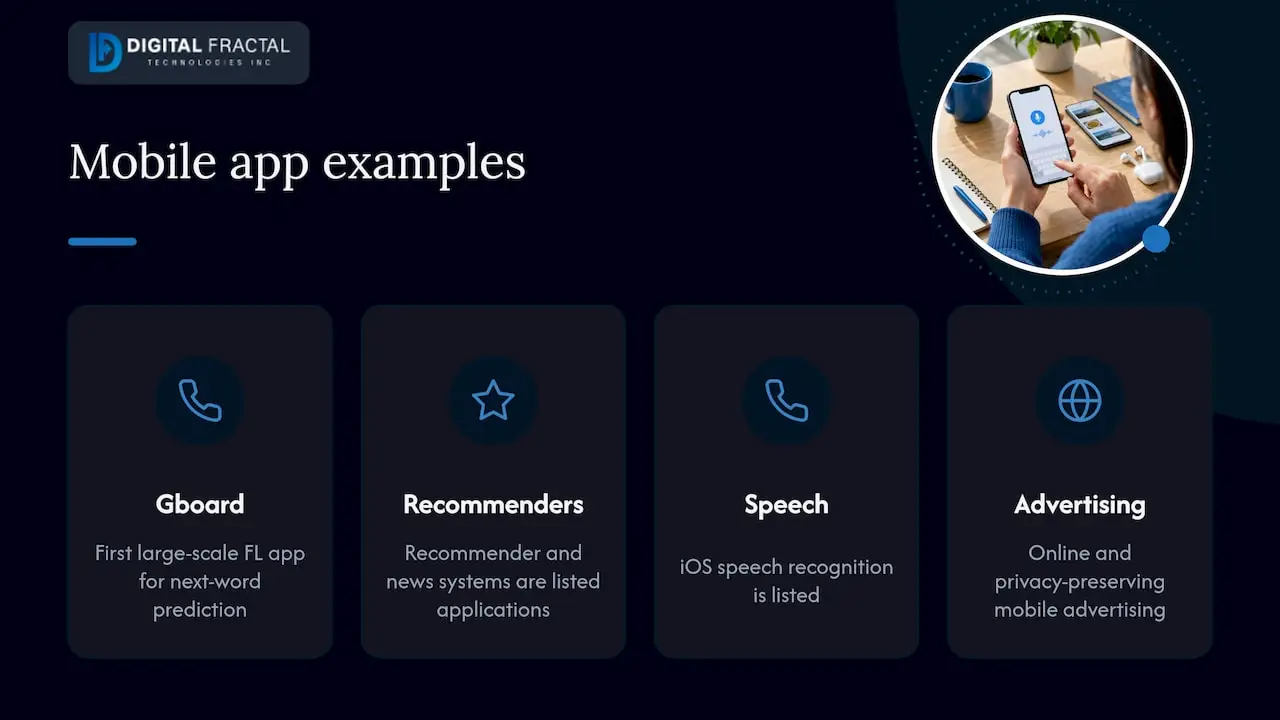
The Open Data Institute’s introduction to federated learning names Gboard, the Android keyboard, as the first large-scale consumer federated learning application, used for next-word prediction without sharing user data with Google. The same report lists recommender systems, online advertising, iOS speech recognition, news recommendations in the Brave browser and privacy-preserving mobile advertising.
For a developer, the pattern is clear: personalization that improves with use, while typed text, voice, location or behavior stays on the phone.
Federated learning on Android and mobile
Android has a documented path for this. Google’s Privacy Sandbox describes the federated compute flow for on-device personalization:
- A client module on the device downloads a public encryption key.
- It receives a training task and the current model version.
- It trains on local data, encrypts its contribution and uploads it.
- Once enough contributions arrive, the server combines them inside a trusted execution environment, after attestation under the NIST-referenced RATS standard.
- The server applies clipping and differential-privacy noise, then produces the next model version.
Notice how many layers are stacked: local training, encryption, secure hardware, clipping and noise. That is the layered idea in practice, and it is the standard to design toward in your own app.
What this means for a mobile team:
- Training happens in the background. Plan for battery, connectivity and device state, because rounds run when conditions allow.
- Devices differ. The Privacy Commissioner of Canada lists the computational cost of regularly sending aggregate insights across millions of devices, and the diversity of operating systems and hardware, as the main challenges of adopting federated learning. Build for the spread of devices your users carry.
- Model size matters. Models that run and train on a phone need to be compact, which shapes your architecture from the start.
- iOS and Android both need a plan. If you ship on both, the federated design should be platform-neutral at the server and tuned at the client. Our mobile and web app development work covers iOS, Android and cross-platform builds.
What to verify before you trust a system
A privacy-preserving label is a claim. These are the checks that turn it into evidence.
| Check | What good looks like |
|---|---|
| Where raw data lives | It stays on the device or inside each organization; nothing is persisted centrally except combined results |
| What the server sees | Only combined updates, with encryption in transit and keys held briefly in memory |
| Leakage bound | A stated privacy budget from differential privacy, not just the claim that data is not shared |
| Attack resistance | Protection against recovering training data from updates or from the final model |
| Data quality gates | Poor-quality participants cannot degrade the model for everyone |
| Utility | Accuracy on your real task is measured against a non-private baseline |
The second row comes from the ACM Queue description of federated systems, where decrypted values exist only briefly and no non-aggregated data is kept on the server. The attack row reflects NIST’s warning that researchers have found ways to recover sensitive training data from model updates and from the final model, even when federated learning is used.
Data quality deserves its own attention. The Belgian logistics study found that federated learning can work despite highly varied carrier data, but that quality gates are essential because one participant with poor data can drag the model down for all. It also reported that building trust with participants and handling inconsistent legacy systems were as hard as the engineering. Plan time for both.
For the utility check, you need a fair test on your own data. A guide on how to benchmark models on your own workload shows the general method: run candidate models against the tasks you actually have, then compare privacy-protected and unprotected versions on the same measures.
Security and compliance review belongs in the process from day one, not at launch. Our AI integration security playbook lays out a 30, 90 and 180 day sequence for security teams, and if your models read images, see GDPR compliance for image recognition.
How to decide whether it fits your organization
Work through these questions in order.
- Can the data legally and practically move? If a central copy is allowed and safe, you may not need federated learning at all. If partners, regulations or device ownership block centralization, federated learning is the natural fit.
- How many parties and devices are involved? Two or three companies with stable servers is a very different build from millions of phones.
- How sensitive is the output? Models trained on health, financial or personal behavior data call for a differential privacy layer on top of federated training.
- What accuracy do you need? Privacy protections trade against accuracy. Set the acceptable gap before you start, per use case.
- Is your data ready? Inconsistent formats, missing labels and unclear ownership slow every approach. Our guide to enterprise data readiness shows how to assess this.
- Who runs it? Someone has to maintain the training rounds, monitor participants and answer privacy questions from partners and regulators.
A worked example: a regional carrier with three depots wants to predict vehicle breakdowns. Each depot’s telematics data is commercially sensitive and governed by separate contracts. The carrier trains a model at each depot, combines updates centrally, and adds noise to the updates. It tests the result against a model trained on one depot alone. The decisions that matter are the privacy budget, the minimum number of depots per round and the accuracy gap it will accept. None of those is a coding decision, and all of them are cheaper to make before the build.
Where we come in
If you are weighing federated learning, differential privacy or a simpler on-premise design, our AI Readiness Audit is built for that decision. It identifies where automation and AI will pay off in your operations, and it is priced as a one-off engagement at $2,500 to $10,000. From there, our AI consulting and machine learning solutions cover strategy, implementation and build-out, and we aim to deliver tangible business transformation within 90 days, with solutions customized to your workflows, systems and goals rather than generic advice.
For mobile teams, our Android and iOS development and AI-enhanced app work put the on-device side and the server side in one project.
Our view
Most teams ask which privacy technique to pick. We think the better question is which problem you are solving, because the technique follows from it.
The best projects we see in logistics, construction and mobile start with a plain inventory: what data you hold, who else holds the rest, and what decision a better model would improve. Privacy-preserving methods then become design choices, not add-ons.
That is why we start with an audit rather than a tool. A tailored plan tied to your workflows and systems beats a generic framework, and the layers matter: local training, a formal leakage bound, encryption and a measured accuracy target belong together.
If the value is there, a 90-day path from decision to working automation is realistic. If a simpler design gets you the result, you will know that early, too.
Souhail
FAQ
What is the difference between federated learning and differential privacy?
Federated learning is about where training happens: data stays on devices or inside each organization, and only model updates move. Differential privacy is about what the model can reveal: it adds noise so that no single person’s data changes the result much. Systems that handle sensitive data often use both.
Does federated learning guarantee that data cannot be recovered?
No. NIST notes that attacks exist that can recover training data from model updates and from final models, even under federated learning. That is why encryption, secure aggregation and differential privacy are layered on top, and why you should ask for a stated privacy bound.
Can federated learning run on Android phones?
Yes. Google documents an on-device personalization flow in which the phone trains locally, encrypts its contribution and uploads it, and the server combines contributions in a trusted environment and adds noise. Plan for background training, varied hardware and compact models.
What are common federated learning use cases in logistics?
Arrival-time prediction across carriers, shippers and ports, predictive maintenance across depots or fleets, and anomaly detection on sensor data. The common thread is that several parties hold useful data that none of them can or wants to pool.
How do we know if it suits our business?
Start with whether your data can move, how many parties are involved, how sensitive the output is and what accuracy you need. A short readiness assessment answers these before you commit to a build.
Sources
- Privacy Tech-Know blog: Privacy Enhancing Technologies, Office of the Privacy Commissioner of Canada
- How to deploy machine learning with differential privacy, NIST
- The UK-US blog series on privacy-preserving federated learning, NIST
- Privacy-preserving federated learning: understanding the costs and benefits, UK Responsible Technology Adoption Unit
- Advancements in Federated Learning: Models, Methods, and Privacy, ACM Computing Surveys
- Federated Learning and Privacy, ACM Queue
- Federated Learning for Data Trust in Logistics, Annals of CISIS
- Federated learning: an introduction, Open Data Institute
- On-Device Personalization Federated Compute Server, Google Privacy Sandbox
- AI model benchmarking: how to test models on your own workload