
AI Governance Roles: Who Owns What in Your Organization

AI governance is not one job. It is a set of clearly assigned responsibilities: someone approves high-risk use cases, someone controls who can touch a model, someone watches it in production, and someone independent challenges all of it. In Canada, federal guidance gives a workable blueprint, and most organizations can map it onto the people they already have.
This guide explains each role, what it should own, how model access control and ML monitoring fit in, and what it takes to build a career in the field.
TL;DR
- AI governance is the formal system that sets decision rights, accountability, escalation and reporting for AI. Roles are how that system becomes real.
- Canadian federal guidance splits duties between developers, who build, and managers, who operate systems and control access, monitoring and human oversight.
- Governance works best as a cross-functional team: data, privacy, security, legal, ethics and equity, not the technology team alone.
- Monitoring and access control need named owners, written procedures and an escalation path before a model goes live.
- Governance careers reward technical literacy plus writing and policy skills, and demand is growing from a small base.
Table of Contents
- What AI governance roles are for
- The core roles and what each one owns
- Managers and developers: who is accountable for what
- Model access control: who decides, and what it includes
- ML model monitoring: who watches the model and what they watch
- Privacy and legal roles in the loop
- How the roles scale by company size
- Perspective: governance should be built around real workflows
- Building a career in AI governance
- Where to start this quarter
- Get your roles and controls mapped
- FAQ
- Sources
What AI governance roles are for
A governance structure is the set of formal mechanisms that decide who holds AI decision rights, who is accountable for outcomes, how concerns escalate, how risks are reported, and how high-risk use cases are approved, escalated or rejected. Roles are the people who carry those mechanisms.
The common failure is not a missing policy. It is a policy nobody owns. A model drifts, a vendor changes a feature, or an employee pastes customer data into a chatbot, and nobody knows whose problem it is. Good role design removes that ambiguity before the incident.
The International Association of Privacy Professionals describes AI governance as distributed across roles, and identifies eight types of work: policy, governance, technical, product, ethics, risk, legal and assurance. That is useful for planning. You do not need eight new hires. You need each type of work to have an owner, even if one person covers two or three.
The core roles and what each one owns
The table below translates Canadian guidance into functions. Job titles will differ from company to company, so match on the duty, not the label.
| Role | What it owns | Typical questions it answers |
|---|---|---|
| Executive sponsor | Final accountability, risk appetite, resourcing | Is this use case worth the risk? Who signs off? |
| AI system manager (operator) | Running the system: access, monitoring, human oversight, incident reporting | Who can use the model, and what is it doing today? |
| Developer or vendor liaison | Design, development, testing, technical risk, incident records | Was it tested properly? What changed in the last release? |
| Privacy lead | Legal authority for personal information, consent, access and correction | Are we allowed to use this data this way? |
| Security lead | Cybersecurity, identity and access management, logging | Can someone misuse or extract this model? |
| Legal and compliance | Regulatory duties, contracts, procedures | What do our obligations require? |
| Ethics and equity reviewer | Harm across groups, fairness testing | Who could this system treat worse? |
| Assurance or challenge function | Independent assessment of controls | Do the controls actually work? |
The federal government’s own guidance supports this cross-functional shape. The Treasury Board of Canada Secretariat says departmental AI governance requires consultation with chief data officers and privacy, security, legal, data-ethics and equity teams, especially for high-risk or high-impact projects. The point is that AI decisions should not sit with a technology team alone.
The independent challenge role
The professional skills framework SFIA describes governance and assurance as defining expectations and decision frameworks, evaluating risk posture and control adequacy, coordinating stakeholders and advising executives, without owning engineering or audit delivery. In practice, that means the person who judges whether controls are adequate should not be the person who built or runs the system. In a small firm that independence may come from a board member, an outside advisor or a peer review step.
Managers and developers: who is accountable for what
Canada’s Voluntary Code of Conduct on advanced generative AI is the clearest statement of the split. It gives developers and managers shared accountability for proportionate risk-management frameworks, policies, procedures and staff training.
Innovation, Science and Economic Development Canada (ISED) defines the two sides in its implementation guide. Managers operate AI systems as products or services and may control their operation, access and monitoring. Developers design and develop systems or components. Managers are expected to work with other actors in the value chain.
ISED lists the manager’s governance duties: controlling access, monitoring operation, managing cybersecurity and model drift, maintaining human oversight, and identifying and reporting serious incidents. If you buy or integrate a model rather than build it, you are very likely the manager in this picture. That matters, because it means the duties above are yours even when a vendor trained the model.
A simple way to make this concrete is a one-page responsibility sheet per AI system:
- Name the system and its business purpose.
- Name the manager who owns daily operation and the developer or vendor contact.
- Name who approves access, who reviews monitoring, and who receives incident reports.
- Record the escalation path and who can pause the system.
- Record the privacy, security and legal reviewers who signed off.
Model access control: who decides, and what it includes
Access control is a manager duty under ISED’s guidance, but the decisions behind it are shared. The business owner decides who needs the model. Security decides how identity is verified. Privacy decides which data the model may see.
For sensitive environments, a 2026 discussion paper on sovereign AI infrastructure resilience recommends Canadian-controlled access to sensitive data and operations, strong identity and access management, encryption, auditable lineage, model evaluations, bias testing and red-teaming. You may not need all of that for an internal dispatch tool, but it is a good ceiling to scale down from.
A practical access-control baseline:
- Named users and roles. No shared logins. Separate who can query a model, who can change prompts or configuration, and who can retrain or redeploy.
- Least privilege for data. Connect a model only to the data its use case needs.
- Logged access. Every change and privileged action leaves a record someone actually reviews.
- Offboarding. Access is removed when people change roles, and API keys are rotated.
- Vendor boundaries. Know what data leaves your environment and who at the vendor can see it.
If your team is planning a rollout, our 30, 90, 180 day AI integration security playbook lays out how security teams can phase these controls.
ML model monitoring: who watches the model and what they watch
Monitoring is where governance meets daily operations. ISED’s guide says managers should monitor deployed systems for harmful uses or impacts, including performance across demographic groups, user behaviour, feedback, incidents and model drift. When something looks wrong, managers inform developers or put usage controls in place.
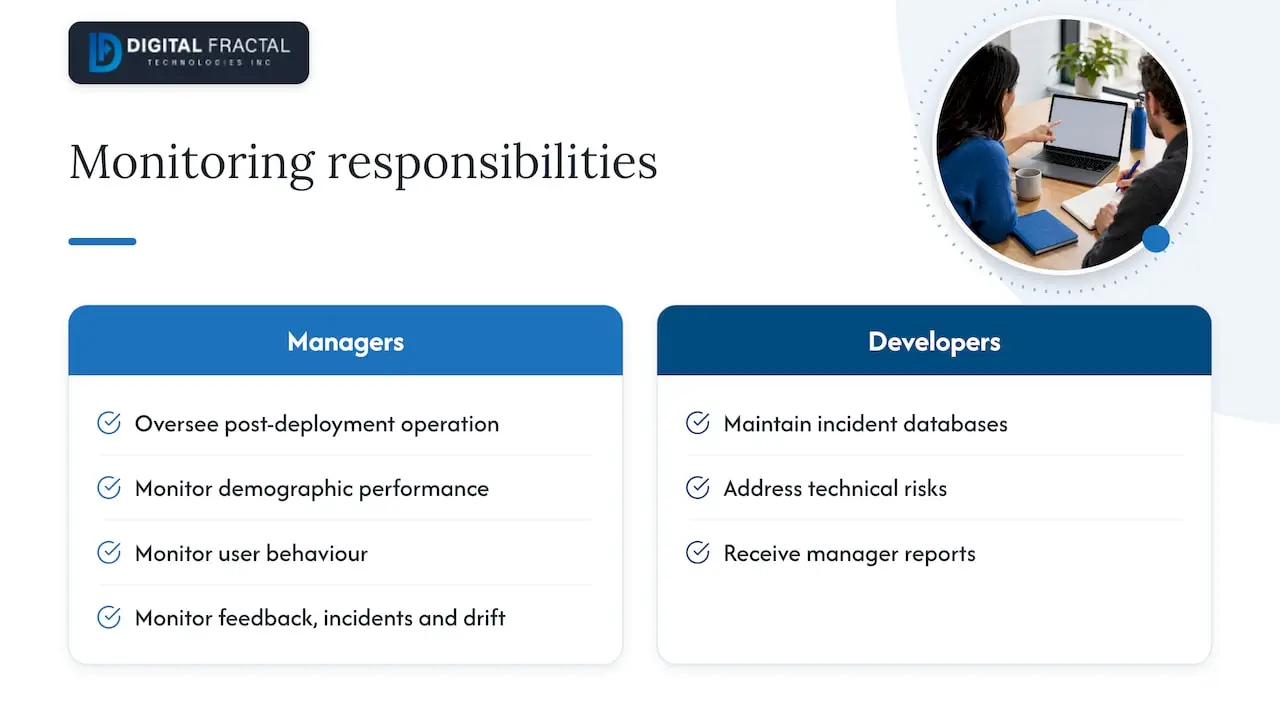
The Voluntary Code treats this as a shared responsibility. Managers oversee operation and use after deployment, and can draw on third-party feedback where appropriate. Developers maintain incident databases and address technical risks. For federal departments, the Treasury Board adds that robust tracking, assessment and monitoring processes are what allow promising use cases to advance.
Monitoring has a business side too. A model can be healthy technically and still fail to change an outcome. If you run AI in customer-facing or marketing workflows, a method such as incrementality testing with agentic AI helps you check whether a use case produces measurable lift, which is the kind of evidence an executive sponsor needs when deciding whether to keep funding it.
Monitoring best practices
ISED’s guide gives a list that works well as a starting checklist. Establish ongoing monitoring and evaluation, detect harmful uses, track performance across demographic groups and user behaviour, collect feedback and incident reports, evaluate model drift, create feedback channels, review incidents, set escalation and developer-communication procedures, and mitigate harmful uses or impacts. Turned into an operating routine, it looks like this:
- Baseline before launch. Developers should run pre-deployment testing across tasks and contexts, plus adversarial testing, cybersecurity-risk assessment and benchmarking against recognised standards, as the Voluntary Code expects. Keep the results as your reference point.
- Define what triggers action. Pick thresholds for accuracy, drift and complaint volume, and write down who is called when one is crossed.
- Track groups, not only averages. An overall accuracy figure can hide a failure for one customer segment or language.
- Capture feedback. Give users an easy way to flag bad outputs and make sure those flags reach the model owner.
- Review incidents on a schedule. Look at patterns, not only single events, and feed lessons back to developers.
- Know who can pause. The manager should be able to restrict or suspend use without waiting for a committee.
Agentic AI needs deeper logging
Autonomous agents raise the bar. The Canadian Centre for Cyber Security recommends continuous monitoring and auditing of agentic AI, including internal operations rather than only inputs and outputs, so you keep traceability and alignment with governance standards. It also recommends logging prompts, tool calls, memory interactions, decisions and actions, keeping real-time monitoring in place, and using runtime anomaly detection, behavioural baselines and alerts or pauses. If an agent can take actions in your systems, the person who owns its monitoring should be able to reconstruct exactly what it did and why.
Privacy and legal roles in the loop
When models touch personal information, the privacy lead becomes a primary governance role. The Office of the Privacy Commissioner of Canada says responsible generative AI governance should document legal authority for collecting, using, disclosing and deleting personal information, ensure meaningful consent where consent is relied upon, and provide procedures for access and correction.
That translates into concrete tasks: a privacy review before a use case is approved, a record of what data the system uses, and a process for responding when someone asks to see or correct information. Put these in the approval workflow so they cannot be skipped.
How the roles scale by company size
The Conference Board of Canada and the Vector Institute’s 2024 report finds that Canadian companies increasingly see AI-risk and governance functions as necessary. Larger AI-adjacent organizations already have dedicated teams or roles, while smaller ones expect to hire for the function in future.
If you are in the second group, start light:
- Under about 50 people: an executive sponsor, one named operator per AI system, and external or part-time input for privacy, legal and security reviews.
- Mid-sized firms: a small governance group that meets on a regular cadence, with a standing intake form for new use cases.
- Large enterprises: a dedicated governance office, with an independent assurance function separate from engineering.
The form matters less than the clarity. One person owning three duties, in writing, beats a committee of ten with no accountability.
Perspective: governance should be built around real workflows
Most governance failures we see are not about missing policy documents. They are about roles that were never tied to a specific system, workflow or decision. A model gets deployed, it works for a while, and then nobody can say who approves a change or who gets the alert when it drifts.
That is why we start with the work itself. In an AI readiness audit, we map where AI will touch your workflows, data and systems, and we name an owner for each touchpoint before anything is built. For logistics, construction and oil and gas teams, that usually means a clear operator for each automation, defined access rules, and monitoring that lands with someone who can act on it.
Our approach is not generic consulting. We tailor solutions to your workflows, systems and goals, and we aim to deliver tangible change within 90 days. Governance roles are part of that design, not an afterthought. If you want a deeper framework, see our AI governance framework for Canadian businesses.
Souhail
Building a career in AI governance
Many readers arrive here asking about the career, so here is what the evidence supports.
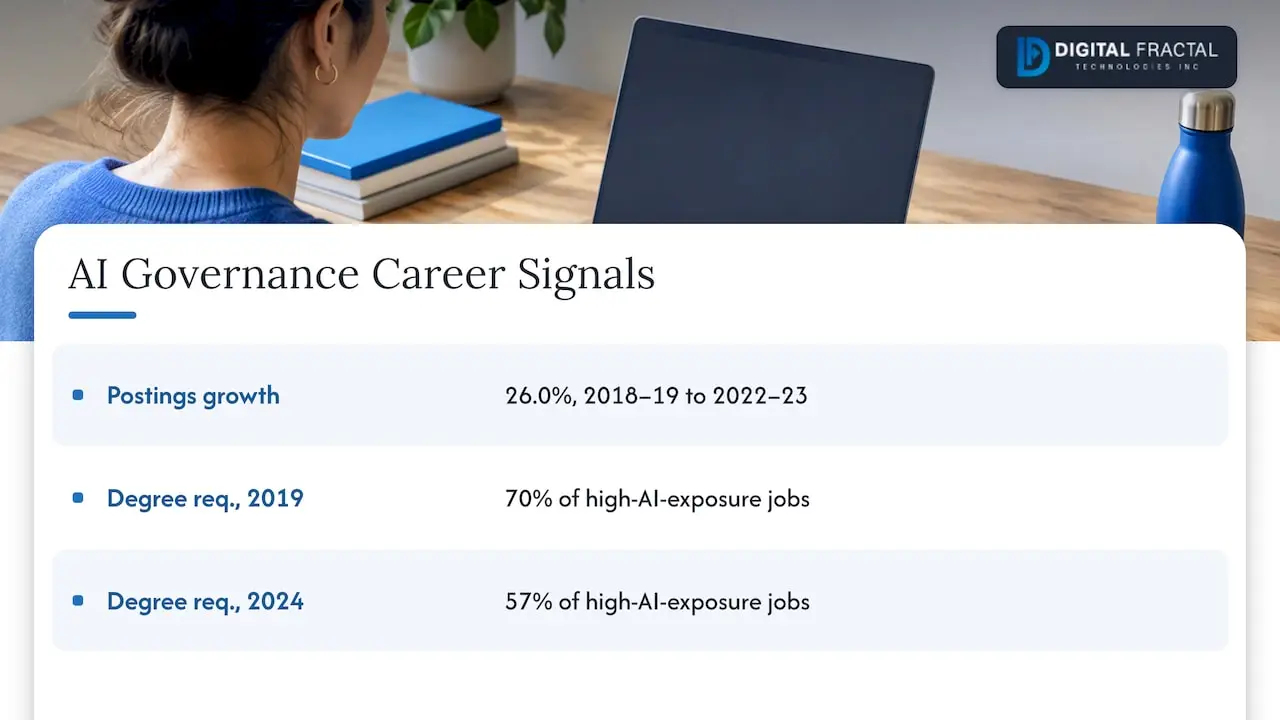
Demand is rising from a small base. The 2024 Canadian talent report found that job postings requesting AI ethics and governance skills rose 26.0% between 2018 to 2019 and 2022 to 2023, although the number of postings remained minimal. The report also links governance, privacy, cybersecurity, change management and executive AI literacy to building trust and supporting wider AI adoption in Canada.
Technical literacy helps. 80,000 Hours says technical governance has strong demand and relatively few qualified candidates, with routes through think tanks, government and internal company governance. It also cautions that pay can be lower than comparable technical industry work and job security may be weaker. Governance roles can involve more writing, communication and policy work than engineering.
Degrees matter a little less than they did. PwC’s 2025 Canada analysis reports that degree requirements for high-AI-exposure jobs fell from 70% in 2019 to 57% in 2024. Demonstrable skill and experience carry more weight than before.
To pick a lane, use the eight work types from the IAPP framework above. A privacy professional moves naturally into legal and policy work. An engineer fits technical and assurance work. A product manager fits product and governance work. Then build the missing half: policy writers learn how models are tested and monitored, and engineers learn to write a clear risk memo.
Where to start this quarter
You do not need a new department to improve your position. Try this sequence:
- List every AI system in use, including vendor tools and employee-adopted chatbots.
- Assign an operator and an executive sponsor to each.
- Write the access rules and review them against least privilege.
- Decide what you monitor, who sees it and who can pause the system.
- Schedule privacy, security and legal review for any high-risk use case before launch.
- Name who will independently challenge the controls once a year.
If you are unsure where your gaps are, our AI readiness checklist is a good first pass, and our guide to enterprise data readiness covers the data side.
Get your roles and controls mapped
Our AI Readiness Audit identifies where AI fits in your operations and who needs to own each piece, so governance is designed alongside the automation rather than bolted on later. It is a one-off engagement priced from $2,500 to $10,000, depending on scope.
If you want to see what it covers, review the AI Readiness Audit, or explore our wider AI consulting and machine learning solutions for strategy, training and implementation.
FAQ
What is the AI governance role in an organization?
It is the set of responsibilities that decides who approves AI use cases, who is accountable for outcomes, and how concerns escalate and get reported. It is rarely a single job. It is usually spread across an executive sponsor, system operators, and privacy, security, legal and ethics reviewers.
Who is responsible for monitoring ML models in production?
Under Canadian federal guidance, the manager who operates the system is best placed to monitor it, maintain human oversight and detect incidents. Developers support that work by maintaining incident records and addressing technical risks. Both need a clear route to report problems to each other.
Who should control access to AI models?
The operating manager should hold day-to-day responsibility, with security setting identity and access standards and privacy deciding what data the model may see. Give each person the least access needed, log privileged actions, and review the list when roles change.
Is AI governance a good career?
Demand for governance skills is growing in Canada from a small base, and qualified technical candidates are scarce. Pay and job security can be less certain than in comparable engineering roles, so personal fit and a mix of technical and policy skills matter.
Do small companies need a dedicated AI governance role?
Usually not at first. Name an executive sponsor and one operator per AI system, and bring in privacy, legal and security input as needed. Add dedicated capacity as the number and risk of your AI use cases grows.
Sources
- AI Governance: designing AI governance structures (UTS Human Technology Institute)
- AI Governance Skills Framework (IAPP)
- Guide on Departmental AI Responsibilities (Government of Canada)
- SFIA AI assurance and governance role archetypes
- Voluntary Code of Conduct on advanced generative AI systems (ISED)
- Implementation guide for managers of AI systems (ISED)
- Sovereign AI Infrastructure Resilience discussion paper (ISED)
- Careful adoption of agentic AI (Canadian Centre for Cyber Security)
- Principles for responsible, trustworthy and privacy-protective generative AI (Office of the Privacy Commissioner of Canada)
- Artificial Intelligence Talent in Canada (Conference Board of Canada and Vector Institute)
- 2025 Global AI Jobs Barometer, Canada analysis (PwC)
- How can tech experience make a difference in AI governance? (80,000 Hours)