
Network Latency in DApps: Common Problems and Fixes

Network latency is one of the biggest challenges for decentralized applications (DApps). It impacts transaction speed, user experience, and even security. If your DApp feels slow or unresponsive, it’s likely due to delays in data transit, node processing, or blockchain consensus.
Here’s what you need to know:
- Latency causes delays in transactions, outdated interfaces, and security risks like front-running.
- Key factors include slow node synchronization, consensus mechanisms, and geographical distance between nodes.
- Solutions include optimizing RPC infrastructure, using caching, adopting faster protocols like Proof-of-Stake, and reducing physical data travel through edge computing.
DApps that address these issues stand a better chance of retaining users and maintaining trust. Let’s break down the causes and fixes for these latency problems.
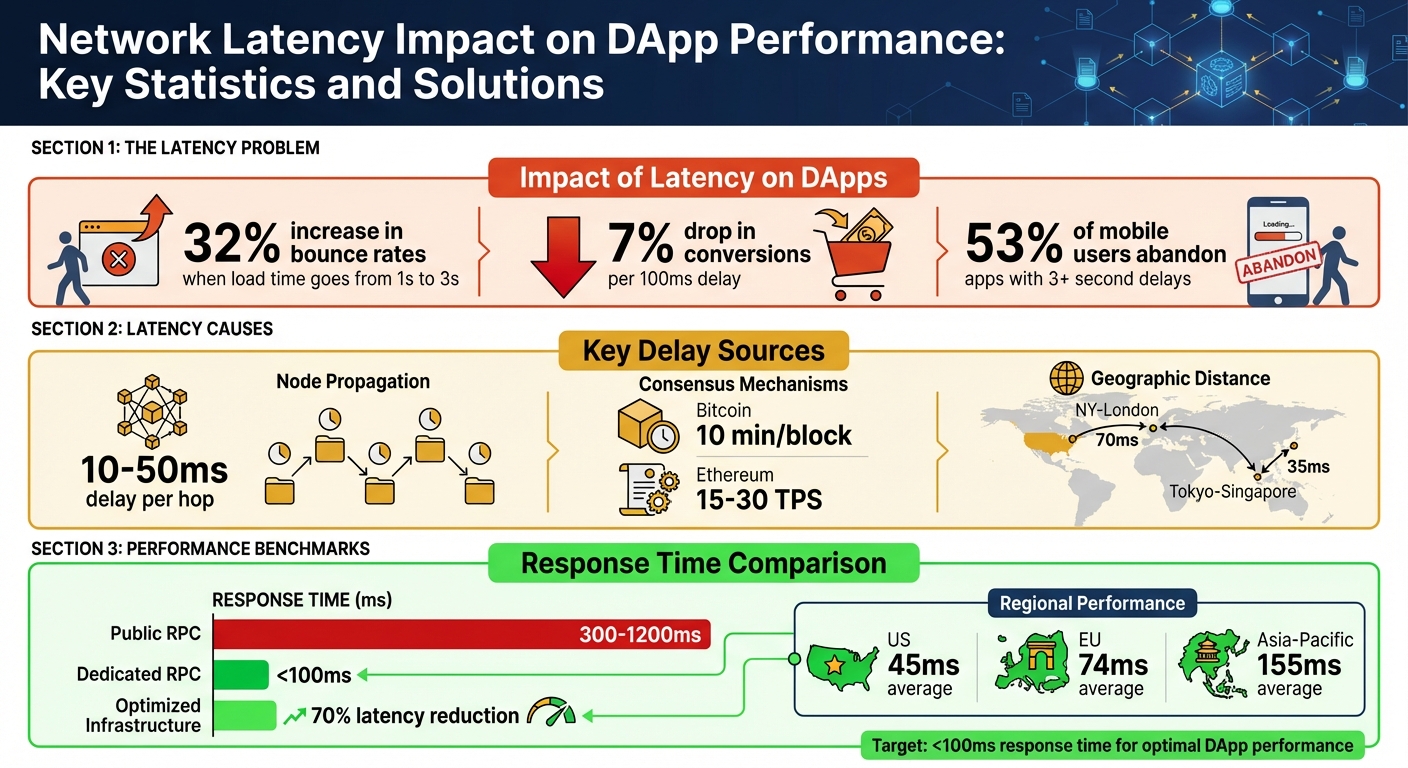
Network Latency Impact on DApp Performance: Key Statistics and Solutions
Supra 101 | The All-in-One Solution for dApp Builders
sbb-itb-fd1fcab
Common Network Latency Problems in DApps
Network latency isn’t just a minor inconvenience – it can severely affect transaction reliability, user satisfaction, and the scalability of decentralised applications (DApps). When delays creep in, users experience frustration, security risks increase, and the overall appeal of a DApp diminishes. Let’s break down three key ways high latency can disrupt DApps.
Slow Transaction Confirmations
Nothing frustrates users more than waiting for transactions to go through. When you initiate a transaction, it has to navigate the network, sit in the mempool, and finally get added to a block. This process can take time. For instance, Bitcoin averages 10 minutes per block, while Ethereum manages about 15–30 transactions per second. When demand spikes, these delays can skyrocket.
Take the 2021 launch of the Bored Ape Yacht Club (BAYC) as an example. The Ethereum network became so congested that gas fees soared past $500 per transaction, leaving many users with failed transactions and hefty losses. DeFi platforms like Uniswap became nearly unusable for everyday traders. To make matters worse, Ethereum’s EIP-1559 standard requires a 10% price bump for replacement transactions. If this isn’t met, transactions can stall in the mempool, clogging the user’s nonce queue and halting all subsequent transactions. This leads to support tickets, abandoned carts, and frustrated users.
These delays don’t just irritate users – they set off a chain reaction of technical and operational headaches.
Poor User Experience
Latency doesn’t just slow transactions; it disrupts the entire user experience. Delayed RPC responses can cause interfaces to display outdated information, such as incorrect wallet balances or failed transactions that actually succeeded.
The impact is measurable: DApp bounce rates increase by 32% when page load times jump from one to three seconds. Even a tiny 100ms delay can reduce conversion rates by as much as 7%. In DeFi apps, latency often results in "structural slippage", where token prices or liquidity pools shift by the time a transaction is processed. Imagine planning to buy a token at $100, only to see your transaction confirm at $105 due to delays.
"Speed is invisible when it works and unforgivable when it doesn’t." – QuickNode
The stakes are even higher in gaming DApps. For instance, Axie Infinity saw a 40% drop in daily active users in 2025 after infrastructure changes increased response times from 150ms to 400ms. When users feel they can’t rely on immediate feedback, they move on to faster platforms.
Scalability Challenges and Security Risks
Latency doesn’t just frustrate users – it also strains a DApp’s infrastructure and exposes it to security threats. As latency rises, a network’s ability to handle more users and transactions simultaneously drops. This creates a vicious cycle: more users cause congestion, which increases delays, further reducing the network’s throughput.
But the risks don’t stop there. Delayed transactions sitting in the mempool are vulnerable to bots using Maximal Extractable Value (MEV) tactics. These bots spot pending transactions, calculate profitable trades, and submit competing transactions with higher fees. In this scenario, every delay becomes an opportunity for exploitation.
"In DeFi, speed isn’t a luxury – it’s survival. And yet, latency remains the most underestimated risk in the entire stack." – Smart Liquidity Research
For Proof-of-Stake networks, high latency can cause validators to miss block proposals or attestations, leading to financial penalties known as slashing. These delays don’t just inconvenience users – they penalize network participants and create openings for attackers to profit. Quick transaction processing is essential to keep DApps secure and efficient.
Next, we’ll explore strategies to tackle these latency challenges and improve DApp performance.
Primary Causes of Network Latency in DApps
To solve network latency issues in decentralised applications (DApps), you first need to understand why they occur. These delays aren’t caused by bugs or poor coding but are instead tied to the fundamental structure of decentralised networks. Here are the three main factors contributing to network lag.
Node Synchronization and Data Propagation
Decentralised networks use peer-to-peer propagation to share information. When a transaction or block is created, it doesn’t get broadcast to all nodes simultaneously. Instead, each node shares it with a few peers, which then pass it along to others, creating a ripple effect. This "wave-like" process adds about 10–50ms of delay per hop.
The way your node syncs with the network also plays a role. There are three primary syncing methods:
- Full Sync: Downloads and verifies every block from the blockchain’s start – this can mean handling up to 2TB of data for Ethereum. It’s the slowest but most secure method.
- Snap Sync: Downloads a recent snapshot of the blockchain and fills in the gaps. It balances speed and data access.
- Light Sync: Only downloads block headers, making it the fastest option but unsuitable for developers needing full data access.
A delay of just 10 seconds could mean missing around 150 Ethereum transactions. This explains why users sometimes notice outdated token prices or incorrect wallet balances. But syncing isn’t the only cause of latency – consensus protocols also play a big part.
Consensus Mechanisms
Consensus protocols decide how quickly transactions are finalised, and each mechanism introduces its own delays. Block intervals create a baseline delay. For instance, if a block time is 400ms, a 50ms network delay eats up 12.5% of that window.
The type of finality also matters. In classical Byzantine Fault Tolerance (BFT) systems like Tendermint, a transaction is finalised as soon as it’s confirmed. In contrast, longest-chain consensus (used by Bitcoin, Ethereum, and Solana) allows for potential chain reorganisations. Users often wait until a transaction is "k-blocks deep" to consider it final. On Ethereum, reorganisations occur roughly every 24.43 blocks, affecting about 16.69 transactions per hour.
"In classical BFT systems… a transaction is finalised once it gets confirmed, whereas in longest-chain consensus… a transaction may get included in a block and then reorged." – Lefteris Kokoris-Kogias, Researcher, Paradigm
Congestion adds another layer of delay. Validators prioritise transactions with higher fees, leaving lower-fee transactions stuck in the mempool. Since transactions are processed sequentially, this creates a bottleneck. But beyond consensus and processing delays, geography also plays a major role in network latency.
Geographical Distribution of Nodes
The physical location of nodes introduces unavoidable delays due to the limits of data transmission. For example, a data packet travelling from New York to London takes about 70ms, while the trip from Tokyo to Singapore takes around 35ms. Within the same data centre, the delay is under 1ms.
Crossing continents involves multiple routers, each adding processing time and potential congestion. For protocols like Solana, which rotate block leaders, geography can create a "slot lag penalty." If the block leader is in Tokyo and your RPC node is in New York, your transaction faces the full delay of that physical distance.
"Latency is often treated as a buzzword, but in the world of Solana high-frequency trading (HFT), it is a physics problem. There is no software optimisation that can beat the speed of light." – AllenHark Team
Regional performance varies widely. As of early 2026, QuickNode reports average response times of 45ms in the US, 74ms in the EU, and 155ms in Asia-Pacific. For DApps aiming to serve a global audience, this uneven distribution means some users will inevitably face slower performance based on their location. Together, propagation delays, consensus mechanisms, and geography create the intricate latency challenges that developers must tackle.
Solutions to Reduce Network Latency in DApps
Tackling issues like node synchronization, consensus delays, and network distances requires a combination of infrastructure upgrades and protocol-level improvements. These strategies aim to address bottlenecks and enhance the overall performance of DApps.
Optimizing RPC Nodes and Infrastructure
The RPC layer acts as the bridge between your DApp and the blockchain. Unfortunately, it’s often a major bottleneck. Public RPC endpoints typically deliver response times ranging from 300 ms to 1,200 ms, whereas dedicated providers can maintain response times under 100 ms. This difference is critical, as even a 100 ms delay can lead to a 1% drop in conversion rates.
Dedicated RPC endpoints help mitigate noisy-neighbour problems and ensure faster response times. To further reduce latency, co-locate RPC nodes with backend services or near major validators, such as Solana’s hubs in Frankfurt, minimizing round-trip times.
"Your RPC layer is more than ‘just another API’. For dApps, it’s the gateway between your code and the chain." – Fito Benitez
Other strategies include implementing caching to store frequently accessed data like NFTs or token lists, which cuts down redundant network calls. Using filters like getProgramAccountsFilter can reduce response sizes, while pagination helps manage large datasets effectively. For real-time updates, switch from constant polling to WebSockets, which offer event-driven subscriptions. This not only reduces server load but also provides instant data delivery.
To prevent UI flicker, use EIP-1898 for block-bound reads, which ties reads to a specific block hash rather than the constantly changing "latest" block. Techniques like Gzip compression for RPC data and circuit breakers to pause API calls during system stress can further optimize performance.
Advanced Layer 1 Enhancements
Improving infrastructure is just the start. Protocol-level enhancements address latency at its core. Sharding, for instance, divides the blockchain into smaller segments, enabling parallel transaction processing instead of sequential handling. Ethereum’s shift to Proof-of-Stake eliminated the computational burden of mining, resulting in faster transaction times.
Modern protocols like QUIC and HTTP/3 improve resilience against packet loss and establish faster connections compared to traditional TCP. Advanced RPC routing techniques can cut latency by over 30% and reduce operational costs by up to 40%. In 2022 benchmarks, QuickNode achieved a global average response time of 86 ms, nearly double the speed of its closest competitor.
Emerging technologies like AI-powered routing are poised to revolutionize network performance by predicting congestion and optimizing routing decisions in real time. When combined with edge computing, which processes data closer to users, these innovations minimize data travel distances.
For developers, adding off-chain caching layers with tools like Redis or Memcached can ease the load on blockchain nodes, especially for frequently accessed data like user profiles. Setting up fallback providers with per-method stall timeouts (e.g., 300–500 ms for head reads) ensures that a slow provider doesn’t drag down the entire system.
Custom Solutions by Digital Fractal Technologies
Tailored solutions can lead to dramatic performance improvements. Digital Fractal Technologies specializes in creating custom approaches to reduce latency across multiple levels. Their AI-optimized node clustering uses intelligent load balancers to route requests based on live performance metrics rather than just geographic proximity. This prevents bottlenecks and ensures smooth response times, even during traffic surges.
Custom API integrations using WebSockets and gRPC enable event-driven updates, eliminating the need for constant polling and achieving sub-second transaction propagation. Network optimization can deliver latency improvements measured in hundreds of milliseconds – far more impactful than code-level CPU tweaks, which typically save only microseconds.
"With network optimization, the difference you can achieve may suddenly be in the range of hundreds of milliseconds. In terms of magnitude, network changes can have a thousand times more impact." – ERPC
Digital Fractal’s ultra-low-latency infrastructure places applications in the same data centres as major validators or uses Private Network Interconnects (PNI) to minimize network distances. Since intercontinental communication can add over 100 ms in round-trip ping, this approach significantly reduces delays. By deploying horizontal scaling with RPC clusters behind load balancers, their solutions can handle high traffic volumes and concurrent WebSocket connections without compromising performance. A well-optimized RPC node can cut DApp latency by up to 70%, transforming sluggish interactions into near-instantaneous responses.
Conclusion
Latency can erode user trust and discourage engagement. When a decentralised application (DApp) responds in less than 100 milliseconds, users see it as dependable and polished. But if delays stretch beyond three seconds, over half of mobile users – 53%, to be exact – are likely to abandon the app entirely. In the competitive world of DApps, success often depends on achieving lightning-fast performance.
Reducing latency starts with optimising RPC nodes and improving Layer 1 protocols. Dedicated RPC nodes can drastically cut response times, transforming frustrating delays into near-instant interactions. On the other hand, Layer 1 upgrades like sharding or adopting Proof-of-Stake consensus mechanisms help eliminate bottlenecks, laying the foundation for a smoother, more scalable ecosystem.
With the DApp market expected to grow at an annual rate of 56.1% through 2030, businesses that prioritise performance are better positioned to attract and retain users. Low latency isn’t just about speed – it also enhances security, scalability, and cost control. Faster transaction finality reduces risks like front-running attacks, while streamlined request patterns help lower infrastructure expenses by avoiding unnecessary network calls. From fine-tuning nodes to leveraging advanced consensus protocols, every improvement contributes to better DApp performance.
Digital Fractal Technologies Inc stands out by offering tailored solutions that combine the speed of Web2 with the security of Web3. Their full-stack services include smart contract auditing, multi-chain deployment, and custom blockchain infrastructure, all aimed at delivering measurable gains in both response times and operational efficiency.
Whether you’re building a new DApp or refining an existing one, addressing latency is key to creating applications that users trust and adopt widely. Faster response times not only improve transaction speeds but also strengthen the security and resilience of blockchain ecosystems.
FAQs
How can I measure latency in my DApp?
You can measure latency in your DApp by monitoring how long blockchain interactions take to respond. Tools like txping are helpful for tracking both RPC latency and block inclusion times. If you prefer, you can also use simple tools like curl or ping, or rely on libraries like Web3.js or ethers.js combined with performance.now() to benchmark RPC response times.
For continuous monitoring, consider using network tools or setting up automated dashboards. These can help you keep an eye on RPC health and maintain the performance of your DApp.
When should I use WebSockets instead of polling?
WebSockets are a great choice when your application demands low latency and real-time interaction. By keeping a persistent connection open, WebSockets allow data to flow instantly without the need for repeated requests. This approach not only cuts down on latency but also minimizes network overhead.
They work particularly well for use cases like live feeds, instant messaging, or real-time collaboration tools. In these scenarios, frequent updates are essential, and relying on polling could lead to delays or wasted resources.
How do I reduce MEV risk caused by slow confirmations?
To lower the risk of MEV (Maximal Extractable Value) caused by slow transaction confirmations, you can adopt various strategies to limit the possibility of transaction reordering. One approach is using private transaction channels or working with RPC providers that offer private order flow.
Additionally, implementing slippage and deadline checks can add an extra layer of protection. For actions involving sensitive data, consider using commit-reveal schemes to keep details hidden until it’s safe to reveal them.
Another proactive step is educating users about wallets that support private RPCs and MEV-Share, which can significantly reduce their exposure to MEV risks during delays. These measures combined can help create a more secure transaction process.