
The CEO’s Dilemma: Why the Next 12 Months Will Define Your Company’s Future | Digital Fractal

A candid conversation about AI adoption for business leaders
I need to be direct with you. In the next year, your company will fall into one of two categories—and the gap between them will become permanent.
This isn’t about technology for technology’s sake. This is about survival, competitive advantage, and whether your business will thrive or become irrelevant.
The Reality: A Widening Economic Divide
Right now, a fundamental shift is happening in the business world. Companies adopting AI are operating at a speed and efficiency level that’s leaving everyone else behind. This isn’t speculation—it’s measurable, observable, and accelerating.
Look at the markets. Companies leveraging AI tools are seeing unprecedented growth. Those that aren’t? They’re watching their market share erode, unable to compete on price, speed, or innovation.
The brutal truth: this gap is widening every month. And soon, it will be too wide to cross.
Why This Matters to You (Not Your IT Department)
Here’s what I want you to understand: AI isn’t a technical upgrade. It’s a fundamental shift in how work gets done.
Think about it this way:
What if your team could:
- Draft proposals, reports, and analyses in minutes instead of days?
- Make complex decisions with instant access to synthesized information from thousands of sources?
- Automate repetitive tasks that currently consume 40% of your knowledge workers’ time?
- Scale operations without proportionally scaling headcount?
This isn’t future-thinking. This is happening right now at companies that have adopted AI tools.
Breaking Down the Jargon: What You Actually Need to Know
Let me translate the technical terms into business value:
Large Language Models (LLMs)
Think of these as expert assistants that never sleep, never take vacation, and can handle an unlimited number of tasks simultaneously. They read, write, analyze, and reason through problems at superhuman speed.
Business impact: Your team’s productivity multiplies. Tasks that took hours now take minutes.
Tools Like Claude
These are AI systems you can interact with conversationally—no coding required. You ask questions, request analyses, draft documents, or solve problems in plain English.
Business impact: Every employee becomes exponentially more capable, regardless of their technical skill level.
AI Automation Systems
These are frameworks that let AI tools work on your behalf—managing workflows, processing information, and completing entire projects autonomously.
Business impact: Operations that required entire departments can run with minimal human oversight, freeing your team for strategic work.
The 12-Month Window
Why am I emphasizing this timeline?
Because within the next year, I predict we’ll reach a tipping point where:
- The capability gap becomes insurmountable – Companies using AI will have automated so much of their operations that competing with them on cost or speed becomes impossible.
- Talent migration accelerates – Your best people will leave for companies where they can work with cutting-edge tools. Nobody wants to feel left behind or stuck in the slow lane.
- Customer expectations shift permanently – When your competitors can respond in minutes instead of days, your current response times become unacceptable.
- The cost of entry increases – Right now, enterprise AI adoption is accessible. Soon, you’ll be paying catch-up costs while competitors invest in staying ahead.
What This Looks Like in Practice
Let me paint two scenarios:
Company A (Not adopting AI):
- Proposal development: 2-3 weeks
- Customer inquiry response: 24-48 hours
- Market research: Commissioned quarterly, takes 6 weeks
- Operations analysis: Monthly reports, analyzed by specialist team
- New employee training: 3-6 months to full productivity
Company B (AI-enabled):
- Proposal development: 2-3 hours
- Customer inquiry response: Minutes, with personalized detail
- Market research: On-demand, real-time insights
- Operations analysis: Continuous monitoring with instant alerts
- New employee training: 2-4 weeks to full productivity (AI assists them)
Which company wins the contract? Which company scales faster? Which company’s margins are healthier?
The Path Forward: Practical Steps for Executives
You don’t need to become a technologist. You need to become a strategic adopter.
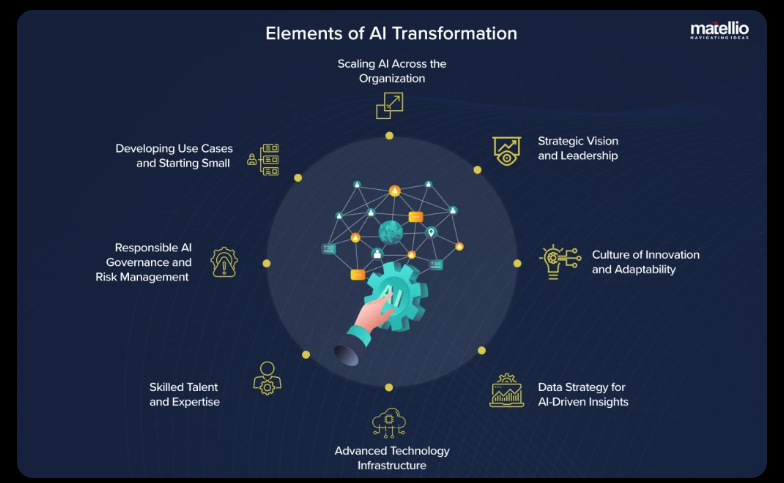
Here’s what effective AI adoption looks like:
Phase 1: Understanding (Weeks 1-4)
- Identify the highest-impact use cases in your organization
- Map current processes that are time-consuming or repetitive
- Understand where your team is spending time that AI could reclaim
Phase 2: Pilot Implementation (Months 2-3)
- Start with one department or function
- Deploy AI tools to solve specific, measurable problems
- Track time savings, quality improvements, and team satisfaction
Phase 3: Scale and Integrate (Months 4-12)
- Expand successful pilots across the organization
- Build AI into your standard operating procedures
- Train your entire team on AI-augmented workflows
The Leadership Question
Here’s what I want you to consider:
A year from now, what will your competitive position be?
Will you be:
- Competing on speed and efficiency that seemed impossible today?
- Attracting top talent because you give them superhuman capabilities?
- Winning contracts because you can deliver faster and better than anyone else?
Or will you be:
- Explaining to your board why margins are shrinking?
- Losing key people to AI-enabled competitors?
- Wondering how everyone else got so far ahead?
This Isn’t About Technology—It’s About Leadership
The companies that will dominate in 12 months aren’t necessarily the ones with the biggest IT budgets. They’re the ones whose leaders said “we’re doing this” and committed to the transformation.
This is a leadership decision, not a technical one.
Your Next Step
The gap is widening. Every month you wait, catching up becomes harder.
At Digital Fractal, we’ve helped dozens of companies navigate this exact transition. We translate AI capabilities into business results—no technical jargon, no unnecessary complexity.
We’ll help you:
- Identify your highest-impact AI opportunities
- Create a realistic 12-month implementation roadmap
- Avoid costly mistakes and false starts
- Build AI capabilities that actually move your business metrics
The cost of a consultation? Free.
The cost of waiting another quarter while your competitors pull ahead? Incalculable.
Take Action Now
Book a free consultation with Digital Fractal. We’ll spend 60 minutes mapping out what AI implementation should look like for your specific business—your challenges, your opportunities, your competitive landscape.
No sales pitch. Just a clear-eyed assessment of where you stand and what you need to do in the next 12 months.