
How AI Transforms E-Commerce Platforms | Digital Fractal, Edmonton, AB

AI is reshaping e-commerce by automating tasks, improving personalization, and driving revenue growth. Here’s what you need to know:
- Market Growth: By 2026, the global AI e-commerce market will reach $8.65 billion, with 89% of retailers already adopting or testing AI tools.
- Revenue Impact: Businesses using AI see a 10–15% boost in revenue, with tools like recommendation engines driving 35% of Amazon‘s sales.
- Efficiency Gains: AI reduces errors in inventory management by 20–50% and cuts cart abandonment rates by up to 45%.
- Customer Experience: Shoppers expect personalization, with 80% seeking tailored experiences. AI enables real-time adjustments based on behaviour.
- Automation: AI chatbots handle 80% of customer queries, saving time and enhancing support.
AI is no longer optional for e-commerce success. From inventory forecasting to customer support, these tools deliver measurable results. Start small, test strategies, and scale what works. Businesses that act quickly will stay ahead in the competitive market.
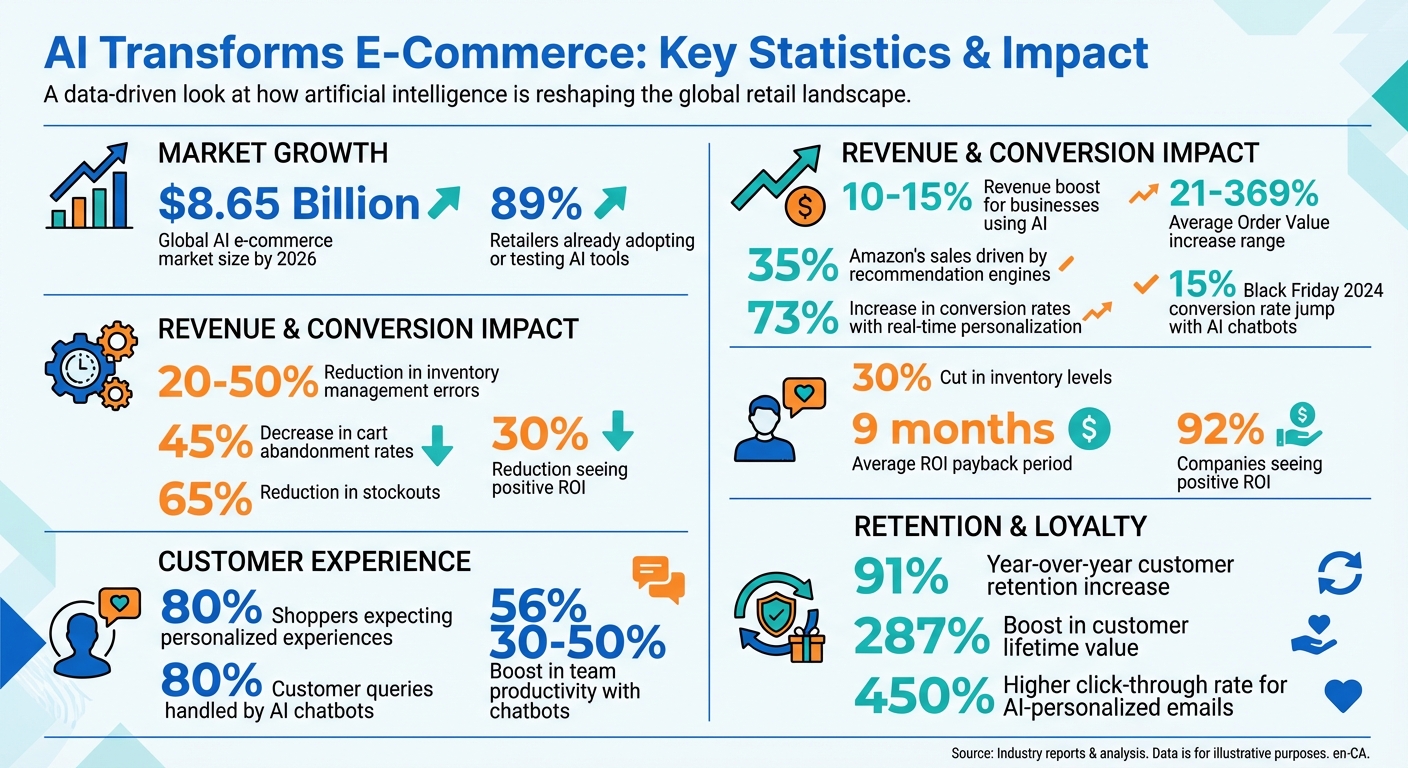
AI in E-Commerce: Key Statistics and Impact Metrics 2026
How AI is transforming the future of ecommerce experiences
sbb-itb-fd1fcab
AI-Powered Recommendation Systems for Better Personalization
Recommendation engines are the backbone of e-commerce success. Take Amazon, for instance – personalized recommendations drive a whopping 35% of its revenue. These systems work by analyzing countless signals in real-time – everything from clicks and scroll depth to mouse movements and even weather patterns. The result? They predict what shoppers want before shoppers even know it themselves.
Modern recommendation systems are all about speed and precision. They ingest real-time data, use feature engineering to craft detailed shopper profiles, and deploy deep learning models to rank and refine product suggestions. Within milliseconds, these systems can generate hundreds of product recommendations, adapting instantly to user actions. For example, if someone clicks on trail running shoes, the AI immediately updates the product carousel to focus on that subcategory.
This level of real-time personalization isn’t just impressive – it’s effective. Conversion rates jump by 73% compared to older batch processing models, and tailored recommendations can increase Average Order Value by anywhere from 21% to 369%, depending on how well the system is implemented. On top of that, more than half of shoppers – 56% to be exact – say they return to a retailer because of the personalized shopping experience. It’s clear that this instant customization is reshaping how businesses connect with their customers.
Using Customer Data for Behavioural Insights
AI recommendation systems rely on three key data streams: event streams (like clicks and cart updates), behavioural signals (such as hover time on product images), and external context (including device type and time of day). By combining these data points, AI creates shopper profiles that go far beyond basic purchase history. These profiles can estimate Customer Lifetime Value, highlight brand preferences, and even detect price sensitivity to fine-tune recommendations.
Here’s a real-world example: Balance ONE used machine learning to spot a 22% spike in demand for probiotics after regional flu outbreaks. This insight reduced their cost-per-order by 32%, saved CA$287,000 annually in inventory costs, and lowered return rates on AI-recommended bundles by 23%.
Even the "cold start" problem – where new users or products lack historical data – is being tackled with hybrid models. These models blend collaborative filtering (based on similar users’ behaviour) with content-based filtering (focused on product attributes like size or material). This approach achieves 15–30% better accuracy than relying on just one method, ensuring that even first-time visitors see relevant suggestions.
Real-Time Product Suggestions and Cart Analysis
Building on these behavioural insights, AI takes personalization to the next level with timely product suggestions. Timing is everything here. For instance, AI can detect when a shopper is about to leave – like when their mouse movements become erratic – and intervene with the right prompt at the right moment. Additionally, features like "Frequently bought together" modules encourage higher order values during checkout.
Shopify has been at the forefront of this innovation. In August 2025, their team rolled out a generative recommender system that treated buyer journeys as sequences of events, not isolated clicks. Using attention mechanisms to track timing and session context, the system delivered impressive results: a 0.94% increase in Shop orders, a 5% boost in high-quality click-through rates, and a 0.71% lift in conversion rates – all while maintaining real-time speeds under 100 milliseconds. As Senior Staff Machine Learning Engineer Ali Khanafer explained:
In commerce, the time of past events matters, and the time of the current session often matters even more because it anchors what is relevant right now.
AI also plays a big role in reducing cart abandonment. By analyzing abandoned carts, it can send personalized recovery emails with updated recommendations. These systems learn which products pair well, identify price points that might cause hesitation, and craft messaging tailored to different customer segments – all in real-time across millions of shopping sessions. This approach has been shown to cut cart abandonment rates by as much as 45%, making it a game-changer for retailers.
AI-Driven Automation for Operational Efficiency
AI is transforming e-commerce operations by automating time-intensive tasks, saving both resources and money. In fact, by Q1 2025, 98% of companies reported using AI in their supply chains for tasks like inventory optimization and demand forecasting. The payoff? AI-enabled e-commerce solutions typically recoup their investment in just nine months.
Instead of relying on outdated, rules-based systems, AI uses predictive models that uncover hidden patterns across multiple data sources. These models combine historical sales data with real-time inputs like social media trends, weather changes, and competitor pricing to predict demand shifts. This approach slashes forecasting errors by 20% to 50% compared to traditional methods. Such operational upgrades pave the way for advancements in inventory management and customer service automation.
AI for Inventory Management and Demand Forecasting
Traditional inventory management often leans on spreadsheets and guesswork, but AI changes the game by delivering precise, daily SKU-level forecasts. These predictions consider factors like sales trends, seasonal shifts, marketing efforts, and even viral social media moments.
A great example? In 2024, Balance ONE adopted a predictive inventory system under CEO James Wilkinson. The AI system identified a 22% rise in probiotic demand during flu season, cutting cost-per-order by 32% year-over-year and saving CA$287,000 annually by reducing excess inventory – all while maintaining a 99.1% in-stock rate. Similarly, LegalOn used AI to track viral TikTok trends and unusual weather patterns. CEO Daniel Lewis shared how their system forecasted a 47% increase in linen dress demand, allowing the company to redistribute inventory, avoid CA$2 million in dead stock, and cut stockout-related losses by 32%.
"Our AI system detected viral TikTok trends and unseasonable weather patterns that spreadsheets failed to identify." – Daniel Lewis, CEO, LegalOn
AI-driven inventory tools can reduce stockouts by up to 65% and cut inventory levels by as much as 30%. About 25% of businesses report that AI-driven demand planning contributes over 5% of their EBIT. Autonomous AI agents now handle stock monitoring, triggering purchase orders or redistributing inventory between stores without human input. Tools like warehouse cameras, drones, and computer vision also help track inventory in real time, minimizing errors in picking and packing.
Before diving into AI for inventory management, ensure your data is ready. You’ll need at least 12 to 18 months of clean, labelled data covering orders and web traffic. Set boundaries like minimum margins and maximum price shifts before enabling automated dynamic pricing. Start with a pilot project focused on a high-impact area, such as demand forecasting or warehouse efficiency, before scaling up.
Customer Support Automation with AI Chatbots
AI doesn’t just optimize inventory; it also streamlines customer service. AI chatbots can manage up to 80% of common customer queries without human help, boosting team productivity by 30% to 50%. In Canada, 56% of shoppers already use AI tools when shopping online, and 72% expect instant support – something chatbots deliver 24/7.
These chatbots integrate seamlessly with e-commerce platforms, CRMs, and inventory systems, allowing them to provide real-time, personalized responses. By accessing data like order history and shipment status, they tailor interactions to each customer. Natural Language Processing (NLP) even enables chatbots to pick up on customer frustration, adjusting their tone or escalating issues to human agents when necessary.
For instance, Lush’s AI assistant, "Marvin", saves their team about five minutes per ticket, adding up to 360 agent hours saved every month. Similarly, Peter Sheppard Footwear introduced AI chatbots on its Shopify store to replicate its premium in-store experience, leading to a 30% increase in revenue. During Black Friday 2024, retailers using AI chatbots saw conversion rates jump by 15%.
"A chatbot is your best salesperson. It can talk to thousands of customers at once, 24/7, and give each one a uniquely personal experience." – Jeniffer Foster, Ecommerce Developer
To ensure a seamless experience, always make it easy for customers to reach a human agent and be transparent about when they’re interacting with AI. Begin with a pilot rollout, perhaps for high-traffic pages or simple tasks like "Where is my order?". Define clear goals, such as reducing ticket volume by 30% or increasing cart recovery by 10%. Also, comply with regulations like GDPR, CCPA, or PIPEDA by removing any personally identifiable information (PII) before feeding data into AI systems.
Adopting these AI strategies can transform e-commerce operations, making them more efficient and customer-focused. At Digital Fractal Technologies Inc, we specialize in helping Canadian businesses implement AI solutions tailored to their needs.
AI for Omnichannel Customer Experiences
Today’s shoppers expect their interactions with brands to feel seamless, whether they’re browsing on mobile, reading an email, or visiting a store. AI makes this possible by pulling data from various sources – like CRM tools, web analytics, and ERP systems – into a single, comprehensive view of the customer. This unified approach ensures consistent pricing, inventory updates, and branding across all channels. It also builds on earlier AI-driven personalisation strategies to create a cohesive omnichannel experience. With 69% of consumers expecting a smooth transition between channels, businesses that deliver on this promise can see customer retention rates soar by as much as 91% year-over-year.
Brands leveraging AI for omnichannel strategies have reported a 287% boost in customer lifetime value, while 80% of shoppers are willing to spend up to 50% more with brands that provide meaningful personalisation. Beyond just tracking customer actions, advanced AI systems can anticipate future needs and trigger timely actions – whether it’s a push notification, an email, or an in-store coupon.
Dynamic Content Personalisation Across Channels
Using AI-powered insights, businesses can adjust content on the fly to match a shopper’s current behaviour. Instead of displaying the same homepage banner to everyone, AI tailors layouts, product recommendations, and email content in real time based on browsing habits, intent, and past purchases. This approach delivers results: AI-personalised emails can achieve a 450% higher click-through rate compared to generic ones.
A standout example of this is Starbucks’ AI platform, Deep Brew. In July 2025, the system segmented Rewards members into highly specific groups and delivered personalised offers across its app and stores. This strategy helped Starbucks grow its program to 34.3 million active members – a 13% year-over-year jump – by encouraging larger purchases and more frequent visits. The secret? Treating each customer as an individual, not just another email address.
Connecting Platforms for Consistent Experiences
AI also ensures that inventory, pricing, and customer data stay in sync across platforms. Picture this: a customer adds an item to their cart on a mobile device, checks its stock on the website, and picks it up in-store. AI ensures that all systems reflect the same information, avoiding headaches like cancelled orders due to stock discrepancies or mismatched pricing.
Take Parachute, a home essentials brand, as an example. In June 2025, they used a unified setup with Shopify and HubSpot to create detailed customer profiles across channels. By integrating past purchases and conversations, they achieved a fivefold increase in buy-online-pickup-in-store (BOPIS) revenue and saved over CA$1 million in operational costs. Founder Ariel Kaye shared:
"The data we access by having everything unified through Shopify lets us truly understand our customers and tailor communications to their needs. This personalisation sets us apart in a crowded market".
To achieve this level of integration, start by consolidating your data into a Customer Data Platform (CDP). This allows you to merge emails, devices, loyalty accounts, and social media profiles into a single, real-time customer profile. Ensure your product catalogue is synced across all systems, from your mobile app to your point-of-sale tools, so stock levels and pricing remain accurate. AI can then pinpoint the most effective touchpoints, helping you allocate budgets wisely and track ROI with precision.
For businesses looking to implement these strategies, partnering with Digital Fractal Technologies Inc can help customise AI solutions to fit your e-commerce platform, creating a unified and engaging omnichannel experience.
How to Implement AI Solutions in Your E-Commerce Platform
Successfully implementing AI starts with defining a clear business goal. For example, you might aim to cut support tickets by 20% or boost the average order value. These specific, measurable objectives help keep your efforts on track and focused. To get started, evaluate your readiness in four key areas: strategic fit, data quality, people and processes (like having a dedicated product owner and data lead), and tech stack compatibility. Make sure you’ve got 12–18 months of data, including orders, traffic, and product details, to give your AI models enough to work with.
Evaluating AI Integration Options
There are three main ways to integrate AI into your e-commerce platform: native platform features, third-party apps, or custom-built solutions.
- Native features: Tools like Shopify Magic or Search & Discovery can be deployed quickly and at a low cost. These are great for businesses just dipping their toes into AI.
- Third-party apps: These provide specialised tools, like advanced chatbots or visual search, without requiring heavy technical expertise.
- Custom-built solutions: If you need tailored workflows, APIs can deliver highly personalised results, but they come with more technical complexity and maintenance needs.
Whichever route you choose, start small. A 30-day pilot or A/B testing for business decisions can help you measure the impact. For instance, you could split your traffic 50/50 between AI-driven and manual processes, then compare metrics like conversion rates and revenue. To calculate ROI, divide the net benefit by the monthly cost, aiming for a payback period of under 12 months.
Here’s an example: In February 2026, Aviator Nation used Shopify’s AI assistant, Sidekick, to analyse data from 20 retail stores and their online platform. Curtis Ulrich, the Director of Ecommerce, discovered that customers who shopped both online and in-store had a 23% higher lifetime value. This insight, which once required hours of manual work, was delivered in moments.
Once you’ve picked your AI strategy, make sure you address legal compliance to protect your business.
Data Privacy and Compliance Requirements
Staying compliant with data privacy laws is essential for maintaining customer trust and operational security. Canadian businesses must prepare for regulations like the Artificial Intelligence and Data Act (AIDA), expected to take effect no sooner than 2025. Quebec’s privacy laws, for example, allow courts to impose fines of up to CA$25,000,000 or 4% of global revenue for non-compliance.
To stay on the right side of the law:
- Record your legal basis for using personal data, whether through consent or specific exceptions.
- Use anonymised or synthetic data whenever possible to reduce the need for processing personal information.
- Conduct Privacy Impact Assessments (PIAs) and Algorithmic Impact Assessments to identify risks before deploying AI.
- Prevent biased outcomes by ensuring your systems don’t unfairly disadvantage users based on prohibited grounds like race or gender.
- Maintain human oversight for critical decisions and provide clear explanations of how automated decisions are made.
Update your privacy policies to be transparent about AI data usage, and log all data collection and usage to ensure traceability. This will also help fulfil individuals’ rights to explanations and contesting decisions.
Monitoring and Optimising AI Systems
Deploying your AI system is just the beginning – ongoing monitoring is key to long-term success. Start by establishing baseline KPIs for at least four weeks before introducing AI so you can measure its true impact. Track performance metrics, confidence scores, and audit trails for every AI-driven process to build trust and ensure stability.
Roll out your AI solution in phases:
- Begin with internal workflows like support triage or reporting.
- Move on to data tasks like product enrichment and normalisation.
- Finally, tackle storefront personalisation once the foundational systems are stable.
A/B testing remains a powerful tool. For example, split traffic evenly between AI-driven and manual workflows to measure the precise impact. Regular audits for algorithmic bias are essential, especially in sensitive areas like personalised pricing or fraud detection. Shopify’s Senior Developer Alex Pilon recommends:
Think small, iterate fast, then scale. When you’re working with big data, testing your prompts on specific cases or running AI-based processes on small batches makes it easier to spot-check and battle-test your process.
For businesses that need tailored solutions, companies like Digital Fractal Technologies Inc offer custom AI consulting and workflow automation to help you create scalable systems aligned with your goals.
Conclusion
AI has shifted from being a helpful addition to becoming a core part of modern e-commerce strategies. By 2026, it will be a critical tool for staying competitive in the digital marketplace. Consider this: 89% of retailers are either using or testing AI solutions, and 92% of companies investing in AI report seeing a positive return on investment within just nine months on average. Those are hard numbers to ignore.
The benefits aren’t just theoretical – they’re measurable. AI-powered personalisation and operational efficiency are driving real revenue growth and cost savings across areas like customer experience and inventory management. Canadian companies like Walmart Canada and Canadian Tire have already shown how effective AI-driven operations can be. These examples highlight that the impact of AI is immediate and actionable.
The question isn’t if you should adopt AI – it’s how quickly you can get started. Whether it’s through recommendation systems or automating operations, these technologies are no longer optional. High-impact areas like inventory forecasting or customer support offer quick payback periods, often between one and six months. For businesses needing tailored solutions, Digital Fractal Technologies Inc provides AI consulting and workflow automation to create scalable systems designed to meet specific goals.
The global AI e-commerce market will hit CA$8.65 billion by 2026. Meanwhile, your competitors are already leveraging these tools, gathering data, and improving their models every day. The longer you wait, the harder it will be to catch up. Start small, experiment quickly, and scale the strategies that deliver results.
FAQs
What’s the best first AI use case for my store?
A great starting point for integrating AI into your store is AI-driven personalization. It’s a smart way to enhance product discovery while improving the overall customer experience. Why? Because it directly impacts engagement, increases sales, and provides clear, measurable returns on your investment.
One of the easiest and most cost-effective ways to begin is with personalized product recommendations. This not only aligns with current trends – like AI-powered customer support, tailored product discovery, and lifecycle messaging – but also helps drive more conversions and streamlines operations.
What data do I need before implementing AI?
To bring AI into your e-commerce platform, start by collecting historical data – think customer behaviour, purchase trends, and product performance. This data is the backbone for training AI models. But it’s not just about having data; it needs to be AI-ready. That means checking its quality, ensuring it’s consistent, and integrating it seamlessly across your systems.
For the best results, unify data from tools like ERP, CRM, and your storefront. When done right, this preparation allows AI to improve both personalization and operational efficiency on your platform.
How do I measure AI ROI in e-commerce?
To figure out the return on investment (ROI) for AI in e-commerce, start by weighing the benefits AI brings – like boosted sales, reduced costs, and smoother operations – against the expenses of implementing it. Key metrics to watch include conversion rate improvements, revenue growth, better inventory management, and higher customer engagement. By using data-backed frameworks and consistently monitoring these KPIs, you can not only validate your AI investments but also fine-tune strategies for even better results down the line.