
AI in Custom App Development for Local Businesses

AI is transforming how businesses in Canada operate, offering smarter tools for faster decisions and streamlined workflows. From predictive analytics to AI chatbots, companies are integrating these technologies into custom applications to solve local challenges, such as managing remote worksites, improving property valuations, and automating retail operations. Key benefits include reduced manual tasks, improved data insights, and faster processes – all while maintaining control over sensitive data through local compliance measures.
Key Takeaways:
- Cost of AI Solutions: Ranges from CAD 20,250 to CAD 105,000+ depending on complexity.
- Implementation Time: AI systems can be integrated within 90 days.
- Real-world Applications:
- Retail: AI chatbots for budget management.
- Real Estate: Property pricing apps with real-time insights.
- Construction: Location-based apps for field operations.
- Results: Businesses report up to a 40% increase in productivity and 3.5x ROI within a year.
Canadian businesses are leveraging AI to modernize operations while addressing local needs like bilingual support, metric systems, and data sovereignty. Whether you’re in retail, real estate, or construction, AI-powered tools can simplify processes, improve efficiency, and drive growth.
Case Study 1: Retail Budget Management App with AI Chatbot
Project Overview
A mid-sized Canadian retailer faced a major hurdle: their budgeting process was bogged down by manual workflows, paper forms, and endless email chains for approvals. These inefficiencies slowed decision-making across multiple store locations. To tackle this, they turned to Digital Fractal Technologies for a mobile solution that could centralize budget management and provide real-time insights for both store managers and head office teams.
The retailer’s existing system had its limits – it could only show historical data. There were no predictive tools or automated insights, leaving staff to manually interpret spending patterns and adjust budgets based on guesswork. To address this, Digital Fractal conducted an AI readiness audit, assessing the retailer’s data sources and tools to pinpoint areas where automation could make an immediate impact. This audit became the foundation for the AI solutions that followed.
AI Implementation and Features
Digital Fractal introduced an AI chatbot powered by Retrieval-Augmented Generation (RAG) technology. This allowed the app to connect with the retailer’s knowledge base, which included product catalogues, historical spending data, and internal budget policies. With this setup, store managers could ask natural language questions like, “What’s my remaining budget for seasonal inventory?” or “How does this month’s spending compare to last year?” The chatbot provided accurate, source-linked answers instantly.
The development team also incorporated contextual memory and prompt engineering, ensuring that the chatbot’s responses aligned with the retailer’s brand tone and financial policies. Beyond answering questions, the AI agent analysed spending patterns, predicted budget issues, suggested adjustments, and automated repetitive tasks like budget approvals and expense categorization – all running 24/7.
The cost of integrating these AI chatbot features ranged between CAD 20,250 and CAD 67,500. Digital Fractal completed the entire deployment within their standard 90-day transformation period.
Results and Benefits
The results were game-changing. By eliminating manual data entry and automating repetitive financial tasks, the retailer saved both time and money on budget administration. Store managers could now make quicker, data-driven decisions about inventory and promotions without waiting for head office approvals. The AI chatbot also handled routine budget queries, freeing up the finance team to focus on strategic initiatives.
With a scalable app architecture, the retailer was well-positioned to add more advanced AI features in the future without overhauling the system. Annual maintenance costs were estimated at 15–20% of the initial development expense, ensuring the solution stayed up-to-date with the latest AI advancements and security standards. This case highlights how AI can transform routine workflows, aligning with broader trends in AI-powered app development for Canadian businesses.
sbb-itb-fd1fcab
Case Study 2: AI Property Pricing App for Real Estate
Project Goals and Challenges
A real estate firm in Ontario faced hurdles with inconsistent property valuations, which not only slowed down sales but also frustrated clients. Traditionally, agents relied on manual comparisons and subjective judgement to set home prices. This approach often led to properties sitting on the market too long or being undervalued. The firm needed a tool that could process vast amounts of market data and deliver accurate, real-time pricing recommendations.
Digital Fractal Technologies stepped in to assess the firm’s data sources and identify how machine learning could be implemented. The challenge wasn’t just about building an app – it involved integrating multiple data streams, such as MLS records, tax rolls, and even unstructured data like property photos and floor plans, into a unified system that agents could trust. These complexities required a tailored AI solution to meet the specific demands of the real estate market.
AI-Driven Features
The app was designed to consolidate structured data and key macroeconomic indicators. AI models were also deployed to analyse unstructured data – like listing photos, floor plans, and renovation histories – adding depth to the structured insights.
One standout feature is its predictive analytics, which move beyond static valuations to deliver dynamic, real-time pricing insights. Additional capabilities include:
- Time-to-sell forecasting: Predicts how long a property might remain on the market.
- Price change alerts: Warns agents about potential price fluctuations.
- Computer vision technology: Analyses listing photos to evaluate property quality, detect wear and tear, and identify recent renovations.
- Geospatial analysis: Uses distance-weighted comparables and heat maps to spot subtle neighbourhood trends before they impact the broader market.
The app’s Automated Valuation Models (AVMs) continuously update pricing as new listings and sales data become available. The AI models demonstrated impressive accuracy, with a median error of just 1.83% for on-market homes compared to 7.01% for off-market properties. These features revolutionized the firm’s pricing strategies and improved its ability to respond to market changes.
Impact and Results
By leveraging the app, the firm gained a competitive advantage, equipping agents with detailed, data-backed market insights. These AI-powered tools allowed agents to confidently justify pricing strategies during listing appointments. This case highlights how AI can reshape traditional processes into strategic benefits for Canadian businesses. With the AI-driven real estate market forecasted to reach CA$41.5 billion by 2033, the Ontario firm is now well-positioned to thrive in this evolving landscape.
Case Study 3: Location-Based AI Navigation App for Construction Services
Development Objectives
A construction services company in British Columbia faced a major challenge: managing operations across remote worksites using outdated methods like paper forms, phone calls, and spreadsheets. This manual approach made it hard to track equipment and personnel, especially in areas with poor connectivity.
To address this, Digital Fractal Technologies developed a mobile app that consolidated these processes into a single platform. Before this, managing a fleet of over 300 vehicles without automation caused delays and increased administrative workload. The new app laid the groundwork for AI-powered tools to simplify operations and improve efficiency in the field.
AI Tools and Features
The app used computer vision to process visual data from construction sites, offering real-time insights into site activities. Thanks to on-device AI, features like navigation and location tracking worked reliably, even in remote areas of British Columbia.
Key functions included automating job dispatch and field service coordination through iPads. Workers could access timesheets, vehicle repair logs, and communication tools without needing to return to the office. The system also handled safety tickets, permits, and certifications automatically, reducing compliance headaches .
"The app provides real-time data on vendor availability 24/7. Having the ability to book in real time or book equipment into the future makes both operations seamless." – James M., CEO
Results Achieved
After adopting the AI-driven workflow automation and real-time insights, the company saw a 40% increase in productivity. These advancements not only streamlined operations but also delivered tangible improvements in performance.
"The application digitized our paper forms, automated permit management, and centralized job dispatching and communications on iPads." – Regg M., Operations
AI Technologies and Implementation Strategies
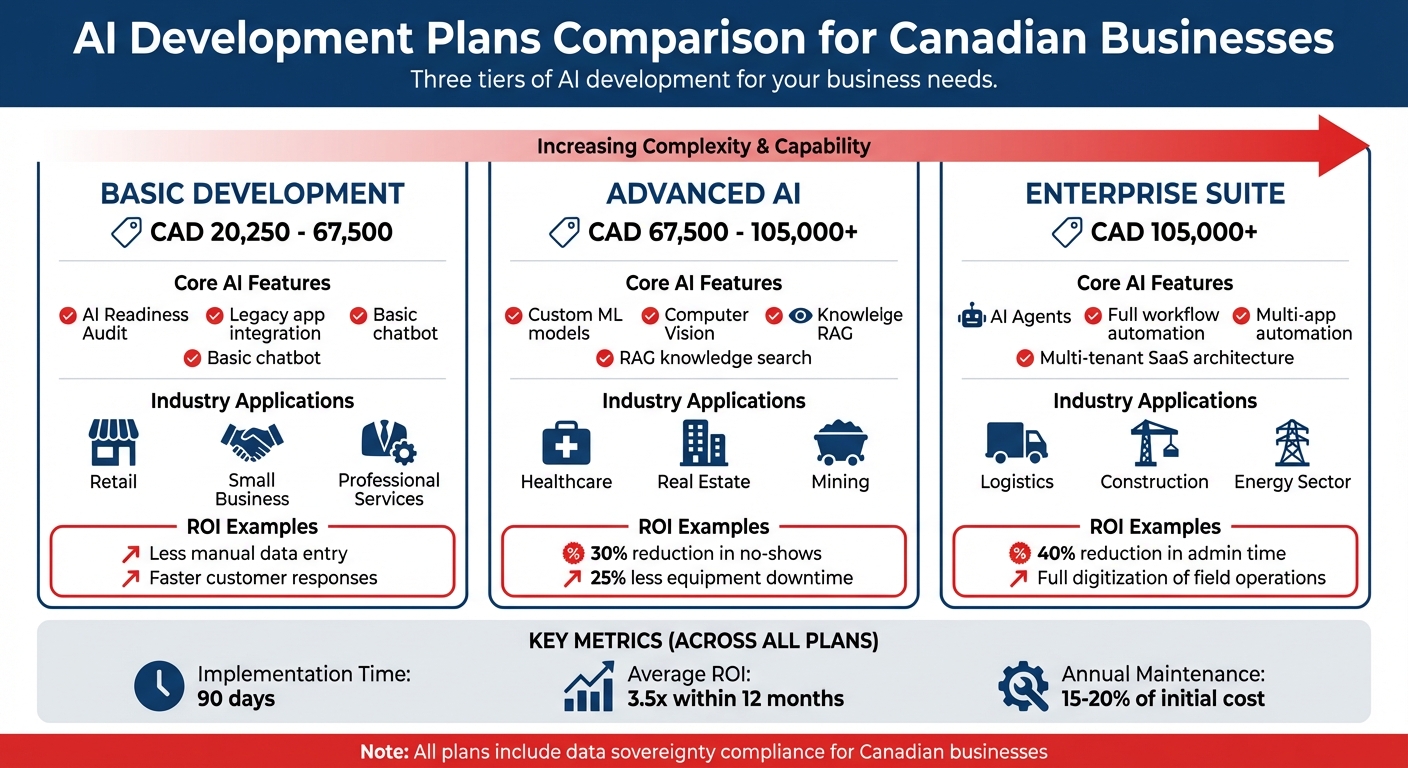
AI Development Plans Comparison for Canadian Businesses
Digital Fractal Technologies takes a step-by-step approach to improving existing systems with AI, focusing on areas like computer vision, machine learning, and AI agents.
The process kicks off with an AI Readiness Audit. This audit evaluates current processes, data infrastructure, and potential risks, delivering a 6–12 month roadmap. It identifies workflows with the highest potential for automation and return on investment. For Canadian businesses operating in remote areas, on-device inference ensures smooth navigation and data analysis, even when connectivity is unreliable.
By streamlining workflows, the company has demonstrated how AI can cut down on hours of repetitive administrative tasks. From consultation to deployment, they implement solutions in just 90 days, concentrating on areas where AI agents can work independently of human input. For example, automating processes like certificate management and job dispatching has significantly reduced the administrative workload for field teams.
These strategies are further outlined in the comparison table below.
Comparison of AI Plans
| Plan Level | Core AI Features | Industry Applications | ROI Examples |
|---|---|---|---|
| Basic Development | AI Readiness Audit, legacy app integration, basic chatbot | Retail, Small Business, Professional Services | Less manual entry; faster responses |
| Advanced AI | Custom ML models, Computer Vision, RAG knowledge search | Healthcare, Real Estate, Mining | 30% reduction in no-shows; 25% less equipment downtime |
| Enterprise Suite | AI Agents, full workflow automation, multi-tenant SaaS architecture | Logistics, Construction, Energy Sector | 40% less admin time; full digitization of field operations |
AI Tools for Canadian Businesses
Digital Fractal also customizes AI tools for specific industries to improve efficiency and reduce costs.
- Construction and field services: AI processes site photos and inspects equipment automatically. AI agents manage safety documentation and compliance for multiple job sites.
- Healthcare and professional services: Intelligent virtual assistants handle support tickets and route requests around the clock by integrating with existing CRM systems.
- Logistics and transportation: Predictive analytics optimize routes and equipment maintenance schedules, cutting downtime by up to 25%.
One critical factor in implementing these tools is ensuring data sovereignty. Canadian businesses retain full control over their information while integrating AI into their existing systems. This approach minimizes disruptions, avoids the need for extensive training, and ensures a smooth transition to AI-powered operations. By embedding AI into current workflows, businesses can enhance their efficiency while keeping their data secure.
Lessons Learned and Future Outlook
Key Takeaways from Case Studies
When AI solutions are tailored to address specific operational challenges, the results can be impressive. Consider these examples: FreshCo cut stockouts by 28%, achieving annual savings of CA$150,000; ReMax Canada boosted listing accuracy to 92% and sped up sales by 22%, adding CA$4.2 million in revenue; and PCL Constructors reduced project delays by 35%, saving CA$2.1 million on a CA$50 million project.
Among Canadian businesses using AI, 78% report improved efficiency, with an average ROI of 3.5x within just 12 months of implementing custom applications. The secret? Starting small. By focusing on modular AI systems that target one business function – like inventory tracking, pricing precision, or field navigation – companies can see tangible results before expanding AI to other areas.
These examples highlight the potential for AI to continue transforming local businesses in meaningful ways.
Future Trends in AI for Local Businesses
As AI technologies advance, Canadian businesses are set to unlock even greater potential. AI-powered CRM systems are expected to see a 25–30% increase in adoption among Canadian SMBs by 2025, thanks to innovations in real-time decision-making and predictive analytics.
Digital Fractal Technologies stands out as a key partner in this space, offering custom CRM development and AI consulting services tailored to meet Canadian needs. This includes bilingual support and compliance with data sovereignty regulations. By starting with targeted AI modules, businesses can gradually scale these systems to embrace the next generation of AI tools.
The future also points toward a growing emphasis on collaborative workflows that combine human expertise with AI capabilities. For Canadian businesses, this means navigating ethical AI practices and ensuring sustainability, particularly as provincial and federal regulations continue to evolve.
FAQs
What data is needed before adding AI to an app?
To integrate AI into an app effectively, the first step is to ensure your data is both well-organized and reliable. Pay special attention to customer interactions, sales records, and operational data – these are often readily available for small businesses and serve as a solid foundation. Clearly outline your objectives, whether it’s automation, data analysis, or something else, and evaluate if your current infrastructure is equipped to handle AI integration. Without high-quality data or the right systems in place, achieving success becomes much harder. Proper preparation makes all the difference.
Should our AI run in the cloud or on-device for remote sites?
When it comes to remote sites, deciding between cloud AI and on-device AI boils down to what matters most for your operations.
Cloud AI delivers the advantage of immense processing power and scalability, making it ideal for handling complex tasks. However, it may come with some trade-offs, such as potential latency and concerns about data privacy.
On the other hand, on-device AI processes data locally, which means quicker response times and greater control over sensitive information. This can be particularly important when privacy is a top priority.
Digital Fractal Technologies can develop AI solutions tailored to your specific needs, whether your focus is on speed, privacy, or the ability to scale.
How can we keep customer data in Canada and stay compliant?
To meet privacy regulations in Canada, organizations must store customer data within the country’s borders and adhere to laws like PIPEDA (Personal Information Protection and Electronic Documents Act). This legislation outlines how personal information should be collected, used, and safeguarded.
Partnering with local providers, such as Digital Fractal Technologies, can be a smart move. These providers offer secure storage solutions that not only help ensure compliance with data residency rules but also protect sensitive information from potential breaches. Keeping data local and secure is a crucial step in maintaining trust and meeting regulatory standards.