Project Overview
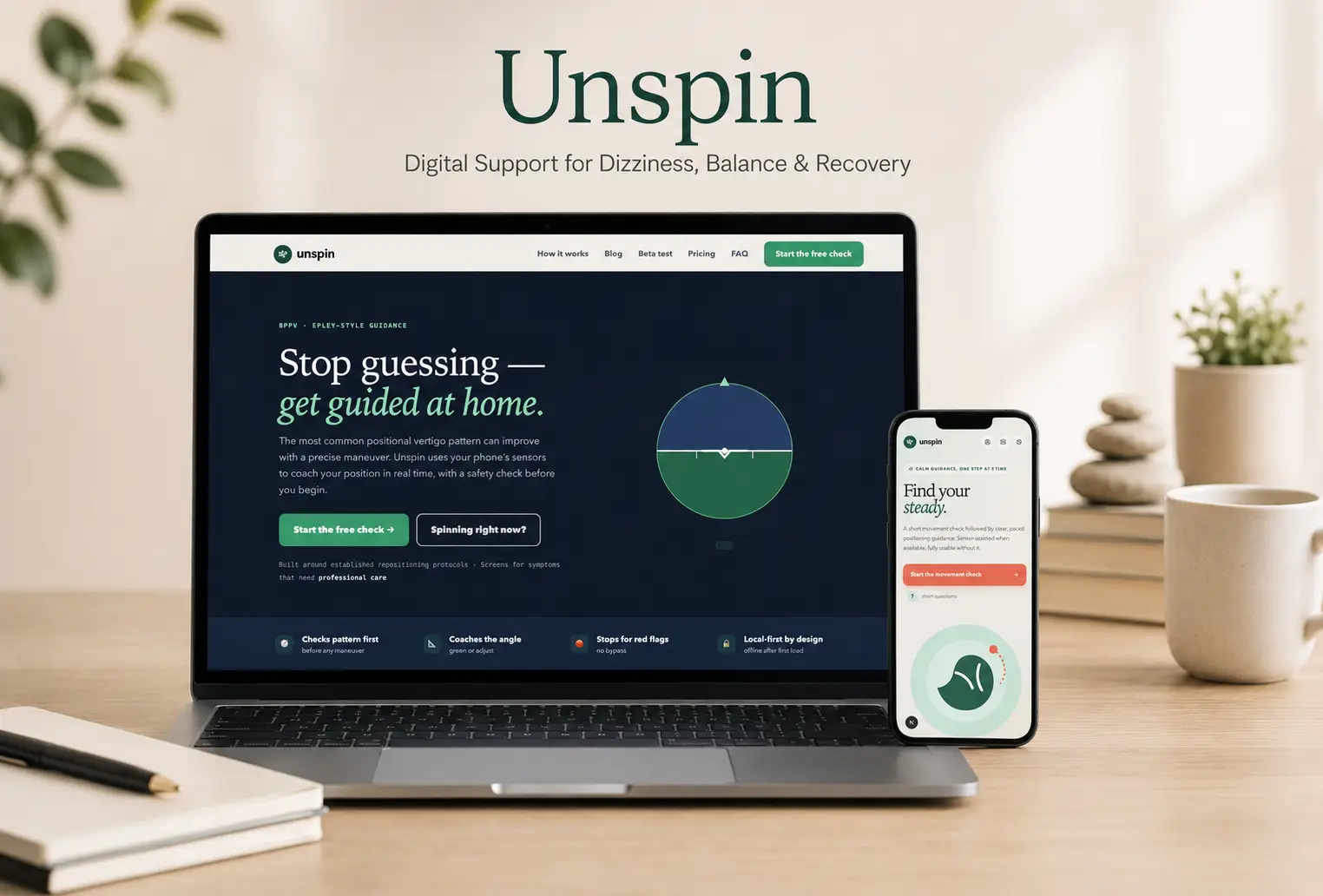
Digital Fractal Technologies developed Unspin, a web-based vertigo support application designed to guide users through a careful, safety-first self-check and structured positioning flow. The project combines a polished marketing landing page, a local-first interactive web app, secure account features, structured beta feedback collection, and an editorial blog system for educational content.
The solution was built as a modern web application framework with a strong emphasis on accessibility, privacy, offline resilience, and cautious health-related language. Rather than acting as a replacement for professional care, Unspin is designed to support users through clear guidance, safety screening, and structured feedback while preserving boundaries around medical advice.
The Problem
People experiencing positional vertigo-like symptoms often need calm, clear, and immediate guidance, but many digital health experiences create more friction than reassurance. Common issues include confusing instructions, lack of safety screening, poor mobile sensor handling, unclear permission prompts, and limited feedback channels for improving the product with real users.
For a vertigo-focused tool, the product also needed to be especially careful. The experience could not overpromise outcomes, ignore warning signs, or present itself as emergency care or a substitute for a qualified professional. It also needed to work reliably on mobile devices, support iPhone motion-permission behavior, and remain usable even when live motion sensors are unavailable.
The Solution
Digital Fractal built Unspin as a local-first web application with a safety-centered user journey. The app begins with a required disclaimer and intake flow, stops immediately when red-flag answers are present, and guides eligible users through a structured session using device orientation when available. If motion access is denied, unavailable, or unreliable, the app falls back to a timer-based mode so the experience remains understandable rather than feeling broken.
The solution includes:
- A responsive landing page for public presentation and tester onboarding.
- A guided app flow with intake screening, session guidance, history, and offline-friendly behavior.
- Motion and orientation support with graceful fallback for unsupported devices.
- Supabase-backed account support and secure session synchronization.
- Stripe-ready payment infrastructure.
- Firebase push-notification scaffolding.
- Privacy-preserving outcome event collection.
- Beta tester feedback forms and an admin triage dashboard.
- A blog CMS with SEO fields, canonical URLs, featured images, draft/publish scheduling, and medical-review safeguards.
- Legal and compliance pages including privacy, terms, data rights, sitemap, robots, and health-check endpoints.
- Docker support for isolated production deployment.
The result is not just a prototype screen — it is a working product foundation with production deployment, database migrations, admin workflows, public pages, and a path for real-world tester feedback.
Conclusion
Unspin demonstrates Digital Fractal Technologies’ ability to design and engineer sensitive health-adjacent software with product polish, technical depth, and responsible boundaries. The project balances usability with caution: it gives users a calmer digital experience while preserving safety stops, privacy controls, and clear disclaimers. As a portfolio project, Unspin highlights end-to-end capability across product strategy, UX, frontend development, backend architecture, database design, authentication, payments, content management, SEO, deployment, and compliance-aware implementation. It is a strong example of building a practical digital health support tool that can evolve through real user testing, clinical review, and iterative product development.