
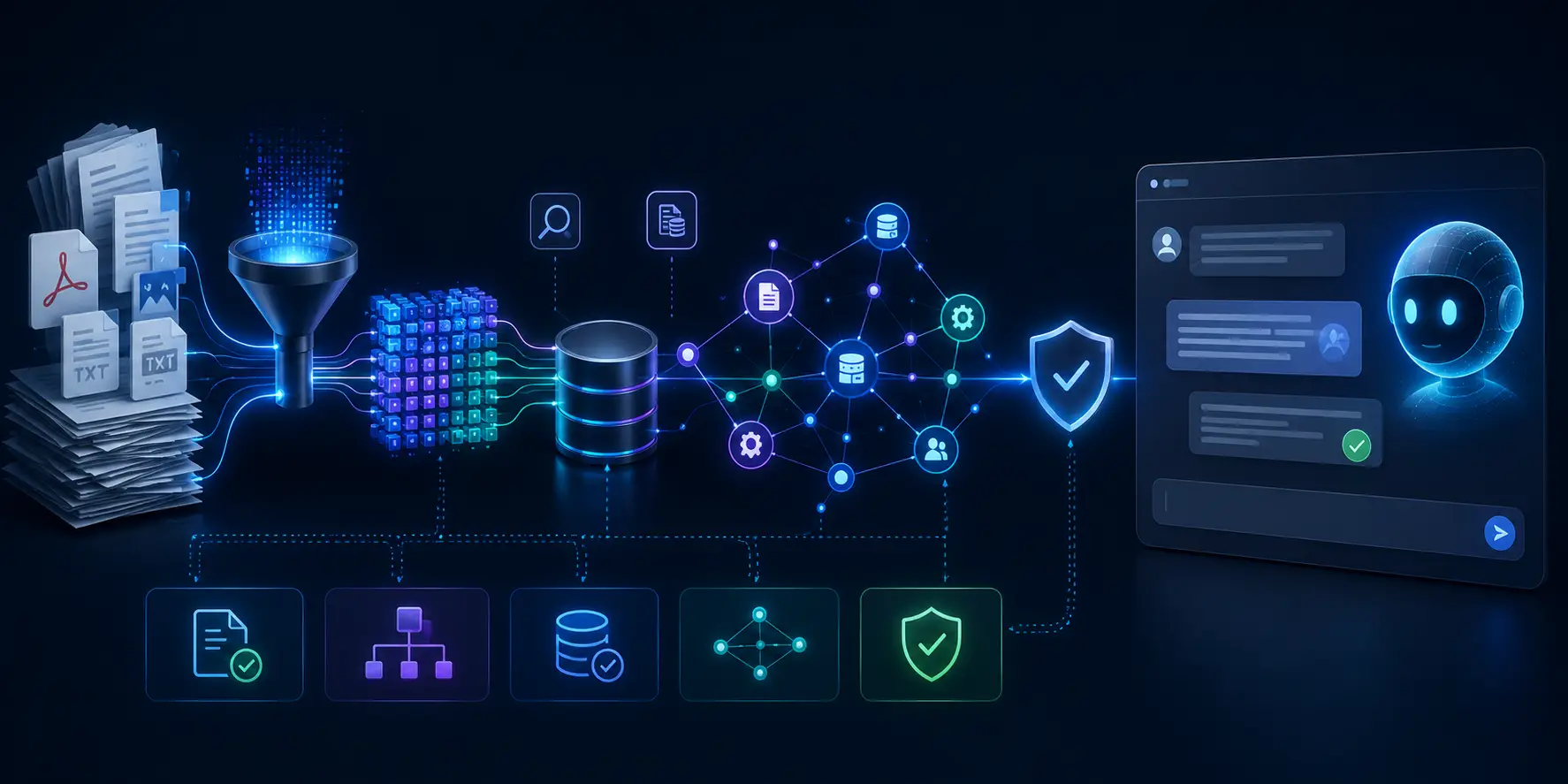
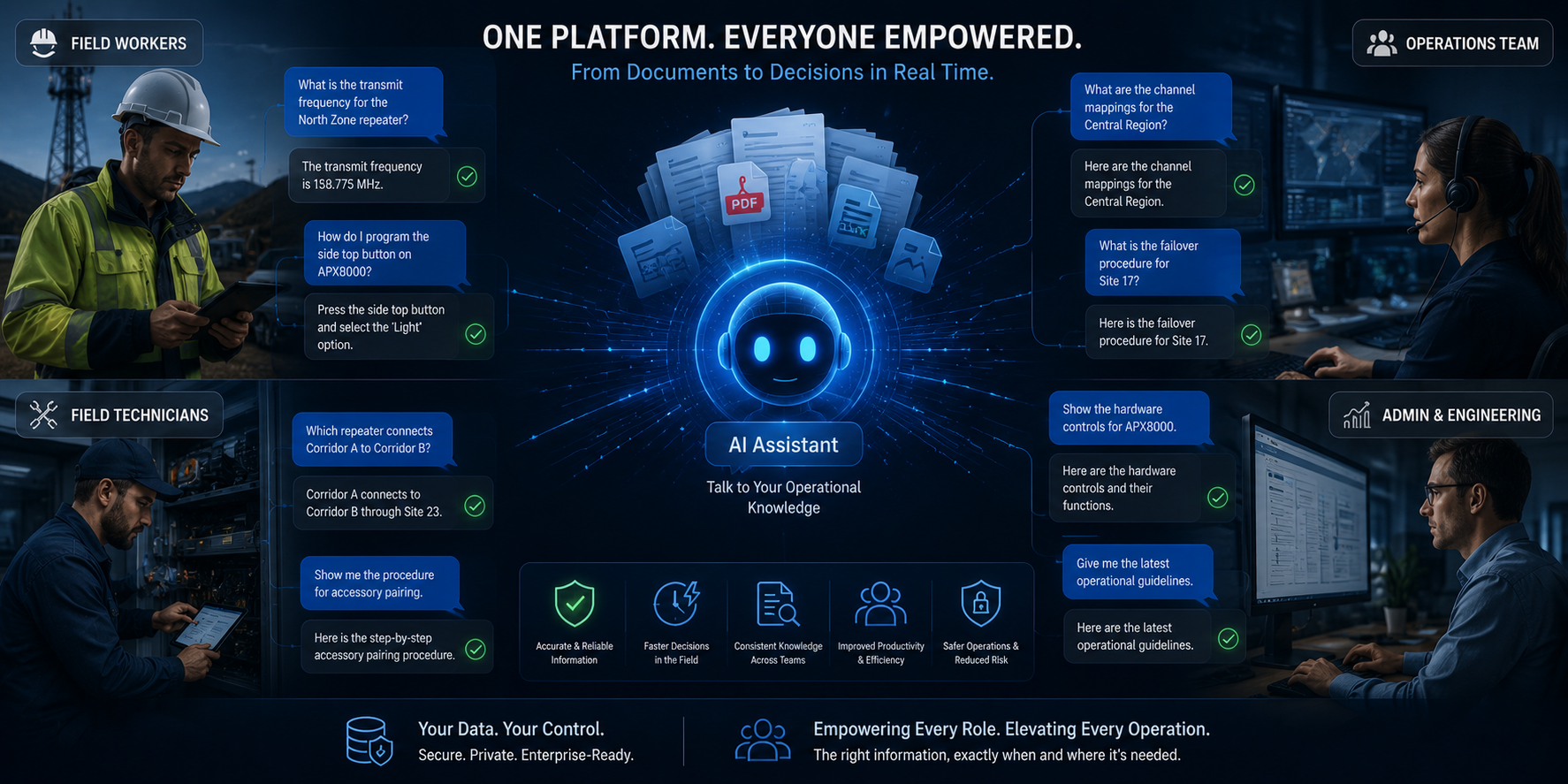
Digital Fractal Technologies designed and developed an advanced AI-powered operational assistant capable of interacting with highly technical internal documentation, operational procedures, route data, hardware references, and structured organizational knowledge. Unlike traditional chatbot systems that simply connect a language model to uploaded PDFs, this platform was engineered to provide grounded, explainable, and operationally reliable responses in environments where accuracy and safety were critical.
The project originated from the need to support users working with fragmented operational documentation spread across manuals, repeater tables, hardware guides, operational procedures, routing references, and multi-column PDF files. The objective was not merely to create a “document chatbot,” but to engineer a domain-aware operational assistant capable of understanding context, validating information, and reducing hallucinated responses in real-world operational workflows.
Business Challenge
Most Retrieval-Augmented Generation (RAG) systems follow a relatively simple architecture:
PDF → Embeddings → Vector Search → LLM Response
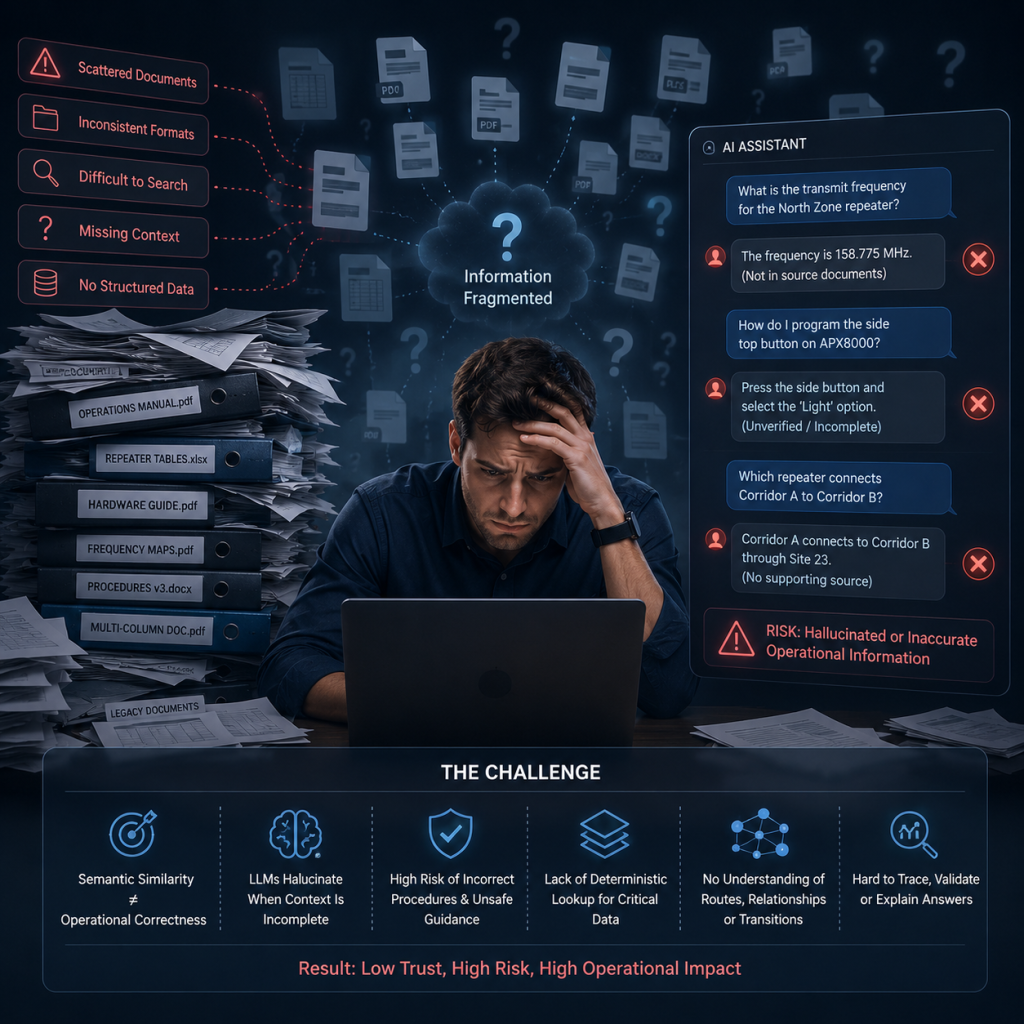
While this approach works reasonably well for generic FAQs and lightweight document retrieval, it becomes unreliable in operational environments where correctness matters. The client’s data included structured identifiers, repeater mappings, route corridors, hardware controls, operational procedures, and deterministic references that could not be approximated or guessed safely. Traditional semantic retrieval systems often produce plausible-sounding answers even when operationally incorrect, creating significant risks in environments requiring exact frequencies, validated routing logic, and hardware-specific instructions.
Another major challenge involved hallucination control. Standard LLM-based systems tend to fill informational gaps when retrieval confidence is low, which can lead to invented procedures, unsupported operational recommendations, or incorrect hardware instructions. The project therefore required a much more advanced architecture focused on validation, explainability, deterministic retrieval, and operational safety rather than simple semantic similarity.
Solution Developed
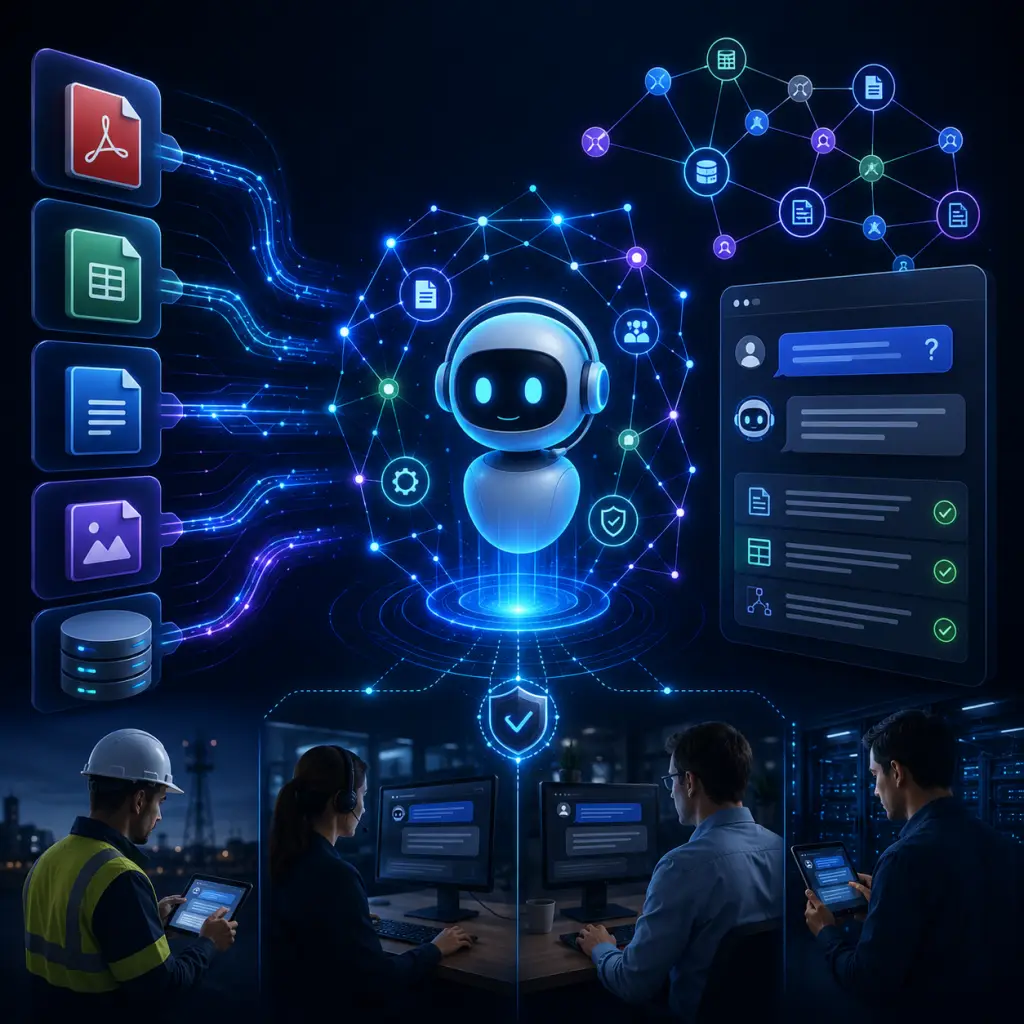
Digital Fractal Technologies engineered a custom AI-powered operational assistant capable of interacting with technical documentation, operational procedures, hardware references, and structured internal knowledge. Unlike traditional document chatbots, the platform was designed to deliver grounded and operationally reliable responses in environments where accuracy and validation were critical.
The solution combined conversational AI, intelligent retrieval systems, and graph-aware operational reasoning to reduce hallucinations and improve contextual understanding. The assistant dynamically selects how information should be retrieved based on the question type, allowing it to handle operational workflows, routing references, hardware controls, and technical support scenarios more reliably than standard RAG systems.
The final platform transformed fragmented operational documentation into a centralized conversational intelligence system capable of improving information accessibility, supporting field operations, and delivering safer AI-assisted decision support.
Architecture & Engineering Approach
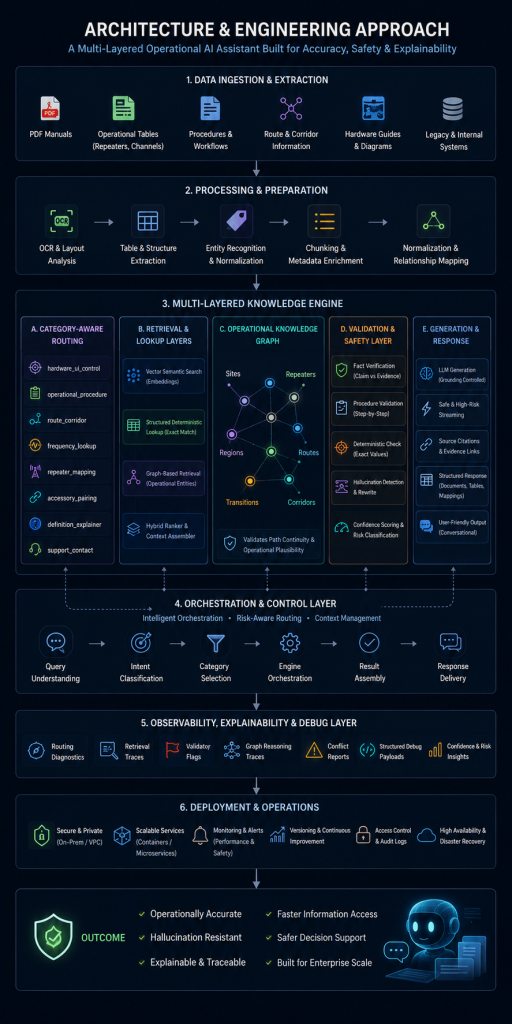
The system architecture evolved significantly throughout the project lifecycle. The initial implementation used a traditional RAG pipeline consisting of document extraction, embeddings generation, vector indexing, and LLM-based answer synthesis. While functional for basic retrieval tasks, the architecture struggled under complex operational scenarios involving fragmented references, geographic routing continuity, and deterministic operational requirements.
To address these limitations, the architecture evolved into a hybrid operational AI platform incorporating:
- category-aware routing
- deterministic structured lookup systems
- graph-assisted operational reasoning
- validation pipelines
- confidence-aware fallbacks
- structured extraction layers
One of the more advanced components involved graph-based operational reasoning. Operational entities such as repeater sites, route corridors, geographic regions, and transition points were modeled as interconnected nodes and edges, allowing the assistant to validate operational continuity before generating responses. This significantly improved route-aware reasoning and geographically constrained recommendations while reducing unsupported routing hallucinations.
The platform also incorporated post-generation validators capable of inspecting generated responses, comparing claims against retrieved evidence, and rewriting or blocking unsupported operational instructions before responses were returned to users. This validator layer became one of the most important architectural safeguards in the entire system.o optimized workforce schedules automatically.
Operational Impact
The final platform achieved major improvements in operational grounding, procedural reliability, hallucination resistance, and user trust. Users were able to query complex operational documentation conversationally while receiving significantly more accurate and explainable responses than traditional flat-vector RAG systems could provide.
The solution also established a scalable foundation for future enterprise AI initiatives involving:
- operational copilots
- technical support assistants
- internal knowledge systems
- field operations guidance
- engineering documentation search
- geographically aware reasoning systems
- safety-aware industrial AI assistants
This project demonstrates Digital Fractal Technologies’ ability to architect and engineer advanced enterprise AI systems that move beyond generic chatbot implementations into domain-aware operational intelligence platforms.
Work Process
Organizations looking to implement advanced AI-powered operational assistants and intelligent knowledge systems can work with our team to evaluate how AI can improve information accessibility, reduce operational uncertainty, and deliver more reliable decision-support systems. We analyze existing documentation, operational workflows, technical procedures, and knowledge-management challenges before engineering custom AI retrieval and reasoning architectures that integrate directly into real-world operational environments while maintaining scalability, explainability, and data privacy.

Discovery
Analyze operational documentation, workflows, technical procedures, routing logic, hardware references, and knowledge-management bottlenecks to identify retrieval, validation, and reasoning challenges.

Integration
Connect internal documents, operational databases, structured references, technical manuals, and organizational knowledge sources while preparing data pipelines for AI ingestion and retrieval.

Optimization
Develop category-aware retrieval systems, deterministic lookup layers, graph-assisted reasoning models, and validation pipelines capable of delivering safer and more reliable operational responses.

Deployment
Validate response reliability, reduce hallucination risks, optimize retrieval accuracy, and deploy scalable production infrastructure with monitoring, explainability, and ongoing model refinement.