
A Western Canadian industrial manufacturing company specializing in engine systems and heavy equipment applications partnered with Digital Fractal Technologies to modernize one of the most time-consuming parts of its engineering and quotation workflow: engine sizing and configuration analysis for complex industrial applications.
The company regularly handled highly technical RFQ packages containing engine sizing requirements for industrial equipment, energy systems, and large-scale operational environments. These engineering packages included process conditions, performance requirements, operating loads, fuel characteristics, environmental variables, and multi-scenario operating cases spread across PDFs, scanned engineering datasheets, and customer-generated documentation.
The objective of the project was to reduce manual engineering effort by automating the extraction, interpretation, and structuring of engine sizing data while preserving the engineering accuracy required for complex industrial applications. Instead of replacing the client’s existing engineering calculation systems, the initiative focused on building an AI-powered workflow layer capable of transforming unstructured engineering documentation into clean, machine-readable datasets suitable for downstream calculations and future workflow automation initiatives.
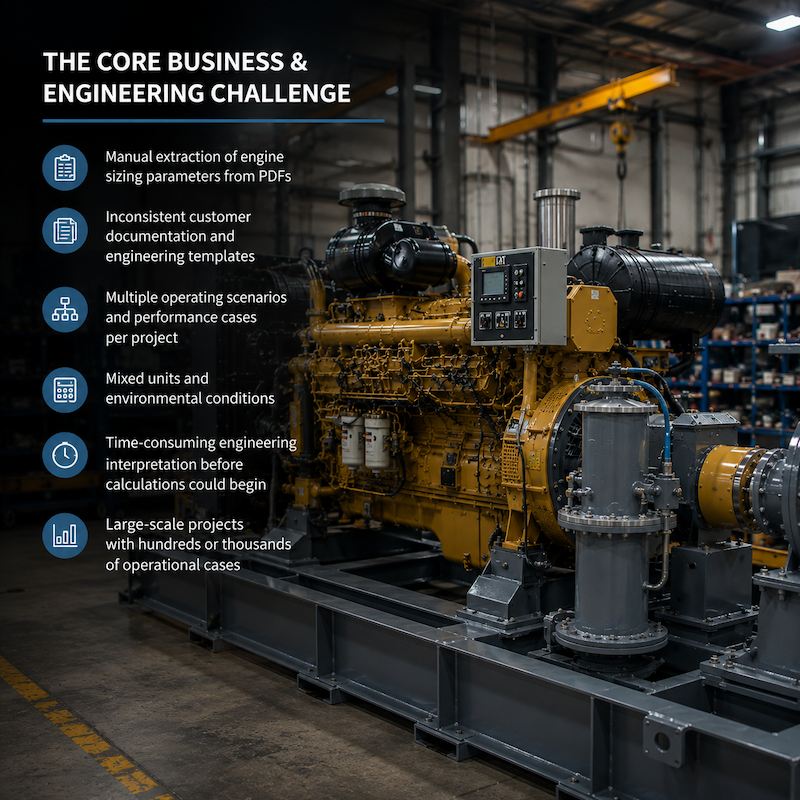
The Core Business & Engineering Challenge
The client’s workflow depended heavily on manual engineering review and repetitive data entry. Each customer used different datasheet formats, units, and reporting structures, making standardization extremely difficult across projects.
Key challenges included:
- Manual extraction of engine sizing parameters from PDFs
- Inconsistent customer documentation and engineering templates
- Multiple operating scenarios and performance cases per project
- Mixed units and environmental conditions
- Time-consuming engineering interpretation before calculations could begin
- Large-scale projects containing hundreds or thousands of operational cases
As project complexity increased, spreadsheet-driven workflows became difficult to scale efficiently.
Another challenge was the inconsistent way engineering data was reviewed and entered across teams. Different customers used different formats, units, and operating assumptions, making manual interpretation slow, repetitive, and difficult to standardize at scale.
Why Traditional Automation Approaches Were Insufficient
Traditional OCR and automation tools could extract text from documents but could not reliably understand engineering relationships and operating conditions. The project required AI capable of interpreting engineering context rather than simply reading tables.
The system needed to handle:
- Environmental and thermal conditions
- Operating load calculations
- Derived engineering values
- Unit normalization and conversions
- Multi-case performance analysis
- Engineering-specific validation rules
The client required a solution that could process complex engineering documentation while maintaining the accuracy needed for industrial engine sizing workflows.
Challenges Faced During Implementation
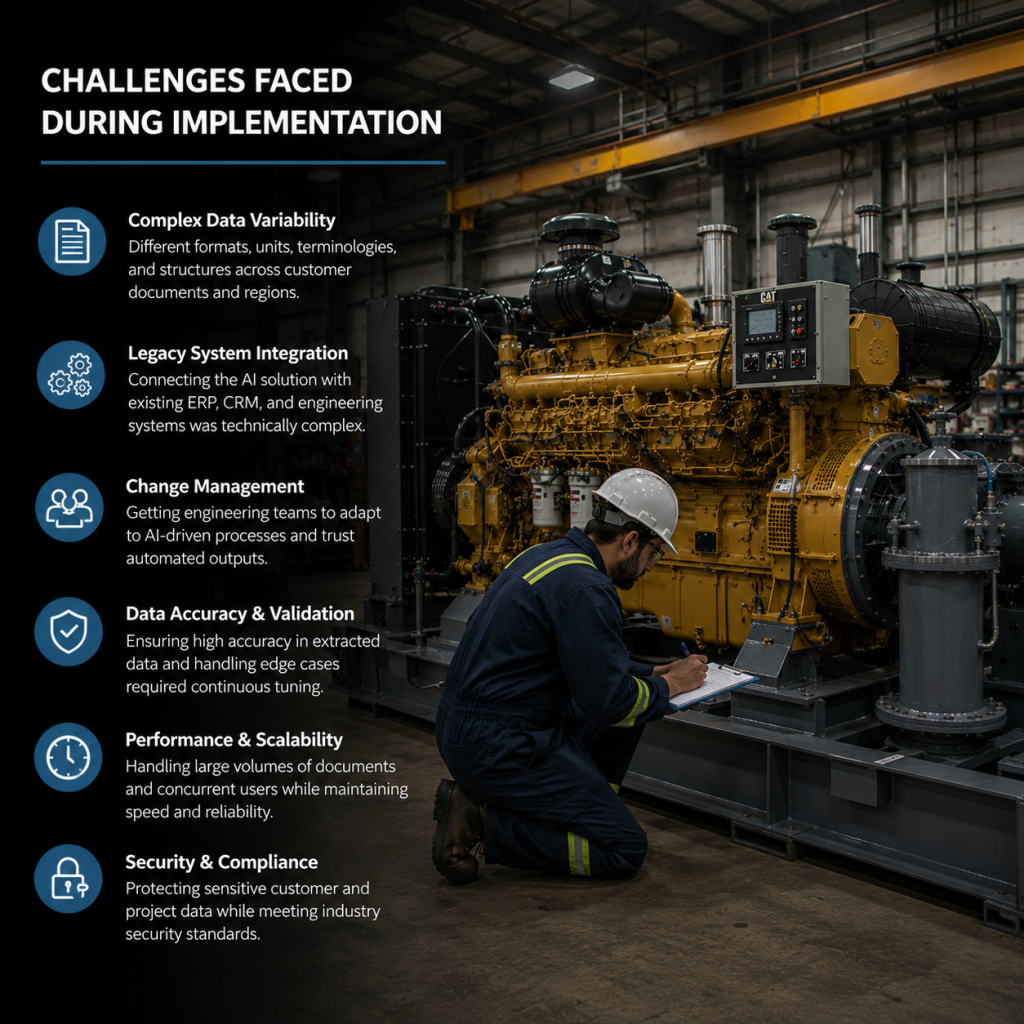
One of the largest challenges involved the inconsistency of customer-provided engineering documents. Some files were clean digital PDFs, while others were scanned, annotated, or generated from legacy systems with inconsistent formatting.
Additional implementation challenges included:
- Processing low-quality scanned engineering documents
- Identifying relationships between operating cases and equipment configurations
- Handling different measurement systems and engineering standards
- Supporting large datasets with thousands of operating scenarios
- Maintaining engineering validation and traceability throughout the workflow
The system also needed to balance automation with human engineering oversight to ensure confidence in the extracted data. Another major challenge involved processing highly inconsistent engineering documentation across different customers and project types. Many RFQ packages contained scanned PDFs, mixed unit systems, incomplete operating data, and non-standard engineering terminology, requiring the AI platform to interpret complex engineering context while still maintaining accuracy, traceability, and performance across large multi-scenario industrial projects.

Our AI Workflow & System Architecture
The solution was built as a modular AI-powered engineering automation platform designed to process complex engine sizing documentation and operational datasets efficiently.
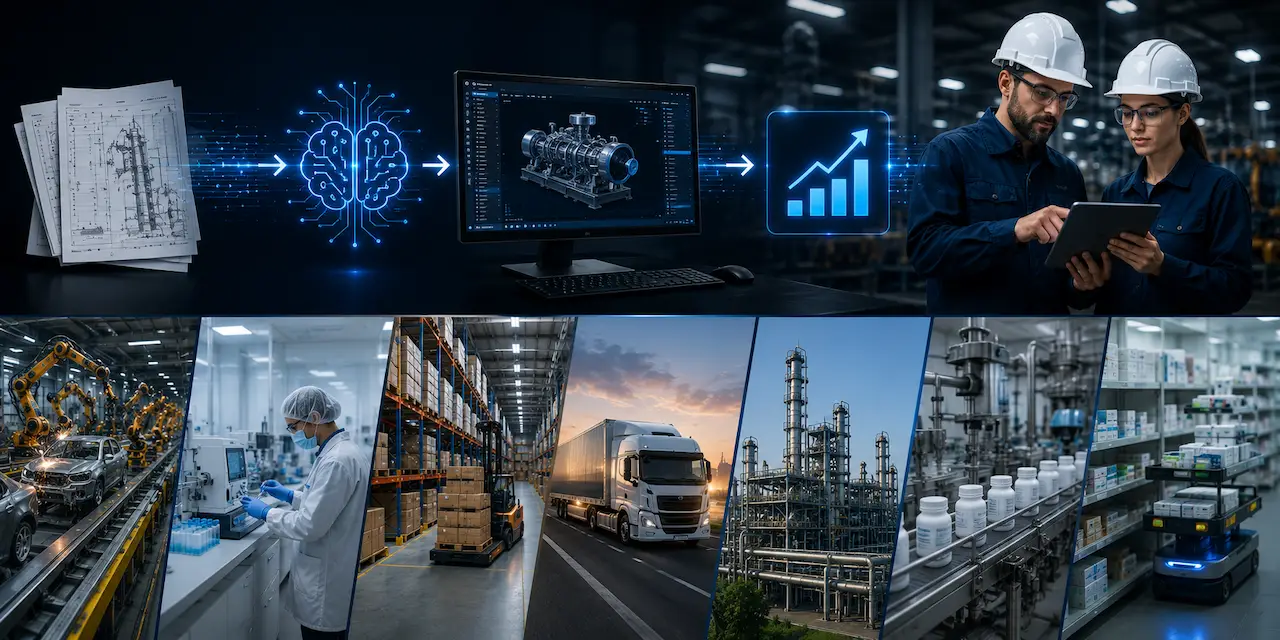
The workflow begins with AI-assisted document ingestion, where engineering PDFs and scanned datasheets are analyzed using OCR and intelligent extraction models. The system identifies engine sizing parameters, operating conditions, environmental variables, and performance cases directly from customer documentation.
A dedicated engineering rules layer then validates and normalizes the extracted data by applying unit conversions, derived calculations, and engineering-specific logic. The processed information is converted into standardized JSON datasets for downstream workflows and future integration into ERP, CPQ, and engineering systems.
Project Outcome & Long-Term Business Value
The completed solution established a scalable AI foundation for modernizing engineering workflows within a complex industrial manufacturing environment. The client gained a more efficient and standardized process for handling engineering documentation, engine sizing preparation, and multi-case project analysis while reducing operational bottlenecks associated with manual workflows.
Beyond the immediate operational improvements, the project created long-term strategic value by enabling future integration opportunities with ERP systems, CPQ platforms, engineering databases, and enterprise analytics tools. The structured JSON architecture and modular workflow design positioned the organization for broader digital transformation initiatives across engineering, quotation management, and operational workflow automation.
The project also demonstrated how AI can be applied effectively within industrial and manufacturing environments where engineering interpretation, process complexity, and operational scalability are critical to business performance.
Ready to Modernize Your Engineering Workflows?
Organizations looking to modernize engineering workflows and automate complex operational processes can work with our team to evaluate how AI can improve efficiency, reduce repetitive manual tasks, and streamline engineering operations. We analyze existing workflows, engineering documentation, operational constraints, and data-processing bottlenecks before developing custom AI-driven automation systems that integrate into real-world industrial environments and scale with future growth.

Discovery
Analyze engineering workflows, RFQ documentation, operational requirements, process constraints, and manual bottlenecks to identify automation opportunities and define technical objectives.

Integration
Connect engineering documents, operational datasets, internal workflows, and business systems while structuring the data required for AI processing and workflow automation.

Optimization
Develop and train AI-driven extraction, interpretation, and validation models capable of processing engineering documents, operational scenarios, and complex industrial workflows.

Deployment
Validate outputs, refine automation accuracy, deploy production infrastructure, and optimize the system for long-term operational scalability and future integrations.