
Built for a Large Moving & Logistics Company
How We Built an Intelligent Scheduling System That Converts Human Dispatcher Notes Into Optimized Crew Assignments
Modern workforce scheduling sounds simple until it reaches real operational scale.
For large moving and logistics companies managing dozens of employees, hundreds of jobs, varying certifications, vehicle requirements, shifting customer schedules, and constantly changing dispatcher instructions, scheduling quickly becomes one of the most operationally expensive and error-prone processes in the business.
Our client faced exactly this challenge.
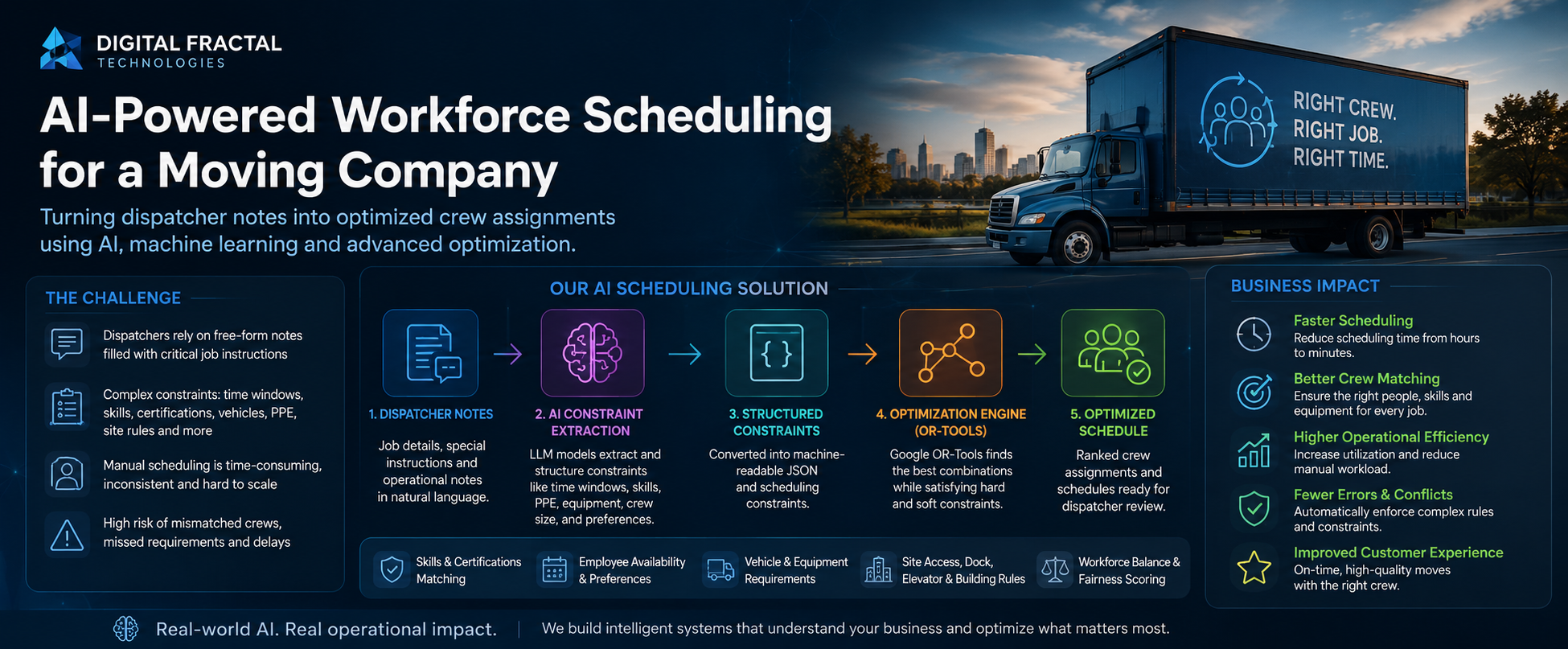
Their dispatchers managed scheduling through a combination of operational software, employee availability data, and highly detailed human-written notes attached to jobs. These notes contained critical scheduling instructions, exceptions, safety requirements, customer restrictions, crew preferences, vehicle requirements, timing constraints, and sequencing dependencies.
The problem was that none of this information was structured.
Critical scheduling intelligence existed inside free-form text written differently by different dispatchers every day.
Examples included instructions such as:
- “Need PPE – steel toes, hard hats, vests.”
- “Cannot be at destination before 6pm.”
- “Need all installers to dismantle cubicles.”
- “Do not use this crew at night.”
- “Need careful drivers as dock at destination is not easy to back into.”
- “Only load 20 file carts at a time.”
Human dispatchers could interpret these notes intuitively.
Traditional scheduling systems could not.
The company needed a system capable of understanding operational language the same way an experienced dispatcher would — while also balancing workforce optimization at scale.
That became the foundation for the AI Scheduler project.
Key Objectives
- Automate the resource scheduling process for crews, vehicles, and multi-day job assignments.
- Ensure compliance with dozens of operational constraints defined by dispatch, HR, customer requirements, and internal workflow rules.
- Increase crew utilization toward full-day schedules while respecting employee preferences and limitations.
- Reduce overtime, scheduling errors, and dispatch planning time.
- Enable dynamic optimization that adapts as human schedulers accept or modify AI suggestions.
Case Study: Chameleon Forms App
The moving & logistics company previously faced major operational challenges:
1. Manual Scheduling Complexity
Schedulers manually matched 50–100 crew members per day against job requirements, availability constraints, job pairings, and vehicle readiness — consuming several hours daily.
2. Inconsistent Job-Crew Alignment
Assignments depended heavily on human memory, leading to inconsistent placement of leads, trainees, specialists, and drivers.
3. Difficulty Fulfilling Training Programs
Staff development goals were rarely met because training wasn’t fully embedded into dispatch logic.
4. High Operational Cost and Overtime
Subcontractors often exceeded soft caps. Some employees were unintentionally booked into overtime or double shifts.
5. Pairing Short Jobs Manually
Schedulers manually built full-day combinations (e.g., 2–3 hour flex jobs), a tedious and error-prone process.
6. Vehicle Constraints Not Centralized
Low-profile trucks, maintenance windows, and truck-driver requirements weren’t integrated into scheduling tools.
The AI scheduling platform was developed to eliminate these inefficiencies.
Solution Delivered
AI-Driven Scheduling Engine
A custom intelligent agent ingests live job data, user profiles, vehicle availability, and multi-day job groupings, then generates optimized daily schedules using:
- Constraint-based reasoning
- Machine learning from dispatcher feedback
- Natural language interpretation of job notes
- Training and development goals
- Priority-tier resource allocation
- Multi-day and out-of-city rules
The engine produces draft schedules that dispatchers can approve or modify — and the system learns from those changes.
Core Features
1. Smart Crew Assignment
2. 2. Automatic Vehicle Matching
3. Multi-Day Job Handling
4. Training & Development Engine
5. Overtime & Subcontractor Protection
6. Interpersonal Compatibility Rules
7. Natural Language Interpretation
8. Human-in-the-Loop Scheduling
Technology Stack
- Custom AI Agent Framework
- Constraint-Satisfaction Engine (CSP)
- Job & Resource Knowledge Graph
- Natural Language Processing for Notes Interpretation
- Machine Learning Feedback Loop
- API Integration with Existing Dispatch System
- React & Node.js Web Interface (optional)
Impact & Results
60–80% Reduction in Scheduling Time
Dispatchers automate the majority of daily scheduling, saving hours per day.
Increased Crew Utilization
More staff hit their target hours while avoiding OT violations.
Improved Vehicle Utilization
Vehicle matching becomes accurate, preventing job delays or truck misassignments.
Higher Scheduling Accuracy
Fewer missed constraints, human errors, double bookings, and last-minute fixes.
Continuous Learning
As dispatchers edit AI-generated schedules, the system adapts to company culture, preferences, and exceptions.
Enhanced Training Outcomes
Crew development goals are executed within normal scheduling flow.
Features in Development
- Job pairing optimizer for short-duration jobs
- Predictive capacity planning for future weeks
- AI dispatcher assistant messaging & explanations
- Optimization visualization dashboards
- Automated fleet downtime forecasting
Conclusion
This AI-powered scheduling platform transforms workforce coordination for the moving & logistics industry. It reduces cost, improves crew satisfaction, enhances operational reliability, and supports continuous staff development — all through a modern intelligent dispatch system that evolves as the business grows.
With an impeccable track record servicing organizations and institutions across various industries, we are your one-stop shop for software development solutions. Contact us today and learn how we can transform your business through the power of digital.