

How We Built an Intelligent Scheduling System That Converts Human Dispatcher Notes Into Optimized Crew Assignments
Workforce scheduling becomes extremely complex at operational scale. Large moving and logistics companies must coordinate employees, vehicles, certifications, customer schedules, and constantly changing dispatcher instructions every day.
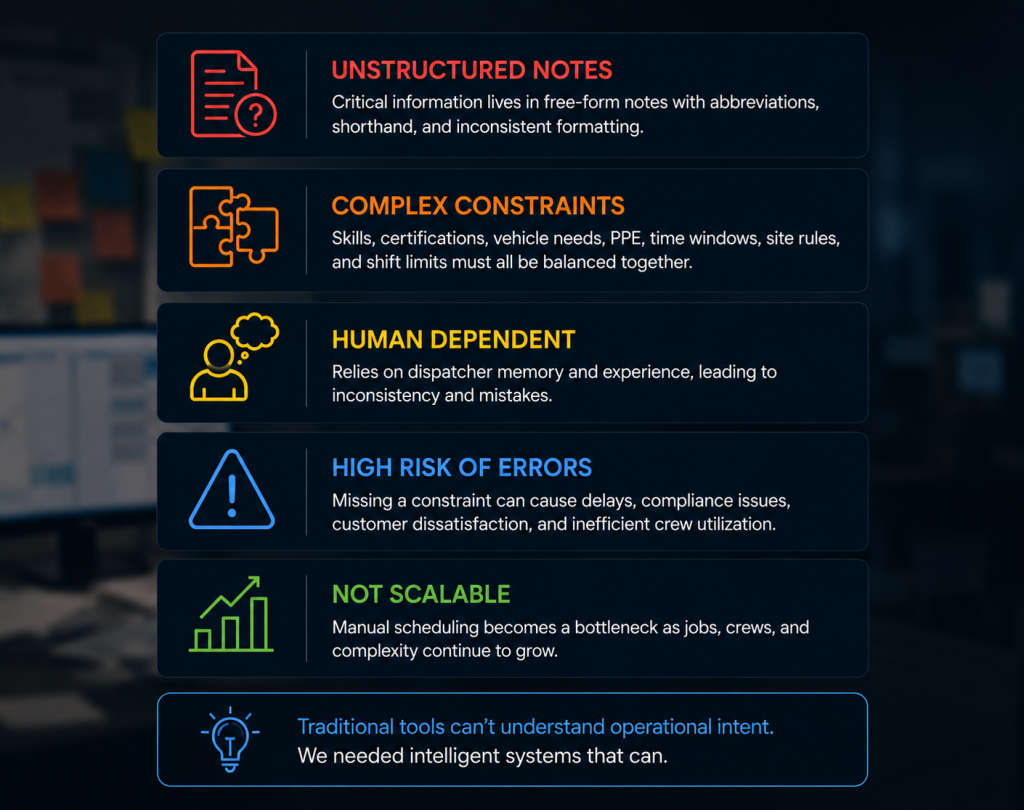
Our client relied heavily on dispatcher notes containing critical scheduling details such as safety requirements, crew preferences, timing restrictions, vehicle requirements, and site limitations. The problem was that this information existed as unstructured free-form text written differently by dispatchers across hundreds of jobs.
Examples included instructions like:
- “Need PPE – steel toes, hard hats, vests.”
- “Cannot be at destination before 6pm.”
- “Do not use this crew at night.”
- “Need careful drivers as dock at destination is not easy to back into.”
Experienced dispatchers could interpret these notes instantly, but traditional scheduling systems could not.
To solve this, we developed an AI-powered scheduling platform for our Alberta based client, capable of understanding dispatcher language, extracting operational constraints automatically, and generating optimized crew assignments using AI and mathematical optimization.
The Core Business Problem
The client operated a large moving and logistics company where dispatchers coordinated crews, vehicles, schedules, and customer jobs daily. Although operational software was already in place, many critical scheduling instructions still existed inside free-form dispatcher notes. These notes included timing restrictions, preferred employees, certifications, vehicle requirements, safety rules, and customer-specific instructions that directly affected scheduling decisions.
As operations grew, scheduling became increasingly difficult to manage manually. Dispatchers had to balance employee availability, skill requirements, overtime limits, crew composition, and multi-day projects simultaneously. Most traditional scheduling systems struggled because these operational rules were stored in unstructured human-written notes rather than clean database fields.
The company needed an AI-powered scheduling platform capable of understanding dispatcher notes, extracting operational constraints automatically, and generating optimized workforce assignments using intelligent scheduling logic and mathematical optimization.

Why Traditional Scheduling Software Was Not Enough
Traditional scheduling systems rely heavily on structured data and predefined rules. The client’s operation was far more complex. Critical scheduling requirements were buried inside dispatcher notes written in natural language using abbreviations, shorthand, inconsistent formatting, and evolving operational terminology. Important details such as crew preferences, vehicle restrictions, certifications, timing limitations, and safety requirements were not stored in standardized fields that conventional scheduling platforms could interpret automatically.
The scheduling process also required balancing workforce availability, skill requirements, overtime limitations, multi-day projects, and operational constraints simultaneously. Human dispatchers could understand these nuances through experience, but traditional software could not interpret operational intent from unstructured notes. The business needed an intelligent system capable of understanding real-world operational language and transforming it into optimized scheduling decisions automatically.
Our AI Scheduling Architecture
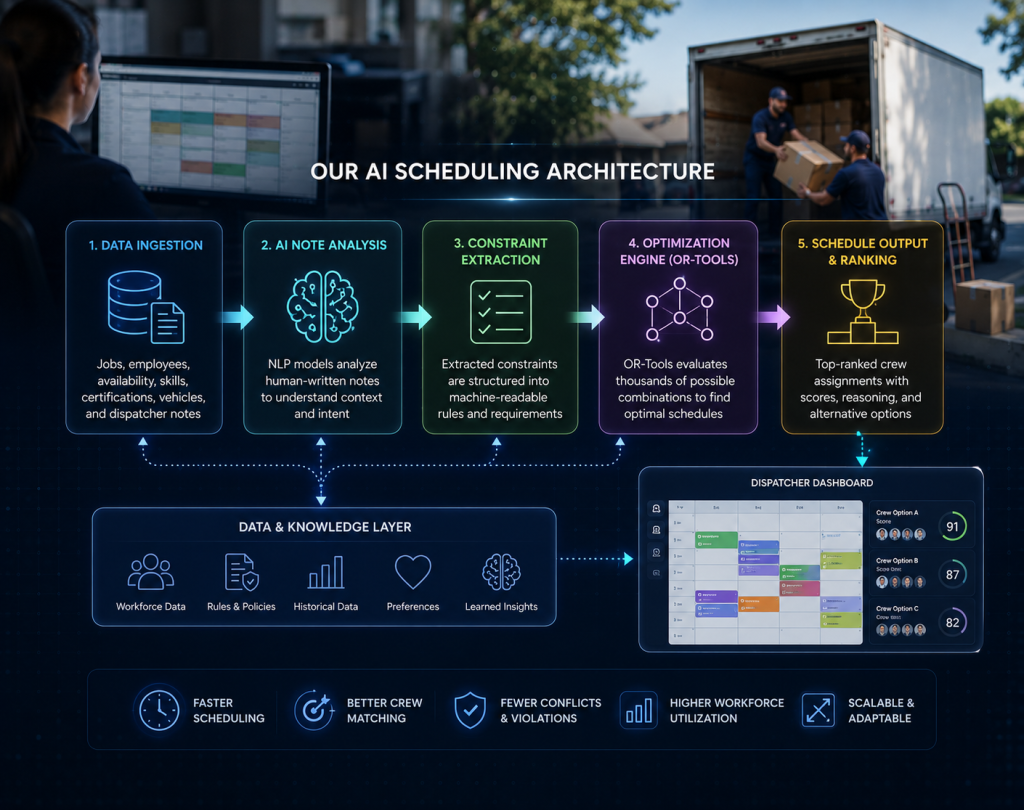
We designed the platform using a multi-stage AI and optimization workflow that transformed dispatcher notes into structured scheduling decisions. The system combined natural language processing, constraint extraction, and mathematical optimization into a single scheduling pipeline.
Core components included:
- Job and workforce data ingestion
- AI-powered note analysis
- Constraint extraction and structuring
- OR-Tools optimization engine
- Crew assignment ranking
- Schedule validation and scoring
The result was a system capable of converting unstructured operational language into optimized workforce schedules automatically.
Workforce Optimization Using OR-Tools
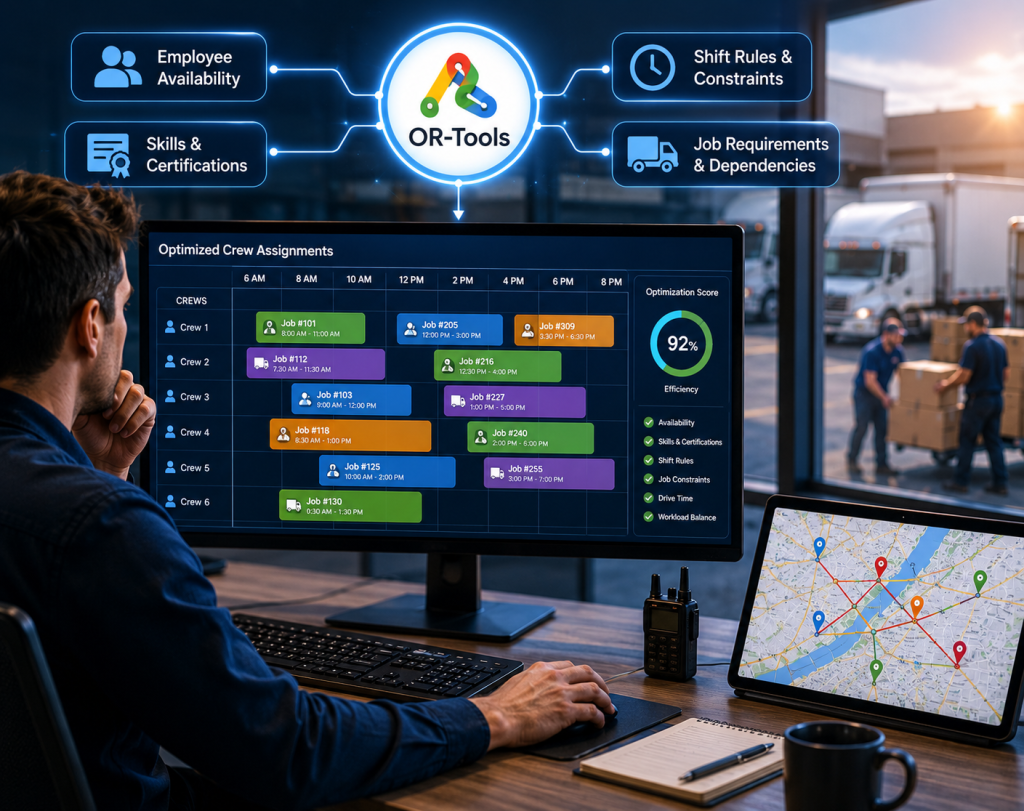
Once scheduling constraints were extracted, the platform used Google OR-Tools to generate optimized crew assignments. The system evaluated thousands of possible combinations while balancing operational requirements, workforce availability, and scheduling rules.
The optimization engine considered factors such as:
- Employee availability
- Certifications and skills
- Crew composition
- Preferred working hours
- Consecutive shift limitations
- Driver requirements
- Multi-job dependencies
- Workforce balancing
Instead of producing a single schedule, the system ranked multiple valid scheduling solutions based on operational quality and efficiency.
Real-World Workforce Complexity
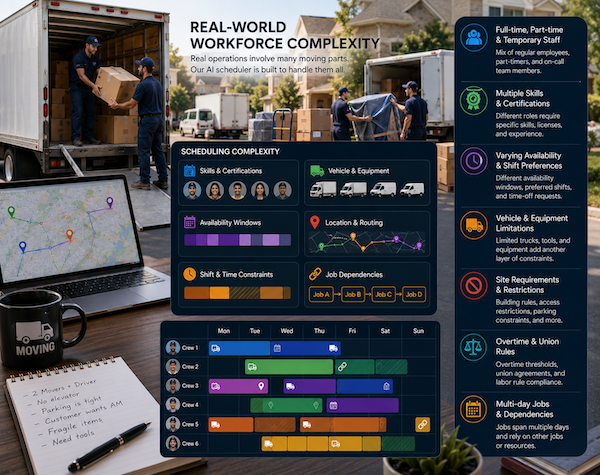
One of the biggest challenges was handling the complexity of real-world workforce operations. The scheduling environment included regular employees, part-time staff, extras, varying certifications, and employees with unique restrictions or availability limitations.
The platform also needed to account for:
- Weekend staffing shortages
- Overtime considerations
- Vehicle and equipment limitations
- Shift restrictions
- Preferred employee assignments
- Site-specific operational rules
- Multi-day project sequencing
This required significantly more intelligence than traditional workforce scheduling software.
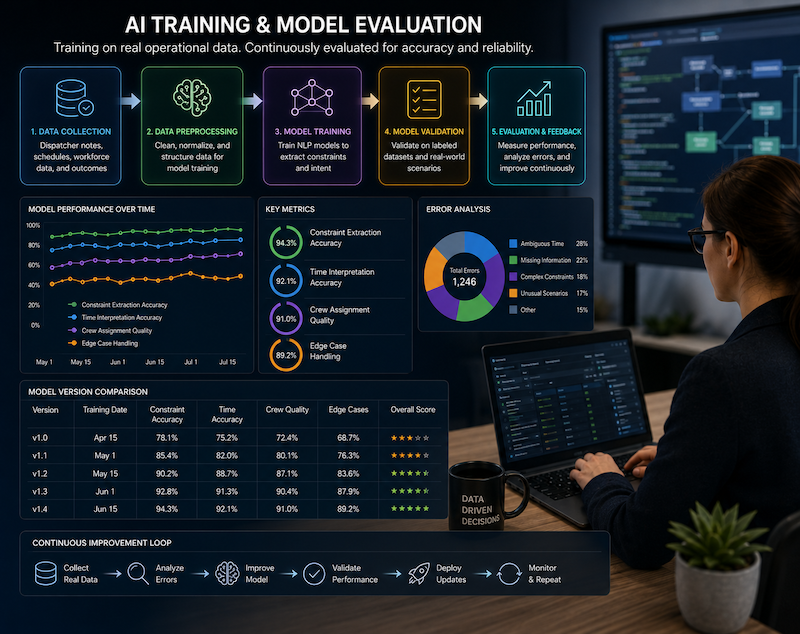
AI Training & Model Evaluation
The AI models underwent multiple rounds of training and evaluation to improve scheduling accuracy and constraint extraction performance. The system continuously learned from operational data, dispatcher notes, and real scheduling outcomes.
Key evaluation areas included:
- Constraint extraction accuracy
- Time interpretation
- Crew assignment quality
- Edge-case handling
- Schema consistency
- Missing data detection
The training process focused heavily on improving the system’s ability to interpret messy real-world dispatcher language reliably.
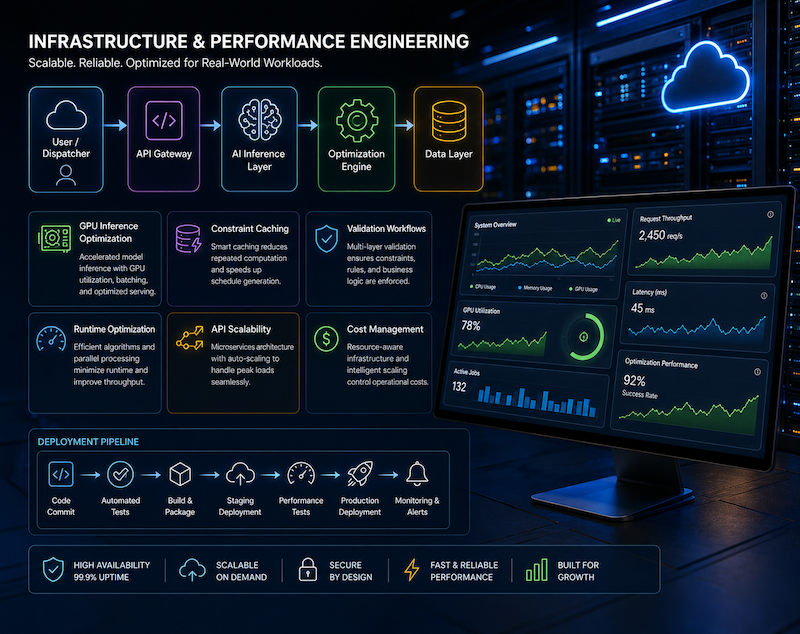
Infrastructure & Performance Engineering
The platform architecture was designed for scalability, cost efficiency, and production deployment. We separated model training, AI inference, scheduling optimization, and API orchestration into independent components to improve reliability and performance.
Engineering considerations included:
- GPU inference optimization
- Constraint caching
- Validation workflows
- Runtime optimization
- API scalability
- Cost management
- Production deployment readiness
The system was built to support both development flexibility and long-term operational scalability.
Operational Impact
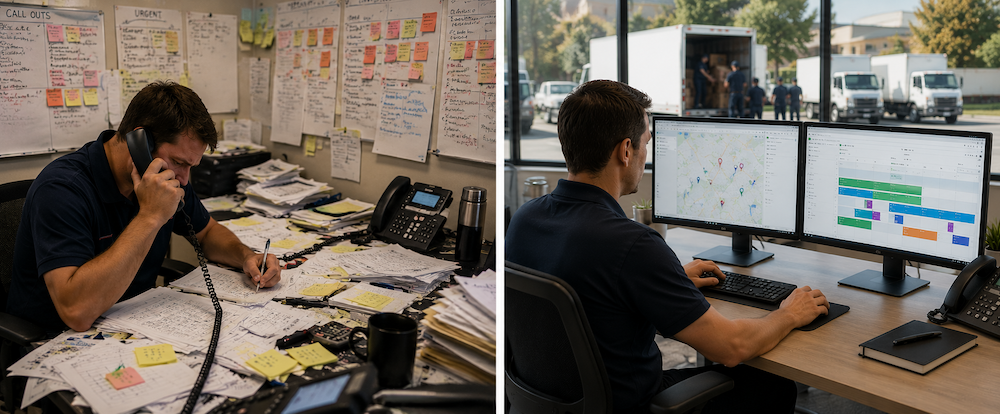
The AI Scheduler helped reduce the complexity of manual workforce coordination by assisting dispatchers with faster and more consistent scheduling decisions. Instead of relying entirely on human interpretation of dispatcher notes and operational constraints, the platform automatically analyzed scheduling requirements and generated optimized crew assignments.
The system improved workforce utilization, reduced scheduling conflicts, and helped scale operations more efficiently as job volume and workforce complexity increased. Rather than replacing dispatchers, the platform acted as an intelligent operational assistant designed to support real-world scheduling and resource allocation at scale.
Work Process
Businesses looking to modernize scheduling and workforce operations can work with our team to evaluate how AI can improve efficiency, reduce manual coordination, and optimize resource allocation. We analyze existing workflows, operational constraints, and scheduling challenges, then develop custom AI models and optimization systems that integrate directly into real-world business operations and scale with future growth.

Discovery
Analyze workflows, dispatcher notes, workforce rules, constraints, and operational bottlenecks.

Integration
Connect scheduling systems, workforce data, availability, vehicles, and operational inputs.

Optimization
Train AI models to extract constraints and generate optimized schedules.

Deployment
Validate results, refine scheduling accuracy, and deploy scalable production infrastructure.